
What fines have Canadian pricing and online-marketing cases actually produced, and how do they compare with the statutory maximum?
Nine selected Canadian pricing and online-marketing cases from 2017 to 2026 ended with penalties of C$825,000 to C$15,000,000, per the Competition Bureau's cases table, read November 21, 2026, which lists other cases not in this set. Of the nine, only the Rogers Tribunal decision is above the Competition Act's C$10,000,000 first-order maximum. Updated November 21, 2026.
By Martin DejnickiUpdated
Short answer
Nine selected Canadian pricing and online-marketing cases from 2017 to 2026 ended with penalties of C$825,000 to C$5,000,000 in eight consent agreements and C$15,000,000 in one Competition Tribunal decision against Rogers, per the Competition Bureau's cases table read November 21, 2026, which also lists cases outside this set. The Competition Act's fixed first-order maximum for a corporation is C$10,000,000, with a higher alternative ceiling.
Nine selected cases from the Bureau table, 2017 to 2026, ended with pricing and online-marketing penalties of C$825,000 to C$15,000,000; only Rogers' (a Tribunal decision) is above the C$10,000,000 first-order maximum
Penalty by case as the Competition Bureau states it, C$, nine selected pricing and online-marketing cases from the Bureau table with a stated amount, 2017 to 2026; the Act's fixed first-order maximum for a corporation is C$10,000,000
- Eight cases ended in consent agreements, which are negotiated, not court findings; Rogers is a Competition Tribunal decision.
- The Act's ceiling is the greater of C$10,000,000 (C$15,000,000 for each subsequent order) and an alternative based on the benefit derived or 3% of worldwide revenues; the Bureau does not say which applied to Rogers.
- Practice groups are Deploi's classification of the Bureau's wording.
- Costs paid on top are in the table (C$100,000 to C$500,000 where stated).
- No reference line or on-bar 'Tribunal decision' tag is drawn: the renderer has no reference line for bars and the tag overlapped on phones. The Rogers bar is highlighted, and the C$10,000,000 maximum and Tribunal status are stated in the title and notes.
- The nine are selected from the Bureau's table of cases; the chart does not cover every Canadian case or every pricing case.
Source: Competition Bureau Canada, Deceptive marketing practices: Cases and outcomes, read November 21, 2026; Competition Act, s.74.1 (Justice Laws), read November 20, 2026. Read on .
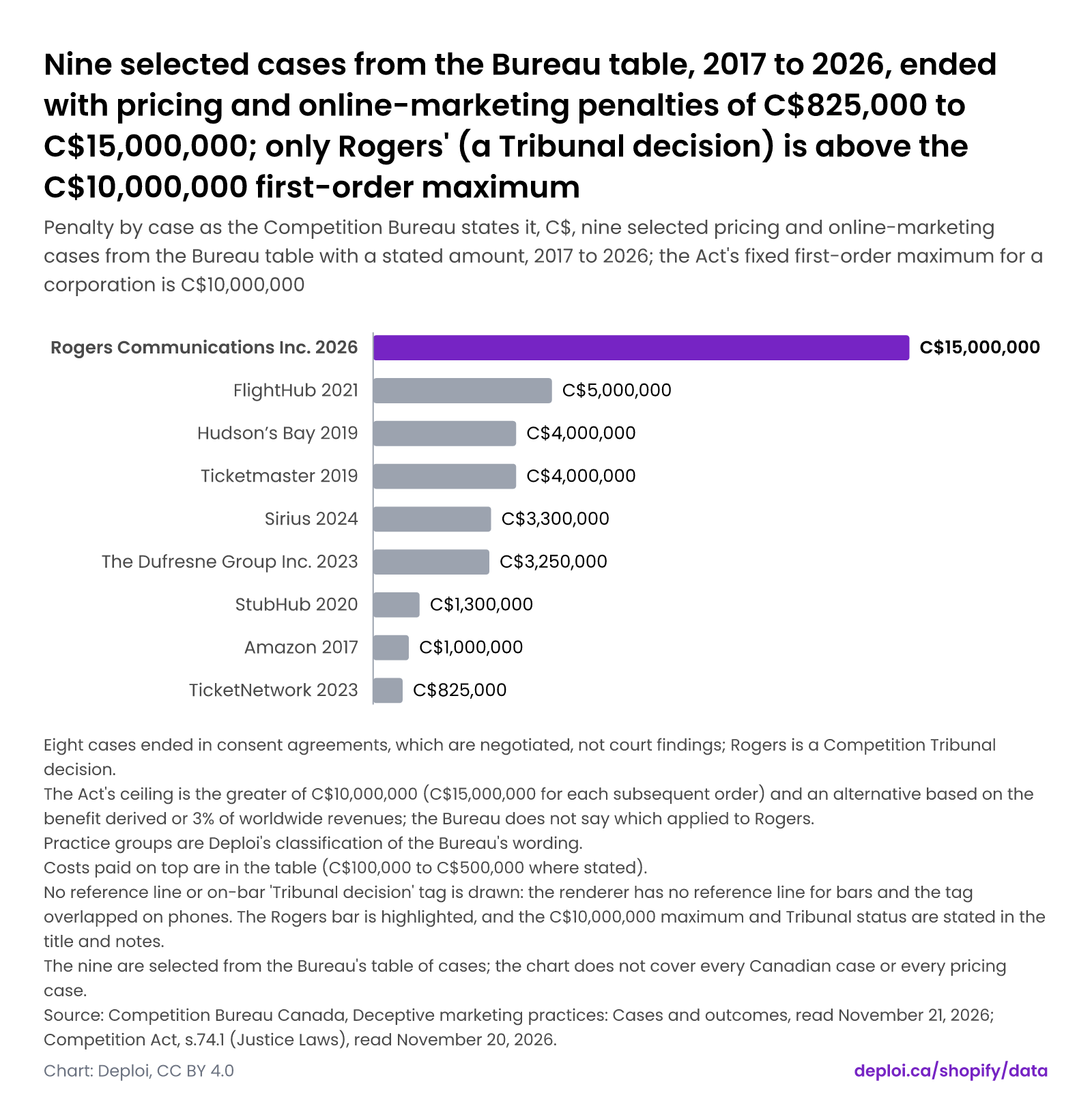
What penalties have Canadian pricing and online-marketing cases produced from 2017 to 2026?
Nine selected Canadian pricing and online-marketing cases from 2017 to 2026 ended with penalties from C$825,000 (TicketNetwork, 2023) to C$15,000,000 (Rogers, 2026), per the Competition Bureau's cases table read November 21, 2026, which lists other cases not in this set. Of the nine, eight were consent agreements with penalties of C$825,000 to C$5,000,000; Rogers is a Competition Tribunal decision.
The largest consent agreement among the nine was FlightHub's C$5,000,000 in 2021, over what the Bureau describes as allegations of hidden fees, authoring positive consumer reviews and numerous false or misleading price claims.
| Case | Resolved | Practice group (Deploi's classification) | Resolution | Penalty | Costs stated separately | Penalty as % of C$10,000,000 (computed by Deploi) |
|---|---|---|---|---|---|---|
| Rogers Communications | October 28, 2026 | other online representations | Competition Tribunal decision | C$15,000,000 | not published | 150% |
| FlightHub | February 24, 2021 | drip pricing | Consent agreement | C$5,000,000 | not published | 50% |
| Hudson's Bay | May 8, 2019 | price claims | Consent agreement | C$4,000,000 | C$500,000 | 40% |
| Ticketmaster | June 27, 2019 | drip pricing | Consent agreement | C$4,000,000 | C$500,000 | 40% |
| Sirius | June 5, 2024 | drip pricing | Consent agreement | C$3,300,000 | not published | 33% |
| The Dufresne Group | September 27, 2023 | urgency cues | Consent agreement | C$3,250,000 | C$100,000 | 32.5% |
| StubHub | February 13, 2020 | drip pricing | Consent agreement | C$1,300,000 | not published | 13% |
| Amazon | January 11, 2017 | price claims | Consent agreement | C$1,000,000 | C$100,000 | 10% |
| TicketNetwork | November 21, 2023 | drip pricing | Consent agreement | C$825,000 | not published | 8.25% |
Amounts are as the Bureau states them. The case set is nine pricing and online-marketing cases selected from the Bureau's table, which lists other cases that are not in this set, so the lowest amount and the ranges on this page describe the nine only. Other online representations is Deploi's residual group for wording that fits none of the three named groups.
How do those penalties compare with the statutory maximum?
The Competition Act sets a fixed maximum administrative monetary penalty of C$10,000,000 for a corporation's first order under section 74.1, per the Act's text on Justice Laws read November 20, 2026. Eight of the nine penalties were between 8.25% and 50% of that figure, and Rogers' C$15,000,000 Tribunal penalty was 150% of it, computed by Deploi.
The Act also allows a higher alternative ceiling: three times the value of the benefit derived from the deceptive conduct or, if that cannot be reasonably determined, 3% of the corporation's annual worldwide gross revenues. For each subsequent order, the Act's fixed maximum is C$15,000,000. The Bureau's table reports the Tribunal's C$15,000,000 order against Rogers but does not say which ceiling applied.
The dataset has no benefit or revenue figures for these cases, so the alternative ceiling is not applied to any of them.
Which pricing practices drew the largest penalties?
Among the nine selected cases, the largest pricing penalty is FlightHub's C$5,000,000 (2021), a drip pricing case by Deploi's classification, and the five drip pricing cases ranged from C$825,000 (TicketNetwork) to C$5,000,000, per the Competition Bureau's table read November 21, 2026. Price claims cases were C$1,000,000 (Amazon) and C$4,000,000 (Hudson's Bay), and the urgency cues case C$3,250,000 (The Dufresne Group).
Practice groups are Deploi's classification of the Bureau's wording; the verbatim wording is in the dataset. Where the wording fits more than one group, drip pricing is assigned first, then urgency cues, then price claims, so FlightHub, Ticketmaster and StubHub, whose wording also fits price claims, count as drip pricing. With five, two and one cases in the groups, the ranges describe these selected cases only, not what each practice typically draws. Rogers, at C$15,000,000, falls in other online representations, the residual group for wording that fits none of the three named groups; the Bureau's case concerned advertising wireless plans as offering unlimited data.
Drip pricing cases in the data include Ticketmaster (C$4,000,000), Sirius (C$3,300,000) and StubHub (C$1,300,000).
Were costs paid on top of the penalties?
Four of the nine selected cases carry costs stated separately from the penalty, per the Competition Bureau's cases and outcomes table read November 21, 2026: C$500,000 each for Hudson's Bay (2019) and Ticketmaster (2019), and C$100,000 each for The Dufresne Group (2023) and Amazon (2017). For the other four consent agreements and the Rogers decision, costs are not published.
Costs are shown separately because the Bureau states them separately. They are not added to the penalty figures on this page, so the percentages of the C$10,000,000 maximum use the penalty alone.
What do these outcomes not show about enforcement risk?
The outcomes show what nine selected cases ended with, as the Competition Bureau states it in its cases and outcomes table read November 21, 2026, and not what a new case would produce. Eight were consent agreements, which are negotiated, not court findings, and the Bureau's table states amounts without the benefit or revenue figures behind them.
The data covers nine pricing and online-marketing cases selected from the Bureau's table, which lists other cases that are not in this set, so the counts, the lowest amount and the ranges on this page describe the nine only. It is not a count of all investigations or warnings.
Rules are quoted from the official text with the publisher named. This page is not legal advice. Deploi is not affiliated with Shopify or the Competition Bureau.
The data
Each chart on this page is drawn from the numbers below. Units are in the column headers.
| Case | Resolved on | Practice group | Penalty (C$) | Costs paid on top (C$) | Penalty as share of fixed maximum (%) |
|---|---|---|---|---|---|
| Rogers Communications Inc. 2026 | Oct 28, 2026 | other online representations | 15,000,000 | Not stated | 150 |
| FlightHub 2021 | Feb 24, 2021 | drip pricing | 5,000,000 | Not stated | 50 |
| Hudson’s Bay 2019 | May 8, 2019 | price claims | 4,000,000 | 500,000 | 40 |
| Ticketmaster 2019 | Jun 27, 2019 | drip pricing | 4,000,000 | 500,000 | 40 |
| Sirius 2024 | Jun 5, 2024 | drip pricing | 3,300,000 | Not stated | 33 |
| The Dufresne Group Inc. 2023 | Sep 27, 2023 | urgency cues | 3,250,000 | 100,000 | 32.5 |
| StubHub 2020 | Feb 13, 2020 | drip pricing | 1,300,000 | Not stated | 13 |
| Amazon 2017 | Jan 11, 2017 | price claims | 1,000,000 | 100,000 | 10 |
| TicketNetwork 2023 | Nov 21, 2023 | drip pricing | 825,000 | Not stated | 8.25 |
Download Penalties in Canadian pricing and online-marketing cases, 2017 to 2026, against the Competition Act's first-order maximum, Competition Bureau cases and outcomes as CSV · All 13 columns on the dataset page
Methodology
Reading the chart: Nine selected cases from the Bureau table, 2017 to 2026, ended with pricing and online-marketing penalties of C$825,000 to C$15,000,000; only Rogers' (a Tribunal decision) is above the C$10,000,000 first-order maximum
- Eight cases ended in consent agreements, which are negotiated, not court findings; Rogers is a Competition Tribunal decision.
- The Act's ceiling is the greater of C$10,000,000 (C$15,000,000 for each subsequent order) and an alternative based on the benefit derived or 3% of worldwide revenues; the Bureau does not say which applied to Rogers.
- Practice groups are Deploi's classification of the Bureau's wording.
- Costs paid on top are in the table (C$100,000 to C$500,000 where stated).
- No reference line or on-bar 'Tribunal decision' tag is drawn: the renderer has no reference line for bars and the tag overlapped on phones. The Rogers bar is highlighted, and the C$10,000,000 maximum and Tribunal status are stated in the title and notes.
- The nine are selected from the Bureau's table of cases; the chart does not cover every Canadian case or every pricing case.
Caveats: Penalties in Canadian pricing and online-marketing cases, 2017 to 2026, against the Competition Act's first-order maximum, Competition Bureau cases and outcomes
- Amounts are as the Bureau states them; most cases ended in consent agreements, which are negotiated, not court findings. Rogers is a Competition Tribunal decision.
- One penalty, Rogers' C$15,000,000 (2026), exceeds the Act's fixed first-order maximum. For a corporation the Act's ceiling is the greater of '$10,000,000 and, for each subsequent order, $15,000,000' and an alternative based on the benefit derived or 3% of annual worldwide gross revenues; the Bureau's entry (the Tribunal 'ordered the company to pay a $15 million penalty') does not say whether the order was a first or a subsequent order or which ceiling applied. The dataset has no benefit or revenue figures, so the alternative ceiling is not applied to any case.
- Practice groups are Deploi's classification of the Bureau's wording; the verbatim text is in the table.
- Costs or other payments are stated separately by the Bureau and are not added to penalties.
- The case set is nine pricing and online-marketing cases with a stated penalty amount, resolved from 2017 to 2026, drawn from the Bureau's table of 'all cases that were made public by the Competition Bureau since 2015'; it is not every case in that table. Entries whose amounts the table does not print are not rows.
- The maximum row quotes the Competition Act (section 74.1) as published by the Department of Justice Canada.
- Rules are quoted from the official text with the publisher named; this is not legal or tax advice.
- Amounts are in Canadian dollars (C$) and are not adjusted for inflation.
Deploi's charts and compilation are licensed CC BY 4.0. The underlying facts belong to their sources, which are named on every page. How Deploi Shopify Data works.
Sources
Tier A sources are primary documents: filings, official releases and official price pages. How sources are ranked.
- Tier ADeceptive marketing practices: Cases and outcomes
Competition Bureau Canada · HTML · Read on
- Tier ACompetition Act, R.S.C. 1985, c. C-34, full text
Department of Justice Canada · HTML · Read on
Cite and reuse
Deploi's charts and compilation are licensed CC BY 4.0. The underlying facts belong to their sources, which are named on every page.
APA
Deploi. (2026). What fines have Canadian pricing and online-marketing cases actually produced, and how do they compare with the statutory maximum? [Web page]. https://deploi.ca/shopify/data/canada-deceptive-marketing-fines-actual-vs-maximum Retrieved November 21, 2026.
BibTeX
@misc{deploi_canada_deceptive_marketing_fines_actual_vs_maximum_2026,
  author = {{Deploi}},
  title = {What fines have Canadian pricing and online-marketing cases actually produced, and how do they compare with the statutory maximum?},
  year = {2026},
  url = {https://deploi.ca/shopify/data/canada-deceptive-marketing-fines-actual-vs-maximum},
  note = {Accessed 2026-11-21}
}
Embed this chart
Embed code
<iframe src="https://deploi.ca/embed/shopify/data/deceptive-marketing-penalties-by-case" title="Nine selected cases from the Bureau table, 2017 to 2026, ended with pricing and online-marketing penalties of C$825,000 to C$15,000,000; only Rogers' (a Tribunal decision) is above the C$10,000,000 first-order maximum" loading="lazy" style="width:100%;height:520px;border:0"></iframe> <p style="font:12px/1.4 Arial,sans-serif;margin:4px 0 0">Source: <a href="https://deploi.ca/shopify/data/charts/deceptive-marketing-penalties-by-case">Deploi, Nine selected cases from the Bureau table, 2017 to 2026, ended with pricing and online-marketing penalties of C$825,000 to C$15,000,000; only Rogers' (a Tribunal decision) is above the C$10,000,000 first-order maximum</a></p>
Keep the credit line under the embed. It is the license condition.
Downloads
- Chart: Nine selected cases from the Bureau table, 2017 to 2026, ended with pricing and online-marketing penalties of C$825,000 to C$15,000,000; only Rogers' (a Tribunal decision) is above the C$10,000,000 first-order maximum PNG
- Data: Penalties in Canadian pricing and online-marketing cases, 2017 to 2026, against the Competition Act's first-order maximum, Competition Bureau cases and outcomes CSV
Questions
What fines have Canadian drip pricing cases actually produced?
By Deploi's classification, five of the nine selected cases from 2017 to 2026 are drip pricing cases, with penalties from C$825,000 (TicketNetwork) to C$5,000,000 (FlightHub), per the Competition Bureau's cases and outcomes table read November 21, 2026. Ticketmaster agreed to pay C$4,000,000 and Sirius C$3,300,000. The range covers these five only; the table lists other cases that are not in this set.
What is the maximum penalty under the Competition Act for deceptive marketing?
The fixed maximum administrative monetary penalty for a corporation's first order is C$10,000,000 under section 74.1, per the Act's text read November 20, 2026. The Act allows a higher alternative ceiling: three times the benefit derived or, if that cannot be reasonably determined, 3% of annual worldwide gross revenues.
Did any of the nine selected cases go above C$10,000,000?
One of the nine did. The Competition Tribunal ordered Rogers to pay a C$15,000,000 penalty in a decision released October 28, 2026, as the Bureau reports it, which is 150% of the C$10,000,000 fixed first-order maximum, computed by Deploi. The other eight penalties were C$5,000,000 or less.
How much did Hudson's Bay agree to pay in its regular-price claims case?
Hudson's Bay agreed to a C$4,000,000 penalty and C$500,000 in costs in a consent agreement on May 8, 2019, per the Competition Bureau's cases and outcomes table read November 21, 2026. The Bureau's allegations concerned regular price claims and clearance promotions.
Are these penalties court decisions?
Mostly not. Eight of the nine cases ended in consent agreements, which are negotiated rather than court findings, per the Competition Bureau's table read November 21, 2026. The Rogers penalty came from a Competition Tribunal decision.
More on Canada
- Can a Canadian online store let a gift card expire or charge fees on it, and how do the rules differ by province?
The official pages of the nine provinces covered state that gift cards may not carry an expiry date, with listed exceptions, and cap mall card dormancy fees at C$2.50 a month where they state an amount, read November 21, 2026. Updated November 21, 2026.
- How many business days do Canada Post's parcel services take from drop-off to door, by distance and area type?
Between major urban centres across Canada the standard is next day for Priority, 2 days for Xpresspost, 2 to 8 for Expedited Parcel and 4 to 10 for Regular Parcel, per Canada Post's guide last updated September 7, 2026. Updated November 21, 2026.
- How much does the US dollar move against the Canadian dollar in a month, and how often would a fixed USD price list have drifted by more than 3%?
The Bank of Canada daily USD/CAD rate moved by more than 3% in 8.4% of 30-day windows from January 3, 2017 to November 20, 2026, computed by Deploi from the Valet API. Updated November 21, 2026.
- Is the shipping charge on a web order subject to PST in British Columbia, Saskatchewan and Manitoba?
The delivery charge is subject to PST in all three provinces when taxable goods ship in from outside the province; for goods shipped from inside, each text sets its own conditions, per provincial tax texts read November 21, 2026. Updated November 21, 2026.
- What do signature, proof-of-age, cash-on-delivery and redirection options cost on a Canada Post parcel shipped within Canada?
A signature costs C$2.00, proof of age C$3.00, collect on delivery C$7.25 and package redirection C$13.00 per package on Canada Post parcels shipped within Canada, per the Parcel Services price document effective September 7, 2026. Updated November 21, 2026.
- What must a BC store do before a subscription renews automatically, and how do the rules change with the length of the renewal term?
For renewals of more than 60 days, British Columbia requires notice 30 to 60 days before the renewal date and a refund of the prescribed portion within 15 days when the customer cancels after the renewal date; the amendments took effect August 1, 2026, per Consumer Protection BC and BC Laws, read November 21, 2026. Updated November 21, 2026.
Changes
- · Penalties in Canadian pricing and online-marketing cases, 2017 to 2026, against the Competition Act's first-order maximum, Competition Bureau cases and outcomes
First release. 11 rows, 12 fields read from 2 sources; each value agreed by extractor and verifier or ruled by the judge.