
In which large emerging markets do online shoppers pay only cash on delivery, and how far apart are Indonesia, the Philippines, Thailand, India and China?
In 2024, 78.8% of online shoppers in the Philippines and 77.2% in Indonesia paid only cash on delivery, against 46.0% in India, 40.8% in Thailand and 6.9% in China, computed by Deploi from the World Bank Global Findex 2025 (survey year 2024). Updated November 21, 2026.
By Martin DejnickiUpdated Data through 2024
Short answer
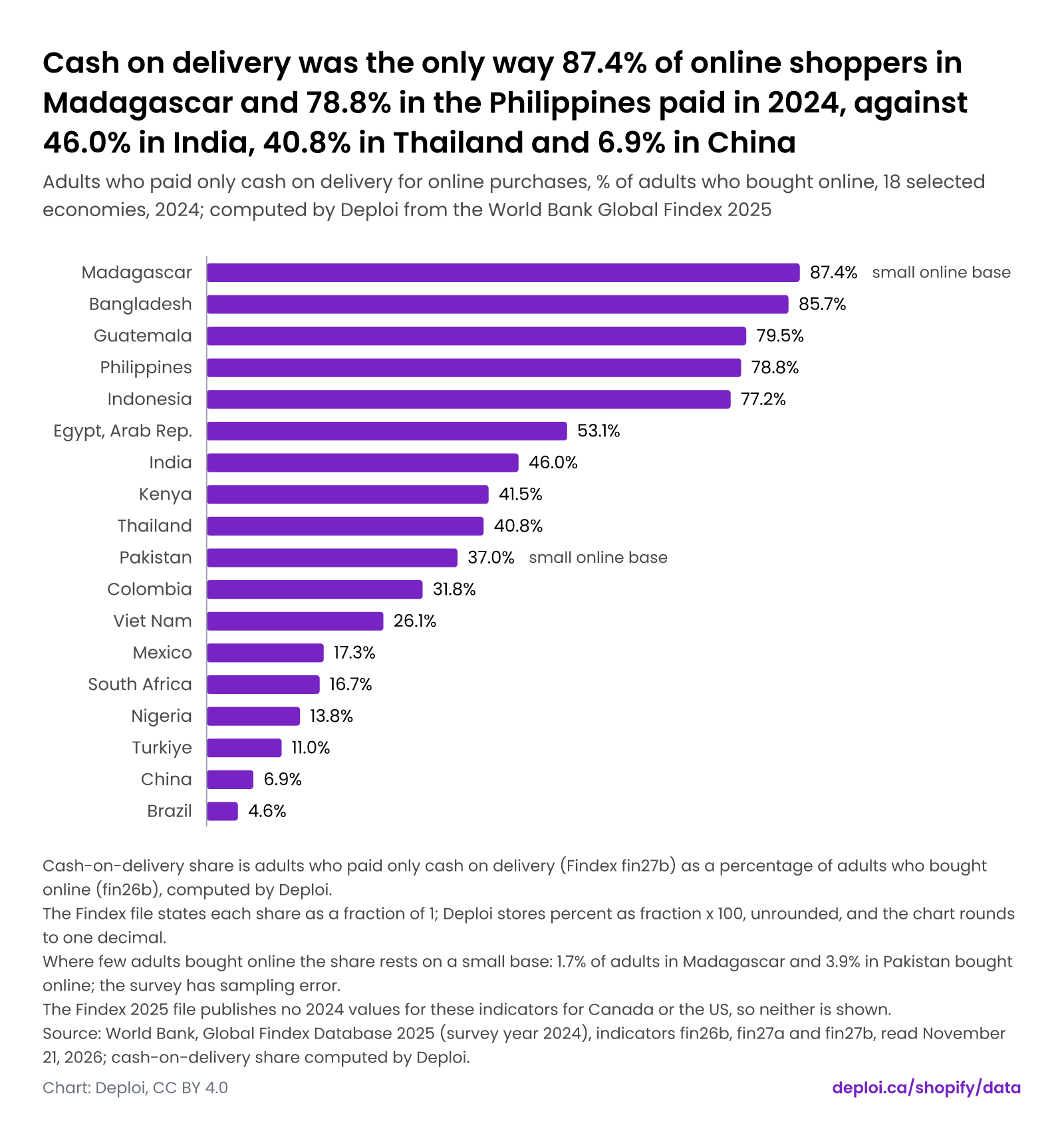
Cash on delivery was the only payment method used by 78.8% of online shoppers in the Philippines and 77.2% in Indonesia in 2024, against 46.0% in India, 40.8% in Thailand and 6.9% in China, computed by Deploi from the World Bank Global Findex 2025 (survey year 2024). Online shoppers are adults who made a purchase online in the past year.
Cash on delivery was the only way 87.4% of online shoppers in Madagascar and 78.8% in the Philippines paid in 2024, against 46.0% in India, 40.8% in Thailand and 6.9% in China
Adults who paid only cash on delivery for online purchases, % of adults who bought online, 18 selected economies, 2024; computed by Deploi from the World Bank Global Findex 2025
- Cash-on-delivery share is adults who paid only cash on delivery (Findex fin27b) as a percentage of adults who bought online (fin26b), computed by Deploi.
- The Findex file states each share as a fraction of 1; Deploi stores percent as fraction x 100, unrounded, and the chart rounds to one decimal.
- Where few adults bought online the share rests on a small base: 1.7% of adults in Madagascar and 3.9% in Pakistan bought online; the survey has sampling error.
- The Findex 2025 file publishes no 2024 values for these indicators for Canada or the US, so neither is shown.
Source: World Bank, Global Findex Database 2025 (survey year 2024), indicators fin26b, fin27a and fin27b, read November 21, 2026; cash-on-delivery share computed by Deploi. Read on .
How far apart are Indonesia, the Philippines, Thailand, India and China?
Across the five economies, the cash on delivery share of online shoppers ranged from 78.8% in the Philippines to 6.9% in China in 2024, with Indonesia at 77.2%, India at 46.0% and Thailand at 40.8%, computed by Deploi from the World Bank Global Findex 2025 (survey year 2024). Indonesia and the Philippines are within 1.6 percentage points of each other.
Of the five, Thailand and China have the highest shares of adults who bought online in 2024, 46.6% and 74.4%. India has the lowest share at 16.2%, the Philippines 27.4% and Indonesia 26.3%, per the World Bank Global Findex 2025.
How do cash on delivery and paying online compare as a share of all adults?
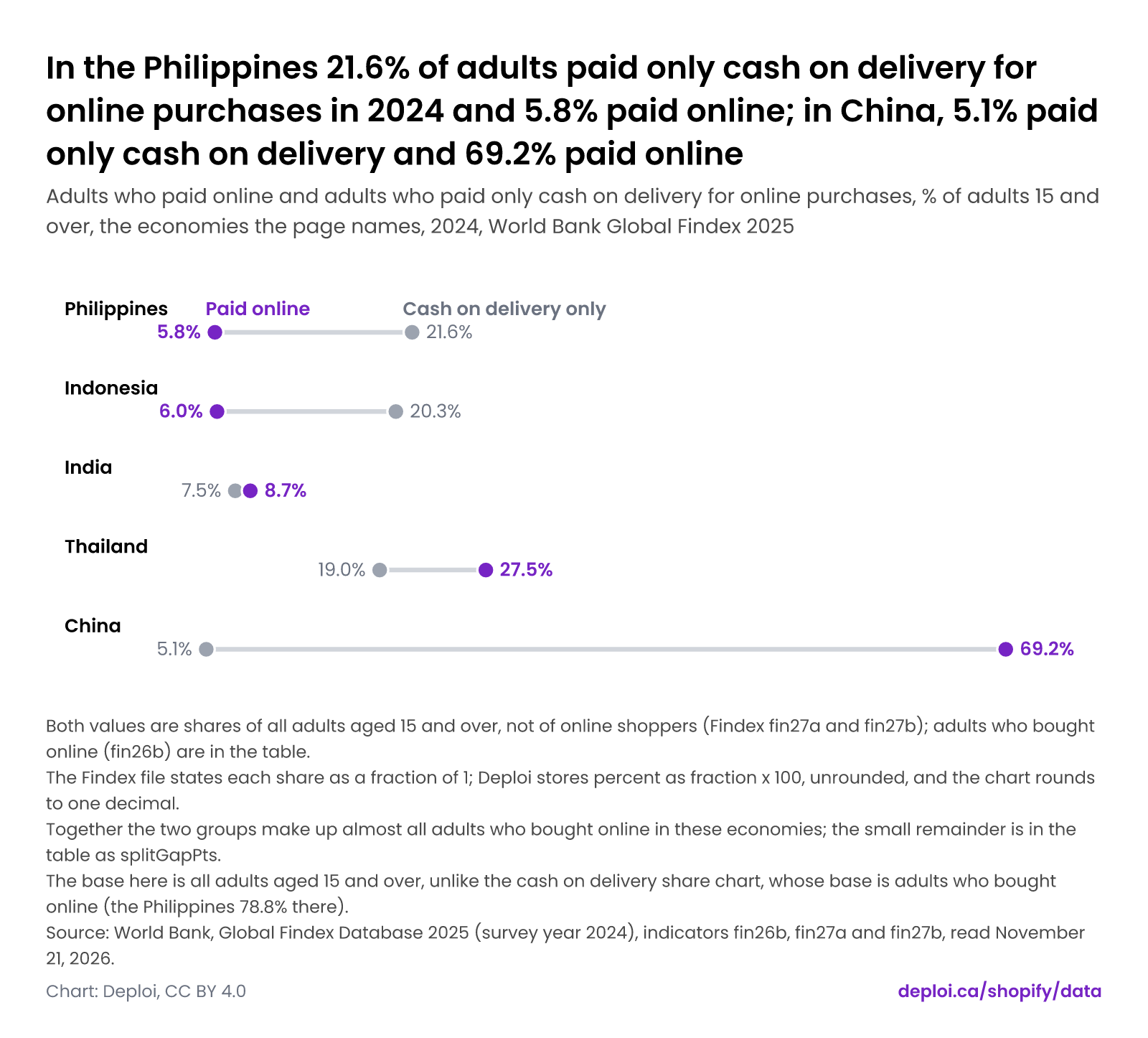
In the Philippines 21.6% of all adults paid only cash on delivery for online purchases in 2024 and 5.8% paid online, while in China 5.1% paid only cash on delivery and 69.2% paid online, per the World Bank Global Findex 2025 (survey year 2024). All four figures are shares of adults aged 15 and over, not of online shoppers.
| Economy | Bought online | Paid online | Paid only cash on delivery |
|---|---|---|---|
| Indonesia | 26.3% | 6.0% | 20.3% |
| Philippines | 27.4% | 5.8% | 21.6% |
| Thailand | 46.6% | 27.5% | 19.0% |
| India | 16.2% | 8.7% | 7.5% |
| China | 74.4% | 69.2% | 5.1% |
The two groups together make up almost all adults who bought online. The small remainder is in the dataset as the split check, in percentage points, computed by Deploi.
In the Philippines 21.6% of adults paid only cash on delivery for online purchases in 2024 and 5.8% paid online; in China, 5.1% paid only cash on delivery and 69.2% paid online
Adults who paid online and adults who paid only cash on delivery for online purchases, % of adults 15 and over, the economies the page names, 2024, World Bank Global Findex 2025
- Both values are shares of all adults aged 15 and over, not of online shoppers (Findex fin27a and fin27b); adults who bought online (fin26b) are in the table.
- The Findex file states each share as a fraction of 1; Deploi stores percent as fraction x 100, unrounded, and the chart rounds to one decimal.
- Together the two groups make up almost all adults who bought online in these economies; the small remainder is in the table as splitGapPts.
- The base here is all adults aged 15 and over, unlike the cash on delivery share chart, whose base is adults who bought online (the Philippines 78.8% there).
Source: World Bank, Global Findex Database 2025 (survey year 2024), indicators fin26b, fin27a and fin27b, read November 21, 2026. Read on .
What do the Global Findex figures measure, and how are they displayed?
The Global Findex 2025 is a World Bank survey of adults aged 15 and over in 2024, and its indicators fin26b, fin27a and fin27b give adults who made an online purchase in the past year, who paid online, and who paid only cash on delivery. The cash on delivery share is computed by Deploi from them.
The Findex file states each share as a fraction of 1, not a percent. Deploi stores percent as the fraction times 100, unrounded, so Indonesia's 26.3% of adults who bought online is the Findex fraction times 100, and the page shows one decimal. The figures are survey estimates with sampling error, and the Findex glossary states the definitions.
Source: World Bank, Global Findex Database 2025, filtered by Deploi to 18 selected economies, group all, year 2024, read November 21, 2026.
The 18 economies were selected by Deploi from the Global Findex 2025 sample, not by the World Bank. They are the five economies named in the question and 13 others Deploi chose in Asia, Africa, Latin America and Türkiye, each with 2024 values for all three indicators. Highest and lowest refer to the 18 economies shown, not to the full Findex sample.
What do the figures not cover?
The dataset covers 18 selected economies in the 2024 Findex sample, and Canada and the United States are not shown because the World Bank Global Findex 2025 does not publish these indicators for them for 2024. Where few adults bought online, as in Madagascar (1.7%) and Pakistan (3.9%), the cash on delivery share rests on a small base.
The Findex measures the share of online shoppers who paid only cash on delivery. It does not state which other payment methods the rest used, and it does not say whether a shopper would have bought with another method. Deploi is not affiliated with Shopify or the World Bank.
The data
Each chart on this page is drawn from the numbers below. Units are in the column headers.
In the Philippines 21.6% of adults paid only cash on delivery for online purchases in 2024 and 5.8% paid online; in China, 5.1% paid only cash on delivery and 69.2% paid online
| Economy | Bought something online (% of adults 15+) | Paid online (% of adults 15+) | Paid only cash on delivery (% of adults 15+) | Split check (percentage points) | Cash on delivery share of online shoppers (% of online shoppers) |
|---|---|---|---|---|---|
| Indonesia | 26.3 | 6.0 | 20.3 | 0 | 77.222 |
| Philippines | 27.4 | 5.8 | 21.6 | 0 | 78.778 |
| Thailand | 46.6 | 27.5 | 19.0 | 0.046 | 40.825 |
| India | 16.2 | 8.7 | 7.5 | 0.104 | 45.969 |
| China | 74.4 | 69.2 | 5.1 | 0.141 | 6.887 |
Download Adults who bought online and how they paid, cash on delivery against paying online, 18 selected economies, World Bank Global Findex 2025 (survey year 2024) as CSV · All 9 columns on the dataset page
Methodology
Reading the chart: Cash on delivery was the only way 87.4% of online shoppers in Madagascar and 78.8% in the Philippines paid in 2024, against 46.0% in India, 40.8% in Thailand and 6.9% in China
- Cash-on-delivery share is adults who paid only cash on delivery (Findex fin27b) as a percentage of adults who bought online (fin26b), computed by Deploi.
- The Findex file states each share as a fraction of 1; Deploi stores percent as fraction x 100, unrounded, and the chart rounds to one decimal.
- Where few adults bought online the share rests on a small base: 1.7% of adults in Madagascar and 3.9% in Pakistan bought online; the survey has sampling error.
- The Findex 2025 file publishes no 2024 values for these indicators for Canada or the US, so neither is shown.
Reading the chart: In the Philippines 21.6% of adults paid only cash on delivery for online purchases in 2024 and 5.8% paid online; in China, 5.1% paid only cash on delivery and 69.2% paid online
- Both values are shares of all adults aged 15 and over, not of online shoppers (Findex fin27a and fin27b); adults who bought online (fin26b) are in the table.
- The Findex file states each share as a fraction of 1; Deploi stores percent as fraction x 100, unrounded, and the chart rounds to one decimal.
- Together the two groups make up almost all adults who bought online in these economies; the small remainder is in the table as splitGapPts.
- The base here is all adults aged 15 and over, unlike the cash on delivery share chart, whose base is adults who bought online (the Philippines 78.8% there).
Caveats: Adults who bought online and how they paid, cash on delivery against paying online, 18 selected economies, World Bank Global Findex 2025 (survey year 2024)
- This dataset covers 18 economies only, selected by Deploi from the Global Findex 2025 sample, not by the World Bank: the five economies the page question names (Indonesia, the Philippines, Thailand, India and China) and 13 others Deploi chose from Asia, Africa, Latin America and Türkiye. Other Findex economies are not shown, so highest and lowest refer to the 18 economies shown only.
- Shares are of all adults aged 15 and over, not of online shoppers, except the computed cash-on-delivery share.
- The Findex 2025 file publishes no 2024 values for these three indicators for Canada or the United States, so there is no Canada or US comparison.
- Survey data with sampling error; the Findex file states the definitions in its glossary.
- The Findex database file states each share as a fraction of 1 (for example 0.263); this dataset stores percent = fraction x 100, unrounded, and rounds only for display.
- Percent is the Findex fraction times 100, stored unrounded and displayed to one decimal, so a displayed share can differ in the last digit from a sum of displayed shares.
Deploi's charts and compilation are licensed CC BY 4.0. The underlying facts belong to their sources, which are named on every page. How Deploi Shopify Data works.
Sources
Tier A sources are primary documents: filings, official releases and official price pages. How sources are ranked.
Cite and reuse
Deploi's charts and compilation are licensed CC BY 4.0. The underlying facts belong to their sources, which are named on every page.
APA
Deploi. (2026). In which large emerging markets do online shoppers pay only cash on delivery, and how far apart are Indonesia, the Philippines, Thailand, India and China? [Web page]. https://deploi.ca/shopify/data/cash-on-delivery-share-by-country Retrieved November 21, 2026.
BibTeX
@misc{deploi_cash_on_delivery_share_by_country_2026,
  author = {{Deploi}},
  title = {In which large emerging markets do online shoppers pay only cash on delivery, and how far apart are Indonesia, the Philippines, Thailand, India and China?},
  year = {2026},
  url = {https://deploi.ca/shopify/data/cash-on-delivery-share-by-country},
  note = {Accessed 2026-11-21}
}
Embed a chart
Embed: Cash on delivery was the only way 87.4% of online shoppers in Madagascar and 78.8% in the Philippines paid in 2024, against 46.0% in India, 40.8% in Thailand and 6.9% in China
Embed code
<iframe src="https://deploi.ca/embed/shopify/data/cod-share-of-online-shoppers" title="Cash on delivery was the only way 87.4% of online shoppers in Madagascar and 78.8% in the Philippines paid in 2024, against 46.0% in India, 40.8% in Thailand and 6.9% in China" loading="lazy" style="width:100%;height:660px;border:0"></iframe>
<p style="font:12px/1.4 Arial,sans-serif;margin:4px 0 0">Source: <a href="https://deploi.ca/shopify/data/charts/cod-share-of-online-shoppers">Deploi, Cash on delivery was the only way 87.4% of online shoppers in Madagascar and 78.8% in the Philippines paid in 2024, against 46.0% in India, 40.8% in Thailand and 6.9% in China</a></p>
Embed: In the Philippines 21.6% of adults paid only cash on delivery for online purchases in 2024 and 5.8% paid online; in China, 5.1% paid only cash on delivery and 69.2% paid online
Embed code
<iframe src="https://deploi.ca/embed/shopify/data/online-buyers-by-payment-route" title="In the Philippines 21.6% of adults paid only cash on delivery for online purchases in 2024 and 5.8% paid online; in China, 5.1% paid only cash on delivery and 69.2% paid online" loading="lazy" style="width:100%;height:560px;border:0"></iframe>
<p style="font:12px/1.4 Arial,sans-serif;margin:4px 0 0">Source: <a href="https://deploi.ca/shopify/data/charts/online-buyers-by-payment-route">Deploi, In the Philippines 21.6% of adults paid only cash on delivery for online purchases in 2024 and 5.8% paid online; in China, 5.1% paid only cash on delivery and 69.2% paid online</a></p>
Keep the credit line under the embed. It is the license condition.
Downloads
- Chart: Cash on delivery was the only way 87.4% of online shoppers in Madagascar and 78.8% in the Philippines paid in 2024, against 46.0% in India, 40.8% in Thailand and 6.9% in China PNG
- Chart: In the Philippines 21.6% of adults paid only cash on delivery for online purchases in 2024 and 5.8% paid online; in China, 5.1% paid only cash on delivery and 69.2% paid online PNG
- Data: Adults who bought online and how they paid, cash on delivery against paying online, 18 selected economies, World Bank Global Findex 2025 (survey year 2024) CSV
Questions
What share of online shoppers in the Philippines pay only cash on delivery?
In the Philippines, 78.8% of online shoppers paid only cash on delivery in 2024, computed by Deploi from the World Bank Global Findex 2025 (survey year 2024). Of all adults in the Philippines, 27.4% bought online, 21.6% paid only cash on delivery and 5.8% paid online.
How common is cash on delivery in India, Thailand and China?
Cash on delivery was the only payment method used by 46.0% of online shoppers in India, 40.8% in Thailand and 6.9% in China in 2024, computed by Deploi from the World Bank Global Findex 2025 (survey year 2024).
Which economy has the highest cash on delivery share?
Madagascar, at 87.4% of online shoppers in 2024, is highest of the 18 economies shown, then Bangladesh at 85.7% and Guatemala at 79.5%, computed by Deploi from the World Bank Global Findex 2025. Only 1.7% of adults in Madagascar bought online.
Why are Canada and the United States not in the data?
The World Bank Global Findex 2025 does not publish its online purchase and payment indicators (fin26b, fin27a and fin27b) for Canada or the United States for 2024, so the dataset has no Canada or US comparison. It covers 18 selected economies, from Madagascar to Brazil.
Is the cash on delivery share a share of all adults?
No. The share is adults who paid only cash on delivery as a percentage of adults who bought online, computed by Deploi from the World Bank Global Findex 2025. Adults who paid only cash on delivery were 21.6% of all adults aged 15 and over in the Philippines in 2024, against 78.8% of online shoppers.
More on Adoption and market
- Does Shopify's share of websites fall among top-ranked sites, by visitor country?
Shopify ran 10.8% of the sites with US visitors in the Chrome UX Report top 100,000 rank tier but 3.5% in the top 10,000 tier, the widest drop of 16 countries, computed by Deploi from HTTP Archive's crawl of October 1, 2026. Updated November 20, 2026.
- How has Shopify's W3Techs market share grown since 2015 compared with Wix, Squarespace and WordPress?
Shopify's W3Techs market share was 8.1% on November 20, 2026, up from 0.7% on January 1, 2015, against 6.2% for Wix, 3.6% for Squarespace and 57.4% for WordPress, per W3Techs' trend report. Updated November 20, 2026.
- In which countries do Shopify stores most often show Shop Pay, and where is it barely present?
Shop Pay appears on 53.2% of Shopify stores HTTP Archive detects worldwide, from 81.4% for visitors in Australia to 20.3% in India, in its October 2026 mobile crawl, retrieved November 20, 2026. Shares computed by Deploi. Updated November 20, 2026.
- In which countries does another ecommerce platform run more sites than Shopify?
Cafe24 runs 6.4 sites for every Shopify site in South Korea, and WooCommerce leads Shopify in Poland, Brazil, Spain, Italy and the Netherlands, computed by Deploi from HTTP Archive's crawl of October 1, 2026. Updated November 20, 2026.
- Is Shopware losing Germany, Austria and Switzerland to Shopify, and by how much, in detected sites since 2020?
Among sites with visitors in Germany, HTTP Archive detected Shopify on 32,905 mobile origins in October 2026 and Shopware on 6,709, or 4.9 Shopify sites per Shopware site, computed by Deploi, up from 0.5 in January 2020. Updated November 20, 2026.
- Are enterprise sites moving off Magento, Salesforce Commerce Cloud and SAP to Shopify?
Shopify is the only one of six platforms that grew among the top 100,000 sites between January 2022 and September 2026, reaching 1,830 origins, per HTTP Archive. Updated October 18, 2026.
Changes
- · Adults who bought online and how they paid, cash on delivery against paying online, 18 selected economies, World Bank Global Findex 2025 (survey year 2024)
First release. 18 rows, 6 fields read from 1 sources; each value agreed by extractor and verifier or ruled by the judge.