
The Competition Bureau will generally not challenge a 'Product of Canada' claim if at least 98% of direct costs are Canadian, or 'Made in Canada' at 51% plus a qualifier
Minimum share of total direct costs of producing or manufacturing a non-food good incurred in Canada, %, Competition Bureau guidance read November 21, 2026; both claims also need the last substantial transformation in Canada
By Martin DejnickiUpdated Data through November 21, 2026
Short answer
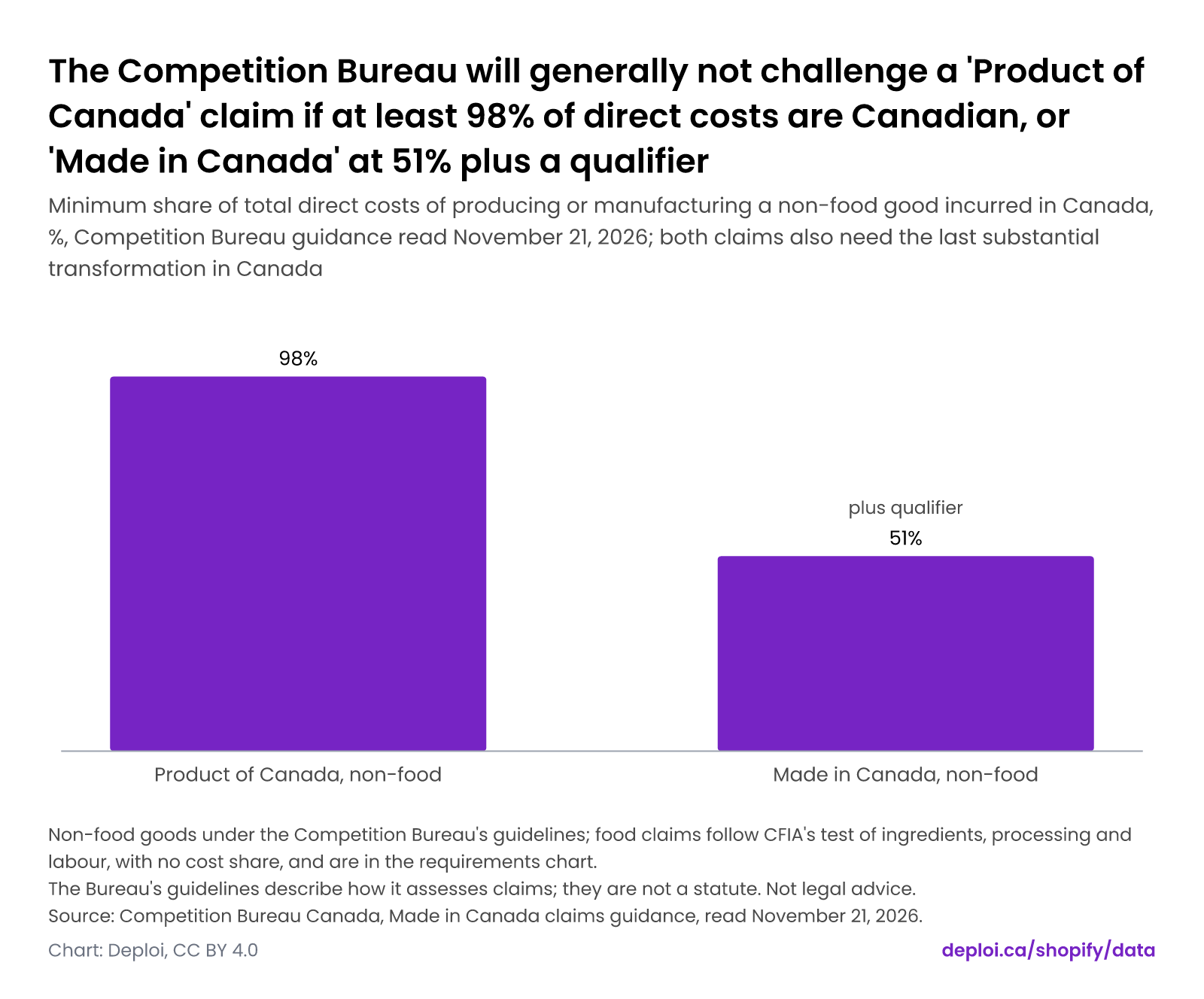
The Competition Bureau's guidance, read November 21, 2026, says it will generally not challenge a non-food 'Product of Canada' claim if at least 98% of the good's total direct costs of production or manufacture are incurred in Canada and its last substantial transformation happened in Canada. For 'Made in Canada' the conditions are at least 51% of those costs, the same transformation test and a qualifying statement.
The Competition Bureau will generally not challenge a 'Product of Canada' claim if at least 98% of direct costs are Canadian, or 'Made in Canada' at 51% plus a qualifier
Minimum share of total direct costs of producing or manufacturing a non-food good incurred in Canada, %, Competition Bureau guidance read November 21, 2026; both claims also need the last substantial transformation in Canada
- Non-food goods under the Competition Bureau's guidelines; food claims follow CFIA's test of ingredients, processing and labour, with no cost share, and are in the requirements chart.
- The Bureau's guidelines describe how it assesses claims; they are not a statute. Not legal advice.
Source: Competition Bureau Canada, Made in Canada claims guidance, read November 21, 2026. Read on .
The data
Each chart on this page is drawn from the numbers below. Units are in the column headers.
Methodology
Reading the chart: The Competition Bureau will generally not challenge a 'Product of Canada' claim if at least 98% of direct costs are Canadian, or 'Made in Canada' at 51% plus a qualifier
- Non-food goods under the Competition Bureau's guidelines; food claims follow CFIA's test of ingredients, processing and labour, with no cost share, and are in the requirements chart.
- The Bureau's guidelines describe how it assesses claims; they are not a statute. Not legal advice.
Caveats: 'Product of Canada' and 'Made in Canada' claims: Canadian share of direct costs, last substantial transformation, qualifying statements and penalties, Competition Bureau and CFIA, 2026
- Not legal advice. Guidance as the Competition Bureau and CFIA state it on the capture date.
- The Bureau's guidelines describe how it assesses claims; they are not a statute.
- The Competition Bureau introduces its conditions with 'We will generally not challenge a claim that states that a good is ... if these ... conditions are met': the cost shares and transformation tests are the conditions under which the Bureau generally will not challenge a claim, not a license or a statute.
- Cost shares are stated for non-food goods only; the food rows follow CFIA's test and their cost share is not published.
- The penalty row is the Bureau's summary for deceptive marketing practices in general, not for origin claims only.
- CFIA: 'Generally, the percentage referred to as very little or minor is considered to be less than a total of 2% of the product' (very low levels of ingredients not generally produced in Canada do not disqualify a food from a 'Product of Canada' claim).
Deploi's charts and compilation are licensed CC BY 4.0. The underlying facts belong to their sources, which are named on every page. How Deploi Shopify Data works.
Sources
Tier A sources are primary documents: filings, official releases and official price pages. How sources are ranked.
- Tier AMade in Canada claims
Competition Bureau Canada · HTML · Read on
- Tier APenalties and remedies for non-compliance (deceptive marketing practices)
Competition Bureau Canada · HTML · Read on
- Tier AOrigin claims on food labels (Product of Canada and Made in Canada guidelines)
Canadian Food Inspection Agency · HTML · Read on
Cite and reuse
Deploi's charts and compilation are licensed CC BY 4.0. The underlying facts belong to their sources, which are named on every page.
APA
Deploi. (2026). The Competition Bureau will generally not challenge a 'Product of Canada' claim if at least 98% of direct costs are Canadian, or 'Made in Canada' at 51% plus a qualifier (Version 1) [Chart]. https://deploi.ca/shopify/data/charts/canada-claim-cost-share Retrieved November 21, 2026.
BibTeX
@misc{deploi_canada_claim_cost_share_2026,
  author = {{Deploi}},
  title = {The Competition Bureau will generally not challenge a 'Product of Canada' claim if at least 98\% of direct costs are Canadian, or 'Made in Canada' at 51\% plus a qualifier},
  year = {2026},
  version = {1},
  url = {https://deploi.ca/shopify/data/charts/canada-claim-cost-share},
  note = {Accessed 2026-11-21}
}
Embed this chart
Embed code
<iframe src="https://deploi.ca/embed/shopify/data/canada-claim-cost-share" title="The Competition Bureau will generally not challenge a 'Product of Canada' claim if at least 98% of direct costs are Canadian, or 'Made in Canada' at 51% plus a qualifier" loading="lazy" style="width:100%;height:550px;border:0"></iframe> <p style="font:12px/1.4 Arial,sans-serif;margin:4px 0 0">Source: <a href="https://deploi.ca/shopify/data/charts/canada-claim-cost-share">Deploi, The Competition Bureau will generally not challenge a 'Product of Canada' claim if at least 98% of direct costs are Canadian, or 'Made in Canada' at 51% plus a qualifier</a></p>
Keep the credit line under the embed. It is the license condition.
Downloads
- Chart: The Competition Bureau will generally not challenge a 'Product of Canada' claim if at least 98% of direct costs are Canadian, or 'Made in Canada' at 51% plus a qualifier PNG
- Data: 'Product of Canada' and 'Made in Canada' claims: Canadian share of direct costs, last substantial transformation, qualifying statements and penalties, Competition Bureau and CFIA, 2026 CSV
Changes
- · 'Product of Canada' and 'Made in Canada' claims: Canadian share of direct costs, last substantial transformation, qualifying statements and penalties, Competition Bureau and CFIA, 2026
First release. 5 rows, 7 fields read from 3 sources; each value agreed by extractor and verifier or ruled by the judge.