
Both laws give senders 10 business days to honor an unsubscribe, but only CASL requires consent before the first email
Rules for commercial email under Canada's Anti-Spam Legislation (CASL) and the US CAN-SPAM Act, as written in the statutes read November 20, 2026; a filled check means the law requires it
By Martin DejnickiUpdated Data through November 20, 2026
Short answer
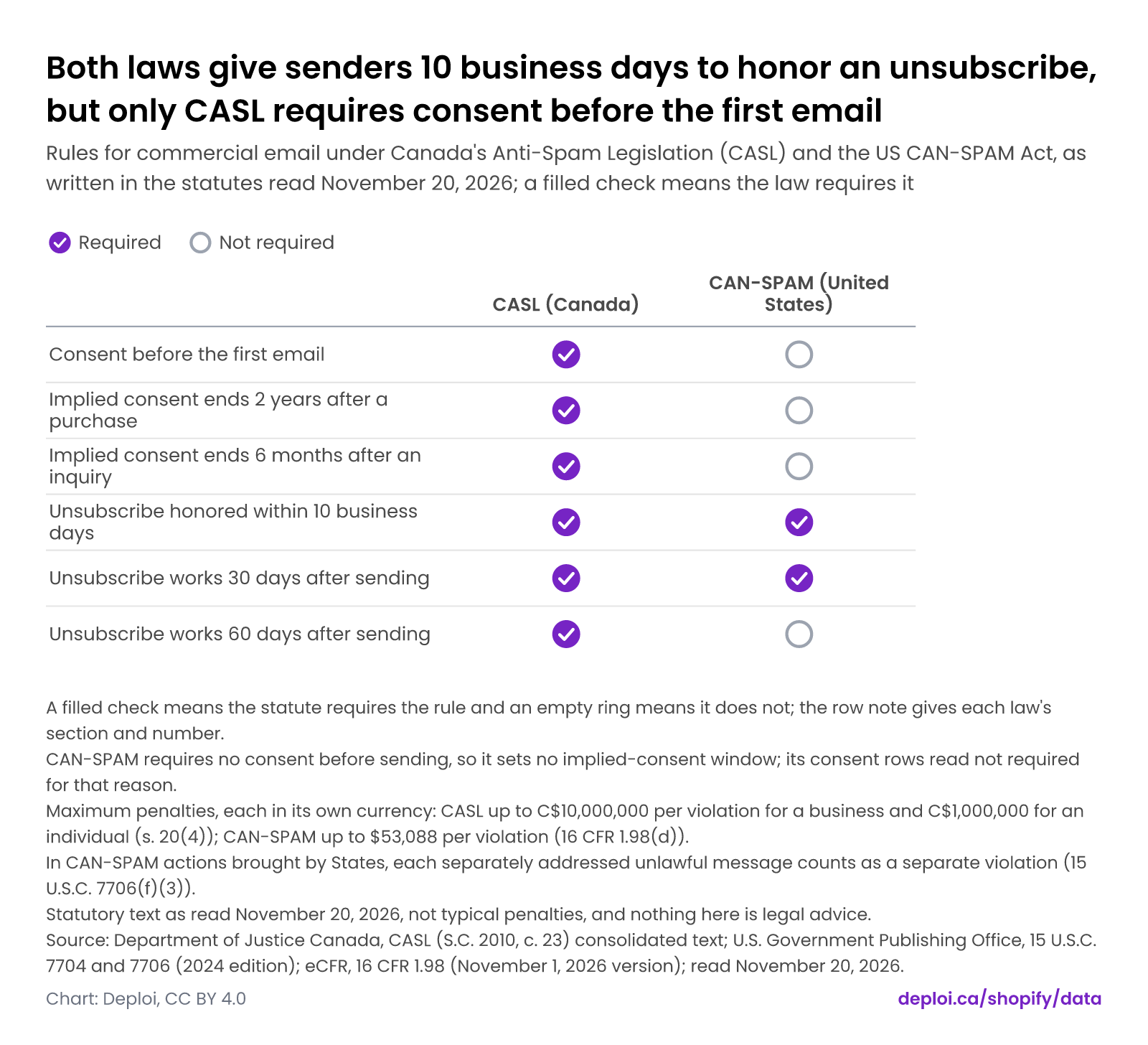
As written in the Department of Justice Canada's CASL text and 15 U.S.C. 7704, read November 20, 2026, CASL requires consent before a commercial email (s. 6(1)), implied for 2 years after a purchase and 6 months after an inquiry; CAN-SPAM requires none. Both laws give 10 business days to honor an unsubscribe request. The mechanism must work 60 days (CASL) or 30 (CAN-SPAM). Maximums are C$10,000,000 per violation under CASL and $53,088 under CAN-SPAM.
Both laws give senders 10 business days to honor an unsubscribe, but only CASL requires consent before the first email
Rules for commercial email under Canada's Anti-Spam Legislation (CASL) and the US CAN-SPAM Act, as written in the statutes read November 20, 2026; a filled check means the law requires it
- A filled check means the statute requires the rule and an empty ring means it does not; the row note gives each law's section and number.
- CAN-SPAM requires no consent before sending, so it sets no implied-consent window; its consent rows read not required for that reason.
- Maximum penalties, each in its own currency: CASL up to C$10,000,000 per violation for a business and C$1,000,000 for an individual (s. 20(4)); CAN-SPAM up to $53,088 per violation (16 CFR 1.98(d)).
- In CAN-SPAM actions brought by States, each separately addressed unlawful message counts as a separate violation (15 U.S.C. 7706(f)(3)).
- Statutory text as read November 20, 2026, not typical penalties, and nothing here is legal advice.
Source: Department of Justice Canada, CASL (S.C. 2010, c. 23) consolidated text; U.S. Government Publishing Office, 15 U.S.C. 7704 and 7706 (2024 edition); eCFR, 16 CFR 1.98 (November 1, 2026 version); read November 20, 2026. Read on .
The data
Each chart on this page is drawn from the numbers below. Units are in the column headers.
| Rule | CASL (Canada) | CAN-SPAM (United States) | Matrix note |
|---|---|---|---|
| Consent before the first email | Required | Not required | CASL s. 6(1): opt-in, consent before sending. CAN-SPAM, 15 U.S.C. 7704(a)(4)(A): opt-out, sending allowed until the recipient objects. |
| Implied consent ends 2 years after a purchase | Required | Not required | CASL s. 10(10)(a): consent implied for 2 years after a purchase. CAN-SPAM, 15 U.S.C. 7704(a)(4)(A): opt-out, no consent asked and so no implied-consent period. |
| Implied consent ends 6 months after an inquiry | Required | Not required | CASL s. 10(10)(e): consent implied for 6 months after an inquiry. CAN-SPAM, 15 U.S.C. 7704(a)(4)(A): opt-out, no consent asked and so no implied-consent period. |
| Unsubscribe honored within 10 business days | Required | Required | CASL s. 11(3): within 10 business days. CAN-SPAM, 15 U.S.C. 7704(a)(4)(A)(i): within 10 business days. |
| Unsubscribe works 30 days after sending | Required | Required | CASL s. 11(2): at least 60 days after sending. CAN-SPAM, 15 U.S.C. 7704(a)(3)(A)(ii): at least 30 days after transmission. |
| Unsubscribe works 60 days after sending | Required | Not required | CASL s. 11(2): at least 60 days after sending. CAN-SPAM, 15 U.S.C. 7704(a)(3)(A)(ii): at least 30 days after transmission. |
Download CASL and CAN-SPAM rules for commercial email: consent, implied-consent windows, unsubscribe deadlines, as written on November 20, 2026 as CSV · All 12 columns on the dataset page
Methodology
Reading the chart: Both laws give senders 10 business days to honor an unsubscribe, but only CASL requires consent before the first email
- A filled check means the statute requires the rule and an empty ring means it does not; the row note gives each law's section and number.
- CAN-SPAM requires no consent before sending, so it sets no implied-consent window; its consent rows read not required for that reason.
- Maximum penalties, each in its own currency: CASL up to C$10,000,000 per violation for a business and C$1,000,000 for an individual (s. 20(4)); CAN-SPAM up to $53,088 per violation (16 CFR 1.98(d)).
- In CAN-SPAM actions brought by States, each separately addressed unlawful message counts as a separate violation (15 U.S.C. 7706(f)(3)).
- Statutory text as read November 20, 2026, not typical penalties, and nothing here is legal advice.
Caveats: CASL and CAN-SPAM rules for commercial email: consent, implied-consent windows, unsubscribe deadlines, as written on November 20, 2026
- CAN-SPAM's consent model is classified as opt-out by Deploi's reading of the Act's wording: section 7704 requires no consent before the first message and makes sending unlawful only after the recipient objects.
- CAN-SPAM requires no consent before sending, so it sets no implied-consent window; its consent rows read not required for that reason.
- Statutory text as read November 20, 2026, not legal advice; a later amendment can change it.
Deploi's charts and compilation are licensed CC BY 4.0. The underlying facts belong to their sources, which are named on every page. How Deploi Shopify Data works.
Sources
Tier A sources are primary documents: filings, official releases and official price pages. How sources are ranked.
- Tier A15 U.S.C. 7704 Other protections for users of commercial electronic mail (U.S. Code, 2024 Edition)
U.S. Government Publishing Office (GovInfo) · HTML · Read on
- Tier AAn Act to promote the efficiency and adaptability of the Canadian economy (CASL), S.C. 2010, c. 23, full text
Department of Justice Canada · HTML · Read on
Cite and reuse
Deploi's charts and compilation are licensed CC BY 4.0. The underlying facts belong to their sources, which are named on every page.
APA
Deploi. (2026). Both laws give senders 10 business days to honor an unsubscribe, but only CASL requires consent before the first email (Version 1) [Chart]. https://deploi.ca/shopify/data/charts/casl-vs-can-spam-rules Retrieved November 20, 2026.
BibTeX
@misc{deploi_casl_vs_can_spam_rules_2026,
  author = {{Deploi}},
  title = {Both laws give senders 10 business days to honor an unsubscribe, but only CASL requires consent before the first email},
  year = {2026},
  version = {1},
  url = {https://deploi.ca/shopify/data/charts/casl-vs-can-spam-rules},
  note = {Accessed 2026-11-20}
}
Embed this chart
Embed code
<iframe src="https://deploi.ca/embed/shopify/data/casl-vs-can-spam-rules" title="Both laws give senders 10 business days to honor an unsubscribe, but only CASL requires consent before the first email" loading="lazy" style="width:100%;height:560px;border:0"></iframe>
<p style="font:12px/1.4 Arial,sans-serif;margin:4px 0 0">Source: <a href="https://deploi.ca/shopify/data/charts/casl-vs-can-spam-rules">Deploi, Both laws give senders 10 business days to honor an unsubscribe, but only CASL requires consent before the first email</a></p>
Keep the credit line under the embed. It is the license condition.
Changes
- · CASL and CAN-SPAM rules for commercial email: consent, implied-consent windows, unsubscribe deadlines, as written on November 20, 2026
First release. 8 rule rows and 6 matrix rows from CASL and 15 U.S.C. 7704.