
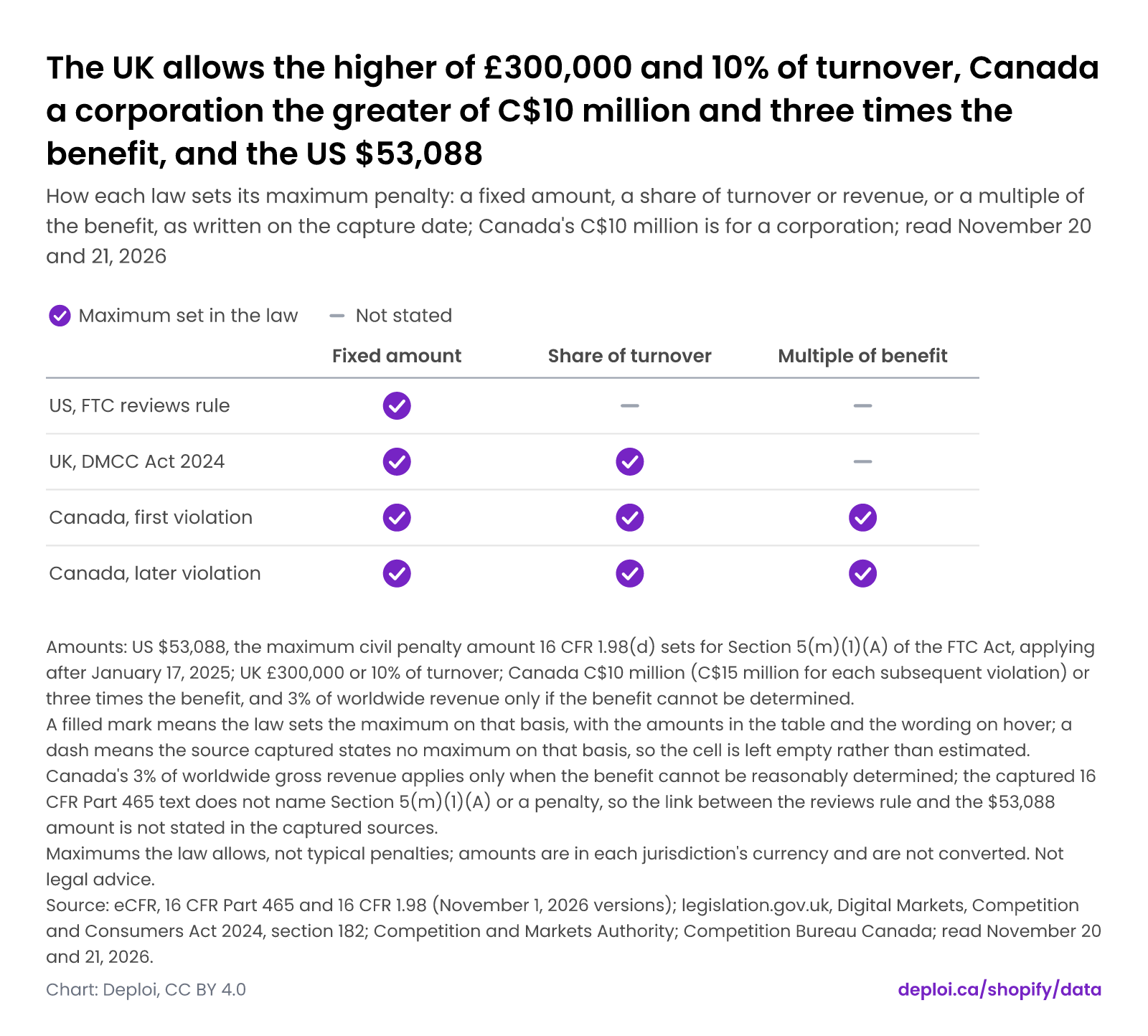
The UK allows the higher of £300,000 and 10% of turnover, Canada a corporation the greater of C$10 million and three times the benefit, and the US $53,088
How each law sets its maximum penalty: a fixed amount, a share of turnover or revenue, or a multiple of the benefit, as written on the capture date; Canada's C$10 million is for a corporation; read November 20 and 21, 2026
By Martin DejnickiUpdated Data through November 21, 2026
Short answer
As written on the capture date, 16 CFR 1.98(d) sets $53,088 as the maximum civil penalty for Section 5(m)(1)(A) of the FTC Act, applying after January 17, 2025; the link to the reviews rule is not stated in the captured sources. The UK DMCC Act 2024 allows £300,000 or, if higher, 10% of turnover. Canada allows a corporation the greater of C$10 million (C$15 million if repeated) and three times the benefit.
The UK allows the higher of £300,000 and 10% of turnover, Canada a corporation the greater of C$10 million and three times the benefit, and the US $53,088
How each law sets its maximum penalty: a fixed amount, a share of turnover or revenue, or a multiple of the benefit, as written on the capture date; Canada's C$10 million is for a corporation; read November 20 and 21, 2026
- Amounts: US $53,088, the maximum civil penalty amount 16 CFR 1.98(d) sets for Section 5(m)(1)(A) of the FTC Act, applying after January 17, 2025; UK £300,000 or 10% of turnover; Canada C$10 million (C$15 million for each subsequent violation) or three times the benefit, and 3% of worldwide revenue only if the benefit cannot be determined.
- A filled mark means the law sets the maximum on that basis, with the amounts in the table and the wording on hover; a dash means the source captured states no maximum on that basis, so the cell is left empty rather than estimated.
- Canada's 3% of worldwide gross revenue applies only when the benefit cannot be reasonably determined; the captured 16 CFR Part 465 text does not name Section 5(m)(1)(A) or a penalty, so the link between the reviews rule and the $53,088 amount is not stated in the captured sources.
- Maximums the law allows, not typical penalties; amounts are in each jurisdiction's currency and are not converted. Not legal advice.
Source: eCFR, 16 CFR Part 465 and 16 CFR 1.98 (November 1, 2026 versions); legislation.gov.uk, Digital Markets, Competition and Consumers Act 2024, section 182; Competition and Markets Authority; Competition Bureau Canada; read November 20 and 21, 2026. Read on .
The data
Each chart on this page is drawn from the numbers below. Units are in the column headers.
| Law | Fixed amount | Share of turnover | Multiple of benefit | Basis | Maximum amount (local currency) | Currency | Turnover-based maximum (% of turnover or revenue) | Multiple of the benefit (times) | In force from |
|---|---|---|---|---|---|---|---|---|---|
| US, FTC reviews rule | Maximum set in the law | Not stated | Not stated | 53,088 | $ | Not stated | Not stated | ||
| UK, DMCC Act 2024 | Maximum set in the law | Maximum set in the law | Not stated | The amount of a monetary penalty imposed under subsection (4)(b) must be a fixed amount not exceeding £300,000 or, if higher, 10% of the total value of the turnover (if any) of the respondent. | 300,000 | £ | 10 | Not stated | Apr 6, 2025 |
| Canada, first violation | Maximum set in the law | Maximum set in the law | Maximum set in the law | For corporations, the penalty for a first-time violation is up to the greater of:
$10 million ($15 million for each subsequent violation); and
three times the value of the benefit derived from the deceptive conduct, or, if that amount cannot be reasonably determined, 3% of the corporation’s annual worldwide gross revenue. | 10,000,000 | $ | 3 | 3 | |
| Canada, later violation | Maximum set in the law | Maximum set in the law | Maximum set in the law | For corporations, the penalty for a first-time violation is up to the greater of:
$10 million ($15 million for each subsequent violation); and
three times the value of the benefit derived from the deceptive conduct, or, if that amount cannot be reasonably determined, 3% of the corporation’s annual worldwide gross revenue. | 15,000,000 | $ | 3 | 3 |
Download Maximum penalties for fake reviews and misleading price claims: US FTC rule, UK Digital Markets, Competition and Consumers Act, and Canada's Competition Act, 2026 as CSV · All 12 columns on the dataset page
Methodology
Reading the chart: The UK allows the higher of £300,000 and 10% of turnover, Canada a corporation the greater of C$10 million and three times the benefit, and the US $53,088
- Amounts: US $53,088, the maximum civil penalty amount 16 CFR 1.98(d) sets for Section 5(m)(1)(A) of the FTC Act, applying after January 17, 2025; UK £300,000 or 10% of turnover; Canada C$10 million (C$15 million for each subsequent violation) or three times the benefit, and 3% of worldwide revenue only if the benefit cannot be determined.
- A filled mark means the law sets the maximum on that basis, with the amounts in the table and the wording on hover; a dash means the source captured states no maximum on that basis, so the cell is left empty rather than estimated.
- Canada's 3% of worldwide gross revenue applies only when the benefit cannot be reasonably determined; the captured 16 CFR Part 465 text does not name Section 5(m)(1)(A) or a penalty, so the link between the reviews rule and the $53,088 amount is not stated in the captured sources.
- Maximums the law allows, not typical penalties; amounts are in each jurisdiction's currency and are not converted. Not legal advice.
Caveats: Maximum penalties for fake reviews and misleading price claims: US FTC rule, UK Digital Markets, Competition and Consumers Act, and Canada's Competition Act, 2026
- Maximums the law allows, not typical penalties.
- $53,088 is the maximum civil penalty amount 16 CFR 1.98(d) sets for Section 5(m)(1)(A) of the FTC Act, 15 U.S.C. 45(m)(1)(A), and applies to penalties assessed after January 17, 2025, as 16 CFR 1.98 states in its November 2026 text. The captured 16 CFR Part 465 text calls each listed practice 'an unfair or deceptive act or practice and a violation of this part' but does not name Section 5(m)(1)(A) or a penalty, so the link between the reviews rule and that amount is not stated in the captured sources. The US row states no maximum for misleading price claims.
- Not published: the US turnover share and benefit multiple, the UK benefit multiple, and the start date for the US and Canada.
- Canada's 3% of annual worldwide gross revenue applies where the benefit cannot be reasonably determined.
- Amounts are in each jurisdiction's currency and are not converted; not legal advice.
Deploi's charts and compilation are licensed CC BY 4.0. The underlying facts belong to their sources, which are named on every page. How Deploi Shopify Data works.
Sources
Tier A sources are primary documents: filings, official releases and official price pages. How sources are ranked.
- Tier APenalties and remedies for non-compliance (deceptive marketing practices)
Competition Bureau Canada · HTML · Read on
- Tier A16 CFR 1.98 Adjustment of civil monetary penalty amounts (eCFR XML, 2026-11-01 version)
Office of the Federal Register and U.S. Government Publishing Office (eCFR) · TEXT · Read on
- Tier ACMA to boost consumer and business confidence as new consumer protection regime comes into force
Competition and Markets Authority (GOV.UK) · HTML · Read on
- Tier ADigital Markets, Competition and Consumers Act 2024, section 182 (final infringement notice)
UK Government (legislation.gov.uk) · HTML · Read on
- Tier A16 CFR Part 465 Rule on the Use of Consumer Reviews and Testimonials (eCFR 2026-11-01)
Office of the Federal Register (eCFR) · HTML · Read on
Cite and reuse
Deploi's charts and compilation are licensed CC BY 4.0. The underlying facts belong to their sources, which are named on every page.
APA
Deploi. (2026). The UK allows the higher of £300,000 and 10% of turnover, Canada a corporation the greater of C$10 million and three times the benefit, and the US $53,088 (Version 1) [Chart]. https://deploi.ca/shopify/data/charts/fake-review-penalties-matrix Retrieved November 21, 2026.
BibTeX
@misc{deploi_fake_review_penalties_matrix_2026,
  author = {{Deploi}},
  title = {The UK allows the higher of £300,000 and 10\% of turnover, Canada a corporation the greater of C\$10 million and three times the benefit, and the US \$53,088},
  year = {2026},
  version = {1},
  url = {https://deploi.ca/shopify/data/charts/fake-review-penalties-matrix},
  note = {Accessed 2026-11-21}
}
Embed this chart
Embed code
<iframe src="https://deploi.ca/embed/shopify/data/fake-review-penalties-matrix" title="The UK allows the higher of £300,000 and 10% of turnover, Canada a corporation the greater of C$10 million and three times the benefit, and the US $53,088" loading="lazy" style="width:100%;height:490px;border:0"></iframe>
<p style="font:12px/1.4 Arial,sans-serif;margin:4px 0 0">Source: <a href="https://deploi.ca/shopify/data/charts/fake-review-penalties-matrix">Deploi, The UK allows the higher of £300,000 and 10% of turnover, Canada a corporation the greater of C$10 million and three times the benefit, and the US $53,088</a></p>
Keep the credit line under the embed. It is the license condition.
Downloads
- Chart: The UK allows the higher of £300,000 and 10% of turnover, Canada a corporation the greater of C$10 million and three times the benefit, and the US $53,088 PNG
- Data: Maximum penalties for fake reviews and misleading price claims: US FTC rule, UK Digital Markets, Competition and Consumers Act, and Canada's Competition Act, 2026 CSV
Changes
- · Maximum penalties for fake reviews and misleading price claims: US FTC rule, UK Digital Markets, Competition and Consumers Act, and Canada's Competition Act, 2026
First release. 4 rows: the US FTC reviews rule, the UK Act and the Competition Act for a first and a subsequent violation, read November 20 and 21, 2026.