
The 173.185(c) smaller-battery exception sets conditions of 20 Wh a cell and 100 Wh a battery, or 60 and 300 Wh for highway or rail only
Size limits for a lithium ion cell or battery under 49 CFR 173.185(c), Wh; the higher pair is for highway or rail only and the air conditions are in the notes; eCFR, title 49 issue date November 12, 2026, read November 22, 2026
By Martin DejnickiUpdated
Short answer
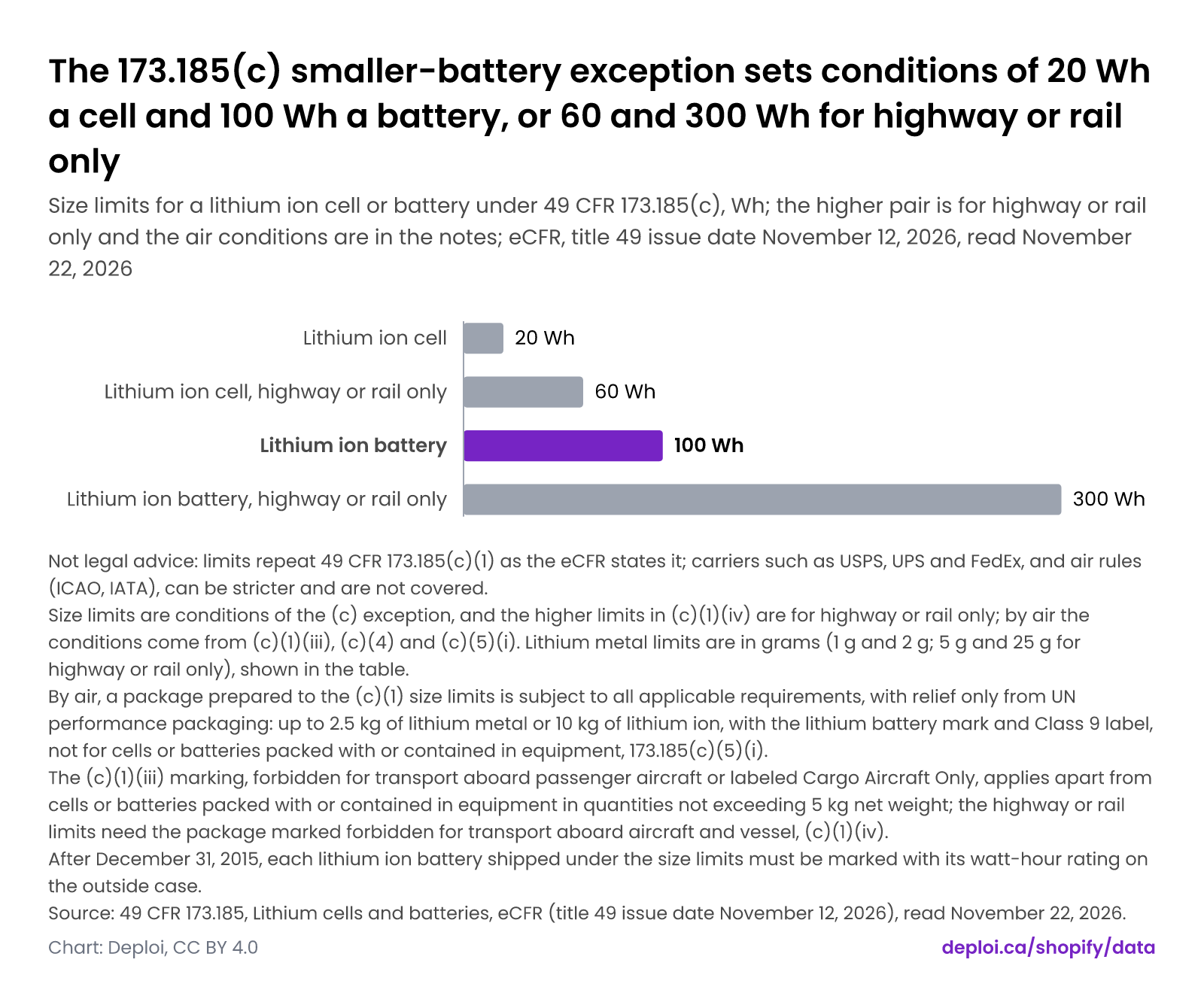
According to the eCFR text of 49 CFR 173.185 read on November 22, 2026, the conditions of the smaller-battery exception are 20 Wh for a lithium ion cell and 100 Wh for a battery, raised to 60 and 300 Wh for highway or rail only. By air, relief comes only from UN performance packaging, and (c)(5)(i) does not apply to batteries or cells packed with, or contained in, equipment.
The 173.185(c) smaller-battery exception sets conditions of 20 Wh a cell and 100 Wh a battery, or 60 and 300 Wh for highway or rail only
Size limits for a lithium ion cell or battery under 49 CFR 173.185(c), Wh; the higher pair is for highway or rail only and the air conditions are in the notes; eCFR, title 49 issue date November 12, 2026, read November 22, 2026
- Not legal advice: limits repeat 49 CFR 173.185(c)(1) as the eCFR states it; carriers such as USPS, UPS and FedEx, and air rules (ICAO, IATA), can be stricter and are not covered.
- Size limits are conditions of the (c) exception, and the higher limits in (c)(1)(iv) are for highway or rail only; by air the conditions come from (c)(1)(iii), (c)(4) and (c)(5)(i). Lithium metal limits are in grams (1 g and 2 g; 5 g and 25 g for highway or rail only), shown in the table.
- By air, a package prepared to the (c)(1) size limits is subject to all applicable requirements, with relief only from UN performance packaging: up to 2.5 kg of lithium metal or 10 kg of lithium ion, with the lithium battery mark and Class 9 label, not for cells or batteries packed with or contained in equipment, 173.185(c)(5)(i).
- The (c)(1)(iii) marking, forbidden for transport aboard passenger aircraft or labeled Cargo Aircraft Only, applies apart from cells or batteries packed with or contained in equipment in quantities not exceeding 5 kg net weight; the highway or rail limits need the package marked forbidden for transport aboard aircraft and vessel, (c)(1)(iv).
- After December 31, 2015, each lithium ion battery shipped under the size limits must be marked with its watt-hour rating on the outside case.
Source: 49 CFR 173.185, Lithium cells and batteries, eCFR (title 49 issue date November 12, 2026), read November 22, 2026. Read on .
The data
Each chart on this page is drawn from the numbers below. Units are in the column headers.
| Item | Condition | Watt-hour limit (Wh) | Lithium content limit (g) | Net mass limit per package (kg) | Paragraph |
|---|---|---|---|---|---|
| Lithium ion cell | size limit | 20 | Not stated | Not stated | 173.185(c)(1)(i) |
| Lithium ion battery | size limit | 100 | Not stated | Not stated | 173.185(c)(1)(i) |
| Lithium ion cell, highway or rail only | highway or rail only | 60 | Not stated | Not stated | 173.185(c)(1)(iv) |
| Lithium ion battery, highway or rail only | highway or rail only | 300 | Not stated | Not stated | 173.185(c)(1)(iv) |
| Lithium metal cell | size limit | Not stated | 1 | Not stated | 173.185(c)(1)(ii) |
| Lithium metal battery | size limit | Not stated | 2 | Not stated | 173.185(c)(1)(ii) |
| Lithium metal cell, highway or rail only | highway or rail only | Not stated | 5 | Not stated | 173.185(c)(1)(iv) |
| Lithium metal battery, highway or rail only | highway or rail only | Not stated | 25 | Not stated | 173.185(c)(1)(iv) |
| Net mass of cells or batteries per package, packed with, or contained in, equipment, by air | air | Not stated | Not stated | 5 | 173.185(c)(4)(i) |
| Lithium metal cells or batteries by air, most per package without UN performance packaging (all other applicable requirements apply; lithium battery mark and Class 9 label; (c)(5)(i) does not apply to batteries or cells packed with, or contained in, equipment, which come under (c)(4), up to 5 kg net) | air | Not stated | Not stated | 2.5 | 173.185(c)(5)(i) |
| Lithium ion cells or batteries by air, most per package without UN performance packaging (all other applicable requirements apply; lithium battery mark and Class 9 label; (c)(5)(i) does not apply to batteries or cells packed with, or contained in, equipment, which come under (c)(4), up to 5 kg net) | air | Not stated | Not stated | 10 | 173.185(c)(5)(i) |
Download US hazardous materials rules for small lithium batteries under 49 CFR 173.185: the watt-hour and lithium-content limits of the paragraph (c) exception for smaller cells or batteries, the higher limits for highway or rail only, the passenger aircraft marking, the air package limits, the lithium battery mark size, the letter height of the aircraft markings, and the test-summary and equipment conditions as CSV · All 10 columns on the dataset page
Methodology
Reading the chart: The 173.185(c) smaller-battery exception sets conditions of 20 Wh a cell and 100 Wh a battery, or 60 and 300 Wh for highway or rail only
- Not legal advice: limits repeat 49 CFR 173.185(c)(1) as the eCFR states it; carriers such as USPS, UPS and FedEx, and air rules (ICAO, IATA), can be stricter and are not covered.
- Size limits are conditions of the (c) exception, and the higher limits in (c)(1)(iv) are for highway or rail only; by air the conditions come from (c)(1)(iii), (c)(4) and (c)(5)(i). Lithium metal limits are in grams (1 g and 2 g; 5 g and 25 g for highway or rail only), shown in the table.
- By air, a package prepared to the (c)(1) size limits is subject to all applicable requirements, with relief only from UN performance packaging: up to 2.5 kg of lithium metal or 10 kg of lithium ion, with the lithium battery mark and Class 9 label, not for cells or batteries packed with or contained in equipment, 173.185(c)(5)(i).
- The (c)(1)(iii) marking, forbidden for transport aboard passenger aircraft or labeled Cargo Aircraft Only, applies apart from cells or batteries packed with or contained in equipment in quantities not exceeding 5 kg net weight; the highway or rail limits need the package marked forbidden for transport aboard aircraft and vessel, (c)(1)(iv).
- After December 31, 2015, each lithium ion battery shipped under the size limits must be marked with its watt-hour rating on the outside case.
Caveats: US hazardous materials rules for small lithium batteries under 49 CFR 173.185: the watt-hour and lithium-content limits of the paragraph (c) exception for smaller cells or batteries, the higher limits for highway or rail only, the passenger aircraft marking, the air package limits, the lithium battery mark size, the letter height of the aircraft markings, and the test-summary and equipment conditions
- Federal Hazardous Materials Regulations only; carriers (USPS, UPS, FedEx) and air rules (ICAO, IATA) can be stricter and are not covered.
- Watt-hours, grams, kilograms and millimetres never share an axis, so each limit sits in its own column.
- The size limits in 173.185(c)(1) are conditions of the exception in paragraph (c) for smaller cells or batteries, and the higher limits in (c)(1)(iv) are for highway or rail only. By air, the conditions come from (c)(1)(iii), (c)(4) and (c)(5)(i). Under (c)(5)(i), a package prepared to the (c)(1) size limits is subject to all applicable requirements of the subchapter, with relief only from the UN performance packaging requirements in (b)(3)(ii) when it holds no more than 2.5 kg lithium metal or 10 kg lithium ion cells or batteries and displays both the lithium battery mark and the Class 9 Lithium Battery label; that paragraph does not apply to batteries or cells packed with, or contained in, equipment.
- By air, a package of cells or batteries packed with, or contained in, equipment stays within the paragraph (c) exception up to 5 kg net of cells or batteries, with no more than the minimum number needed to power the equipment plus two spare sets, 173.185(c)(4)(i). Unless the cells or batteries are packed with or contained in equipment in quantities up to 5 kg net, the outer package must be marked forbidden for transport aboard passenger aircraft or labeled Cargo Aircraft Only, 173.185(c)(1)(iii); a package marked for highway or rail only under (c)(1)(iv) does not need that marking.
- The dataset is not legal advice.
Deploi's charts and compilation are licensed CC BY 4.0. The underlying facts belong to their sources, which are named on every page. How Deploi Shopify Data works.
Sources
Tier A sources are primary documents: filings, official releases and official price pages. How sources are ranked.
- Tier A49 CFR 173.185, Lithium cells and batteries (eCFR XML, title 49 issue date 2026-11-12)
Office of the Federal Register and U.S. Government Publishing Office (eCFR) · TEXT · Read on
Cite and reuse
Deploi's charts and compilation are licensed CC BY 4.0. The underlying facts belong to their sources, which are named on every page.
APA
Deploi. (2026). The 173.185(c) smaller-battery exception sets conditions of 20 Wh a cell and 100 Wh a battery, or 60 and 300 Wh for highway or rail only (Version 1) [Chart]. https://deploi.ca/shopify/data/charts/lithium-ion-watt-hour-limits-by-mode Retrieved November 22, 2026.
BibTeX
@misc{deploi_lithium_ion_watt_hour_limits_by_mode_2026,
  author = {{Deploi}},
  title = {The 173.185(c) smaller-battery exception sets conditions of 20 Wh a cell and 100 Wh a battery, or 60 and 300 Wh for highway or rail only},
  year = {2026},
  version = {1},
  url = {https://deploi.ca/shopify/data/charts/lithium-ion-watt-hour-limits-by-mode},
  note = {Accessed 2026-11-22}
}
Embed this chart
Embed code
<iframe src="https://deploi.ca/embed/shopify/data/lithium-ion-watt-hour-limits-by-mode" title="The 173.185(c) smaller-battery exception sets conditions of 20 Wh a cell and 100 Wh a battery, or 60 and 300 Wh for highway or rail only" loading="lazy" style="width:100%;height:390px;border:0"></iframe>
<p style="font:12px/1.4 Arial,sans-serif;margin:4px 0 0">Source: <a href="https://deploi.ca/shopify/data/charts/lithium-ion-watt-hour-limits-by-mode">Deploi, The 173.185(c) smaller-battery exception sets conditions of 20 Wh a cell and 100 Wh a battery, or 60 and 300 Wh for highway or rail only</a></p>
Keep the credit line under the embed. It is the license condition.
Downloads
- Chart: The 173.185(c) smaller-battery exception sets conditions of 20 Wh a cell and 100 Wh a battery, or 60 and 300 Wh for highway or rail only PNG
- Data: US hazardous materials rules for small lithium batteries under 49 CFR 173.185: the watt-hour and lithium-content limits of the paragraph (c) exception for smaller cells or batteries, the higher limits for highway or rail only, the passenger aircraft marking, the air package limits, the lithium battery mark size, the letter height of the aircraft markings, and the test-summary and equipment conditions CSV
Changes
- · US hazardous materials rules for small lithium batteries under 49 CFR 173.185: the watt-hour and lithium-content limits of the paragraph (c) exception for smaller cells or batteries, the higher limits for highway or rail only, the passenger aircraft marking, the air package limits, the lithium battery mark size, the letter height of the aircraft markings, and the test-summary and equipment conditions
First release. 18 rows, 9 fields read from 1 sources; each value agreed by extractor and verifier or ruled by the judge.