
The US restricts 8 phthalates in toys and child care articles and Canada 6; only 4 are restricted in both
Phthalates restricted in toys and child care articles, by country, and the vinyl parts Canada's limit covers; both limits 1,000 mg/kg (0.1%); Canada's text current to October 29, 2026, eCFR as read November 25, 2026
By Martin DejnickiUpdated
Short answer
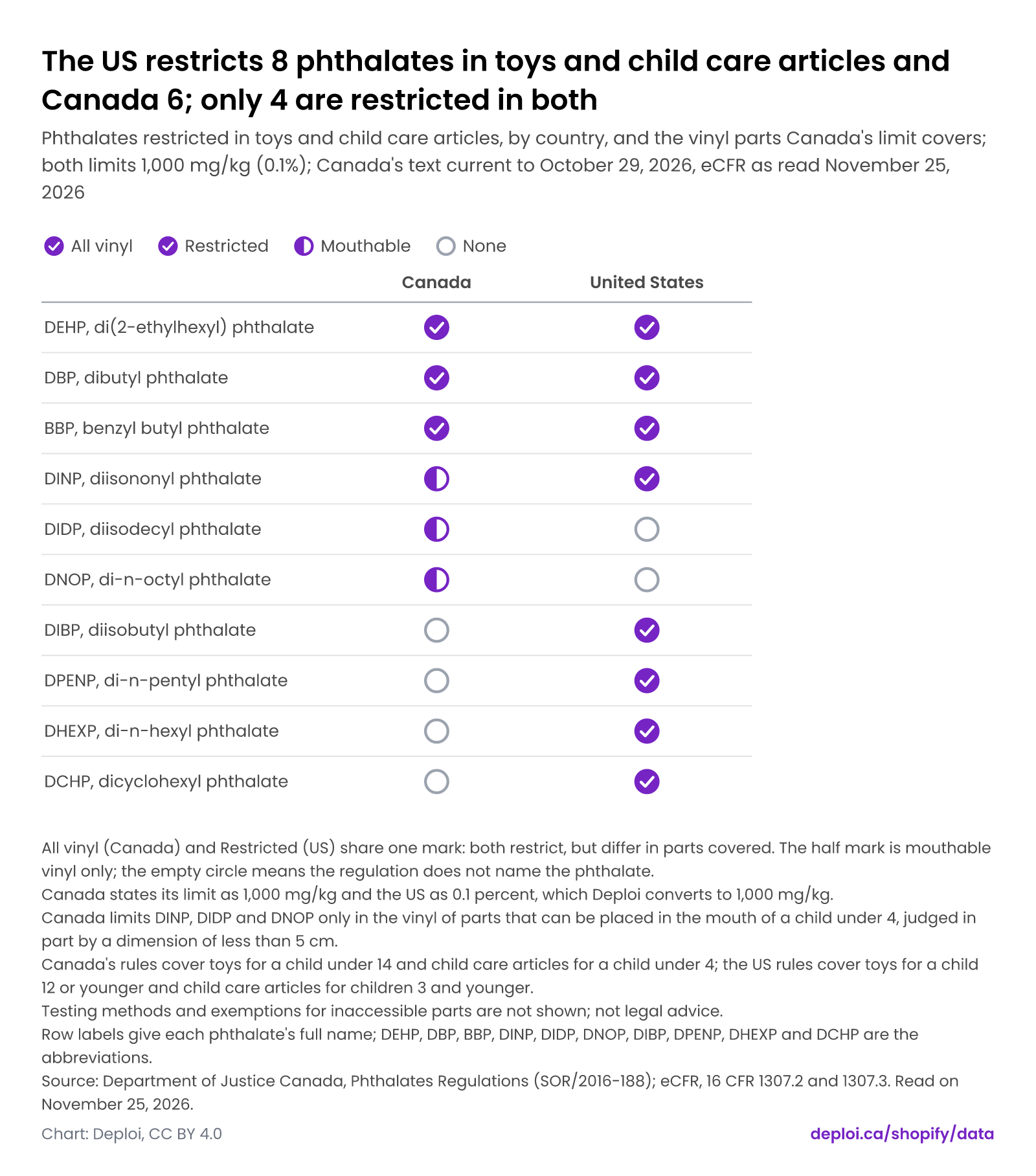
Canada restricts 6 phthalates in toys and child care articles and the US restricts 8, both at 1,000 mg/kg. Four are restricted in both: DEHP, DBP, BBP and DINP. Canada alone restricts DIDP and DNOP, in mouthable vinyl; the US alone restricts DIBP, DPENP, DHEXP and DCHP. Rules as read on November 25, 2026.
The US restricts 8 phthalates in toys and child care articles and Canada 6; only 4 are restricted in both
Phthalates restricted in toys and child care articles, by country, and the vinyl parts Canada's limit covers; both limits 1,000 mg/kg (0.1%); Canada's text current to October 29, 2026, eCFR as read November 25, 2026
- All vinyl (Canada) and Restricted (US) share one mark: both restrict, but differ in parts covered. The half mark is mouthable vinyl only; the empty circle means the regulation does not name the phthalate.
- Canada states its limit as 1,000 mg/kg and the US as 0.1 percent, which Deploi converts to 1,000 mg/kg.
- Canada limits DINP, DIDP and DNOP only in the vinyl of parts that can be placed in the mouth of a child under 4, judged in part by a dimension of less than 5 cm.
- Canada's rules cover toys for a child under 14 and child care articles for a child under 4; the US rules cover toys for a child 12 or younger and child care articles for children 3 and younger.
- Testing methods and exemptions for inaccessible parts are not shown; not legal advice.
- Row labels give each phthalate's full name; DEHP, DBP, BBP, DINP, DIDP, DNOP, DIBP, DPENP, DHEXP and DCHP are the abbreviations.
Source: Department of Justice Canada, Phthalates Regulations (SOR/2016-188); eCFR, 16 CFR 1307.2 and 1307.3. Read on .
The data
Each chart on this page is drawn from the numbers below. Units are in the column headers.
| Phthalate | Canada | United States | Section | Canada limit (mg/kg) | US limit (%) | US limit in mg/kg |
|---|---|---|---|---|---|---|
| DEHP, di(2-ethylhexyl) phthalate | All vinyl | Restricted | SOR/2016-188, s. 2; 16 CFR 1307.3(a) | 1,000 | 0.1 | 1,000 |
| DBP, dibutyl phthalate | All vinyl | Restricted | SOR/2016-188, s. 2; 16 CFR 1307.3(a) | 1,000 | 0.1 | 1,000 |
| BBP, benzyl butyl phthalate | All vinyl | Restricted | SOR/2016-188, s. 2; 16 CFR 1307.3(a) | 1,000 | 0.1 | 1,000 |
| DINP, diisononyl phthalate | Mouthable | Restricted | SOR/2016-188, s. 3(1); 16 CFR 1307.3(b) | 1,000 | 0.1 | 1,000 |
| DIDP, diisodecyl phthalate | Mouthable | None | SOR/2016-188, s. 3(1) | 1,000 | Not stated | Not stated |
| DNOP, di-n-octyl phthalate | Mouthable | None | SOR/2016-188, s. 3(1) | 1,000 | Not stated | Not stated |
| DIBP, diisobutyl phthalate | None | Restricted | 16 CFR 1307.3(b) | Not stated | 0.1 | 1,000 |
| DPENP, di-n-pentyl phthalate | None | Restricted | 16 CFR 1307.3(b) | Not stated | 0.1 | 1,000 |
| DHEXP, di-n-hexyl phthalate | None | Restricted | 16 CFR 1307.3(b) | Not stated | 0.1 | 1,000 |
| DCHP, dicyclohexyl phthalate | None | Restricted | 16 CFR 1307.3(b) | Not stated | 0.1 | 1,000 |
Download Phthalate limits in toys and child care articles, Canada and the United States as CSV · All 12 columns on the dataset page
Methodology
Reading the chart: The US restricts 8 phthalates in toys and child care articles and Canada 6; only 4 are restricted in both
- All vinyl (Canada) and Restricted (US) share one mark: both restrict, but differ in parts covered. The half mark is mouthable vinyl only; the empty circle means the regulation does not name the phthalate.
- Canada states its limit as 1,000 mg/kg and the US as 0.1 percent, which Deploi converts to 1,000 mg/kg.
- Canada limits DINP, DIDP and DNOP only in the vinyl of parts that can be placed in the mouth of a child under 4, judged in part by a dimension of less than 5 cm.
- Canada's rules cover toys for a child under 14 and child care articles for a child under 4; the US rules cover toys for a child 12 or younger and child care articles for children 3 and younger.
- Testing methods and exemptions for inaccessible parts are not shown; not legal advice.
- Row labels give each phthalate's full name; DEHP, DBP, BBP, DINP, DIDP, DNOP, DIBP, DPENP, DHEXP and DCHP are the abbreviations.
Caveats: Phthalate limits in toys and child care articles, Canada and the United States
- Limits as written on November 25, 2026; testing methods and exemptions for inaccessible parts are summarized only where the quoted text states them.
- The US limits apply to any plasticized component part of a children's toy or child care article, or any other component part made of other materials that may contain phthalates (16 CFR 1307.3(c)).
- Not restricted means the regulation does not name that phthalate; it is not a finding about safety.
- Canada states its limit in mg/kg and the United States as a percent; the US limit in mg/kg is computed by Deploi as the percent times 10,000.
- Scope rows carry an age in years or a dimension in cm and have no phthalate or limit.
- The dataset is not legal advice.
Deploi's charts and compilation are licensed CC BY 4.0. The underlying facts belong to their sources, which are named on every page. How Deploi Shopify Data works.
Sources
Tier A sources are primary documents: filings, official releases and official price pages. How sources are ranked.
- Tier A16 CFR 1307.2 Definitions, phthalates in toys and child care articles (eCFR), read 2026-11-25
U.S. Government Publishing Office / Office of the Federal Register (eCFR) · HTML · Read on
- Tier A16 CFR 1307.3 Prohibition of children's toys and child care articles containing specified phthalates (eCFR), read 2026-11-25
U.S. Government Publishing Office / Office of the Federal Register (eCFR) · HTML · Read on
- Tier APhthalates Regulations, SOR/2016-188 (Justice Laws Website), read 2026-11-25
Department of Justice Canada (Justice Laws Website) · HTML · Read on
Cite and reuse
Deploi's charts and compilation are licensed CC BY 4.0. The underlying facts belong to their sources, which are named on every page.
APA
Deploi. (2026). The US restricts 8 phthalates in toys and child care articles and Canada 6; only 4 are restricted in both (Version 1) [Chart]. https://deploi.ca/shopify/data/charts/phthalates-restricted-canada-vs-us Retrieved November 25, 2026.
BibTeX
@misc{deploi_phthalates_restricted_canada_vs_us_2026,
  author = {{Deploi}},
  title = {The US restricts 8 phthalates in toys and child care articles and Canada 6; only 4 are restricted in both},
  year = {2026},
  version = {1},
  url = {https://deploi.ca/shopify/data/charts/phthalates-restricted-canada-vs-us},
  note = {Accessed 2026-11-25}
}
Embed this chart
Embed code
<iframe src="https://deploi.ca/embed/shopify/data/phthalates-restricted-canada-vs-us" title="The US restricts 8 phthalates in toys and child care articles and Canada 6; only 4 are restricted in both" loading="lazy" style="width:100%;height:670px;border:0"></iframe>
<p style="font:12px/1.4 Arial,sans-serif;margin:4px 0 0">Source: <a href="https://deploi.ca/shopify/data/charts/phthalates-restricted-canada-vs-us">Deploi, The US restricts 8 phthalates in toys and child care articles and Canada 6; only 4 are restricted in both</a></p>
Keep the credit line under the embed. It is the license condition.
Changes
- · Phthalate limits in toys and child care articles, Canada and the United States
First release: 15 rows from 3 sources (the Phthalates Regulations and 16 CFR 1307.2 and 1307.3), read on November 25, 2026.