
Importing food (with some foods excluded), or preparing it for export or another province (with 4 listed exceptions), needs a Safe Food for Canadians licence
Whether the Safe Food for Canadians Regulations (SOR/2018-108) require a licence for each activity, sections 5(2), 7(2) and 17(2), text current on November 21, 2026; Justice Laws Website
By Martin DejnickiUpdated
Short answer
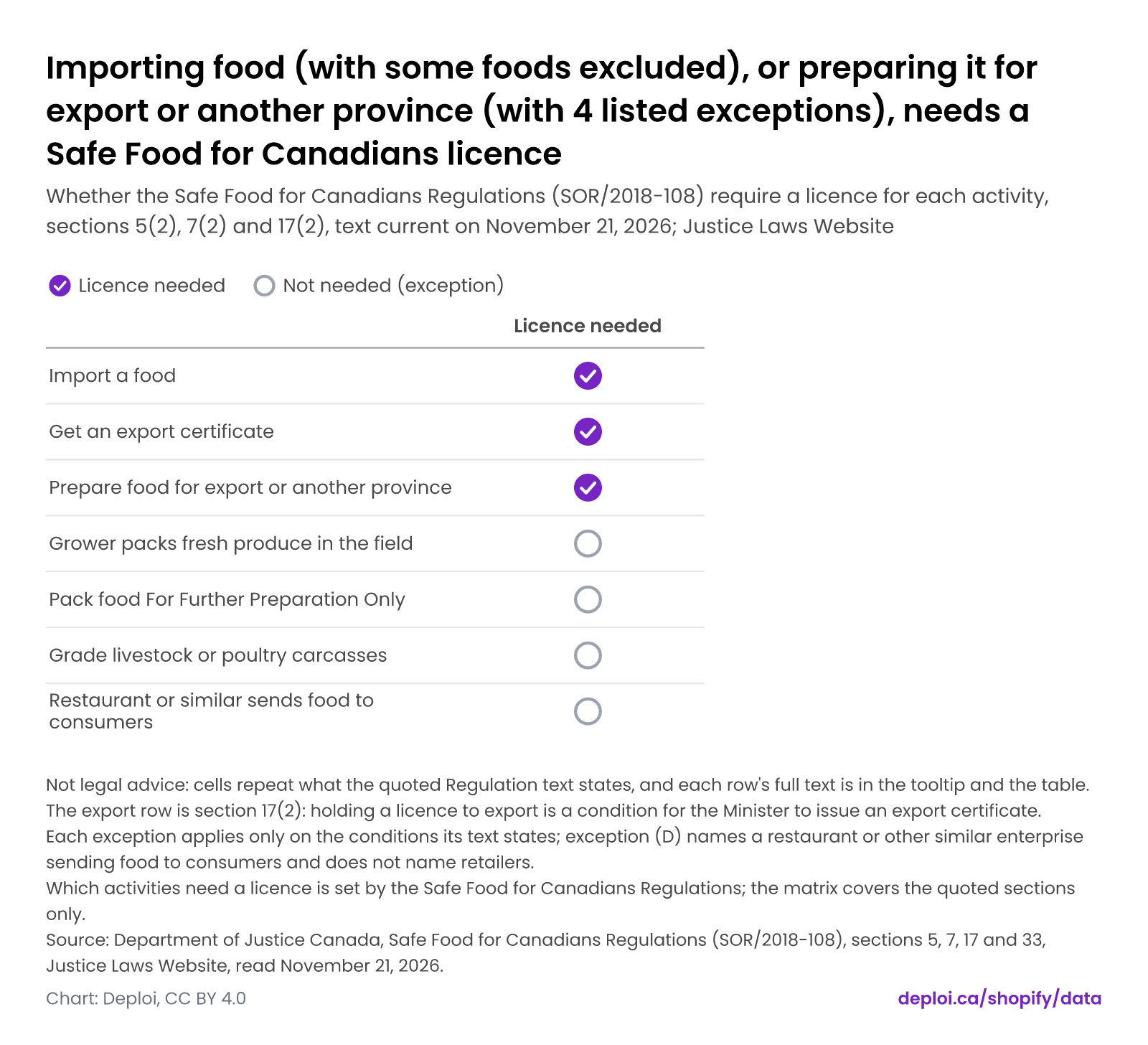
The Safe Food for Canadians Regulations (SOR/2018-108) require a licence to import a food other than those in s 11(2)(a) to (c) (s 5(2)) and to prepare food other than those in s 11(2)(a) or (b) for export or another province (s 7(2)(a)(i)). Under s 17(2), a licence to export is a condition for an export certificate for commercial food. Four activities are excepted.
Importing food (with some foods excluded), or preparing it for export or another province (with 4 listed exceptions), needs a Safe Food for Canadians licence
Whether the Safe Food for Canadians Regulations (SOR/2018-108) require a licence for each activity, sections 5(2), 7(2) and 17(2), text current on November 21, 2026; Justice Laws Website
- Not legal advice: cells repeat what the quoted Regulation text states, and each row's full text is in the tooltip and the table.
- The export row is section 17(2): holding a licence to export is a condition for the Minister to issue an export certificate.
- Each exception applies only on the conditions its text states; exception (D) names a restaurant or other similar enterprise sending food to consumers and does not name retailers.
- Which activities need a licence is set by the Safe Food for Canadians Regulations; the matrix covers the quoted sections only.
Source: Department of Justice Canada, Safe Food for Canadians Regulations (SOR/2018-108), sections 5, 7, 17 and 33, Justice Laws Website, read November 21, 2026. Read on .
The data
Each chart on this page is drawn from the numbers below. Units are in the column headers.
| Activity | Licence needed (yes, no or not stated) | Section | Rule as stated | Licence term (years) | Small-business sales line (C$ gross annual food sales) | Record keeping (years) |
|---|---|---|---|---|---|---|
| Import a food | Licence needed | s 5(2) | (2) For the purposes of subsection 10(2) of the Act, any food — other than a food referred to in any of paragraphs 11(2)(a) to (c) of these Regulations — is a prescribed food commodity that a person is prohibited to import unless the person is authorized to do so by a licence. | Not stated | Not stated | Not stated |
| Get an export certificate | Licence needed | s 17(2) | (2) The Minister may issue a certificate or other document referred to in section 48 of the Act in respect of a food commodity that is intended for commercial use if the applicant holds a licence to export the food commodity and | Not stated | Not stated | Not stated |
| Prepare food for export or another province | Licence needed | s 7(2)(a)(i) | (2) For the purposes of subsection 13(2) of the Act, any food — other than a food referred to in paragraph 11(2)(a) or (b) of these Regulations — and any food animal is a prescribed food commodity that is to be exported or sent or conveyed from one province to another, and any of the following activities is a prescribed activity that a person is prohibited to conduct in respect of that prescribed food commodity unless the person is authorized to conduct that activity by a licence:
(a) in the case of a food,
(i) manufacturing, processing, treating, preserving, grading, packaging and labelling, other than | Not stated | Not stated | Not stated |
| Grower packs fresh produce in the field | Not needed (exception) | s 7(2)(a)(i)(A) | (A) the packaging and labelling of fresh fruits or vegetables in the field by the person who grows or harvests them if they are to be sent or conveyed from one province to another to be subsequently manufactured, processed, treated, preserved or graded by a licence holder, | Not stated | Not stated | Not stated |
| Pack food For Further Preparation Only | Not needed (exception) | s 7(2)(a)(i)(B) | (B) the packaging and labelling of a food referred to in subparagraph 11(2)(c)(i) if, at the time that the food is exported or is sent or conveyed from one province to another, it is not a consumer prepackaged food and it has a label applied or attached to it, or accompanying it, that bears the expression “For Further Preparation Only” or “pour conditionnement ultérieur seulement”, | Not stated | Not stated | Not stated |
| Grade livestock or poultry carcasses | Not needed (exception) | s 7(2)(a)(i)(C) | (C) the grading of a livestock carcass and a poultry carcass, and | Not stated | Not stated | Not stated |
| Restaurant or similar sends food to consumers | Not needed (exception) | s 7(2)(a)(i)(D) | (D) any such activity conducted by a restaurant or other similar enterprise, where the food is to be sent or conveyed by the restaurant or other similar enterprise to consumers, and | Not stated | Not stated | Not stated |
| Licence expiry | Not stated | s 33(1) | 33 (1) A licence expires two years after the date of issuance or renewal that is specified in it, unless the licence is cancelled before that date. | 2 | Not stated | Not stated |
| Written preventive control plan | Not stated | s 86(1) and 86(3) | 86 (1) A licence holder must prepare, keep and maintain a written preventive control plan that meets the requirements of section 89 for any activity identified in their licence that they conduct in respect of a food or food animal.
(2) Despite subsection (1), a preventive control plan is not required to be prepared, kept or maintained for any activity that the licence holder conducts in respect of a food, other than fish or a meat product, that is exported, unless a certificate or other document referred to in section 48 of the Act is sought in respect of the food.
(3) Despite subsection (1), if a licence holder’s gross sales that are derived from food are $100,000 or less for the 12 months before the day on which they most recently made an application for the issuance, renewal or amendment of a licence, a preventive control plan must be prepared, kept and maintained only for any activity that they conduct in respect of
(a) a food animal, meat product, fish, dairy product, egg, processed egg product or processed fruit or vegetable product that is identified in their licence; and
(b) a food in respect of which a certificate or other document referred to in section 48 of the Act is sought. | Not stated | 100,000 | Not stated |
| Traceability: retention period of documents | Not stated | s 90(3) | (3) The documents referred to in subsections (1) and (2) must be kept for two years after the day on which the food was provided to another person or sold at retail, and must be accessible in Canada. | Not stated | Not stated | 2 |
Download Safe Food for Canadians Regulations: which food activities need a licence, the listed exceptions, the licence term, the written preventive control plan and its small-business sales line, and how long traceability records are kept as CSV · All 9 columns on the dataset page
Methodology
Reading the chart: Importing food (with some foods excluded), or preparing it for export or another province (with 4 listed exceptions), needs a Safe Food for Canadians licence
- Not legal advice: cells repeat what the quoted Regulation text states, and each row's full text is in the tooltip and the table.
- The export row is section 17(2): holding a licence to export is a condition for the Minister to issue an export certificate.
- Each exception applies only on the conditions its text states; exception (D) names a restaurant or other similar enterprise sending food to consumers and does not name retailers.
- Which activities need a licence is set by the Safe Food for Canadians Regulations; the matrix covers the quoted sections only.
Caveats: Safe Food for Canadians Regulations: which food activities need a licence, the listed exceptions, the licence term, the written preventive control plan and its small-business sales line, and how long traceability records are kept
- Not legal advice. Cells repeat what the quoted Regulation text states; a business selling only within one province may still be subject to provincial food law, which the dataset does not cover.
- Exceptions carry conditions in the text; the verbatim text is the row note. Exception (D) names a restaurant or other similar enterprise sending food to consumers and does not name retail sellers. The row key exception|restaurant-or-retail-to-consumers is a fixed internal key set at planning; the item label and ruleText follow the Regulation's wording.
- The export row is section 17(2): holding a licence to export is a condition for the Minister to issue an export certificate; paragraphs after the lead-in are not quoted.
- The preventive control plan row quotes section 86(1) to (3) in full, including the exception in 86(2) for exported food other than fish or meat unless an export certificate is sought.
Deploi's charts and compilation are licensed CC BY 4.0. The underlying facts belong to their sources, which are named on every page. How Deploi Shopify Data works.
Sources
Tier A sources are primary documents: filings, official releases and official price pages. How sources are ranked.
- Tier ASafe Food for Canadians Regulations (SOR/2018-108), full text
Department of Justice Canada (Justice Laws Website) · HTML · Read on
Cite and reuse
Deploi's charts and compilation are licensed CC BY 4.0. The underlying facts belong to their sources, which are named on every page.
APA
Deploi. (2026). Importing food (with some foods excluded), or preparing it for export or another province (with 4 listed exceptions), needs a Safe Food for Canadians licence (Version 1) [Chart]. https://deploi.ca/shopify/data/charts/sfcr-licence-by-activity Retrieved November 21, 2026.
BibTeX
@misc{deploi_sfcr_licence_by_activity_2026,
  author = {{Deploi}},
  title = {Importing food (with some foods excluded), or preparing it for export or another province (with 4 listed exceptions), needs a Safe Food for Canadians licence},
  year = {2026},
  version = {1},
  url = {https://deploi.ca/shopify/data/charts/sfcr-licence-by-activity},
  note = {Accessed 2026-11-21}
}
Embed this chart
Embed code
<iframe src="https://deploi.ca/embed/shopify/data/sfcr-licence-by-activity" title="Importing food (with some foods excluded), or preparing it for export or another province (with 4 listed exceptions), needs a Safe Food for Canadians licence" loading="lazy" style="width:100%;height:570px;border:0"></iframe>
<p style="font:12px/1.4 Arial,sans-serif;margin:4px 0 0">Source: <a href="https://deploi.ca/shopify/data/charts/sfcr-licence-by-activity">Deploi, Importing food (with some foods excluded), or preparing it for export or another province (with 4 listed exceptions), needs a Safe Food for Canadians licence</a></p>
Keep the credit line under the embed. It is the license condition.
Downloads
- Chart: Importing food (with some foods excluded), or preparing it for export or another province (with 4 listed exceptions), needs a Safe Food for Canadians licence PNG
- Data: Safe Food for Canadians Regulations: which food activities need a licence, the listed exceptions, the licence term, the written preventive control plan and its small-business sales line, and how long traceability records are kept CSV
Changes
- · Safe Food for Canadians Regulations: which food activities need a licence, the listed exceptions, the licence term, the written preventive control plan and its small-business sales line, and how long traceability records are kept
First release. 10 rows, 8 columns from 1 source (Justice Laws Website, SOR/2018-108); each value agreed by extractor and verifier or ruled by the judge.