
Do British Columbia, Saskatchewan and Manitoba make an online store a packaging producer, and what line exempts a small seller?
British Columbia takes a small packaging producer out of its Part 2 plan rules and Saskatchewan exempts one, under C$1,000,000 in revenue or 1 tonne of packaging a year, and Manitoba's regulation states no such line, per provincial texts read November 21, 2026. Updated November 21, 2026.
By Martin DejnickiUpdated Data through November 21, 2026
Short answer
British Columbia's regulation names online sales; Saskatchewan's names the Canadian-resident brand owner, first importer and retailer in turn, not online sellers as such; Manitoba's deems a person who solicits and accepts orders from Manitoba and causes delivery there the first supplier. Below C$1,000,000 in revenue or 1 tonne a year, British Columbia's Part 2 plan rules do not apply and Saskatchewan exempts the producer; Manitoba states no line, per provincial texts read November 21, 2026.
British Columbia takes small packaging producers out of Part 2 plans; Saskatchewan exempts those under C$1,000,000 or 1 tonne a year; Manitoba states no line
Whether each province's packaging stewardship text states a small-producer revenue line (C$1,000,000 in gross revenue) or weight line (1 tonne of packaging a year) and names online sales, read November 21, 2026; Quebec and New Brunswick not covered
- A check means the quoted text states the line or names online sales; an open ring means it does not. The lines are C$1,000,000 in gross revenue and 1 tonne of packaging a year.
- Manitoba's s 1(5) deems a person who solicits orders from persons in Manitoba, accepts orders that originate there and causes delivery there to be the first supplier; it does not use the words online, internet, distance or remote.
- British Columbia's definition lists other criteria, including registered charities and a single point of retail sale in the province; the table quotes the full text.
- Quebec and New Brunswick are not covered, and Ontario is on its own page; this is not legal advice.
Source: BC Laws, B.C. Reg. 449/2004 (current to November 17, 2026); Manitoba Laws, Man. Reg. 195/2008 (current to November 18, 2026); Government of Saskatchewan, Product Stewardship Program Development Guidelines; read November 21, 2026. Read on .
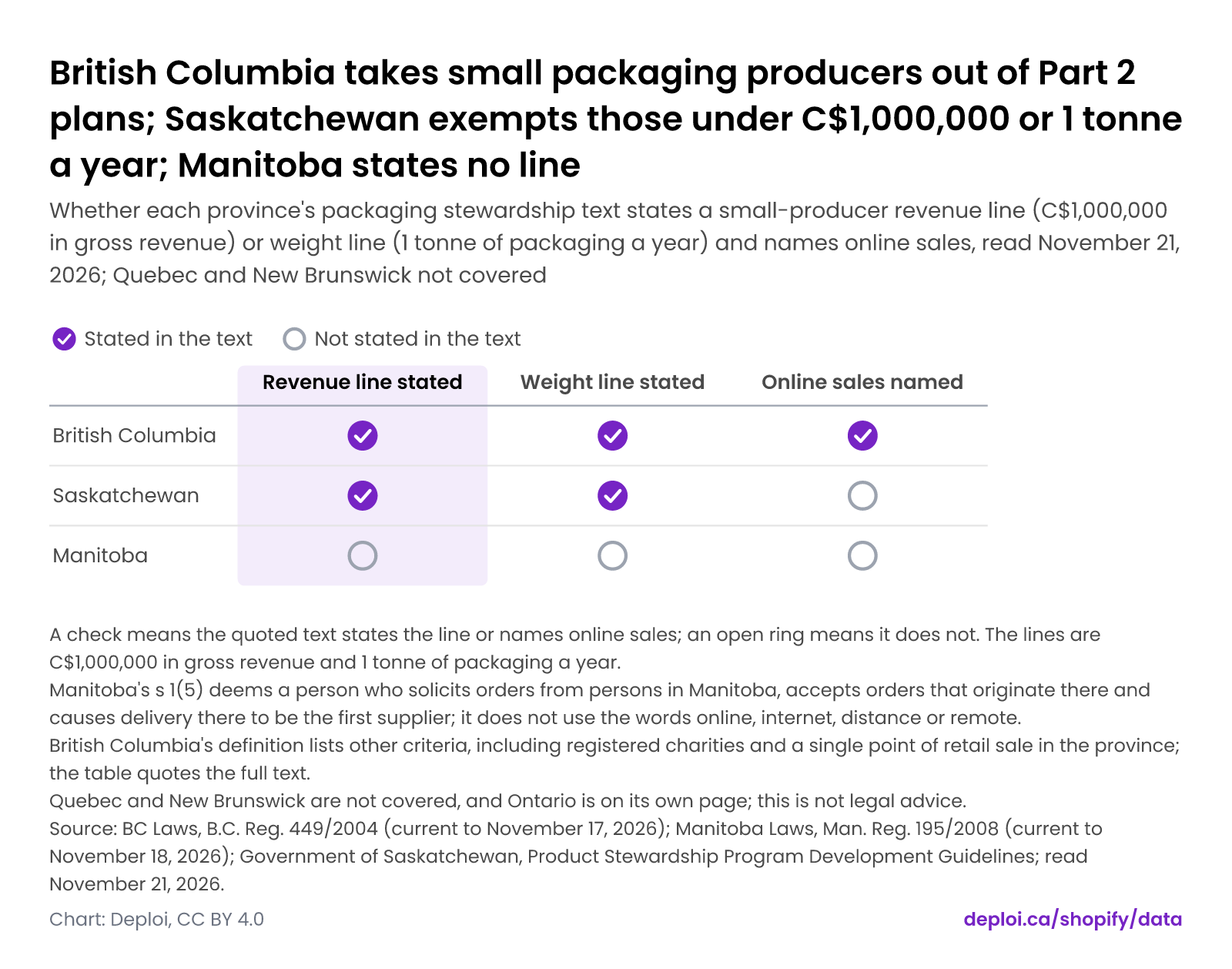
Which provinces state a small-producer revenue or weight line?
British Columbia's Recycling Regulation and Saskatchewan's household packaging and paper regulations each state a revenue line of C$1,000,000 and a weight line of 1 tonne a year, below either of which British Columbia's Part 2 plan rules do not apply and Saskatchewan exempts the producer; Manitoba's Packaging and Printed Paper Stewardship Regulation states neither, per the provincial texts read November 21, 2026.
| Province | Revenue line | Weight line | Online sales named in the text | Citation |
|---|---|---|---|---|
| British Columbia | less than C$1,000,000 gross revenue in BC | less than 1 tonne | yes | B.C. Reg. 449/2004, s 1(1), 1(4), 3(2) |
| Saskatchewan | less than C$1 million gross annual revenue | less than 1 tonne a year | no | Regulations, 2023, s 3, 6(4) and 6(5), as reproduced in the Ministry guidelines |
| Manitoba | not stated | not stated | no | Man. Reg. 195/2008, s 1(5) |
Online sales named means the quoted text uses a word such as online. A no does not mean the province excludes online sellers.
Does British Columbia treat an online store as a producer?
British Columbia's Recycling Regulation says a person sells or offers a product for sale if it does so by any means, including online, by phone or by mail, and its producer definition, subject to paragraphs (c) and (d), names the brand manufacturer, else the trademark owner or licensee, else the importer into the province, per B.C. Reg. 449/2004, current to November 17, 2026.
A small producer is exempt from Part 2 for packaging and paper (section 3(2)). Section 1(1) counts a producer as small if it is a registered charity or has no more than one point of retail sale in the province. It also counts one that meets one or both of two tests:
- gross revenue in the most recent calendar year of less than C$1,000,000 in British Columbia;
- less than 1 tonne of packaging and paper products in that year used in a commercial enterprise, sold, offered for sale or distributed in the province.
The retail-point test does not apply to a producer of newspaper. Paragraph (b) of the producer definition is "subject to paragraphs (c) and (d)", and the revenue, weight and retail-point tests are each "subject to subsection (2)". This page quotes none of those provisions.
How does Saskatchewan define the producer and the exemption?
In Saskatchewan the producer of household packaging and paper supplied to an end user is the Canadian-resident brand owner, else the first importer, else the retailer that supplied it, and a business is exempt if it generates less than C$1 million in gross annual revenue or supplies less than 1 tonne a year, per the Ministry guidelines read November 21, 2026.
The guidelines reproduce the Household Packaging and Paper Stewardship Program Regulations, 2023, sections 3 and 6. The page quotes the guidelines, not the regulation itself.
Section 6(5) puts the onus of proof on the producer: if it claims the exemption, it must show it is entitled to it. Section 3(1) is "subject to subsections (2) and (3)", which this page does not quote. The quoted text does not name online sales.
What does Manitoba's regulation say about sellers that ship into the province?
Manitoba's Man. Reg. 195/2008, current to November 18, 2026, deems a person who solicits orders for the designated material from persons in Manitoba, accepts orders that originate there and causes the designated material to be delivered in Manitoba to be the first supplier in the province, and it states no revenue or weight line.
That is section 1(5), read with the definition of steward of designated material in section 1(1). All three conditions are joined by "and".
The text does not use the words online, internet, distance or remote, so the dataset's online sales flag reads no for Manitoba. That flag follows the words in the quoted text. It is not a statement that Manitoba exempts or excludes online sellers, and this page makes no such claim.
What does this page leave out?
The page covers British Columbia, Saskatchewan and Manitoba only, from B.C. Reg. 449/2004, the Saskatchewan Ministry guidelines and Man. Reg. 195/2008 read November 21, 2026; Quebec and New Brunswick are not covered because their current packaging regulations were not read, and Ontario is on its own page.
Fees are set by each stewardship organization and are not in the dataset. No summary or draft plan from a stewardship organization is used for a revenue or weight figure.
This is not legal or tax advice. Deploi is not affiliated with Shopify or any provincial government.
The data
Each chart on this page is drawn from the numbers below. Units are in the column headers.
| Province | Revenue line stated (yes or no) | Weight line stated (yes or no) | Online sales named (yes or no) | Source | Revenue line (C$ per year) | Weight line (tonnes per year) | Exemption as stated | Producer or supplier as stated |
|---|---|---|---|---|---|---|---|---|
| British Columbia | Stated in the text | Stated in the text | Stated in the text | B.C. Reg. 449/2004 (Environmental Management Act, Recycling Regulation), s 1(1) "small producer", s 1(4) and s 3(2) | 1,000,000 | 1 | "small producer", in respect of the producer of a product within the packaging and paper product category, means one of the following: (a) the producer is a charitable organization registered under the Income Tax Act (Canada); (b) the producer meets one or both of the following criteria: (i) subject to subsection (2), the producer had a gross revenue in the most recent calendar year of less than $1 000 000 in British Columbia; (ii) subject to subsection (2), the producer produced in the most recent calendar year less than one tonne of products within the packaging and paper product category that have been or will be used in a commercial enterprise, sold, offered for sale or distributed in British Columbia; (c) subject to subsection (2), the producer, other than a producer of newspaper, does not have more than one point of retail sale in British Columbia; … (2) This Part does not apply to a small producer in respect of a product in the packaging and paper product category. | (b) subject to paragraphs (c) and (d), in respect of the producer of a product within a product category other than the beverage container product category or the tire product category, (i) a person who manufactures the product and uses in a commercial enterprise, sells, offers for sale or distributes the product in British Columbia under the manufacturer's own brand, (ii) if subparagraph (i) does not apply, a person who is not the manufacturer of the product but is the owner or licensee of a trademark under which a product is used in a commercial enterprise, sold, offered for sale or distributed in British Columbia, whether or not the trademark is registered, or (iii) if subparagraphs (i) and (ii) do not apply, a person who imports the product into British Columbia in order to use in a commercial enterprise, sell, offer for sale or distribute the product in British Columbia, (4) For the purposes of the definition of "producer", a person sells a product or offers a product for sale if the person sells the product or offers the product for sale by any means, including the following: (a) online; (b) by phone; (c) by mail. |
| Saskatchewan | Stated in the text | Stated in the text | Not stated in the text | Household Packaging and Paper Stewardship Program Regulations, 2023, s 3 and s 6(4)-(5), as reproduced in the Product Stewardship Program Development Guidelines | 1,000,000 | 1 | (4) A producer is exempt from complying with subsection (1) if the producer is a business that: (a) generates less than $1 million in gross annual revenue; or (b) annually supplies or distributes less than one tonne of household packaging and paper products; (5) If a producer claims an exemption pursuant to subsection (4), the onus of proof that the producer is entitled to the exemption is on the producer. | 3(1) Subject to subsections (2) and (3), the person that is the producer of household packaging and paper products that are supplied in Saskatchewan to an end user is: (a) if the person is a resident of Canada, the brand owner with respect to the household packaging and paper products; (b) if there is no person as described in clause (a), the person that first imports the household packaging and paper products into Saskatchewan; or (c) if there is no person as described in clause (a) or (b), the retailer who supplied the household packaging and paper products to the end user for use in Saskatchewan. |
| Manitoba | Not stated in the text | Not stated in the text | Not stated in the text | Packaging and Printed Paper Stewardship Regulation, M.R. 195/2008 (The Waste Reduction and Prevention Act, C.C.S.M. c. W40), s 1(5) with s 1(1) "steward of designated material" | Not stated | Not stated | 1(5) For the purpose of clause (a) of the definition "steward of designated material" in subsection (1), a person who (a) solicits orders, directly or through an agent, for the designated material from persons in Manitoba by advertising or other means; (b) accepts orders for the designated material that originate in Manitoba; and (c) causes the designated material to be delivered in Manitoba; is deemed to be the first person who supplies designated material to another person in the course of business in Manitoba. |
Download Packaging and paper stewardship outside Ontario: who is the producer for goods sold into the province and the revenue or weight line that exempts a small producer, British Columbia, Saskatchewan and Manitoba as CSV · All 13 columns on the dataset page
Methodology
Reading the chart: British Columbia takes small packaging producers out of Part 2 plans; Saskatchewan exempts those under C$1,000,000 or 1 tonne a year; Manitoba states no line
- A check means the quoted text states the line or names online sales; an open ring means it does not. The lines are C$1,000,000 in gross revenue and 1 tonne of packaging a year.
- Manitoba's s 1(5) deems a person who solicits orders from persons in Manitoba, accepts orders that originate there and causes delivery there to be the first supplier; it does not use the words online, internet, distance or remote.
- British Columbia's definition lists other criteria, including registered charities and a single point of retail sale in the province; the table quotes the full text.
- Quebec and New Brunswick are not covered, and Ontario is on its own page; this is not legal advice.
Caveats: Packaging and paper stewardship outside Ontario: who is the producer for goods sold into the province and the revenue or weight line that exempts a small producer, British Columbia, Saskatchewan and Manitoba
- Quebec and New Brunswick are not covered: their current packaging regulations were not read at capture.
- Ontario is on its own page of this section and is not repeated.
- British Columbia's Recycling Regulation takes small producers out of Part 2 (plans) for packaging and paper (s 3(2)); the quoted text does not say whether a small producer is also outside Part 3.
- Manitoba's regulation states no revenue or weight line, so those cells read not stated. The online sales flag follows a keyword rule on the quoted text (online, internet, distance or remote); a no for Manitoba does not mean the regulation excludes online sellers.
- The Saskatchewan text is the Ministry's guidelines that reproduce the regulation, not the regulation itself.
- Fees are set by each stewardship organization and are not in this dataset.
- Rules are quoted from the official text with the publisher named. This is not legal or tax advice.
Deploi's charts and compilation are licensed CC BY 4.0. The underlying facts belong to their sources, which are named on every page. How Deploi Shopify Data works.
Sources
Tier A sources are primary documents: filings, official releases and official price pages. How sources are ranked.
- Tier ARecycling Regulation, B.C. Reg. 449/2004 (consolidation current to November 17, 2026; s 1(1) small producer, s 1(4) online sales, s 3(2))
King's Printer, British Columbia (BC Laws) · HTML · Read on
- Tier APackaging and Printed Paper Stewardship Regulation, Man. Reg. 195/2008 (current to 18 Nov 2026, last amendment M.R. 203/2014; s 1(1) steward, s 1(5))
Province of Manitoba (Manitoba Laws) · PDF · Read on
- Tier AProduct Stewardship Program Development Guidelines: The Household Packaging and Paper Stewardship Program Regulations, 2023 (ss 2, 3, 6(4) quoted beside guidance)
Government of Saskatchewan (Ministry of Environment) · PDF · Read on
Cite and reuse
Deploi's charts and compilation are licensed CC BY 4.0. The underlying facts belong to their sources, which are named on every page.
APA
Deploi. (2026). Do British Columbia, Saskatchewan and Manitoba make an online store a packaging producer, and what line exempts a small seller? [Web page]. https://deploi.ca/shopify/data/packaging-stewardship-small-seller-exemptions-by-province Retrieved November 21, 2026.
BibTeX
@misc{deploi_packaging_stewardship_small_seller_exemptions_by_province_2026,
  author = {{Deploi}},
  title = {Do British Columbia, Saskatchewan and Manitoba make an online store a packaging producer, and what line exempts a small seller?},
  year = {2026},
  url = {https://deploi.ca/shopify/data/packaging-stewardship-small-seller-exemptions-by-province},
  note = {Accessed 2026-11-21}
}
Embed this chart
Embed code
<iframe src="https://deploi.ca/embed/shopify/data/packaging-stewardship-lines-by-province" title="British Columbia takes small packaging producers out of Part 2 plans; Saskatchewan exempts those under C$1,000,000 or 1 tonne a year; Manitoba states no line" loading="lazy" style="width:100%;height:450px;border:0"></iframe>
<p style="font:12px/1.4 Arial,sans-serif;margin:4px 0 0">Source: <a href="https://deploi.ca/shopify/data/charts/packaging-stewardship-lines-by-province">Deploi, British Columbia takes small packaging producers out of Part 2 plans; Saskatchewan exempts those under C$1,000,000 or 1 tonne a year; Manitoba states no line</a></p>
Keep the credit line under the embed. It is the license condition.
Downloads
- Chart: British Columbia takes small packaging producers out of Part 2 plans; Saskatchewan exempts those under C$1,000,000 or 1 tonne a year; Manitoba states no line PNG
- Data: Packaging and paper stewardship outside Ontario: who is the producer for goods sold into the province and the revenue or weight line that exempts a small producer, British Columbia, Saskatchewan and Manitoba CSV
Questions
Is an online store a packaging producer in British Columbia?
It can be. B.C. Reg. 449/2004 says a person sells a product by any means, including online, and, subject to paragraphs (c) and (d), names as producer the brand manufacturer, else the trademark owner or licensee, else the importer into the province, per the regulation current to November 17, 2026.
What revenue exempts a small packaging producer in Saskatchewan?
Less than C$1 million in gross annual revenue, or supplying less than 1 tonne of household packaging and paper a year, per section 6(4) as reproduced in the Saskatchewan Ministry guidelines read November 21, 2026. The onus of proof is on the producer.
Does Manitoba exempt small packaging producers?
Man. Reg. 195/2008, current to November 18, 2026, states no revenue or weight line, so this page records none. Its section 1(5) deems a person who solicits and accepts orders from Manitoba and causes delivery there to be the first supplier.
Do the British Columbia and Saskatchewan lines use the same numbers?
Yes in amount: C$1,000,000 in gross revenue and 1 tonne of packaging and paper a year, per B.C. Reg. 449/2004 and the Saskatchewan Ministry guidelines, read November 21, 2026. British Columbia measures revenue in the province in the most recent calendar year; Saskatchewan states gross annual revenue.
Does this page cover Quebec and New Brunswick?
No. Their current packaging regulations were not read on November 21, 2026, so the page gives no line for them. Ontario's Blue Box rules are on a separate page of this section.
More on Canada
- Can a Canadian online store let a gift card expire or charge fees on it, and how do the rules differ by province?
The official pages of the nine provinces covered state that gift cards may not carry an expiry date, with listed exceptions, and cap mall card dormancy fees at C$2.50 a month where they state an amount, read November 21, 2026. Updated November 21, 2026.
- Does a Canadian store charge GST or HST on an order shipped outside Canada, and what changes for a pickup in Canada?
Goods a supplier ships to a destination outside Canada, or mails or couriers to an address outside Canada, are zero-rated under Schedule VI, Part V, section 12 of the Excise Tax Act, consolidated to October 29, 2026, and goods delivered or made available in Canada are supplied in Canada under section 142(1)(a). Updated November 21, 2026.
- Does an online store shipping to Ontario owe Blue Box packaging duties, and below what Ontario revenue is it exempt?
Ontario exempts a producer whose revenue in a calendar year in Ontario from products and services is less than C$2,000,000 from Parts IV, VI, VII (other than section 66) and VIII for the next 2 calendar years under section 73 of O. Reg. 391/21, read November 21, 2026. Updated November 21, 2026.
- How do Canadians pay: what share of purchases is cash, debit, credit and tap?
Credit cards paid for 46% of Canadian purchases by number in 2024, debit cards 23% and cash 21%, per the Bank of Canada's 2024 Methods-of-Payment Survey. Updated November 21, 2026.
- How fast must a store report a product safety incident in Canada, the US and the EU, and what fines follow in Canada?
Canada sets a 2-day incident report, the US 24 hours after a firm has reportable information and the EU no fixed period, with Canadian fines up to C$5,000,000 under s. 41(1) and a court-set fine on indictment under s. 41(3), per the Canada Consumer Product Safety Act, 16 CFR 1115.14 and Regulation (EU) 2023/988, read November 21, 2026. Updated November 21, 2026.
- How many business days do Canada Post's parcel services take from drop-off to door, by distance and area type?
Between major urban centres across Canada the standard is next day for Priority, 2 days for Xpresspost, 2 to 8 for Expedited Parcel and 4 to 10 for Regular Parcel, per Canada Post's guide last updated September 7, 2026. Updated November 21, 2026.
Changes
- · Packaging and paper stewardship outside Ontario: who is the producer for goods sold into the province and the revenue or weight line that exempts a small producer, British Columbia, Saskatchewan and Manitoba
First release. 3 rows, 9 fields read from 3 sources; each value agreed by extractor and verifier or ruled by the judge.