
Which products are exempt from PST in British Columbia, Saskatchewan and Manitoba, and what limits apply to children's and used clothing?
British Columbia and Manitoba exempt children's clothing and footwear from provincial sales tax, Manitoba at C$150 or less an item, and no exemption is stated in the captured Saskatchewan bulletins, read November 21, 2026. Updated November 21, 2026.
By Martin DejnickiUpdated Data through November 21, 2026
Short answer
British Columbia and Manitoba exempt children's clothing and footwear from provincial sales tax, Manitoba at C$150 or less an item, per the provinces' tax bulletins read November 21, 2026. Used clothing is exempt in British Columbia under C$100 an item and in Manitoba at C$100 or less. The captured Saskatchewan bulletins state neither exemption. Printed books, basic groceries and feminine hygiene products are stated exempt in all three, some within conditions.
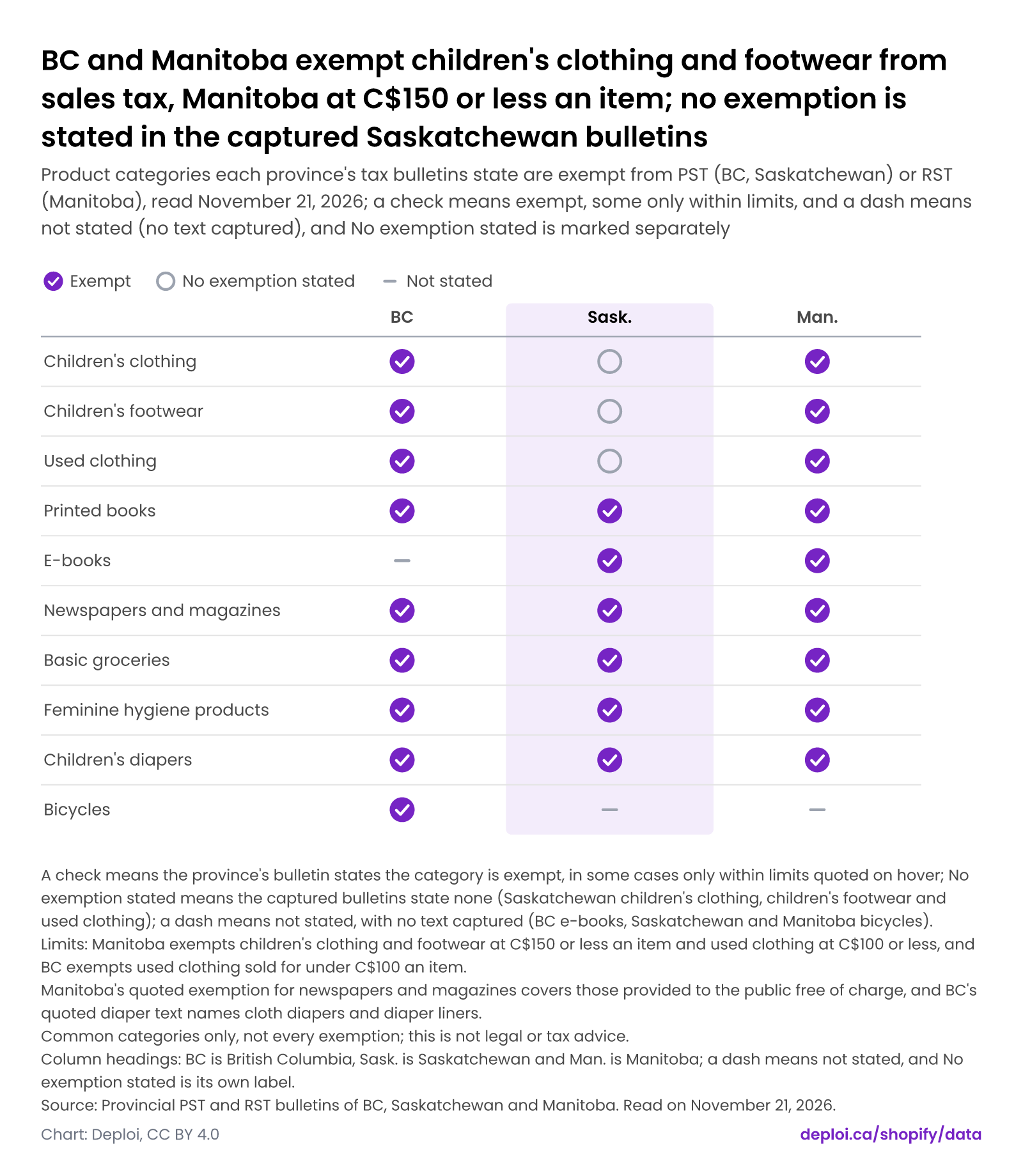
BC and Manitoba exempt children's clothing and footwear from sales tax, Manitoba at C$150 or less an item; no exemption is stated in the captured Saskatchewan bulletins
Product categories each province's tax bulletins state are exempt from PST (BC, Saskatchewan) or RST (Manitoba), read November 21, 2026; a check means exempt, some only within limits, and a dash means not stated (no text captured), and No exemption stated is marked separately
- A check means the province's bulletin states the category is exempt, in some cases only within limits quoted on hover; No exemption stated means the captured bulletins state none (Saskatchewan children's clothing, children's footwear and used clothing); a dash means not stated, with no text captured (BC e-books, Saskatchewan and Manitoba bicycles).
- Limits: Manitoba exempts children's clothing and footwear at C$150 or less an item and used clothing at C$100 or less, and BC exempts used clothing sold for under C$100 an item.
- Manitoba's quoted exemption for newspapers and magazines covers those provided to the public free of charge, and BC's quoted diaper text names cloth diapers and diaper liners.
- Common categories only, not every exemption; this is not legal or tax advice.
- Column headings: BC is British Columbia, Sask. is Saskatchewan and Man. is Manitoba; a dash means not stated, and No exemption stated is its own label.
Source: Provincial PST and RST bulletins of BC, Saskatchewan and Manitoba. Read on .
Which products are exempt from PST in British Columbia, Saskatchewan and Manitoba?
Of the 10 product categories compared, printed books, basic groceries, feminine hygiene products and children's diapers are stated exempt in all three provinces, in some cases within conditions, while children's clothing, children's footwear and used clothing are exempt in British Columbia and Manitoba but carry no stated exemption in Saskatchewan, per the provincial tax bulletins read November 21, 2026.
| Category | British Columbia | Saskatchewan | Manitoba |
|---|---|---|---|
| Children's clothing | exempt | no exemption stated | exempt, C$150 or less an item |
| Children's footwear | exempt | no exemption stated | exempt, C$150 or less an item |
| Printed books | exempt | exempt | exempt |
| E-books | not stated | exempt, qualifying | exempt, qualifying |
| Newspapers and magazines | exempt, qualifying | exempt | exempt, free of charge |
| Basic groceries | exempt | exempt | exempt |
| Feminine hygiene products | exempt | exempt | exempt |
| Children's diapers | exempt, cloth | exempt, cloth or disposable | exempt |
| Bicycles | exempt, non-motorized | not stated | not stated |
| Used clothing | exempt, under C$100 an item | no exemption stated | exempt, C$100 or less |
Not stated means the captured bulletins say nothing about the category for that province. No exemption stated means the captured bulletins have text on the category but state no exemption for it; it does not say the category is taxable. A check in the chart means the bulletin states the category is exempt, and some checks carry limits that show on hover.
What limits apply to children's clothing and footwear?
Manitoba exempts children's clothing and footwear priced at C$150 or less an item within specified children's size ranges, British Columbia exempts children's-sized items and adult-sized items bought for children under 15, and no exemption is stated in the captured Saskatchewan bulletins, per the provincial tax bulletins read November 21, 2026.
- British Columbia: clothing and footwear listed as children's-sized, and adult-sized clothing and footwear "purchased or rented (leased) for children under 15 years of age". Footwear is "designed for girls or boys, with an insole length of 24.25 cm or less".
- Manitoba: children's clothing and footwear priced at C$150 or less, within specified children's size ranges, or larger sizes where the purchaser confirms in writing that the item is for a child 14 years of age or under.
- Saskatchewan: no exemption for children's clothing or footwear is stated in the captured bulletins.
The Manitoba limit is a price per item, so a single item above C$150 is outside the exemption.
What limits apply to used clothing?
British Columbia exempts used clothing or footwear sold for under C$100 an item, Manitoba exempts used clothing or footwear valued at C$100 or less, and no exemption is stated in the captured Saskatchewan bulletins, per the provincial tax bulletins read November 21, 2026. The two limits differ by one boundary case.
An item priced at exactly C$100 is exempt in Manitoba, whose text says "$100 or less", and is not within British Columbia's "under $100 per item".
Saskatchewan's used-goods text applies tax to the selling price less a deduction of C$300 per item. The deduction applies where an individual buys used goods, other than vehicles, for personal use and PST was previously paid. That is a deduction, not an exemption.
Are diapers exempt from PST in all three provinces?
British Columbia exempts cloth diapers and diaper liners and taxes disposable diapers, Saskatchewan exempts baby diapers, cloth or disposable, and Manitoba exempts baby supplies such as diapers, per the provincial tax bulletins read November 21, 2026. The matrix shows a check for all three provinces, with the British Columbia limit to cloth.
British Columbia's children's clothing bulletin lists "Disposable diapers" under Taxable Items, and its grocery and drug stores bulletin lists "Disposable diapers for infants and toddlers" among Examples of Taxable Items.
The BC exemption text reads "cloth diapers and diaper liners". Saskatchewan's text covers baby diapers, cloth or disposable.
Which exemptions are stated by only one or two provinces?
Non-motorized bicycles are stated exempt only by British Columbia, and e-books only by Saskatchewan and Manitoba, on conditions that include no advertising and publication solely for educational, technical, cultural or literary purposes, per the provincial tax bulletins read November 21, 2026. The dataset records not stated, with no text captured, for e-books in British Columbia and for bicycles in the other two provinces.
Saskatchewan's text covers books "including digital or similar electronic equivalents that contain no advertising and are published solely for educational, technical, cultural, or literary purposes". Manitoba's covers books "on audio or electronic media that are produced for use by the general public, published solely for educational, technical, cultural or literary purposes and that contain no advertising". British Columbia's captured text for bicycles reads "Non-motorized bicycles".
Newspapers and magazines are exempt in all three provinces, within conditions in British Columbia and Manitoba. Manitoba exempts those "provided to the public free of charge". British Columbia exempts "qualifying" ones. Saskatchewan's text covers newspapers, magazines and periodicals "including digital or similar electronic equivalents in viewable format".
What does the table leave out?
The table covers 10 common product categories in three provinces, not every exemption, and conditions such as size ranges and price limits decide whether a single item is exempt, per British Columbia's, Saskatchewan's and Manitoba's tax bulletins read November 21, 2026. Provincial sales tax rates and the tax on delivery charges are on other pages.
In the chart, a cell without a check means the captured bulletins state no exemption for that category or have no text on it. The province texts in the chart's table say which. Neither means the province taxes the category, and the page does not say so.
This is not legal or tax advice. Deploi is not affiliated with Shopify or any provincial government.
The data
Each chart on this page is drawn from the numbers below. Units are in the column headers.
| Product category | BC | Sask. | Man. | Province texts | Manitoba price limit (C$ per item) | BC price limit (C$ per item) |
|---|---|---|---|---|---|---|
| Children's clothing | Exempt | No exemption stated | Exempt | BC (exempt): The following clothing and footwear are exempt from PST: The children’s-sized clothing and footwear listed below Adult-sized clothing and footwear when purchased or rented (leased) for children under 15 years of age Saskatchewan (no exemption stated): Children’s clothing and footwear Manitoba (exempt): Children’s clothing and footwear priced at $150 or less, that are within specified children’s size ranges or that are larger than the stated sizes but certified by the purchaser in writing to be for a child 14 years of age or under; | 150 | Not stated |
| Children's footwear | Exempt | No exemption stated | Exempt | BC (exempt): Footwear designed for girls or boys, with an insole length of 24.25 cm or less Saskatchewan (no exemption stated): Children’s clothing and footwear Manitoba (exempt): Children’s clothing and footwear priced at $150 or less, that are within specified children’s size ranges or that are larger than the stated sizes but certified by the purchaser in writing to be for a child 14 years of age or under; | 150 | Not stated |
| Used clothing | Exempt | No exemption stated | Exempt | BC (exempt): Used clothing or used footwear you sell for under $100 per item is exempt from PST, regardless of whether the item is purchased for a child or an adult. Saskatchewan (no exemption stated): When used goods are purchased by an individual for personal use (other than vehicles) and PST was previously paid on the goods, tax applies to the selling price less a deduction of $300 per item as discussed below. Manitoba (exempt): Used clothing or used footwear valued at $100 or less; | 100 | 100 |
| Printed books | Exempt | Exempt | Exempt | BC (exempt): Books that are printed and bound, including colouring books, comic books, cookbooks, dictionaries, garden books, maps sold in book form and pocket books (e.g. crosswords, horoscopes) Saskatchewan (exempt): Books – Paperback, hard cover Manitoba (exempt): Books printed, bound and with a distinct cover, with permanent bindings or punched loose leaf pages, or books on audio or electronic media that are produced for use by the general public, published solely for educational, technical, cultural or literary purposes and that contain no advertising. | Not stated | Not stated |
| E-books | Not stated | Exempt | Exempt | BC (not stated): no text captured Saskatchewan (exempt): Books including digital or similar electronic equivalents that contain no advertising and are published solely for educational, technical, cultural, or literary purposes. Manitoba (exempt): Books printed, bound and with a distinct cover, with permanent bindings or punched loose leaf pages, or books on audio or electronic media that are produced for use by the general public, published solely for educational, technical, cultural or literary purposes and that contain no advertising. | Not stated | Not stated |
| Newspapers and magazines | Exempt | Exempt | Exempt | BC (exempt): Qualifying magazines, newspapers and periodicals Saskatchewan (exempt): Magazines and periodicals including digital or similar electronic equivalents in viewable format, and effective April 1, 2022, includes audio recordings of magazines and periodicals. [...] Newspapers including digital or similar electronic equivalents in viewable format, and effective April 1, 2022, includes audio recordings of newspapers. Manitoba (exempt): Newspapers and magazines that are provided to the public free of charge. | Not stated | Not stated |
| Basic groceries | Exempt | Exempt | Exempt | BC (exempt): Food for human consumption (e.g. basic groceries and prepared food such as restaurant meals) Saskatchewan (exempt): General categories of tax-exempt items include basic groceries, prescription drugs and medicines (that can only be obtained by prescription from a duly qualified medical practitioner), books and magazines, feminine hygiene products, and certain medical equipment and orthopedic appliances. Manitoba (exempt): Food and beverages that are exempted as “basic groceries” under the GST. | Not stated | Not stated |
| Feminine hygiene products | Exempt | Exempt | Exempt | BC (exempt): Sanitary napkins or pads, tampons, sanitary belts, underwear, menstrual cups, or other similar products – when advertised or marketed substantially for menstrual or postpartum purposes Saskatchewan (exempt): Feminine hygiene products – tampons, menstrual cups, sanitary pads and belts Manitoba (exempt): Sanitary napkins, tampons, belts and pads, menstrual cups; | Not stated | Not stated |
| Children's diapers | Exempt | Exempt | Exempt | BC (exempt): cloth diapers and diaper liners Saskatchewan (exempt): Baby diapers – cloth/disposable Manitoba (exempt): Baby supplies, such as diapers, strollers, cribs, gates, and monitors, as well as items used for nursing, feeding or bathing. | Not stated | Not stated |
| Bicycles | Exempt | Not stated | Not stated | BC (exempt): Bicycles and tricycles that qualify for an exemption from PST are: Non-motorized bicycles Saskatchewan (not stated): no text captured Manitoba (not stated): no text captured | Not stated | Not stated |
Download Common product categories exempt from provincial sales tax in British Columbia, Saskatchewan and Manitoba, with price and size conditions, read November 2026 as CSV · All 15 columns on the dataset page
Methodology
Reading the chart: BC and Manitoba exempt children's clothing and footwear from sales tax, Manitoba at C$150 or less an item; no exemption is stated in the captured Saskatchewan bulletins
- A check means the province's bulletin states the category is exempt, in some cases only within limits quoted on hover; No exemption stated means the captured bulletins state none (Saskatchewan children's clothing, children's footwear and used clothing); a dash means not stated, with no text captured (BC e-books, Saskatchewan and Manitoba bicycles).
- Limits: Manitoba exempts children's clothing and footwear at C$150 or less an item and used clothing at C$100 or less, and BC exempts used clothing sold for under C$100 an item.
- Manitoba's quoted exemption for newspapers and magazines covers those provided to the public free of charge, and BC's quoted diaper text names cloth diapers and diaper liners.
- Common categories only, not every exemption; this is not legal or tax advice.
- Column headings: BC is British Columbia, Sask. is Saskatchewan and Man. is Manitoba; a dash means not stated, and No exemption stated is its own label.
Caveats: Common product categories exempt from provincial sales tax in British Columbia, Saskatchewan and Manitoba, with price and size conditions, read November 2026
- The table covers common categories, not every exemption; each province's bulletins list more.
- A yes means the province's bulletin states the category is exempt, in some cases only under conditions that the condition columns quote. A no means no exemption is stated in the captured bulletins; it does not state that the category is taxable. An empty cell means not stated, with no text captured.
- Conditions such as size ranges and price limits decide whether a single item is exempt. Manitoba's price limit is C$150 or less an item for children's clothing and footwear and C$100 or less for used clothing; British Columbia's used clothing limit is under C$100 an item.
- British Columbia exempts cloth diapers and diaper liners; its bulletins list disposable diapers as taxable. Saskatchewan's text covers cloth and disposable baby diapers.
- Rule text cells are quoted verbatim from the provincial bulletins; this is not legal or tax advice.
Deploi's charts and compilation are licensed CC BY 4.0. The underlying facts belong to their sources, which are named on every page. How Deploi Shopify Data works.
Sources
Tier A sources are primary documents: filings, official releases and official price pages. How sources are ranked.
- Tier ABulletin PST 201 Children's clothing and footwear
Province of British Columbia · PDF · Read on
- Tier ABulletin PST 204 Bicycles and tricycles
Province of British Columbia · PDF · Read on
- Tier ABulletin PST 206 Grocery and drug stores
Province of British Columbia · PDF · Read on
- Tier APST exemptions (BC Provincial Sales Tax)
Province of British Columbia · HTML · Read on
- Tier AManitoba Information Bulletin RST 030, Summary of Taxable and Exempt Goods and Services (issued April 1998, revised July 2026)
Government of Manitoba, Manitoba Finance (Taxation Division) · PDF · Read on
- Tier ABulletin PST.002 Grocery, Convenience and Drug Stores (with Appendix: Taxable and Exempt Food and Beverages)
Government of Saskatchewan · PDF · Read on
- Tier ABulletin PST.009 Books, Magazines, Periodicals, Newspapers and Other Reading Materials
Government of Saskatchewan · PDF · Read on
- Tier ABulletin PST.058 Used Goods
Government of Saskatchewan · PDF · Read on
Cite and reuse
Deploi's charts and compilation are licensed CC BY 4.0. The underlying facts belong to their sources, which are named on every page.
APA
Deploi. (2026). Which products are exempt from PST in British Columbia, Saskatchewan and Manitoba, and what limits apply to children's and used clothing? [Web page]. https://deploi.ca/shopify/data/pst-exempt-products-bc-saskatchewan-manitoba Retrieved November 21, 2026.
BibTeX
@misc{deploi_pst_exempt_products_bc_saskatchewan_manitoba_2026,
  author = {{Deploi}},
  title = {Which products are exempt from PST in British Columbia, Saskatchewan and Manitoba, and what limits apply to children's and used clothing?},
  year = {2026},
  url = {https://deploi.ca/shopify/data/pst-exempt-products-bc-saskatchewan-manitoba},
  note = {Accessed 2026-11-21}
}
Embed this chart
Embed code
<iframe src="https://deploi.ca/embed/shopify/data/pst-exemptions-matrix" title="BC and Manitoba exempt children's clothing and footwear from sales tax, Manitoba at C$150 or less an item; no exemption is stated in the captured Saskatchewan bulletins" loading="lazy" style="width:100%;height:670px;border:0"></iframe> <p style="font:12px/1.4 Arial,sans-serif;margin:4px 0 0">Source: <a href="https://deploi.ca/shopify/data/charts/pst-exemptions-matrix">Deploi, BC and Manitoba exempt children's clothing and footwear from sales tax, Manitoba at C$150 or less an item; no exemption is stated in the captured Saskatchewan bulletins</a></p>
Keep the credit line under the embed. It is the license condition.
Downloads
- Chart: BC and Manitoba exempt children's clothing and footwear from sales tax, Manitoba at C$150 or less an item; no exemption is stated in the captured Saskatchewan bulletins PNG
- Data: Common product categories exempt from provincial sales tax in British Columbia, Saskatchewan and Manitoba, with price and size conditions, read November 2026 CSV
Questions
Is children's clothing exempt from PST in British Columbia, Saskatchewan and Manitoba?
Children's clothing and footwear are exempt in British Columbia and in Manitoba at C$150 or less an item. No exemption is stated in the captured Saskatchewan bulletins, per the provincial tax bulletins read November 21, 2026.
Are used clothes exempt from PST?
In British Columbia used clothing or footwear sold for under C$100 an item is exempt, and in Manitoba used clothing valued at C$100 or less is exempt, per the provincial bulletins read November 21, 2026. No exemption is stated in the captured Saskatchewan bulletins.
Are diapers exempt from PST in British Columbia?
Cloth diapers and diaper liners are exempt in British Columbia, and disposable diapers are listed as taxable, per the British Columbia PST bulletins read November 21, 2026. Saskatchewan exempts cloth and disposable baby diapers, and Manitoba exempts baby supplies such as diapers.
Are books exempt from PST in all three provinces?
Printed books are stated exempt in British Columbia, Saskatchewan and Manitoba, per the provincial tax bulletins read November 21, 2026. E-books are stated exempt in Saskatchewan and Manitoba where they contain no advertising and are published solely for educational, technical, cultural or literary purposes; Manitoba's text also says produced for use by the general public. The captured British Columbia bulletins do not state e-books.
Does this table list every PST exemption?
No. The table compares 10 common product categories in the three provinces, and each province's bulletins list more. Size ranges and price limits decide whether a single item is exempt, per the provincial bulletins read November 21, 2026.
More on Canada
- Can a Canadian online store let a gift card expire or charge fees on it, and how do the rules differ by province?
The official pages of the nine provinces covered state that gift cards may not carry an expiry date, with listed exceptions, and cap mall card dormancy fees at C$2.50 a month where they state an amount, read November 21, 2026. Updated November 21, 2026.
- Does an online store shipping to Ontario owe Blue Box packaging duties, and below what Ontario revenue is it exempt?
Ontario exempts a producer whose revenue in a calendar year in Ontario from products and services is less than C$2,000,000 from Parts IV, VI, VII (other than section 66) and VIII for the next 2 calendar years under section 73 of O. Reg. 391/21, read November 21, 2026. Updated November 21, 2026.
- How do Canadians pay: what share of purchases is cash, debit, credit and tap?
Credit cards paid for 46% of Canadian purchases by number in 2024, debit cards 23% and cash 21%, per the Bank of Canada's 2024 Methods-of-Payment Survey. Updated November 21, 2026.
- How fast must a store report a product safety incident in Canada, the US and the EU, and what fines follow in Canada?
Canada sets a 2-day incident report, the US 24 hours after a firm has reportable information and the EU no fixed period, with Canadian fines up to C$5,000,000 under s. 41(1) and a court-set fine on indictment under s. 41(3), per the Canada Consumer Product Safety Act, 16 CFR 1115.14 and Regulation (EU) 2023/988, read November 21, 2026. Updated November 21, 2026.
- How many business days do Canada Post's parcel services take from drop-off to door, by distance and area type?
Between major urban centres across Canada the standard is next day for Priority, 2 days for Xpresspost, 2 to 8 for Expedited Parcel and 4 to 10 for Regular Parcel, per Canada Post's guide last updated September 7, 2026. Updated November 21, 2026.
- How much does the US dollar move against the Canadian dollar in a month, and how often would a fixed USD price list have drifted by more than 3%?
The Bank of Canada daily USD/CAD rate moved by more than 3% in 8.4% of 30-day windows from January 3, 2017 to November 20, 2026, computed by Deploi from the Valet API. Updated November 21, 2026.
Changes
- · Common product categories exempt from provincial sales tax in British Columbia, Saskatchewan and Manitoba, with price and size conditions, read November 2026
First release. 10 rows, 10 fields read from 8 sources; each value agreed by extractor and verifier or ruled by the judge.