
What does a Shopify store expose to AI shopping agents by default, and what can an agent do at each identity tier?
Anonymous AI agents get 2 of 5 capabilities on a Shopify store and signed agents 3, and only a token granted permission can complete a purchase, per Shopify's agent documentation captured November 20, 2026. Updated November 20, 2026.
By Martin DejnickiUpdated Data through November 20, 2026
Short answer
On a Shopify store, anonymous AI agents get 2 of 5 capabilities (catalog and cart), signed agents get 3 (adding checkout), and a token agent gets all 5, with orders and completing checkout only when granted, per Shopify's agent authentication page captured November 20, 2026. Every store also serves 4 default files for agents and crawlers.
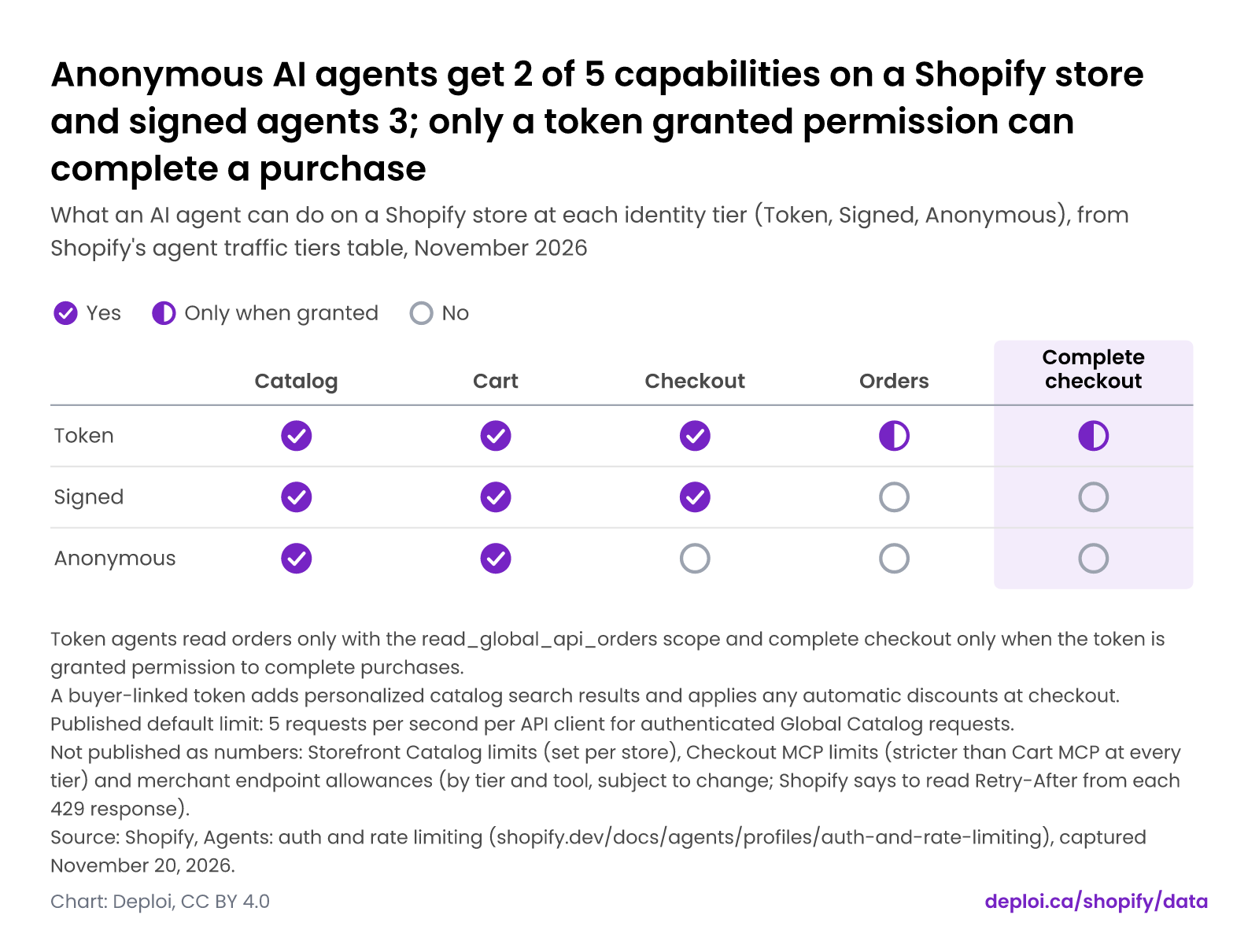
Anonymous AI agents get 2 of 5 capabilities on a Shopify store and signed agents 3; only a token granted permission can complete a purchase
What an AI agent can do on a Shopify store at each identity tier (Token, Signed, Anonymous), from Shopify's agent traffic tiers table, November 2026
- Token agents read orders only with the read_global_api_orders scope and complete checkout only when the token is granted permission to complete purchases.
- A buyer-linked token adds personalized catalog search results and applies any automatic discounts at checkout.
- Published default limit: 5 requests per second per API client for authenticated Global Catalog requests.
- Not published as numbers: Storefront Catalog limits (set per store), Checkout MCP limits (stricter than Cart MCP at every tier) and merchant endpoint allowances (by tier and tool, subject to change; Shopify says to read Retry-After from each 429 response).
Source: Shopify, Agents: auth and rate limiting (shopify.dev/docs/agents/profiles/auth-and-rate-limiting), captured November 20, 2026. Read on .
What can an AI agent do at each identity tier?
Anonymous agents can use catalog and cart, signed agents add checkout, and token agents can use all 5 capabilities, with orders and completing checkout only when granted, per Shopify's agent authentication and rate limiting page captured November 20, 2026. Only a token agent can complete a purchase, and only when the token is granted permission.
| Capability | Token | Signed | Anonymous |
|---|---|---|---|
| Catalog | Yes; personalized search results with a buyer-linked token | Yes | Yes |
| Cart | Yes | Yes | Yes |
| Checkout | Yes; applies any automatic discounts with a buyer-linked token | Yes | No |
| Orders | Yes, with the read_global_api_orders scope, for orders placed through that agent only | No | No |
| Complete checkout | When the token is granted permission to complete purchases | No | No |
| Capabilities available, of 5 | 3 yes and 2 only when granted | 3 | 2 |
How does an agent identify itself at each tier?
A token agent passes a JWT with Bearer token authentication, a signed agent uses HTTP Message Signatures per RFC 9421 with ECDSA P-256, and an anonymous agent sends no credentials, per Shopify's agent authentication page captured November 20, 2026. An anonymous request is sent without an Authorization header or signature headers.
Shopify's page defines each tier by what the request carries: a token, a signature or neither.
What rate limits does Shopify publish for agents?
Shopify's agent authentication and rate limiting page, captured November 20, 2026, publishes a single number: a default limit of 5 requests per second for each API client on authenticated requests to the Global Catalog endpoint. Storefront Catalog, Checkout MCP and merchant endpoint limits are not stated as numbers.
| Limit | What Shopify states |
|---|---|
| Global Catalog | Authenticated requests have a default limit of 5 requests per second for each API client |
| Storefront Catalog | Rate limited separately for each store; the number is not stated |
| Checkout MCP against Cart MCP | Checkout MCP is limited more strictly than Cart MCP at every tier; the numbers are not stated |
| Merchant endpoints | Allowances differ by tier and by tool and can change; the numbers are not stated |
For merchant endpoints, Shopify says to read Retry-After from each 429 response instead of hard-coding a request budget.
Limits rise with identification: Shopify says the Token tier gets the highest limits, Signed gets lower limits and Anonymous gets the lowest, with no numbers stated for the tiers.
Which files does every Shopify store serve to AI agents and crawlers by default?
Every Shopify store serves 4 default files: /agents.md, /llms.txt and /llms-full.txt for AI agents, plus a generated /robots.txt for crawlers, per Shopify's theme template references captured November 20, 2026. Shopify manages /agents.md, and /llms.txt and /llms-full.txt mirror its content. Grouping /robots.txt with the agent files is Deploi's.
| File | Served by default | Default content | Merchant override |
|---|---|---|---|
| /agents.md | Yes | The store's UCP discovery and MCP endpoints, read-only browsing URLs for product, collection and search data, the store's published policies and guidance for personal shopping agents | agents.md.liquid |
| /llms.txt | Yes | Mirrors /agents.md | llms.txt.liquid |
| /llms-full.txt | Yes | Mirrors /agents.md | llms-full.txt.liquid |
| /robots.txt | Yes | Generated rules; Shopify's page describes the file in general terms and does not itemize the default | robots.txt.liquid |
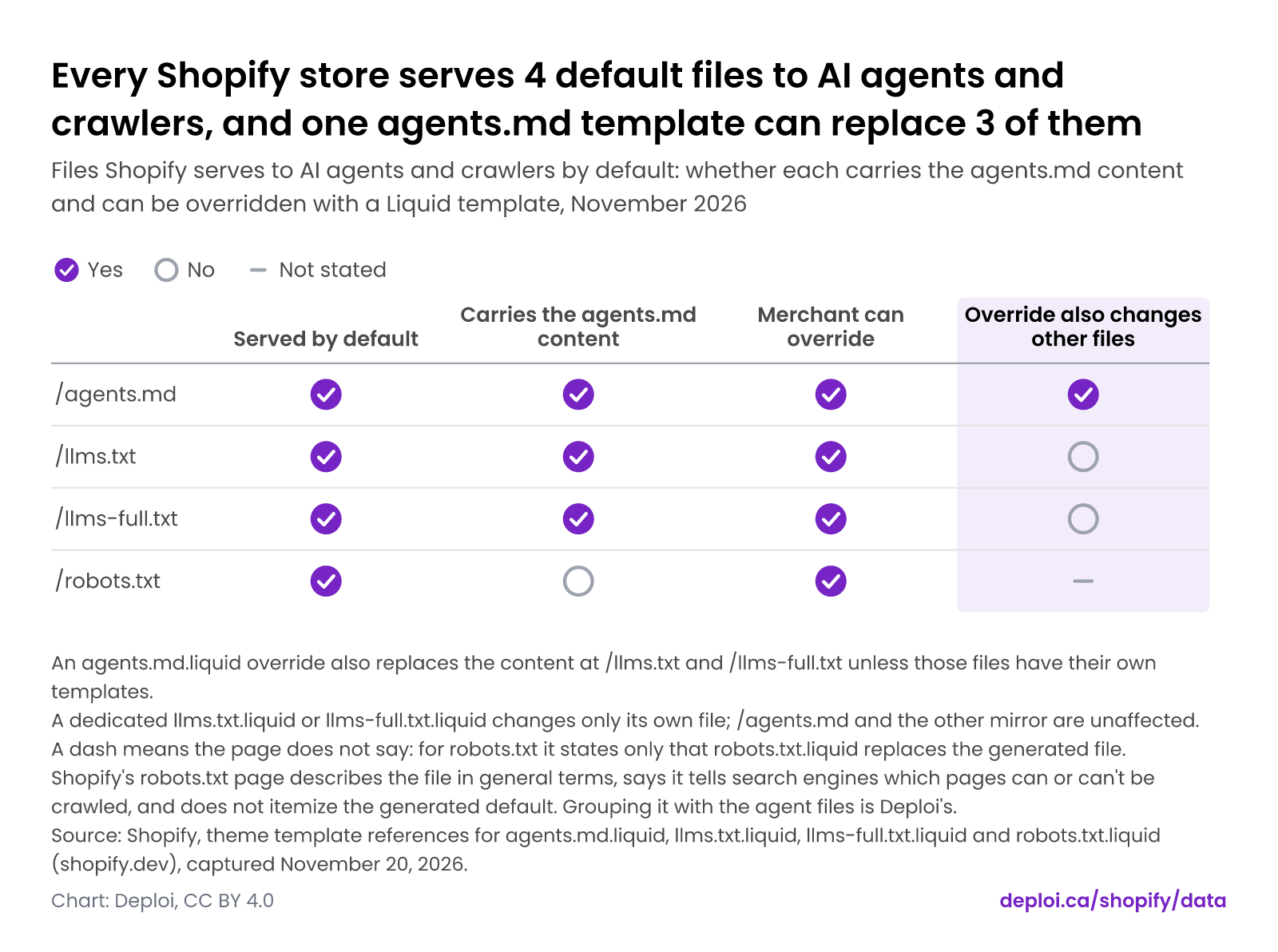
Every Shopify store serves 4 default files to AI agents and crawlers, and one agents.md template can replace 3 of them
Files Shopify serves to AI agents and crawlers by default: whether each carries the agents.md content and can be overridden with a Liquid template, November 2026
- An agents.md.liquid override also replaces the content at /llms.txt and /llms-full.txt unless those files have their own templates.
- A dedicated llms.txt.liquid or llms-full.txt.liquid changes only its own file; /agents.md and the other mirror are unaffected.
- A dash means the page does not say: for robots.txt it states only that robots.txt.liquid replaces the generated file.
- Shopify's robots.txt page describes the file in general terms, says it tells search engines which pages can or can't be crawled, and does not itemize the generated default. Grouping it with the agent files is Deploi's.
Source: Shopify, theme template references for agents.md.liquid, llms.txt.liquid, llms-full.txt.liquid and robots.txt.liquid (shopify.dev), captured November 20, 2026. Read on .
What happens to the other files if a merchant overrides agents.md?
An agents.md.liquid template replaces the Shopify-managed /agents.md and, unless those files have their own templates, the content served at /llms.txt and /llms-full.txt, so one template can replace 3 of the 4 default files, per Shopify's template references captured November 20, 2026.
A dedicated llms.txt.liquid takes precedence for /llms.txt only, and /agents.md and /llms-full.txt are unaffected. A dedicated llms-full.txt.liquid does the same for /llms-full.txt only. A robots.txt.liquid template replaces Shopify's generated robots.txt output; the page states no effect on the other 3 files.
Which Shopify pages were read?
The data comes from 5 Shopify developer pages captured on November 20, 2026: Agents: auth and rate limiting, and the theme template references for agents.md.liquid, llms.txt.liquid, llms-full.txt.liquid and robots.txt.liquid, all on shopify.dev. Each cell is as the page states it, with a dash or not stated where the page is silent.
Shopify's agent documentation changes, and its own pages say merchant endpoint allowances can change, so a later reading can differ from this one.
The data
Each chart on this page is drawn from the numbers below. Units are in the column headers.
Anonymous AI agents get 2 of 5 capabilities on a Shopify store and signed agents 3; only a token granted permission can complete a purchase
| Identity tier | Catalog | Cart | Checkout | Orders | Complete checkout | How the agent identifies itself |
|---|---|---|---|---|---|---|
| Token | Yes | Yes | Yes | Only when granted | Only when granted | JWT passed with Bearer token authentication |
| Signed | Yes | Yes | Yes | No | No | HTTP Message Signatures per RFC 9421 using ECDSA P-256 |
| Anonymous | Yes | Yes | No | No | No | No credentials or signatures provided. Send the request without an `Authorization` header or signature headers |
Download What an AI agent can do on a Shopify store at each identity tier, with Shopify's published rate limits, November 2026 as CSV · All 13 columns on the dataset page
Every Shopify store serves 4 default files to AI agents and crawlers, and one agents.md template can replace 3 of them
| File | Served by default | Carries the agents.md content | Merchant can override | Override also changes other files | Default content | Served by default | Override template | What overriding changes | Where it is served |
|---|---|---|---|---|---|---|---|---|---|
| /agents.md | Yes | Yes | Yes | Yes | Store's UCP discovery and MCP endpoints; read-only browsing URLs for product, collection and search data; the store's published policies; guidance for personal shopping agents | Yes: Shopify manages an agents.md file by default for every store | agents.md.liquid | Replaces the Shopify-managed agents.md and, unless overridden, the content served at /llms.txt and /llms-full.txt | /agents.md |
| /llms.txt | Yes | Yes | Yes | No | Mirrors the content of /agents.md | Yes: Shopify manages /llms.txt by default, mirroring /agents.md | llms.txt.liquid | A dedicated llms.txt.liquid takes precedence for /llms.txt only; /agents.md and /llms-full.txt are unaffected | /llms.txt |
| /llms-full.txt | Yes | Yes | Yes | No | Mirrors the content of /agents.md | Yes: /llms-full.txt is served by default, mirroring /agents.md | llms-full.txt.liquid | A dedicated llms-full.txt.liquid takes precedence for /llms-full.txt only; /agents.md and /llms.txt are unaffected | /llms-full.txt |
| /robots.txt | Yes | No | Yes | Not stated | Groups of rules, each with a user agent, the rules for URLs crawlers can or cannot access, and an optional sitemap URL (page describes the file generally; it does not itemise the generated default) | Yes: Shopify generates a robots.txt file by default | robots.txt.liquid | Replaces Shopify's generated robots.txt output | /robots.txt |
Download Files every Shopify store serves to AI agents and crawlers by default, and what a merchant can override, November 2026 as CSV · All 11 columns on the dataset page
Methodology
Reading the chart: Anonymous AI agents get 2 of 5 capabilities on a Shopify store and signed agents 3; only a token granted permission can complete a purchase
- Token agents read orders only with the read_global_api_orders scope and complete checkout only when the token is granted permission to complete purchases.
- A buyer-linked token adds personalized catalog search results and applies any automatic discounts at checkout.
- Published default limit: 5 requests per second per API client for authenticated Global Catalog requests.
- Not published as numbers: Storefront Catalog limits (set per store), Checkout MCP limits (stricter than Cart MCP at every tier) and merchant endpoint allowances (by tier and tool, subject to change; Shopify says to read Retry-After from each 429 response).
Reading the chart: Every Shopify store serves 4 default files to AI agents and crawlers, and one agents.md template can replace 3 of them
- An agents.md.liquid override also replaces the content at /llms.txt and /llms-full.txt unless those files have their own templates.
- A dedicated llms.txt.liquid or llms-full.txt.liquid changes only its own file; /agents.md and the other mirror are unaffected.
- A dash means the page does not say: for robots.txt it states only that robots.txt.liquid replaces the generated file.
- Shopify's robots.txt page describes the file in general terms, says it tells search engines which pages can or can't be crawled, and does not itemize the generated default. Grouping it with the agent files is Deploi's.
Caveats: What an AI agent can do on a Shopify store at each identity tier, with Shopify's published rate limits, November 2026
- Token agents read orders only with the read_global_api_orders scope and complete checkout only when the token is granted permission to complete purchases. The coded cells mark these two as granted. Order access is restricted to orders placed through the agent.
- A buyer-linked token adds personalized catalog search results and applies any automatic discounts at checkout.
- One rate limit is a number: authenticated Global Catalog requests have a default limit of 5 requests per second for each API client. Storefront Catalog limits (set for each store), Checkout MCP limits (stricter than Cart MCP at every tier) and merchant endpoint allowances (by tier and tool, subject to change) are not stated as numbers, and their limit value is left empty, not set to zero. Shopify says limits rise with identification: Token highest, Signed lower, Anonymous lowest.
- Shopify's agent documentation changes, so a later reading can differ from this one.
Caveats: Files every Shopify store serves to AI agents and crawlers by default, and what a merchant can override, November 2026
- An agents.md.liquid template also replaces the content served at /llms.txt and /llms-full.txt unless those files have their own templates. A dedicated llms.txt.liquid or llms-full.txt.liquid changes only its own file.
- Shopify's robots.txt page describes the file in general terms and does not itemize the generated default, so the default content of /robots.txt is a general description. The page states only that robots.txt.liquid replaces the generated file, so the cascade cell for /robots.txt is empty: not stated. Shopify says robots.txt tells search engines which pages can or can't be crawled; grouping it with the agent files is Deploi's.
- Shopify's agent documentation changes, so a later reading can differ from this one.
Deploi's charts and compilation are licensed CC BY 4.0. The underlying facts belong to their sources, which are named on every page. How Deploi Shopify Data works.
Sources
Tier A sources are primary documents: filings, official releases and official price pages. How sources are ranked.
What an AI agent can do on a Shopify store at each identity tier, with Shopify's published rate limits, November 2026
- Tier AAgents: auth and rate limiting, captured 2026-11-20
Shopify · TEXT · Read on
Files every Shopify store serves to AI agents and crawlers by default, and what a merchant can override, November 2026
- Tier Aagents.md.liquid, captured 2026-11-20
Shopify · TEXT · Read on
- Tier Allms-full.txt.liquid, captured 2026-11-20
Shopify · TEXT · Read on
- Tier Allms.txt.liquid, captured 2026-11-20
Shopify · TEXT · Read on
- Tier Arobots.txt.liquid, captured 2026-11-20
Shopify · TEXT · Read on
Cite and reuse
Deploi's charts and compilation are licensed CC BY 4.0. The underlying facts belong to their sources, which are named on every page.
APA
Deploi. (2026). What does a Shopify store expose to AI shopping agents by default, and what can an agent do at each identity tier? [Web page]. https://deploi.ca/shopify/data/shopify-ai-agent-access Retrieved November 20, 2026.
BibTeX
@misc{deploi_shopify_ai_agent_access_2026,
  author = {{Deploi}},
  title = {What does a Shopify store expose to AI shopping agents by default, and what can an agent do at each identity tier?},
  year = {2026},
  url = {https://deploi.ca/shopify/data/shopify-ai-agent-access},
  note = {Accessed 2026-11-20}
}
Embed a chart
Embed: Anonymous AI agents get 2 of 5 capabilities on a Shopify store and signed agents 3; only a token granted permission can complete a purchase
Embed code
<iframe src="https://deploi.ca/embed/shopify/data/agent-access-by-identity-tier" title="Anonymous AI agents get 2 of 5 capabilities on a Shopify store and signed agents 3; only a token granted permission can complete a purchase" loading="lazy" style="width:100%;height:440px;border:0"></iframe>
<p style="font:12px/1.4 Arial,sans-serif;margin:4px 0 0">Source: <a href="https://deploi.ca/shopify/data/charts/agent-access-by-identity-tier">Deploi, Anonymous AI agents get 2 of 5 capabilities on a Shopify store and signed agents 3; only a token granted permission can complete a purchase</a></p>
Embed: Every Shopify store serves 4 default files to AI agents and crawlers, and one agents.md template can replace 3 of them
Embed code
<iframe src="https://deploi.ca/embed/shopify/data/default-agent-files" title="Every Shopify store serves 4 default files to AI agents and crawlers, and one agents.md template can replace 3 of them" loading="lazy" style="width:100%;height:490px;border:0"></iframe>
<p style="font:12px/1.4 Arial,sans-serif;margin:4px 0 0">Source: <a href="https://deploi.ca/shopify/data/charts/default-agent-files">Deploi, Every Shopify store serves 4 default files to AI agents and crawlers, and one agents.md template can replace 3 of them</a></p>
Keep the credit line under the embed. It is the license condition.
Downloads
- Chart: Anonymous AI agents get 2 of 5 capabilities on a Shopify store and signed agents 3; only a token granted permission can complete a purchase PNG
- Chart: Every Shopify store serves 4 default files to AI agents and crawlers, and one agents.md template can replace 3 of them PNG
- Data: What an AI agent can do on a Shopify store at each identity tier, with Shopify's published rate limits, November 2026 CSV
- Data: Files every Shopify store serves to AI agents and crawlers by default, and what a merchant can override, November 2026 CSV
Questions
What can an anonymous AI agent do on a Shopify store?
An anonymous AI agent can use catalog and cart, 2 of the 5 capabilities, per Shopify's agent authentication page captured November 20, 2026. Checkout needs a signature or a token, and orders and completing a purchase need a token with the matching scope or permission.
What does a signed AI agent get that an anonymous one does not?
A signed agent also gets checkout, per Shopify's agent authentication page captured November 20, 2026. A signed agent, identified with HTTP Message Signatures per RFC 9421, gets 3 of 5 capabilities but not orders or completing checkout.
Which agents can complete a purchase on a Shopify store?
Only a token agent can complete a purchase, and only when its token is granted permission to complete purchases, per Shopify's agent authentication page captured November 20, 2026. Signed and anonymous agents cannot.
What is the rate limit for AI agents on Shopify?
Authenticated Global Catalog requests have a default limit of 5 requests per second for each API client, per Shopify's agent authentication and rate limiting page captured November 20, 2026. Storefront Catalog, Checkout MCP and merchant endpoint limits are not stated as numbers.
What happens if a store overrides /agents.md?
An agents.md.liquid template replaces /agents.md and, unless they have their own templates, the content at /llms.txt and /llms-full.txt, per Shopify's template references captured November 20, 2026.
More on Performance and technology
- Do the largest Shopify stores pass Core Web Vitals as often as the largest stores on other platforms?
Shopify's mobile Core Web Vitals pass rate falls from 76.5% of all origins to 38.4% in the top 100k by popularity, while its median home page grows from 4.1 MB to 6.4 MB, HTTP Archive crawl of October 2026. Updated November 20, 2026.
- How many public Oxygen environments does each Shopify plan get for a Hydrogen storefront, and how long are deployments and logs kept?
Shopify Plus stores can have 25 public Oxygen environments for a Hydrogen storefront, nine other plans and store types 1 each, and development stores and trial plans 0, per shopify.dev read November 20, 2026. Updated November 20, 2026.
- How often does the Universal Commerce Protocol ship dated versions and breaking changes, and how much notice is given?
The Universal Commerce Protocol listed four dated protocol releases in 2026, on January 11, January 23, April 8 and August 25, and GitHub release notes mark three of them as breaking, per ucp.dev and GitHub pages read November 20, 2026. UCP's versioning guide says a breaking change is announced 2 weeks before it is merged. Updated November 20, 2026.
- In which visitor countries do Shopify stores pass Core Web Vitals most and least often?
Shopify stores pass mobile Core Web Vitals more often than all sites in all 21 visitor countries charted, from 31.2% of origins in Indonesia to 89.6% in Norway, HTTP Archive crawl of October 2026. Updated November 20, 2026.
- Is Shopify's Core Web Vitals pass rate slipping in 2026, and on which vital, device and tier of Shopify sites?
Shopify's mobile Interaction to Next Paint (INP) pass rate fell from 91.0% in February 2026 to 85.9% in October, and the overall mobile pass rate from 79.5% in March to 76.5%, as computed by Deploi from HTTP Archive data retrieved November 20, 2026. Updated November 20, 2026.
- What does Shopify guarantee about webhook delivery, and what do its retry and timeout rules say?
Shopify's developer documentation states a 1-second connection timeout, a 5-second response timeout and up to 8 retries over 4 hours for a failed webhook delivery, and deletes an Admin API subscription after 8 consecutive failures. It guarantees neither delivery of every webhook nor delivery in order. Documentation read November 20, 2026. Updated November 20, 2026.
Changes
- · What an AI agent can do on a Shopify store at each identity tier, with Shopify's published rate limits, November 2026
First release. Fifteen tier by capability rows, four rate limit rows and three one-row-per-tier summary rows from one Shopify page. - · Files every Shopify store serves to AI agents and crawlers by default, and what a merchant can override, November 2026
First release. Four default files read from four Shopify template reference pages.