
What must a Shopify app do before it can read customer and order data?
Shopify lists 9 protected customer data requirements for level 1 apps and 7 more for level 2, and marks 32 access scopes as needing its approval, per shopify.dev captured on November 25, 2026. Updated November 25, 2026.
By Martin DejnickiUpdated
Short answer
Shopify lists 9 protected customer data requirements for level 1 apps and 7 more for level 2 apps, so level 2 apps must meet 16, according to shopify.dev as captured on November 25, 2026. An app reaches level 2 when it accesses customer name, email, phone or address fields. Default order scopes cover the last 60 days, and Shopify marks 32 scope names as needing its approval.
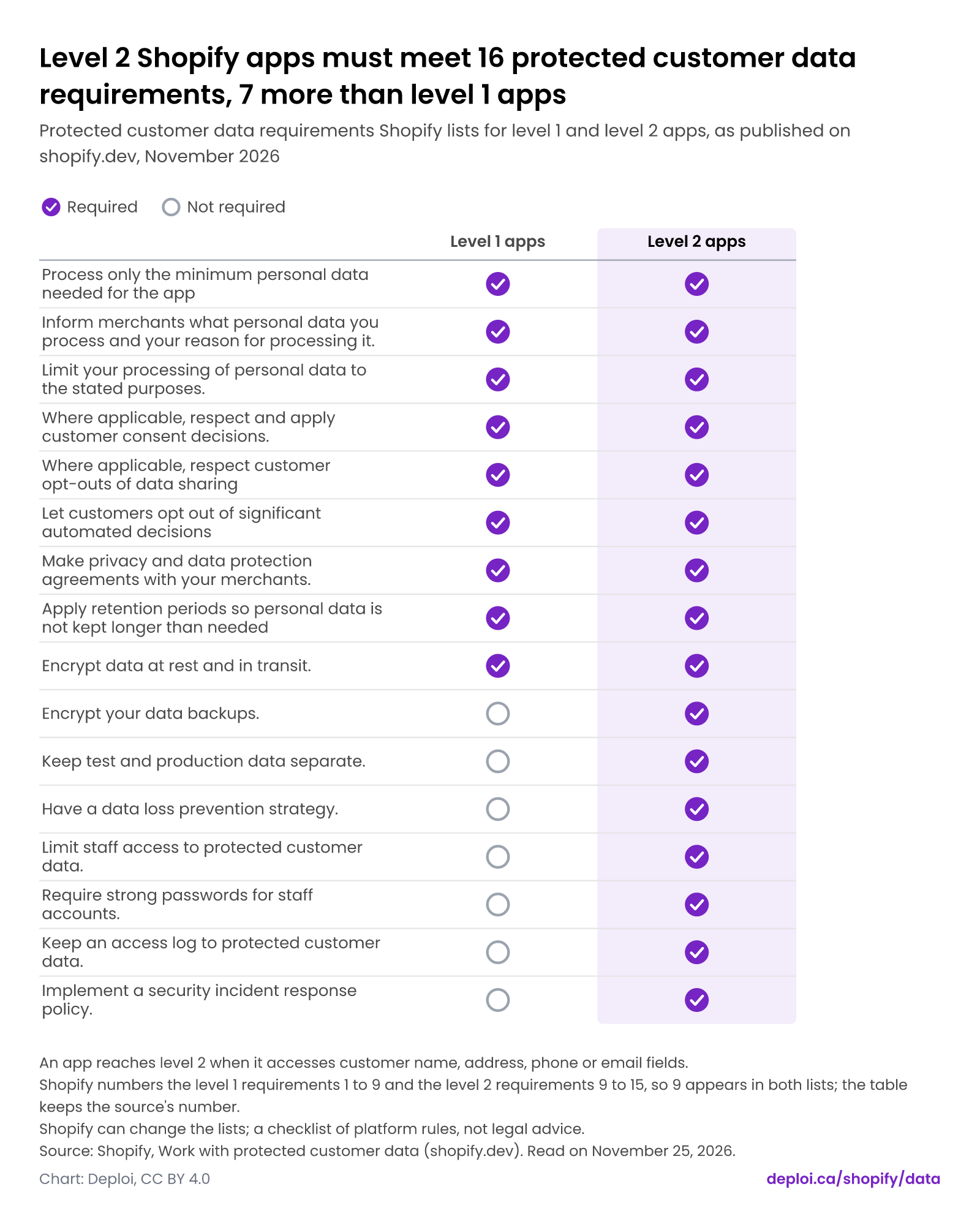
Level 2 Shopify apps must meet 16 protected customer data requirements, 7 more than level 1 apps
Protected customer data requirements Shopify lists for level 1 and level 2 apps, as published on shopify.dev, November 2026
- An app reaches level 2 when it accesses customer name, address, phone or email fields.
- Shopify numbers the level 1 requirements 1 to 9 and the level 2 requirements 9 to 15, so 9 appears in both lists; the table keeps the source's number.
- Shopify can change the lists; a checklist of platform rules, not legal advice.
Source: Shopify, Work with protected customer data (shopify.dev). Read on .
What are the level 1 protected customer data requirements?
Shopify lists 9 requirements for apps that handle protected customer data at level 1, and level 2 apps must meet them too, according to Shopify's Work with protected customer data page on shopify.dev, captured on November 25, 2026. They start with processing only the minimum personal data needed and end with encrypting data at rest and in transit.
The 9 requirements are:
- Process only the minimum personal data required to provide app functionality to merchants.
- Inform merchants what personal data you process and your reason for processing it.
- Limit your processing of personal data to the stated purposes.
- Where applicable, respect and apply customer consent decisions.
- Where applicable, respect and apply customer decisions to opt out of any data sharing such as a ‘data sale’ or similar concept under applicable laws or regulations.
- If you use personal data for automated decision-making and those decisions might have legal or significant effects, then you must allow customers to opt out.
- Make privacy and data protection agreements with your merchants.
- Apply retention periods to make sure that personal data isn’t kept for longer than needed.
- Encrypt data at rest and in transit.
Source: Shopify, Work with protected customer data (shopify.dev), captured November 25, 2026.
What more does a level 2 app have to do?
A level 2 app must meet 7 more requirements on top of the 9 at level 1, according to Shopify's Work with protected customer data page on shopify.dev, captured on November 25, 2026: encrypted backups, separate test and production data, a data loss prevention strategy, limited staff access, strong staff passwords, an access log and an incident response policy.
Shopify numbers the level 2 requirements 9 to 15, so the number 9 appears in both lists. The dataset keeps the source's numbers. The 7 level 2 items are:
- Encrypt your data backups.
- Keep test and production data separate.
- Have a data loss prevention strategy.
- Limit staff access to protected customer data.
- Require strong passwords for staff accounts.
- Keep an access log to protected customer data.
- Implement a security incident response policy.
Source: Shopify, Work with protected customer data (shopify.dev), captured November 25, 2026.
Which customer fields put an app at level 2?
Access to a customer's name, email, phone or address puts an app at level 2 of protected customer data, according to Shopify's Work with protected customer data page on shopify.dev, captured on November 25, 2026. Shopify lists 4 trigger fields.
The page defines them as name (first and last names), email, phone, and address: address line 1, address line 2, geolocation, and zip codes in both billing and shipping addresses. Shopify can change the lists. Source: Shopify, Work with protected customer data (shopify.dev), captured November 25, 2026.
How far back can an app read orders by default?
By default, read_orders gives read access and write_orders gives read and write access to orders created within the last 60 days, according to Shopify's API access scopes page on shopify.dev, captured on November 25, 2026. The page describes read_all_orders as extending whichever order scope the app has.
On that page, read_orders and write_orders carry no Shopify approval required label; the page says that scopes with that label require approval. It also says that, despite its read_ prefix, read_all_orders extends whichever order scope the app has. Source: Shopify, API access scopes (shopify.dev), captured November 25, 2026.
Does an app need approval to read orders older than 60 days?
Apps created under a Partner organization must request Shopify approval before declaring read_all_orders, the scope that extends an app's order scope past the default 60-day window, according to Shopify's API access scopes page on shopify.dev, captured on November 25, 2026. Apps created in the Dev Dashboard under a merchant organization, for use on that organization's stores, do not need this approval.
Shopify's page does not label read_all_orders Shopify approval required, so it is not in the count of 32 labeled scope names. Source: Shopify, API access scopes (shopify.dev), captured November 25, 2026.
How many access scopes need Shopify's approval?
32 access scope names are marked Shopify approval required on Shopify's API access scopes page on shopify.dev, as captured and counted by script on November 25, 2026. The count is of scope names on the page, not of apps or of separate approval processes.
The count comes from the registered capture of the access scopes page. One label on that page can mark both the read and the write scope in a cell, so the page shows fewer labels than scope names. The default 60-day order scopes, read_orders and write_orders, carry no such label. Scopes can change, and Shopify can revise the lists. Source: Shopify, API access scopes (shopify.dev), captured November 25, 2026.
The data
Each chart on this page is drawn from the numbers below. Units are in the column headers.
| Requirement | Level 1 apps (yes/no) | Level 2 apps (yes/no) | Requirement | Level | Number |
|---|---|---|---|---|---|
| Process only the minimum personal data needed for the app | Required | Required | Process only the minimum personal data required to provide app functionality to merchants. | Level 1 | 1 |
| Inform merchants what personal data you process and your reason for processing it. | Required | Required | Inform merchants what personal data you process and your reason for processing it. | Level 1 | 2 |
| Limit your processing of personal data to the stated purposes. | Required | Required | Limit your processing of personal data to the stated purposes. | Level 1 | 3 |
| Where applicable, respect and apply customer consent decisions. | Required | Required | Where applicable, respect and apply customer consent decisions. | Level 1 | 4 |
| Where applicable, respect customer opt-outs of data sharing | Required | Required | Where applicable, respect and apply customer decisions to opt out of any data sharing such as a ‘data sale’ or similar concept under applicable laws or regulations. | Level 1 | 5 |
| Let customers opt out of significant automated decisions | Required | Required | If you use personal data for automated decision-making and those decisions might have legal or significant effects, then you must allow customers to opt out. | Level 1 | 6 |
| Make privacy and data protection agreements with your merchants. | Required | Required | Make privacy and data protection agreements with your merchants. | Level 1 | 7 |
| Apply retention periods so personal data is not kept longer than needed | Required | Required | Apply retention periods to make sure that personal data isn’t kept for longer than needed. | Level 1 | 8 |
| Encrypt data at rest and in transit. | Required | Required | Encrypt data at rest and in transit. | Level 1 | 9 |
| Encrypt your data backups. | Not required | Required | Encrypt your data backups. | Level 2 | 9 |
| Keep test and production data separate. | Not required | Required | Keep test and production data separate. | Level 2 | 10 |
| Have a data loss prevention strategy. | Not required | Required | Have a data loss prevention strategy. | Level 2 | 11 |
| Limit staff access to protected customer data. | Not required | Required | Limit staff access to protected customer data. | Level 2 | 12 |
| Require strong passwords for staff accounts. | Not required | Required | Require strong passwords for staff accounts. | Level 2 | 13 |
| Keep an access log to protected customer data. | Not required | Required | Keep an access log to protected customer data. | Level 2 | 14 |
| Implement a security incident response policy. | Not required | Required | Implement a security incident response policy. | Level 2 | 15 |
Download What a Shopify app must do to read customer and order data as CSV · All 13 columns on the dataset page
Methodology
Reading the chart: Level 2 Shopify apps must meet 16 protected customer data requirements, 7 more than level 1 apps
- An app reaches level 2 when it accesses customer name, address, phone or email fields.
- Shopify numbers the level 1 requirements 1 to 9 and the level 2 requirements 9 to 15, so 9 appears in both lists; the table keeps the source's number.
- Shopify can change the lists; a checklist of platform rules, not legal advice.
Caveats: What a Shopify app must do to read customer and order data
- Requirements as published on shopify.dev on November 25, 2026; Shopify can change the lists.
- Shopify numbers the level 1 requirements 1 to 9 and the level 2 requirements 9 to 15, so 9 appears in both lists; the dataset keeps the source's numbers.
- The count of scopes needing approval is the number of scope names the access scopes page marks Shopify approval required, counted by script.
- On the access scopes page, read_orders and write_orders carry no Shopify approval required label; the page says that scopes with that label require approval.
- A checklist of Shopify's platform rules, not legal advice on privacy law. Deploi is not affiliated with Shopify.
Deploi's charts and compilation are licensed CC BY 4.0. The underlying facts belong to their sources, which are named on every page. How Deploi Shopify Data works.
Sources
Tier A sources are primary documents: filings, official releases and official price pages. How sources are ranked.
- Tier AShopify API access scopes (shopify.dev), full page, capture 2026-11-25
Shopify · HTML · Read on
- Tier AWork with protected customer data (shopify.dev), capture 2026-11-25
Shopify · HTML · Read on
Cite and reuse
Deploi's charts and compilation are licensed CC BY 4.0. The underlying facts belong to their sources, which are named on every page.
APA
Deploi. (2026). What must a Shopify app do before it can read customer and order data? [Web page]. https://deploi.ca/shopify/data/shopify-app-customer-data-rules Retrieved November 25, 2026.
BibTeX
@misc{deploi_shopify_app_customer_data_rules_2026,
  author = {{Deploi}},
  title = {What must a Shopify app do before it can read customer and order data?},
  year = {2026},
  url = {https://deploi.ca/shopify/data/shopify-app-customer-data-rules},
  note = {Accessed 2026-11-25}
}
Embed this chart
Embed code
<iframe src="https://deploi.ca/embed/shopify/data/protected-customer-data-requirements" title="Level 2 Shopify apps must meet 16 protected customer data requirements, 7 more than level 1 apps" loading="lazy" style="width:100%;height:890px;border:0"></iframe>
<p style="font:12px/1.4 Arial,sans-serif;margin:4px 0 0">Source: <a href="https://deploi.ca/shopify/data/charts/protected-customer-data-requirements">Deploi, Level 2 Shopify apps must meet 16 protected customer data requirements, 7 more than level 1 apps</a></p>
Keep the credit line under the embed. It is the license condition.
Questions
What is protected customer data level 2 on Shopify?
Level 2 applies to apps that access customer name, email, phone or address fields. Those apps must meet the 9 level 1 requirements and 7 more, according to Shopify's Work with protected customer data page on shopify.dev, captured November 25, 2026.
How many protected customer data requirements does Shopify list?
9 for level 1 apps and 7 more for level 2 apps, so level 2 apps must meet 16, according to Shopify's Work with protected customer data page on shopify.dev, captured on November 25, 2026.
How many days of orders can a Shopify app read by default?
60 days. By default, read_orders and write_orders cover orders created within the last 60 days, according to Shopify's API access scopes page on shopify.dev, captured on November 25, 2026.
What does read_all_orders do?
It extends whichever order scope the app has, despite its read_ prefix, according to Shopify's API access scopes page on shopify.dev, captured on November 25, 2026. Apps created under a Partner organization must request Shopify approval before declaring it; apps created under a merchant organization for that organization's stores do not.
How many Shopify access scopes need Shopify approval?
32 scope names are marked Shopify approval required on Shopify's API access scopes page, as captured and counted by script on November 25, 2026. The read_all_orders scope, which apps created under a Partner organization need approval for, carries no label and is not counted. The default order scopes, read_orders and write_orders, carry no label either.
More on Performance and technology
- Do sites running a site-search tool pass Core Web Vitals less often?
In October 2026, sites running Klevu, Elasticsearch or Algolia passed mobile Core Web Vitals less often than all sites at 53.0%; the 5 other tools on this page passed more often, per the HTTP Archive. Updated November 25, 2026.
- What size and count limits does Shopify enforce on app extensions?
Shopify enforces 64 KB for a checkout UI extension bundle and 10 MB for all files in a theme app extension, and only suggests limits for CSS and JS, per shopify.dev captured on November 25, 2026. Updated November 25, 2026.
- Do home pages pass Core Web Vitals less often than inner pages, and is the gap in loading, interactivity or layout shift?
On mobile, 56% of secondary pages had good Core Web Vitals in July 2025 against 45% of home pages, per the Web Almanac 2025, which covers sites worldwide. Updated November 22, 2026.
- Do sites running a translation tool pass Core Web Vitals less often?
In October 2026, 73.1% of LangShop sites and 71.9% of Transcy sites had good Core Web Vitals on mobile, against 76.5% of all Shopify sites and 53.0% of all sites, computed by Deploi from HTTP Archive counts. Updated November 22, 2026.
- Does counting soft navigations change a site's Core Web Vitals result, and which site builders and JavaScript frameworks gain or lose?
Counting soft navigations lifts Shopify's share of mobile origins with good Core Web Vitals from 76.5% to 77.2% in October 2026, against 53.0% to 55.9% across all sites, computed by Deploi. Updated November 22, 2026.
- How many results can one Shopify storefront request return: products per Liquid page, loop iterations, predictive search suggestions and Storefront API page size?
Shopify's Liquid paginate tag takes a page size of up to 250, a Storefront API connection returns up to 250 resources, a for loop stops at 50 iterations and predictive search at 10 per result type, as shopify.dev documented on November 22, 2026. Updated November 22, 2026.
Changes
- · What a Shopify app must do to read customer and order data
First release: 23 rows (16 requirements, 4 customer fields and 3 access facts) from 2 shopify.dev pages, Work with protected customer data and API access scopes, read on November 25, 2026.