
What share of Canadian retailers use AI, what do they use it for, and what limits its use?
19.2% of Canadian retailers used AI in the 12 months to the second quarter of 2026, up from 6.6% a year earlier, and 41.1% cited AI not being relevant as a limit, per Statistics Canada, read November 20, 2026. Updated November 20, 2026.
By Martin DejnickiUpdated Data through May 6, 2026
Short answer
19.2% of Canadian retailers used AI to produce goods or deliver services in the 12 months to the second quarter of 2026, up from 6.6% a year earlier and level with all industries, per Statistics Canada's Canadian Survey on Business Conditions, read November 20, 2026. The most cited limit on retail AI use was that it is not relevant to the business, at 41.1%.
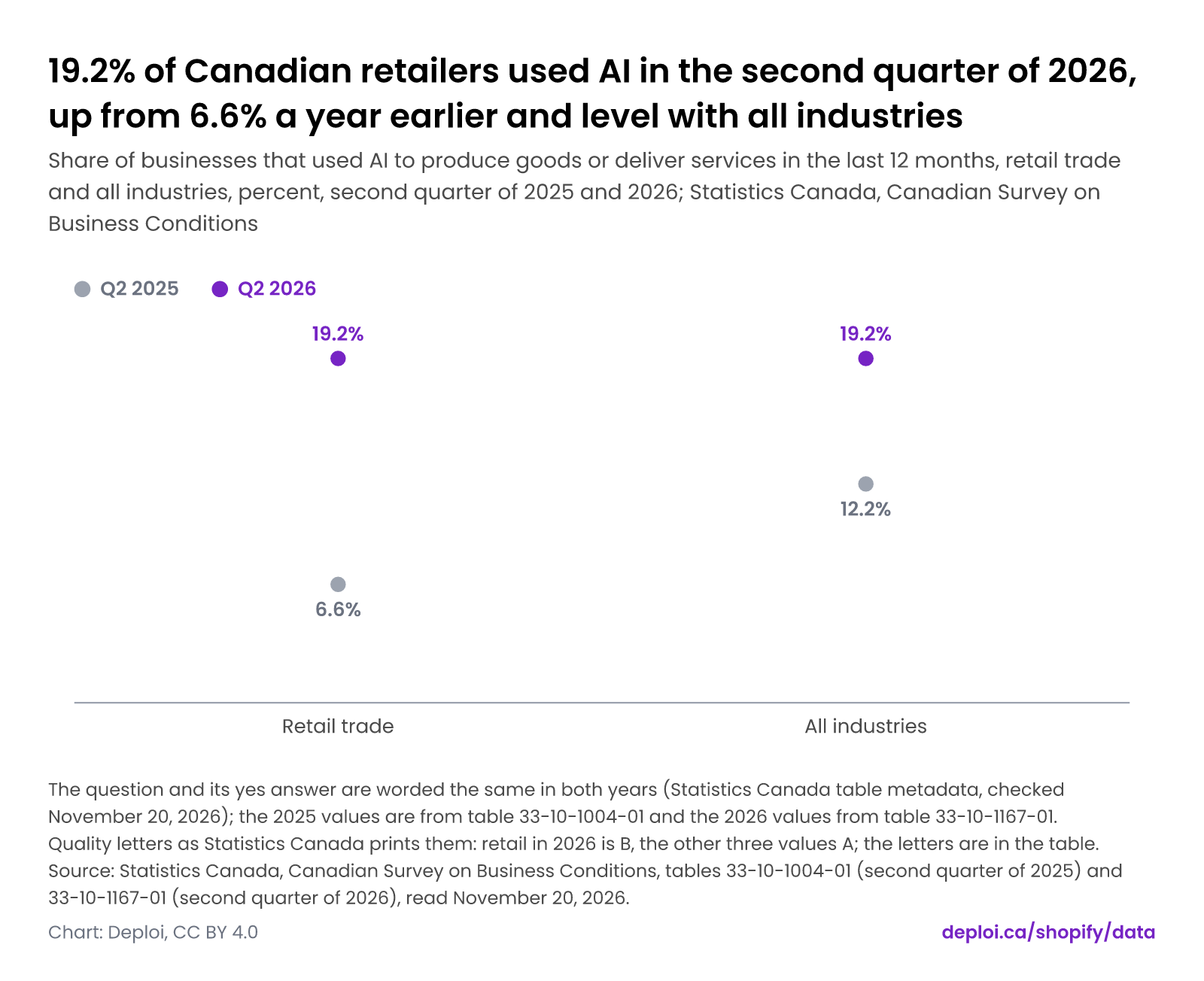
19.2% of Canadian retailers used AI in the second quarter of 2026, up from 6.6% a year earlier and level with all industries
Share of businesses that used AI to produce goods or deliver services in the last 12 months, retail trade and all industries, percent, second quarter of 2025 and 2026; Statistics Canada, Canadian Survey on Business Conditions
- The question and its yes answer are worded the same in both years (Statistics Canada table metadata, checked November 20, 2026); the 2025 values are from table 33-10-1004-01 and the 2026 values from table 33-10-1167-01.
- Quality letters as Statistics Canada prints them: retail in 2026 is B, the other three values A; the letters are in the table.
Source: Statistics Canada, Canadian Survey on Business Conditions, tables 33-10-1004-01 (second quarter of 2025) and 33-10-1167-01 (second quarter of 2026), read November 20, 2026. Read on .
What share of Canadian retailers use AI?
19.2% of Canadian retail businesses used AI to produce goods or deliver services in the 12 months to the second quarter of 2026, up from 6.6% in the 12 months to the second quarter of 2025, per Statistics Canada's Canadian Survey on Business Conditions, read November 20, 2026. All industries were also at 19.2%.
The question and its yes answer are worded the same in both years, per the dimension and member names in both Statistics Canada tables, read November 20, 2026. The 2025 values come from table 33-10-1004-01 and the 2026 values from table 33-10-1167-01.
How much did AI use grow among retailers compared with all industries?
Retail AI use rose from 6.6% to 19.2% between the second quarter of 2025 and the second quarter of 2026, while all industries rose from 12.2% to 19.2%, per Statistics Canada's Canadian Survey on Business Conditions, read November 20, 2026. Retail was below all industries in 2025 and level with them in 2026.
The all-industries rise is 7.0 percentage points, computed by Deploi as the difference between the two published values.
The two quarters come from different tables, with the question worded the same in each.
What do Canadian retailers use AI for?
Among Canadian retailers that used AI in the 12 months to the second quarter of 2026, 46.4% used data analytics, 40.0% virtual agents or chat bots, 35.6% text analytics, 30.5% recommendation systems, 29.4% marketing automation and 22.5% large language models, per Statistics Canada table 33-10-1167-01, read November 20, 2026. These are 6 of the application types the table lists; 5 carry quality letter D.
| Type of AI application | Share of retailers that used AI, Q2 2026 | Quality letter |
|---|---|---|
| Data analytics using AI | 46.4% | D |
| Virtual agents or chat bots | 40.0% | D |
| Text analytics using AI | 35.6% | D |
| Recommendation systems using AI | 30.5% | D |
| Marketing automation using AI | 29.4% | C |
| Large language models | 22.5% | D |
The 6 are a selection of the application types in the table. Other application types in the table, including some with higher shares than large language models, are not shown.
The dataset records these as shares of the retailers that used AI. Each is above the 19.2% of all retailers that used AI, so none can be a share of all retailers. The categories are not exclusive, so the shares do not add to 100.
What limits AI use among Canadian retailers?
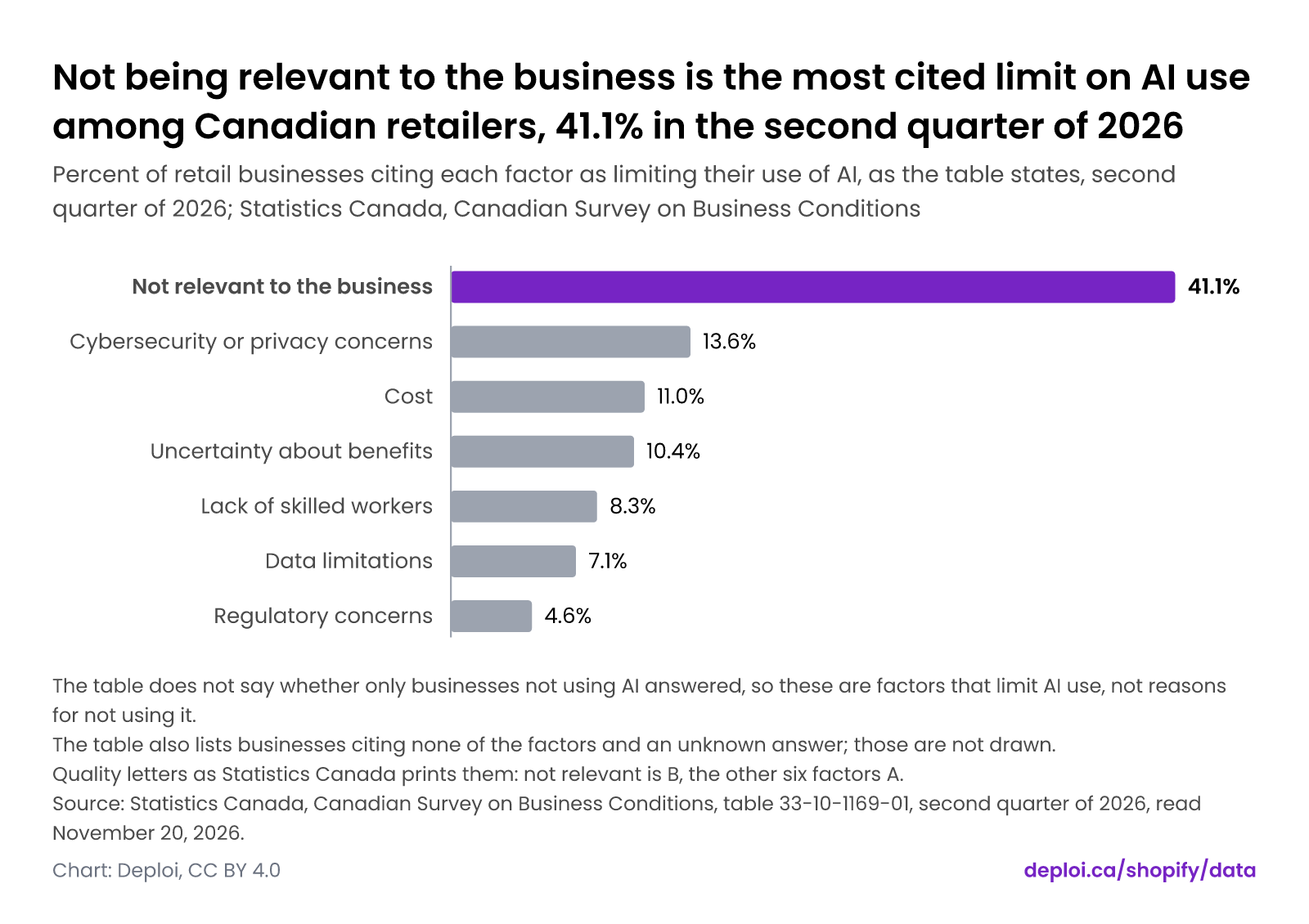
Not being relevant to the business is the most cited limit on AI use among Canadian retailers at 41.1% in the second quarter of 2026, then cybersecurity or privacy concerns at 13.6%, cost at 11.0% and uncertainty about benefits at 10.4%, per Statistics Canada table 33-10-1169-01, read November 20, 2026.
Lack of skilled workers was cited by 8.3%, data limitations by 7.1% and regulatory concerns by 4.6%.
The table does not say whether only businesses not using AI answered, so these are factors that limit AI use, not reasons for not using it. It also lists businesses citing none of the factors and an unknown answer, which are not drawn.
Not being relevant to the business is the most cited limit on AI use among Canadian retailers, 41.1% in the second quarter of 2026
Percent of retail businesses citing each factor as limiting their use of AI, as the table states, second quarter of 2026; Statistics Canada, Canadian Survey on Business Conditions
- The table does not say whether only businesses not using AI answered, so these are factors that limit AI use, not reasons for not using it.
- The table also lists businesses citing none of the factors and an unknown answer; those are not drawn.
- Quality letters as Statistics Canada prints them: not relevant is B, the other six factors A.
Source: Statistics Canada, Canadian Survey on Business Conditions, table 33-10-1169-01, second quarter of 2026, read November 20, 2026. Read on .
What quality letters do these percentages carry?
Statistics Canada prints a quality letter with every value, and the retail AI use figure for the second quarter of 2026 carries B, while the other 3 used-AI values carry A, per tables 33-10-1004-01 and 33-10-1167-01 read November 20, 2026. The 6 application shares shown carry D except marketing automation at C.
On barriers, not relevant to the business carries B and the other 6 factors carry A, per table 33-10-1169-01.
The letters are in the dataset table next to each value, as Statistics Canada prints them.
Which businesses and period does the survey cover?
The figures cover businesses with employees in Canada in the second quarter of 2025 and the second quarter of 2026, from Statistics Canada's Canadian Survey on Business Conditions, read November 20, 2026. Retail trade and all industries are the two groups shown, and AI use is in the last 12 months.
The use question asks whether the business used AI to produce goods or deliver services over the last 12 months.
Applications and barriers are in this dataset for the second quarter of 2026 only, so the page draws no change in them.
The data
Each chart on this page is drawn from the numbers below. Units are in the column headers.
19.2% of Canadian retailers used AI in the second quarter of 2026, up from 6.6% a year earlier and level with all industries
| Industry | Quarter | Share of businesses (%) | Quality flag |
|---|---|---|---|
| Retail trade | Q2 2025 | 6.6 | A |
| Retail trade | Q2 2026 | 19.2 | B |
| All industries | Q2 2025 | 12.2 | A |
| All industries | Q2 2026 | 19.2 | A |
Download Use of AI by Canadian retailers, applications and barriers, Statistics Canada CSBC, 2025 and 2026 as CSV · All 7 columns on the dataset page
Not being relevant to the business is the most cited limit on AI use among Canadian retailers, 41.1% in the second quarter of 2026
| Category | Share of businesses (%) | Quality flag |
|---|---|---|
| Not relevant to the business | 41.1 | B |
| Cybersecurity or privacy concerns | 13.6 | A |
| Cost | 11.0 | A |
| Uncertainty about benefits | 10.4 | A |
| Lack of skilled workers | 8.3 | A |
| Data limitations | 7.1 | A |
| Regulatory concerns | 4.6 | A |
Download Use of AI by Canadian retailers, applications and barriers, Statistics Canada CSBC, 2025 and 2026 as CSV · All 7 columns on the dataset page
Methodology
Reading the chart: 19.2% of Canadian retailers used AI in the second quarter of 2026, up from 6.6% a year earlier and level with all industries
- The question and its yes answer are worded the same in both years (Statistics Canada table metadata, checked November 20, 2026); the 2025 values are from table 33-10-1004-01 and the 2026 values from table 33-10-1167-01.
- Quality letters as Statistics Canada prints them: retail in 2026 is B, the other three values A; the letters are in the table.
Reading the chart: Not being relevant to the business is the most cited limit on AI use among Canadian retailers, 41.1% in the second quarter of 2026
- The table does not say whether only businesses not using AI answered, so these are factors that limit AI use, not reasons for not using it.
- The table also lists businesses citing none of the factors and an unknown answer; those are not drawn.
- Quality letters as Statistics Canada prints them: not relevant is B, the other six factors A.
Caveats: Use of AI by Canadian retailers, applications and barriers, Statistics Canada CSBC, 2025 and 2026
- Survey of businesses with employees; Statistics Canada quality letters are shown with each value, and a value flagged F would not be shown.
- The use question and its yes answer are worded the same in both years; the 2025 values come from table 33-10-1004-01 and the 2026 values from table 33-10-1167-01.
- The barriers table does not say whether only businesses not using AI answered, so the barriers are factors that limit AI use, not reasons for not using it.
- Applications and barriers are in the dataset for the second quarter of 2026 only.
Deploi's charts and compilation are licensed CC BY 4.0. The underlying facts belong to their sources, which are named on every page. How Deploi Shopify Data works.
Sources
Tier A sources are primary documents: filings, official releases and official price pages. How sources are ranked.
- Tier A
Cite and reuse
Deploi's charts and compilation are licensed CC BY 4.0. The underlying facts belong to their sources, which are named on every page.
APA
Deploi. (2026). What share of Canadian retailers use AI, what do they use it for, and what limits its use? [Web page]. https://deploi.ca/shopify/data/canada-retailers-ai-use Retrieved November 20, 2026.
BibTeX
@misc{deploi_canada_retailers_ai_use_2026,
  author = {{Deploi}},
  title = {What share of Canadian retailers use AI, what do they use it for, and what limits its use?},
  year = {2026},
  url = {https://deploi.ca/shopify/data/canada-retailers-ai-use},
  note = {Accessed 2026-11-20}
}
Embed a chart
Embed: 19.2% of Canadian retailers used AI in the second quarter of 2026, up from 6.6% a year earlier and level with all industries
Embed code
<iframe src="https://deploi.ca/embed/shopify/data/canada-retail-ai-use-by-year" title="19.2% of Canadian retailers used AI in the second quarter of 2026, up from 6.6% a year earlier and level with all industries" loading="lazy" style="width:100%;height:550px;border:0"></iframe>
<p style="font:12px/1.4 Arial,sans-serif;margin:4px 0 0">Source: <a href="https://deploi.ca/shopify/data/charts/canada-retail-ai-use-by-year">Deploi, 19.2% of Canadian retailers used AI in the second quarter of 2026, up from 6.6% a year earlier and level with all industries</a></p>
Embed: Not being relevant to the business is the most cited limit on AI use among Canadian retailers, 41.1% in the second quarter of 2026
Embed code
<iframe src="https://deploi.ca/embed/shopify/data/canada-retail-ai-barriers" title="Not being relevant to the business is the most cited limit on AI use among Canadian retailers, 41.1% in the second quarter of 2026" loading="lazy" style="width:100%;height:480px;border:0"></iframe>
<p style="font:12px/1.4 Arial,sans-serif;margin:4px 0 0">Source: <a href="https://deploi.ca/shopify/data/canada-retailers-ai-use#chart-canada-retail-ai-barriers">Deploi, Not being relevant to the business is the most cited limit on AI use among Canadian retailers, 41.1% in the second quarter of 2026</a></p>
Keep the credit line under the embed. It is the license condition.
Downloads
- Chart: 19.2% of Canadian retailers used AI in the second quarter of 2026, up from 6.6% a year earlier and level with all industries PNG
- Chart: Not being relevant to the business is the most cited limit on AI use among Canadian retailers, 41.1% in the second quarter of 2026 PNG
- Data: Use of AI by Canadian retailers, applications and barriers, Statistics Canada CSBC, 2025 and 2026 CSV
Questions
What percentage of Canadian retailers use AI?
19.2% of Canadian retailers used AI in the 12 months to the second quarter of 2026, up from 6.6% a year earlier, per Statistics Canada's Canadian Survey on Business Conditions read November 20, 2026. All industries were also at 19.2%.
What do Canadian retailers that use AI use it for?
Among Canadian retailers that used AI in the 12 months to the second quarter of 2026, 46.4% used data analytics and 40.0% virtual agents or chat bots, per Statistics Canada table 33-10-1167-01 read November 20, 2026. Both values carry quality letter D. The table lists other application types that this page does not show.
How many Canadian retailers use chatbots?
Statistics Canada gives it only as a share of the retailers that used AI: 40.0% of them used virtual agents or chat bots in the 12 months to the second quarter of 2026, per table 33-10-1167-01 read November 20, 2026. In the same survey, 19.2% of all retailers used AI. The value carries quality letter D.
What limits Canadian retailers' use of AI?
Not being relevant to the business is cited most, at 41.1% in the second quarter of 2026, then cybersecurity or privacy at 13.6% and cost at 11.0%, per Statistics Canada table 33-10-1169-01 read November 20, 2026. These are factors limiting AI use, not reasons for not using it.
Is retail ahead of other industries on AI?
No. Retail and all industries were both at 19.2% in the second quarter of 2026, per Statistics Canada's Canadian Survey on Business Conditions read November 20, 2026. In the second quarter of 2025 retail was at 6.6% and all industries at 12.2%.
More on Canada
- How do CASL and CAN-SPAM differ on consent, unsubscribe deadlines and penalties?
CASL requires consent before the first commercial email and CAN-SPAM does not, while both require an unsubscribe request honored within 10 business days, per the statutes read November 20, 2026. Updated November 20, 2026.
- How exposed are Canadian retailers to Canadian tariffs on US goods, and how much of what they buy comes from US suppliers?
In Statistics Canada's survey for the third quarter of 2026, 14.9% of Canadian retailers had made 60% to 79% of their purchases over the last 12 months directly from US suppliers, against 6.9% of all businesses, and 61.9% of retailers that buy from US suppliers said Canada imposed tariffs on goods they bought. Updated November 20, 2026.
- How large is the Canada Post fuel surcharge on a domestic parcel now, and how does it move with the diesel price?
Canada Post's domestic fuel surcharge is 47.0% for the week of November 16, 2026, or 39.9% after temporary relief, a 15% discount that runs to January 3, 2027, per its fuel surcharge page read November 20, 2026. Updated November 20, 2026.
- How long does Shopify Payments take to pay out a Canadian store compared with a US store and other countries, and in which currencies?
Shopify Payments pays out in a minimum of 3 business days in Canada and the US, 2 in Australia, 5 in Japan and 7 in Mexico, per the Shopify Help Center, read November 20, 2026. Updated November 20, 2026.
- How much does a Canadian online shopper spend a year on goods and services ordered online?
Canadian online shoppers spent an average of C$3,376 online in 2020, against C$2,554 in 2018, with those aged 25 to 44 highest at C$4,552, per Statistics Canada's Canadian Internet Use Survey. Updated November 20, 2026.
- What does it cost to send a 0.5 to 2 kg parcel to the US with Canada Post, by service, and what do you give up with the cheapest one?
At Canada Post business list prices, a 1 kg parcel to the US costs C$20.62 by Tracked Packet USA and C$34.39 to C$40.55 by Xpresspost USA, in price tables effective June 26, 2025 and carried in guides updated September 7, 2026. Updated November 20, 2026.
Changes
- · Use of AI by Canadian retailers, applications and barriers, Statistics Canada CSBC, 2025 and 2026
First release. 17 rows from 3 sources, read November 20, 2026.