
How do CASL and CAN-SPAM differ on consent, unsubscribe deadlines and penalties?
CASL requires consent before the first commercial email and CAN-SPAM does not, while both require an unsubscribe request honored within 10 business days, per the statutes read November 20, 2026. Updated November 20, 2026.
By Martin DejnickiUpdated Data through November 20, 2026
Short answer
CASL requires consent before the first commercial email and ends implied consent 2 years after a purchase or 6 months after an inquiry, while CAN-SPAM requires none, per the Department of Justice Canada's CASL text and 15 U.S.C. 7704 read November 20, 2026. Both require an unsubscribe request honored within 10 business days. CASL allows up to C$10,000,000 per violation for a business, and CAN-SPAM up to $53,088.
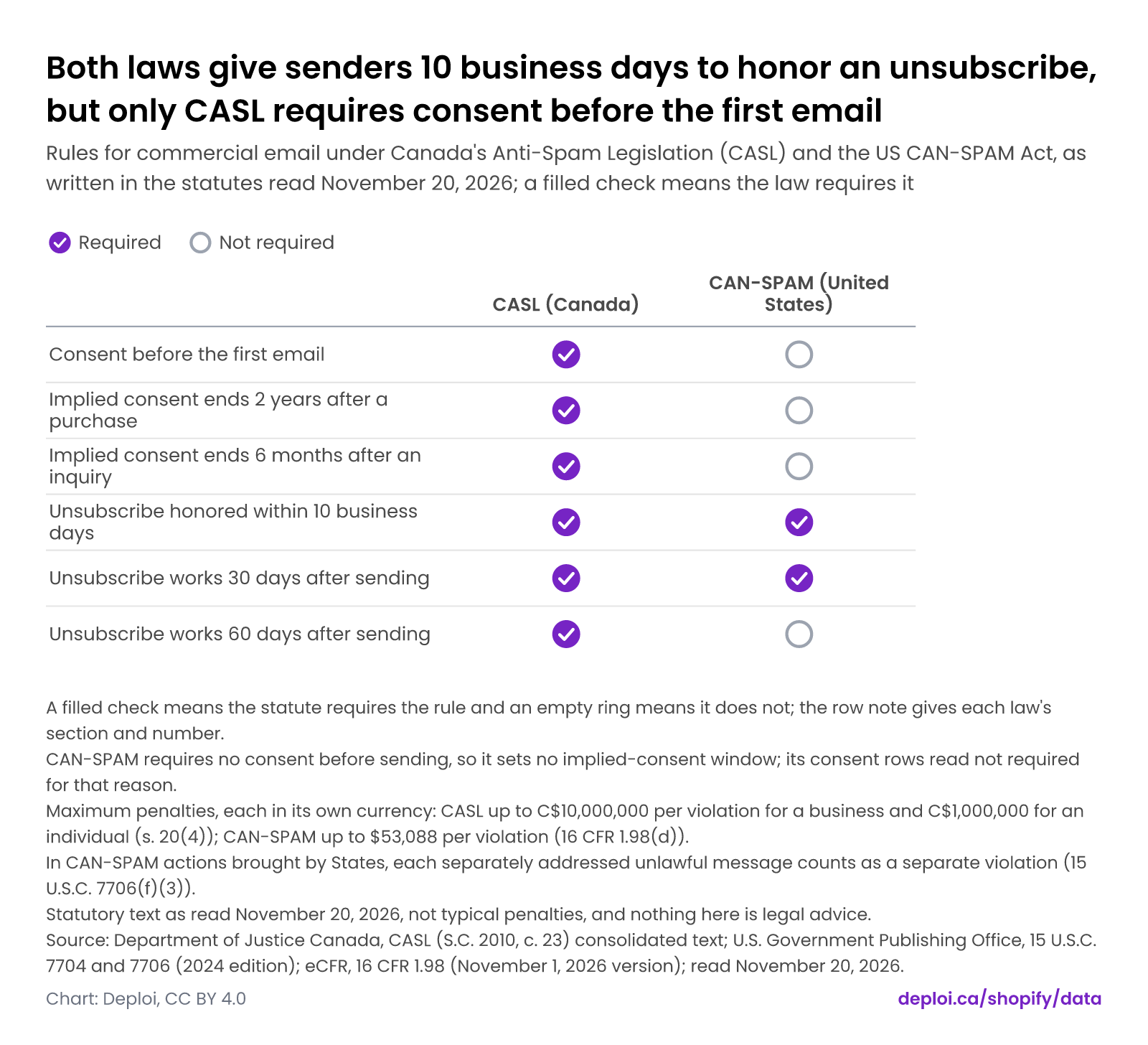
Both laws give senders 10 business days to honor an unsubscribe, but only CASL requires consent before the first email
Rules for commercial email under Canada's Anti-Spam Legislation (CASL) and the US CAN-SPAM Act, as written in the statutes read November 20, 2026; a filled check means the law requires it
- A filled check means the statute requires the rule and an empty ring means it does not; the row note gives each law's section and number.
- CAN-SPAM requires no consent before sending, so it sets no implied-consent window; its consent rows read not required for that reason.
- Maximum penalties, each in its own currency: CASL up to C$10,000,000 per violation for a business and C$1,000,000 for an individual (s. 20(4)); CAN-SPAM up to $53,088 per violation (16 CFR 1.98(d)).
- In CAN-SPAM actions brought by States, each separately addressed unlawful message counts as a separate violation (15 U.S.C. 7706(f)(3)).
- Statutory text as read November 20, 2026, not typical penalties, and nothing here is legal advice.
Source: Department of Justice Canada, CASL (S.C. 2010, c. 23) consolidated text; U.S. Government Publishing Office, 15 U.S.C. 7704 and 7706 (2024 edition); eCFR, 16 CFR 1.98 (November 1, 2026 version); read November 20, 2026. Read on .
Does each law require consent before the first commercial email?
CASL requires consent before the first commercial email, as an opt-in rule in section 6(1), and CAN-SPAM requires none, per the statutes read November 20, 2026. CAN-SPAM makes sending unlawful only after the recipient objects through the unsubscribe mechanism, which Deploi classifies as opt-out, by its reading of the Act's wording.
| Rule | CASL | CAN-SPAM |
|---|---|---|
| Consent before the first email | Required, s. 6(1) | Not required, 15 U.S.C. 7704(a)(4)(A) |
| Consent model | Opt-in | Opt-out, classified by Deploi |
The CAN-SPAM classification rests on paragraph (4)(A) of section 7704, which prohibits sending after the recipient objects, and on the absence of any consent requirement before the first message.
How long does implied consent last under CASL?
CASL implies consent for 2 years after a purchase (s. 10(10)(a)) and for 6 months after an inquiry (s. 10(10)(e)), per the consolidated text read November 20, 2026. CAN-SPAM sets no implied-consent window, because it requires no consent before sending.
| Implied consent window | CASL | CAN-SPAM |
|---|---|---|
| After a purchase | 2 years | No window, no consent asked |
| After an inquiry | 6 months | No window, no consent asked |
How quickly must an unsubscribe request be honored?
Both laws require an unsubscribe request to be honored within 10 business days, CASL in section 11(3) and CAN-SPAM in 15 U.S.C. 7704(a)(4)(A)(i), per the statutes read November 20, 2026. CASL requires the unsubscribe mechanism to work for at least 60 days after sending and CAN-SPAM for at least 30 days.
| Unsubscribe rule | CASL | CAN-SPAM |
|---|---|---|
| Request honored within | 10 business days, s. 11(3) | 10 business days, 7704(a)(4)(A)(i) |
| Mechanism works for at least | 60 days after sending, s. 11(2) | 30 days after transmission, 7704(a)(3)(A)(ii) |
What are the maximum penalties under CASL and CAN-SPAM?
CASL sets a maximum of C$10,000,000 per violation for a business and C$1,000,000 per violation for an individual (s. 20(4)), and CAN-SPAM up to $53,088 per violation (16 CFR 1.98(d)), per the statutes read November 20, 2026. Each amount is in its own currency and is not converted or compared.
In CAN-SPAM actions brought by States, each separately addressed unlawful message counts as a separate violation (15 U.S.C. 7706(f)(3)). CASL writes its amounts in dollars without naming a currency, and Deploi classifies them as Canadian dollars by jurisdiction, because CASL is a Canadian federal statute. These are statutory maximums, not typical penalties.
What do these rules not cover?
The page covers the consent, implied-consent, unsubscribe and penalty rules listed, as written in CASL (S.C. 2010, c. 23), 15 U.S.C. 7704 and 7706 and 16 CFR 1.98 and read on November 20, 2026. It is not legal advice and does not cover every requirement of either law.
Statutory text can be amended, so a later reading can differ. Other requirements of either law are outside this page.
The data
Each chart on this page is drawn from the numbers below. Units are in the column headers.
| Rule | CASL (Canada) | CAN-SPAM (United States) | Matrix note |
|---|---|---|---|
| Consent before the first email | Required | Not required | CASL s. 6(1): opt-in, consent before sending. CAN-SPAM, 15 U.S.C. 7704(a)(4)(A): opt-out, sending allowed until the recipient objects. |
| Implied consent ends 2 years after a purchase | Required | Not required | CASL s. 10(10)(a): consent implied for 2 years after a purchase. CAN-SPAM, 15 U.S.C. 7704(a)(4)(A): opt-out, no consent asked and so no implied-consent period. |
| Implied consent ends 6 months after an inquiry | Required | Not required | CASL s. 10(10)(e): consent implied for 6 months after an inquiry. CAN-SPAM, 15 U.S.C. 7704(a)(4)(A): opt-out, no consent asked and so no implied-consent period. |
| Unsubscribe honored within 10 business days | Required | Required | CASL s. 11(3): within 10 business days. CAN-SPAM, 15 U.S.C. 7704(a)(4)(A)(i): within 10 business days. |
| Unsubscribe works 30 days after sending | Required | Required | CASL s. 11(2): at least 60 days after sending. CAN-SPAM, 15 U.S.C. 7704(a)(3)(A)(ii): at least 30 days after transmission. |
| Unsubscribe works 60 days after sending | Required | Not required | CASL s. 11(2): at least 60 days after sending. CAN-SPAM, 15 U.S.C. 7704(a)(3)(A)(ii): at least 30 days after transmission. |
Download CASL and CAN-SPAM rules for commercial email: consent, implied-consent windows, unsubscribe deadlines, as written on November 20, 2026 as CSV · All 12 columns on the dataset page
Methodology
Reading the chart: Both laws give senders 10 business days to honor an unsubscribe, but only CASL requires consent before the first email
- A filled check means the statute requires the rule and an empty ring means it does not; the row note gives each law's section and number.
- CAN-SPAM requires no consent before sending, so it sets no implied-consent window; its consent rows read not required for that reason.
- Maximum penalties, each in its own currency: CASL up to C$10,000,000 per violation for a business and C$1,000,000 for an individual (s. 20(4)); CAN-SPAM up to $53,088 per violation (16 CFR 1.98(d)).
- In CAN-SPAM actions brought by States, each separately addressed unlawful message counts as a separate violation (15 U.S.C. 7706(f)(3)).
- Statutory text as read November 20, 2026, not typical penalties, and nothing here is legal advice.
Caveats: CASL and CAN-SPAM rules for commercial email: consent, implied-consent windows, unsubscribe deadlines, as written on November 20, 2026
- CAN-SPAM's consent model is classified as opt-out by Deploi's reading of the Act's wording: section 7704 requires no consent before the first message and makes sending unlawful only after the recipient objects.
- CAN-SPAM requires no consent before sending, so it sets no implied-consent window; its consent rows read not required for that reason.
- Statutory text as read November 20, 2026, not legal advice; a later amendment can change it.
Deploi's charts and compilation are licensed CC BY 4.0. The underlying facts belong to their sources, which are named on every page. How Deploi Shopify Data works.
Sources
Tier A sources are primary documents: filings, official releases and official price pages. How sources are ranked.
- Tier A15 U.S.C. 7704 Other protections for users of commercial electronic mail (U.S. Code, 2024 Edition)
U.S. Government Publishing Office (GovInfo) · HTML · Read on
- Tier AAn Act to promote the efficiency and adaptability of the Canadian economy (CASL), S.C. 2010, c. 23, full text
Department of Justice Canada · HTML · Read on
Cite and reuse
Deploi's charts and compilation are licensed CC BY 4.0. The underlying facts belong to their sources, which are named on every page.
APA
Deploi. (2026). How do CASL and CAN-SPAM differ on consent, unsubscribe deadlines and penalties? [Web page]. https://deploi.ca/shopify/data/casl-vs-can-spam Retrieved November 20, 2026.
BibTeX
@misc{deploi_casl_vs_can_spam_2026,
  author = {{Deploi}},
  title = {How do CASL and CAN-SPAM differ on consent, unsubscribe deadlines and penalties?},
  year = {2026},
  url = {https://deploi.ca/shopify/data/casl-vs-can-spam},
  note = {Accessed 2026-11-20}
}
Embed this chart
Embed code
<iframe src="https://deploi.ca/embed/shopify/data/casl-vs-can-spam-rules" title="Both laws give senders 10 business days to honor an unsubscribe, but only CASL requires consent before the first email" loading="lazy" style="width:100%;height:560px;border:0"></iframe>
<p style="font:12px/1.4 Arial,sans-serif;margin:4px 0 0">Source: <a href="https://deploi.ca/shopify/data/charts/casl-vs-can-spam-rules">Deploi, Both laws give senders 10 business days to honor an unsubscribe, but only CASL requires consent before the first email</a></p>
Keep the credit line under the embed. It is the license condition.
Questions
Does CAN-SPAM require opt-in consent?
No. CAN-SPAM requires no consent before the first message and makes sending unlawful only after the recipient objects, per 15 U.S.C. 7704 as read November 20, 2026. Deploi classifies this as opt-out, by its reading of the Act's wording.
Does CASL require consent before sending marketing email?
Yes. CASL section 6(1) requires consent before the first commercial email, as an opt-in rule, per the consolidated text read November 20, 2026. Consent is implied for 2 years after a purchase and 6 months after an inquiry.
How many days do you have to honor an unsubscribe request?
10 business days under both CASL, in section 11(3), and CAN-SPAM, in 15 U.S.C. 7704(a)(4)(A)(i), per the statutes read November 20, 2026. The unsubscribe mechanism must also keep working for at least 60 days after sending under CASL and 30 days under CAN-SPAM.
What is the penalty for breaking CASL compared with CAN-SPAM?
CASL allows up to C$10,000,000 per violation for a business, and CAN-SPAM up to $53,088 per violation (16 CFR 1.98(d)), per CASL and that regulation, read November 20, 2026. The amounts are in different currencies and are not converted or compared.
How long does a purchase give implied consent under CASL?
2 years after the purchase, under section 10(10)(a) of CASL as read November 20, 2026. An inquiry gives implied consent for 6 months under section 10(10)(e).
More on Canada
- How much does a Canadian online shopper spend a year on goods and services ordered online?
Canadian online shoppers spent an average of C$3,376 online in 2020, against C$2,554 in 2018, with those aged 25 to 44 highest at C$4,552, per Statistics Canada's Canadian Internet Use Survey. Updated November 20, 2026.
- What fixed maximum penalties do CASL, PIPEDA, Quebec's Law 25, the Competition Act and the French Charter set for an online store?
For the one penalty charted under each of five Canadian and Quebec laws, the fixed maximum for a business is C$25,000,000 under Quebec's Law 25, C$15,000,000 per subsequent order under the Competition Act, C$10,000,000 under CASL, C$100,000 under PIPEDA and C$30,000 under the French-language Charter for breaking an Office order, per statutes read November 20, 2026. Updated November 20, 2026.
- What import duty does Canada charge by product, from apparel to electronics?
Canada's most common Most-Favoured-Nation duty is 18% on apparel and footwear and Free on electronics and toys, per the Customs Tariff 2026 chapters read November 20, 2026. Updated November 20, 2026.
- What share of households in each Canadian province and 9 metro areas buy online?
In 2023, 84% of Canadian households bought online, up from 76% in 2019, with provincial shares from 79% in Quebec to 87% in Alberta, per Statistics Canada's Households and the Environment Survey, released December 9, 2025. Updated November 20, 2026.
- Which retail categories are growing and which are shrinking in Canada?
Automotive and household fuels grew most of 17 Canadian retail commodity groups, up 25.1% from August 2025 to August 2026, while audio, video and game software fell 18.6%, computed by Deploi from Statistics Canada data released November 6, 2026. Updated November 20, 2026.
- Is Canada's online share of retail really less than half the US share?
Computed by Deploi from each agency's series, Canada's online share of retail was 7.0% in 2025 against 17.0% for the US, but the agencies define retail e-commerce differently. Updated November 19, 2026.
Changes
- · CASL and CAN-SPAM rules for commercial email: consent, implied-consent windows, unsubscribe deadlines, as written on November 20, 2026
First release. 8 rule rows and 6 matrix rows from CASL and 15 U.S.C. 7704.