
What fixed maximum penalties do CASL, PIPEDA, Quebec's Law 25, the Competition Act and the French Charter set for an online store?
For the one penalty charted under each of five Canadian and Quebec laws, the fixed maximum for a business is C$25,000,000 under Quebec's Law 25, C$15,000,000 per subsequent order under the Competition Act, C$10,000,000 under CASL, C$100,000 under PIPEDA and C$30,000 under the French-language Charter for breaking an Office order, per statutes read November 20, 2026. Updated November 20, 2026.
By Martin DejnickiUpdated Data through November 20, 2026
Short answer
Five Canadian and Quebec laws set fixed maximum penalties for a business of C$25,000,000 per offence under Quebec's Law 25, C$15,000,000 per subsequent order under the Competition Act, C$10,000,000 per violation under CASL and C$100,000 on indictment under PIPEDA, per statutes read November 20, 2026. The Charter's C$30,000 applies to breaking an Office order, and a judge may add more.
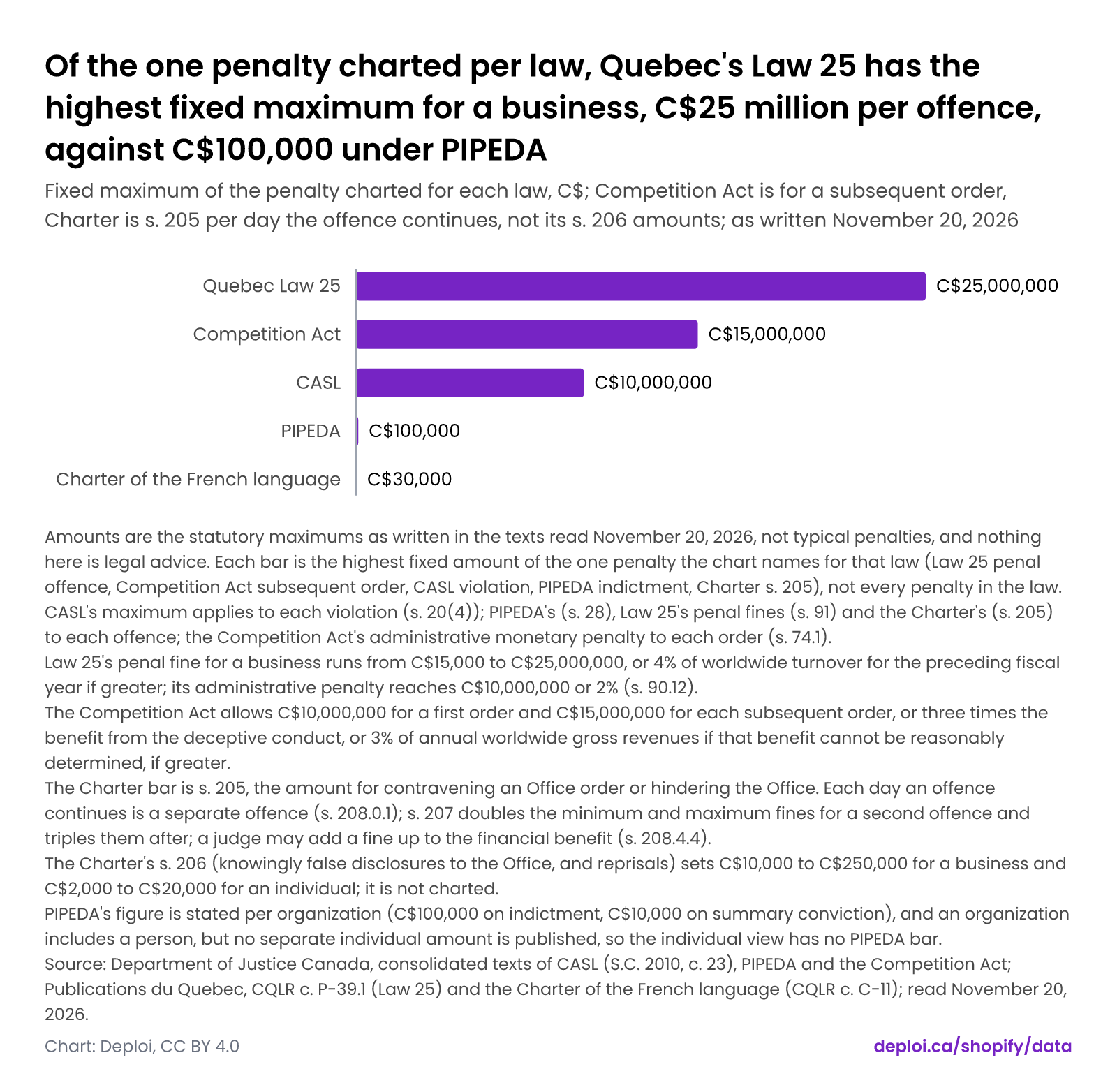
Of the one penalty charted per law, Quebec's Law 25 has the highest fixed maximum for a business, C$25 million per offence, against C$100,000 under PIPEDA
Fixed maximum of the penalty charted for each law, C$; Competition Act is for a subsequent order, Charter is s. 205 per day the offence continues, not its s. 206 amounts; as written November 20, 2026
Business: fixed maximum of the charted penalty under each Canadian law, CAD
For a business: C$25,000,000 under Law 25, C$15,000,000 per subsequent order under the Competition Act, C$10,000,000 under CASL, C$100,000 under PIPEDA and C$30,000 under the Charter for contravening an Office order (s. 205).
Showing: Penalty for: Business. Reset
- Amounts are the statutory maximums as written in the texts read November 20, 2026, not typical penalties, and nothing here is legal advice. Each bar is the highest fixed amount of the one penalty the chart names for that law (Law 25 penal offence, Competition Act subsequent order, CASL violation, PIPEDA indictment, Charter s. 205), not every penalty in the law.
- CASL's maximum applies to each violation (s. 20(4)); PIPEDA's (s. 28), Law 25's penal fines (s. 91) and the Charter's (s. 205) to each offence; the Competition Act's administrative monetary penalty to each order (s. 74.1).
- Law 25's penal fine for a business runs from C$15,000 to C$25,000,000, or 4% of worldwide turnover for the preceding fiscal year if greater; its administrative penalty reaches C$10,000,000 or 2% (s. 90.12).
- The Competition Act allows C$10,000,000 for a first order and C$15,000,000 for each subsequent order, or three times the benefit from the deceptive conduct, or 3% of annual worldwide gross revenues if that benefit cannot be reasonably determined, if greater.
- The Charter bar is s. 205, the amount for contravening an Office order or hindering the Office. Each day an offence continues is a separate offence (s. 208.0.1); s. 207 doubles the minimum and maximum fines for a second offence and triples them after; a judge may add a fine up to the financial benefit (s. 208.4.4).
- The Charter's s. 206 (knowingly false disclosures to the Office, and reprisals) sets C$10,000 to C$250,000 for a business and C$2,000 to C$20,000 for an individual; it is not charted.
- PIPEDA's figure is stated per organization (C$100,000 on indictment, C$10,000 on summary conviction), and an organization includes a person, but no separate individual amount is published, so the individual view has no PIPEDA bar.
Source: Department of Justice Canada, consolidated texts of CASL (S.C. 2010, c. 23), PIPEDA and the Competition Act; Publications du Quebec, CQLR c. P-39.1 (Law 25) and the Charter of the French language (CQLR c. C-11); read November 20, 2026. Read on .
Which charted penalty has the highest fixed maximum for a business?
Of the one penalty charted for each of five laws, Quebec's Law 25 penal offence has the highest fixed maximum for a business, C$25,000,000 per offence in section 91, or 4% of worldwide turnover for the preceding fiscal year if greater, per statutes read November 20, 2026. The Competition Act follows at C$15,000,000 per subsequent order and CASL at C$10,000,000 per violation.
| Law and penalty, for a business | Fixed maximum | Counted per | Section |
|---|---|---|---|
| Quebec Law 25, penal offence | C$25,000,000 | Offence | s. 91 |
| Competition Act, subsequent order | C$15,000,000 | Order | s. 74.1(1)(c)(ii) |
| CASL | C$10,000,000 | Violation | s. 20(4) |
| Quebec Law 25, administrative penalty | C$10,000,000 | Not stated | s. 90.12 |
| PIPEDA, indictable offence | C$100,000 | Offence | s. 28(b) |
| Charter of the French language, breaking an Office order or hindering the Office | C$30,000 | Offence | s. 205 |
| PIPEDA, summary conviction | C$10,000 | Offence | s. 28(a) |
The Competition Act's first-order maximum for a business is C$10,000,000. The Charter's section 206, for knowingly false disclosures to the Office and reprisals, sets up to C$250,000 for a business and is not charted. The chart compares one named penalty per law, not each law's highest amount, and the Competition Act bar is a subsequent-order amount while the Law 25 bar is a first-offence amount. Law 25 is CQLR c. P-39.1 and the Charter is CQLR c. C-11.
How is each penalty counted, and which laws set a minimum fine?
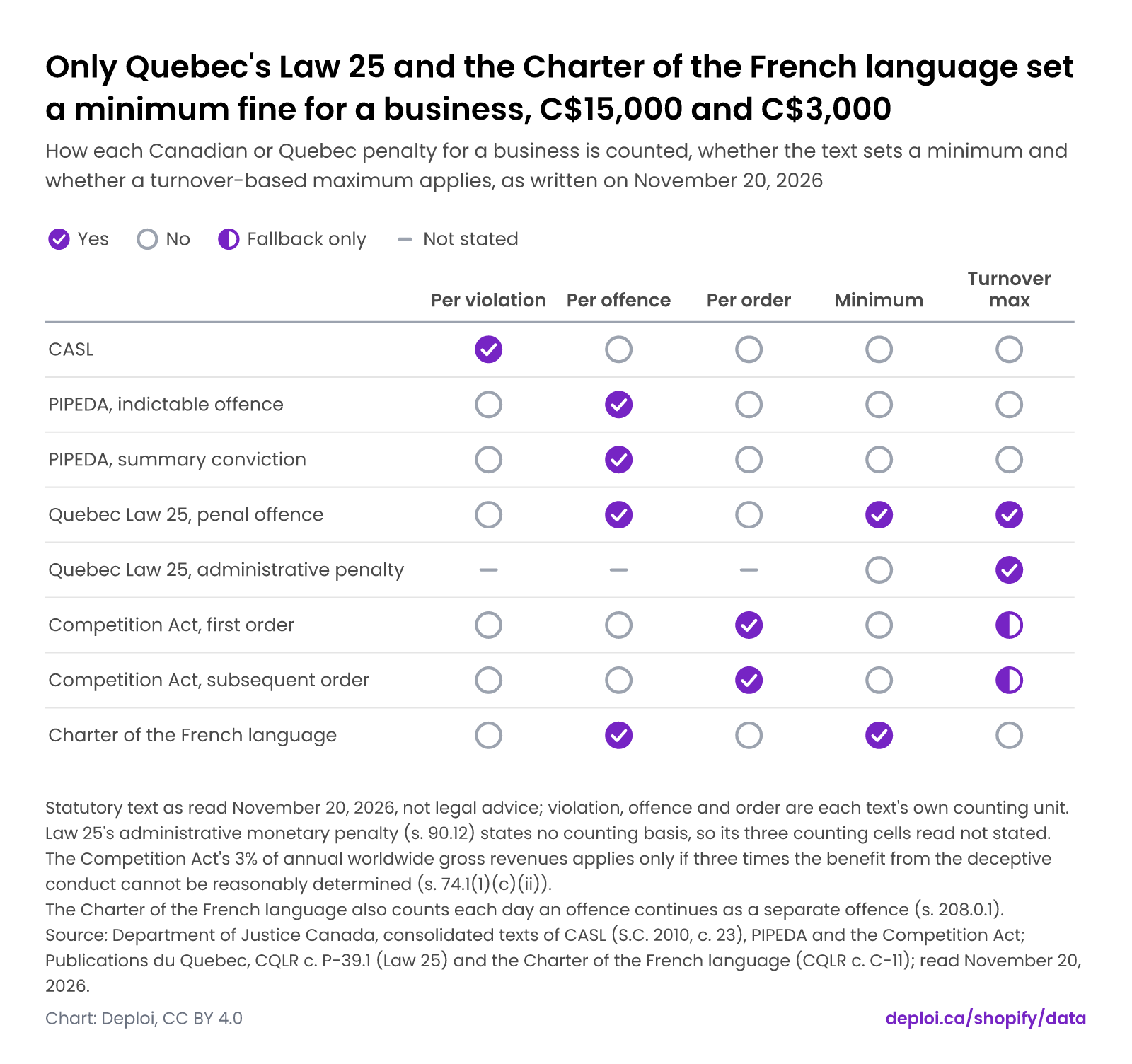
CASL counts per violation, PIPEDA, Law 25's penal fines and the Charter of the French language per offence, and the Competition Act per order, as written in the statutes read November 20, 2026. Only Law 25 and the Charter set a minimum fine for a business, C$15,000 under Law 25's section 91 and C$3,000 under the Charter's section 205.
| Law, for a business | Counted per | Minimum | Turnover-based alternative |
|---|---|---|---|
| CASL | Violation | None | None |
| PIPEDA | Offence | None | None |
| Quebec Law 25, penal | Offence | C$15,000 | 4% of worldwide turnover, if greater |
| Quebec Law 25, administrative | Not stated | None | 2% of worldwide turnover, if greater |
| Competition Act | Order | None | 3% of annual worldwide gross revenues, only if the benefit cannot be reasonably determined |
| Charter of the French language, s. 205 | Offence | C$3,000 | None |
Law 25's administrative penalty states no counting basis. The Charter counts each day an offence continues as a separate offence (s. 208.0.1). It doubles the minimum and maximum fines for a second offence and triples them for a subsequent one, where the prior conviction is within two years (s. 207). Law 25 doubles its penal fines for a subsequent offence, which is not in the figures above.
Only Quebec's Law 25 and the Charter of the French language set a minimum fine for a business, C$15,000 and C$3,000
How each Canadian or Quebec penalty for a business is counted, whether the text sets a minimum and whether a turnover-based maximum applies, as written on November 20, 2026
- Statutory text as read November 20, 2026, not legal advice; violation, offence and order are each text's own counting unit.
- Law 25's administrative monetary penalty (s. 90.12) states no counting basis, so its three counting cells read not stated.
- The Competition Act's 3% of annual worldwide gross revenues applies only if three times the benefit from the deceptive conduct cannot be reasonably determined (s. 74.1(1)(c)(ii)).
- The Charter of the French language also counts each day an offence continues as a separate offence (s. 208.0.1).
Source: Department of Justice Canada, consolidated texts of CASL (S.C. 2010, c. 23), PIPEDA and the Competition Act; Publications du Quebec, CQLR c. P-39.1 (Law 25) and the Charter of the French language (CQLR c. C-11); read November 20, 2026. Read on .
When does a Charter of the French language fine apply to an online store?
Section 205 of Quebec's Charter of the French language sets C$3,000 to C$30,000 for a business for breaking an order of the Office (s. 177), hindering the Office or breaking the Charter's school rules, per the text read November 20, 2026. Sections 205 and 206 do not list the Charter's commercial French-language duties as offences.
A store's first failure to meet a commercial French-language duty is therefore not an offence until it breaks an Office order. Section 205 also fines contraventions of orders under section 128.3. For an individual, section 205 sets C$700 to C$7,000.
Section 206 sets C$10,000 to C$250,000 for a business and C$2,000 to C$20,000 for an individual. It covers knowingly false or misleading disclosures to the Office and reprisals against a person who discloses or cooperates.
Each day an offence continues is a separate offence (s. 208.0.1). A judge may add a fine up to the financial benefit realized, even above the maximum (s. 208.4.4), so C$30,000 is not a hard ceiling. This is not legal advice.
What are the maximums for an individual instead of a business?
For an individual the fixed maximums are C$1,000,000 per violation under CASL and per subsequent order under the Competition Act, C$100,000 per offence under Law 25's penal fines and C$7,000 per offence under section 205 of the Charter, per statutes read November 20, 2026. PIPEDA's fines are stated per organization, which its section 2 defines to include a person, and it publishes no separate individual figure.
Law 25's administrative penalty for an individual is up to C$50,000, and its penal fine starts at C$5,000. The Competition Act allows C$750,000 for an individual's first order. The Charter's section 205 fine for an individual runs from C$700 to C$7,000 per offence, and section 206 sets up to C$20,000.
How do the turnover and benefit alternatives work?
Law 25 and the Competition Act add an alternative maximum that applies if greater than the fixed amount, per the statutes read November 20, 2026. For a business, Law 25 allows 4% of worldwide turnover for the preceding fiscal year for penal fines and 2% for administrative penalties. The Competition Act allows three times the benefit from the deceptive conduct.
The Competition Act's 3% of annual worldwide gross revenues applies only if the benefit cannot be reasonably determined (s. 74.1(1)(c)(ii)). Law 25's administrative penalty reaches C$10,000,000 or 2%.
What do these maximums not show?
The amounts are statutory maximums as written in the texts read November 20, 2026, not typical or expected penalties, and nothing here is legal advice. The chart compares one named penalty per law, not each law's highest amount, and covers only the five laws named on this page. The Charter's section 206 amounts, up to C$250,000, are higher than the charted C$30,000.
All five laws write their amounts in dollars without naming a currency. Deploi classifies them as Canadian dollars by jurisdiction, because CASL, PIPEDA and the Competition Act are Canadian federal statutes and Law 25 and the Charter are Quebec statutes. The dataset's CAN-SPAM and CCPA rows are classified as US dollars the same way, and are not part of this comparison.
PIPEDA's fines apply only to an organization, which its section 2 defines to include a person, that knowingly contravenes the provisions listed in section 28 or obstructs the Commissioner. The comparison covers CASL, PIPEDA, Law 25, the Competition Act's deceptive-marketing rules and the Charter only.
The data
Each chart on this page is drawn from the numbers below. Units are in the column headers.
Of the one penalty charted per law, Quebec's Law 25 has the highest fixed maximum for a business, C$25 million per offence, against C$100,000 under PIPEDA
| Law | Case | Maximum amount (local currency) | Minimum amount (local currency) | Turnover-based maximum (% of worldwide turnover) | Counted per | Section | Canada maximum view |
|---|---|---|---|---|---|---|---|
| CASL | Business | 10,000,000 | Not stated | Not stated | Per violation | CASL (S.C. 2010, c. 23), s. 20(4) | business |
| CASL | Individual | 1,000,000 | Not stated | Not stated | Per violation | CASL (S.C. 2010, c. 23), s. 20(4) | individual |
| PIPEDA | Offence punishable on indictment | 100,000 | Not stated | Not stated | Per offence | Personal Information Protection and Electronic Documents Act, s. 28(b) | business |
| PIPEDA | Offence punishable on summary conviction | 10,000 | Not stated | Not stated | Per offence | Personal Information Protection and Electronic Documents Act, s. 28(a) | |
| Quebec Law 25 | Penal offence, business | 25,000,000 | 15,000 | 4 | Per offence | Act respecting the protection of personal information in the private sector, s. 91 | business |
| Quebec Law 25 | Penal offence, individual | 100,000 | 5,000 | Not stated | Per offence | Act respecting the protection of personal information in the private sector, s. 91 | individual |
| Quebec Law 25 | Administrative monetary penalty, business | 10,000,000 | Not stated | 2 | Act respecting the protection of personal information in the private sector, s. 90.12 | ||
| Quebec Law 25 | Administrative monetary penalty, individual | 50,000 | Not stated | Not stated | Act respecting the protection of personal information in the private sector, s. 90.12 | ||
| Competition Act | Administrative monetary penalty, business, first order | 10,000,000 | Not stated | 3 | Per order: first order; alternatively three times the value of the benefit derived from the deceptive conduct or, if that amount cannot be reasonably determined, 3% of the corporation's annual worldwide gross revenues, if greater | Competition Act, s. 74.1(1)(c)(ii) | |
| Competition Act | Administrative monetary penalty, business, each subsequent order | 15,000,000 | Not stated | 3 | Per order: each subsequent order; alternatively three times the value of the benefit derived from the deceptive conduct or, if that amount cannot be reasonably determined, 3% of the corporation's annual worldwide gross revenues, if greater | Competition Act, s. 74.1(1)(c)(ii) | business |
| Competition Act | Administrative monetary penalty, individual, first order | 750,000 | Not stated | Not stated | Per order: first order; alternatively three times the value of the benefit derived from the deceptive conduct, if reasonably determinable, if greater | Competition Act, s. 74.1(1)(c)(i) | |
| Competition Act | Administrative monetary penalty, individual, each subsequent order | 1,000,000 | Not stated | Not stated | Per order: each subsequent order; alternatively three times the value of the benefit derived from the deceptive conduct, if reasonably determinable, if greater | Competition Act, s. 74.1(1)(c)(i) | individual |
| Charter of the French language | Business: contravening an Office order or hindering the Office (s. 205) | 30,000 | 3,000 | Not stated | Per offence (each day a continuing offence continues is a separate offence, s. 208.0.1; minimum and maximum fines doubled for a second offence and tripled for a subsequent offence where the prior conviction is within two years, s. 207; the judge may add a further fine up to the financial benefit realized, even if the maximum fine has been imposed, s. 208.4.4) | Charter of the French language, s. 205 | business |
| Charter of the French language | Individual: contravening an Office order or hindering the Office (s. 205) | 7,000 | 700 | Not stated | Per offence (each day a continuing offence continues is a separate offence, s. 208.0.1; minimum and maximum fines doubled for a second offence and tripled for a subsequent offence where the prior conviction is within two years, s. 207; the judge may add a further fine up to the financial benefit realized, even if the maximum fine has been imposed, s. 208.4.4) | Charter of the French language, s. 205 | individual |
| Charter of the French language | Business: knowingly false disclosure or reprisal (s. 206) | 250,000 | 10,000 | Not stated | Per offence (each day a continuing offence continues is a separate offence, s. 208.0.1; minimum and maximum fines doubled for a second offence and tripled for a subsequent offence where the prior s. 206 conviction is within five years, s. 207; the judge may add a further fine up to the financial benefit realized, even if the maximum fine has been imposed, s. 208.4.4) | Charter of the French language, s. 206 | |
| Charter of the French language | Individual: knowingly false disclosure or reprisal (s. 206) | 20,000 | 2,000 | Not stated | Per offence (each day a continuing offence continues is a separate offence, s. 208.0.1; minimum and maximum fines doubled for a second offence and tripled for a subsequent offence where the prior s. 206 conviction is within five years, s. 207; the judge may add a further fine up to the financial benefit realized, even if the maximum fine has been imposed, s. 208.4.4) | Charter of the French language, s. 206 | |
| CAN-SPAM Act | Per violation | 53,088 | Not stated | Not stated | Per violation (each separately addressed unlawful message is treated as a separate violation) | 15 U.S.C. 7706(a) and 16 CFR 1.98(d) | |
| GDPR | Higher tier | 20,000,000 | Not stated | 4 | Per infringement (for linked processing operations the total fine may not exceed the gravest infringement, Art. 83(3)) | Article 83(5), Regulation (EU) 2016/679 | |
| GDPR | Lower tier | 10,000,000 | Not stated | 2 | Per infringement (for linked processing operations the total fine may not exceed the gravest infringement, Art. 83(3)) | Article 83(4), Regulation (EU) 2016/679 | |
| UK GDPR | Higher maximum | 17,500,000 | Not stated | 4 | Per infringement | Data Protection Act 2018, s. 157(5) | |
| UK GDPR | Standard maximum | 8,700,000 | Not stated | 2 | Per infringement | Data Protection Act 2018, s. 157(6) | |
| CCPA | Per violation | 2,663 | Not stated | Not stated | Per violation | Civil Code 1798.155(a) (administrative fine) and 1798.199.90(a) (civil penalty), 2025 CPI-adjusted amounts | |
| CCPA | Intentional violation | 7,988 | Not stated | Not stated | Per intentional violation (and violations involving personal information of consumers the violator has actual knowledge are under 16) | Civil Code 1798.155(a) (administrative fine) and 1798.199.90(a) (civil penalty), 2025 CPI-adjusted amounts |
Download Maximum penalties under laws that govern online stores (anti-spam, privacy, deceptive marketing, French language), as written on November 20, 2026 as CSV · All 23 columns on the dataset page
Only Quebec's Law 25 and the Charter of the French language set a minimum fine for a business, C$15,000 and C$3,000
| Penalty | Per violation (yes/no) | Per offence (yes/no) | Per order (yes/no) | Minimum (yes/no) | Turnover max | Chart note | Minimum amount (local currency) | Turnover-based maximum (% of worldwide turnover) | Maximum amount (local currency) | Section |
|---|---|---|---|---|---|---|---|---|---|---|
| CASL | Yes | No | No | No | No | s. 20(4): up to C$10,000,000 per violation. | Not stated | Not stated | 10,000,000 | CASL (S.C. 2010, c. 23), s. 20(4) |
| PIPEDA, indictable offence | No | Yes | No | No | No | s. 28(b): up to C$100,000 per offence. | Not stated | Not stated | 100,000 | Personal Information Protection and Electronic Documents Act, s. 28(b) |
| PIPEDA, summary conviction | No | Yes | No | No | No | s. 28(a): up to C$10,000 per offence. | Not stated | Not stated | 10,000 | Personal Information Protection and Electronic Documents Act, s. 28(a) |
| Quebec Law 25, penal offence | No | Yes | No | Yes | Yes | s. 91: C$15,000 to C$25,000,000 per offence, or 4% of worldwide turnover for the preceding fiscal year if greater. | 15,000 | 4 | 25,000,000 | Act respecting the protection of personal information in the private sector, s. 91 |
| Quebec Law 25, administrative penalty | Not stated | Not stated | Not stated | No | Yes | s. 90.12: up to C$10,000,000, or 2% of worldwide turnover for the preceding fiscal year if greater. | Not stated | 2 | 10,000,000 | Act respecting the protection of personal information in the private sector, s. 90.12 |
| Competition Act, first order | No | No | Yes | No | Fallback only | s. 74.1(1)(c)(ii): up to C$10,000,000 for a first order, or three times the value of the benefit derived from the deceptive conduct or, if that amount cannot be reasonably determined, 3% of the corporation's annual worldwide gross revenues, if greater. | Not stated | 3 | 10,000,000 | Competition Act, s. 74.1(1)(c)(ii) |
| Competition Act, subsequent order | No | No | Yes | No | Fallback only | s. 74.1(1)(c)(ii): up to C$15,000,000 for each subsequent order, or three times the value of the benefit derived from the deceptive conduct or, if that amount cannot be reasonably determined, 3% of the corporation's annual worldwide gross revenues, if greater. | Not stated | 3 | 15,000,000 | Competition Act, s. 74.1(1)(c)(ii) |
| Charter of the French language | No | Yes | No | Yes | No | s. 205: C$3,000 to C$30,000 per offence. | 3,000 | Not stated | 30,000 | Charter of the French language, s. 205 |
Download Maximum penalties under laws that govern online stores (anti-spam, privacy, deceptive marketing, French language), as written on November 20, 2026 as CSV · All 23 columns on the dataset page
Methodology
Reading the chart: Of the one penalty charted per law, Quebec's Law 25 has the highest fixed maximum for a business, C$25 million per offence, against C$100,000 under PIPEDA
- Amounts are the statutory maximums as written in the texts read November 20, 2026, not typical penalties, and nothing here is legal advice. Each bar is the highest fixed amount of the one penalty the chart names for that law (Law 25 penal offence, Competition Act subsequent order, CASL violation, PIPEDA indictment, Charter s. 205), not every penalty in the law.
- CASL's maximum applies to each violation (s. 20(4)); PIPEDA's (s. 28), Law 25's penal fines (s. 91) and the Charter's (s. 205) to each offence; the Competition Act's administrative monetary penalty to each order (s. 74.1).
- Law 25's penal fine for a business runs from C$15,000 to C$25,000,000, or 4% of worldwide turnover for the preceding fiscal year if greater; its administrative penalty reaches C$10,000,000 or 2% (s. 90.12).
- The Competition Act allows C$10,000,000 for a first order and C$15,000,000 for each subsequent order, or three times the benefit from the deceptive conduct, or 3% of annual worldwide gross revenues if that benefit cannot be reasonably determined, if greater.
- The Charter bar is s. 205, the amount for contravening an Office order or hindering the Office. Each day an offence continues is a separate offence (s. 208.0.1); s. 207 doubles the minimum and maximum fines for a second offence and triples them after; a judge may add a fine up to the financial benefit (s. 208.4.4).
- The Charter's s. 206 (knowingly false disclosures to the Office, and reprisals) sets C$10,000 to C$250,000 for a business and C$2,000 to C$20,000 for an individual; it is not charted.
- PIPEDA's figure is stated per organization (C$100,000 on indictment, C$10,000 on summary conviction), and an organization includes a person, but no separate individual amount is published, so the individual view has no PIPEDA bar.
Reading the chart: Only Quebec's Law 25 and the Charter of the French language set a minimum fine for a business, C$15,000 and C$3,000
- Statutory text as read November 20, 2026, not legal advice; violation, offence and order are each text's own counting unit.
- Law 25's administrative monetary penalty (s. 90.12) states no counting basis, so its three counting cells read not stated.
- The Competition Act's 3% of annual worldwide gross revenues applies only if three times the benefit from the deceptive conduct cannot be reasonably determined (s. 74.1(1)(c)(ii)).
- The Charter of the French language also counts each day an offence continues as a separate offence (s. 208.0.1).
Caveats: Maximum penalties under laws that govern online stores (anti-spam, privacy, deceptive marketing, French language), as written on November 20, 2026
- Statutory maximums, not typical penalties; the pages say so and give no legal advice.
- Amounts are in each law's own currency (CAD, USD, EUR or GBP) and are never converted or added.
- The Canadian and Quebec statutes (CASL, PIPEDA, the Competition Act, Law 25 and the Charter of the French language) and the US statutes (CAN-SPAM and CCPA) write amounts as '$' without naming a currency; Deploi classified them as CAD for the Canadian and Quebec statutes and USD for the US statutes by jurisdiction.
- Law 25's administrative penalty states no counting basis, so its basis is empty, not none.
- PIPEDA's fines (s. 28) apply to an organization that knowingly contravenes the provisions listed in section 28 or obstructs the Commissioner, and section 2 defines organization to include an association, a partnership, a person and a trade union, so the C$100,000 and C$10,000 maximums can reach a person. PIPEDA sets no separate individual amount, so no PIPEDA row is marked for the individual view; that does not mean an individual cannot be fined.
- The charts compare one named penalty per law, not each law's highest amount; the Charter's s. 206 rows (up to C$250,000 for a business) are not charted.
- The Charter of the French language rows give its two fine sections. Section 205 (C$3,000 to C$30,000 for a business, C$700 to C$7,000 for a natural person) fines contraventions of sections 78.1 to 78.3 and 176 and of orders under sections 128.3 and 177: for an online store, contravening an order of the Office to comply or stop contravening (s. 177) or hindering the Office (s. 176). Sections 205 and 206 do not list the Charter's commercial French-language duties as offences, so a first failure is not an offence until it breaks an Office order.
- Section 206 of the Charter (C$10,000 to C$250,000 for a business, C$2,000 to C$20,000 for a natural person) applies only to knowingly false or misleading disclosures to the Office (s. 165.22) and reprisals against a person who discloses or cooperates (s. 165.24).
- Under the Charter, the minimum and maximum fines are doubled for a second offence and tripled for a subsequent one (s. 207), each day an offence continues is a separate offence (s. 208.0.1), and a judge may add a fine up to the financial benefit realized, even above the maximum (s. 208.4.4), so C$30,000 is not a hard ceiling.
- Not included in the figures: Law 25 doubles its penal fines for a subsequent offence (s. 92.1: 'In the case of a subsequent offence, the fines under this division are doubled.'), so C$25,000,000 is a first-offence maximum, not a ceiling; the Competition Act amount charted is its subsequent-order amount, so the two bars are on different bases.
- Not included: the Competition Act's criminal offence for false or misleading representations (s. 52) and its fine, and CASL's offence fines (s. 46), which apply to non-compliance with demands and notices issued in an investigation and to obstruction (ss. 42 and 43), not to sending messages. The CASL and Competition Act rows are administrative monetary penalties, not offences: CASL s. 30 says a violation is not an offence, and Competition Act s. 74.1(4) says the terms of the order are set not with a view to punishment.
Deploi's charts and compilation are licensed CC BY 4.0. The underlying facts belong to their sources, which are named on every page. How Deploi Shopify Data works.
Sources
Tier A sources are primary documents: filings, official releases and official price pages. How sources are ranked.
Show all 10 sources
- Tier AUpdated Monetary Thresholds in CCPA
California Privacy Protection Agency · HTML · Read on
- Tier A16 CFR 1.98 Adjustment of civil monetary penalty amounts (eCFR XML, 2026-11-01 version)
Office of the Federal Register and U.S. Government Publishing Office (eCFR) · TEXT · Read on
- Tier ARegulation (EU) 2016/679 (GDPR), Official Journal L 119, English text, Article 83
Publications Office of the European Union (EUR-Lex) · HTML · Read on
- Tier A15 U.S.C. 7706 Enforcement (U.S. Code, 2024 Edition)
U.S. Government Publishing Office (GovInfo) · HTML · Read on
- Tier AAn Act to promote the efficiency and adaptability of the Canadian economy (CASL), S.C. 2010, c. 23, full text
Department of Justice Canada · HTML · Read on
- Tier ACompetition Act, R.S.C. 1985, c. C-34, full text
Department of Justice Canada · HTML · Read on
- Tier APersonal Information Protection and Electronic Documents Act (PIPEDA), full text
Department of Justice Canada · HTML · Read on
- Tier AData Protection Act 2018, section 157 Maximum amount of penalty
The National Archives (legislation.gov.uk) · HTML · Read on
- Tier ACharter of the French language (CQLR c. C-11)
Les Publications du Quebec, Gouvernement du Quebec · HTML · Read on
- Tier AAct respecting the protection of personal information in the private sector (CQLR c. P-39.1, as amended by Law 25)
Les Publications du Quebec, Gouvernement du Quebec · HTML · Read on
Cite and reuse
Deploi's charts and compilation are licensed CC BY 4.0. The underlying facts belong to their sources, which are named on every page.
APA
Deploi. (2026). What fixed maximum penalties do CASL, PIPEDA, Quebec's Law 25, the Competition Act and the French Charter set for an online store? [Web page]. https://deploi.ca/shopify/data/canada-online-store-penalty-maximums Retrieved November 20, 2026.
BibTeX
@misc{deploi_canada_online_store_penalty_maximums_2026,
  author = {{Deploi}},
  title = {What fixed maximum penalties do CASL, PIPEDA, Quebec's Law 25, the Competition Act and the French Charter set for an online store?},
  year = {2026},
  url = {https://deploi.ca/shopify/data/canada-online-store-penalty-maximums},
  note = {Accessed 2026-11-20}
}
Embed a chart
Embed: Of the one penalty charted per law, Quebec's Law 25 has the highest fixed maximum for a business, C$25 million per offence, against C$100,000 under PIPEDA
Embed code
<iframe src="https://deploi.ca/embed/shopify/data/canada-online-store-max-penalties" title="Of the one penalty charted per law, Quebec's Law 25 has the highest fixed maximum for a business, C$25 million per offence, against C$100,000 under PIPEDA" loading="lazy" style="width:100%;height:540px;border:0"></iframe> <p style="font:12px/1.4 Arial,sans-serif;margin:4px 0 0">Source: <a href="https://deploi.ca/shopify/data/charts/canada-online-store-max-penalties">Deploi, Of the one penalty charted per law, Quebec's Law 25 has the highest fixed maximum for a business, C$25 million per offence, against C$100,000 under PIPEDA</a></p>
Embed: Only Quebec's Law 25 and the Charter of the French language set a minimum fine for a business, C$15,000 and C$3,000
Embed code
<iframe src="https://deploi.ca/embed/shopify/data/canada-penalty-basis-matrix" title="Only Quebec's Law 25 and the Charter of the French language set a minimum fine for a business, C$15,000 and C$3,000" loading="lazy" style="width:100%;height:620px;border:0"></iframe> <p style="font:12px/1.4 Arial,sans-serif;margin:4px 0 0">Source: <a href="https://deploi.ca/shopify/data/canada-online-store-penalty-maximums#chart-canada-penalty-basis-matrix">Deploi, Only Quebec's Law 25 and the Charter of the French language set a minimum fine for a business, C$15,000 and C$3,000</a></p>
Keep the credit line under the embed. It is the license condition.
Downloads
- Chart: Of the one penalty charted per law, Quebec's Law 25 has the highest fixed maximum for a business, C$25 million per offence, against C$100,000 under PIPEDA PNG
- Chart: Only Quebec's Law 25 and the Charter of the French language set a minimum fine for a business, C$15,000 and C$3,000 PNG
- Data: Maximum penalties under laws that govern online stores (anti-spam, privacy, deceptive marketing, French language), as written on November 20, 2026 CSV
Questions
What is the maximum penalty under CASL?
C$10,000,000 per violation for a business and C$1,000,000 per violation for an individual, per section 20(4) of CASL (S.C. 2010, c. 23), as written in the Department of Justice Canada text read November 20, 2026.
What is the maximum fine under PIPEDA?
C$100,000 per offence on indictment and C$10,000 on summary conviction, per section 28 of PIPEDA, as written in the Department of Justice Canada text read November 20, 2026. The fines apply to an organization that knowingly contravenes the provisions listed in section 28 or obstructs the Commissioner, and carry no minimum.
What are the penalties under Quebec's Law 25?
A penal fine for a business of C$15,000 to C$25,000,000 per offence, or 4% of worldwide turnover if greater, and an administrative penalty up to C$10,000,000 or 2% if greater, per the statute (CQLR c. P-39.1) read November 20, 2026.
How much can the Competition Act penalize deceptive marketing?
The Competition Act's administrative monetary penalty for deceptive marketing, under section 74.1, is up to C$10,000,000 for a business's first order and C$15,000,000 for each subsequent order, or three times the benefit from the deceptive conduct if greater, as written in the text read November 20, 2026. The page covers this administrative penalty only, not every penalty in the Act.
Which of the five laws has the lowest fixed maximum fine for a business?
PIPEDA's summary conviction fine is the lowest fixed business maximum among the five laws, C$10,000 per offence under section 28(a), against C$100,000 on indictment under section 28(b), per the text read November 20, 2026. The Charter's section 205 allows C$3,000 to C$30,000 per offence.
What fine does the French language Charter set for an online store?
Section 205 sets C$3,000 to C$30,000 for a business that breaks an Office order or hinders the Office, per the text read November 20, 2026. Each day is a separate offence, repeat offences face doubled or tripled fines, and a judge may add a fine up to the financial benefit.
More on Canada
- How do CASL and CAN-SPAM differ on consent, unsubscribe deadlines and penalties?
CASL requires consent before the first commercial email and CAN-SPAM does not, while both require an unsubscribe request honored within 10 business days, per the statutes read November 20, 2026. Updated November 20, 2026.
- How much does a Canadian online shopper spend a year on goods and services ordered online?
Canadian online shoppers spent an average of C$3,376 online in 2020, against C$2,554 in 2018, with those aged 25 to 44 highest at C$4,552, per Statistics Canada's Canadian Internet Use Survey. Updated November 20, 2026.
- What import duty does Canada charge by product, from apparel to electronics?
Canada's most common Most-Favoured-Nation duty is 18% on apparel and footwear and Free on electronics and toys, per the Customs Tariff 2026 chapters read November 20, 2026. Updated November 20, 2026.
- What share of households in each Canadian province and 9 metro areas buy online?
In 2023, 84% of Canadian households bought online, up from 76% in 2019, with provincial shares from 79% in Quebec to 87% in Alberta, per Statistics Canada's Households and the Environment Survey, released December 9, 2025. Updated November 20, 2026.
- Which retail categories are growing and which are shrinking in Canada?
Automotive and household fuels grew most of 17 Canadian retail commodity groups, up 25.1% from August 2025 to August 2026, while audio, video and game software fell 18.6%, computed by Deploi from Statistics Canada data released November 6, 2026. Updated November 20, 2026.
- Is Canada's online share of retail really less than half the US share?
Computed by Deploi from each agency's series, Canada's online share of retail was 7.0% in 2025 against 17.0% for the US, but the agencies define retail e-commerce differently. Updated November 19, 2026.
Changes
- · Maximum penalties under laws that govern online stores (anti-spam, privacy, deceptive marketing, French language), as written on November 20, 2026
First release. 23 rows across 9 laws, read from the consolidated texts; counting-basis and turnover flags set by Deploi.