
What sales tax does a customer pay in each Canadian province and territory in 2026: GST, HST, PST, RST or QST, and what is the combined rate?
As published in November 2026, the combined sales tax on a taxable consumer sale runs from 5% in Alberta and the three territories to 15% in New Brunswick, Newfoundland and Labrador, and Prince Edward Island. Updated November 20, 2026.
By Martin DejnickiUpdated Data through November 20, 2026
Short answer
The combined sales tax on a taxable consumer sale in Canada runs from 5% in Alberta and the three territories, which charge only GST, to 15% HST in New Brunswick, Newfoundland and Labrador, and Prince Edward Island, as published in November 2026 by the Canada Revenue Agency and provincial governments. Quebec's is 14.975%. Combined rates are computed by Deploi.
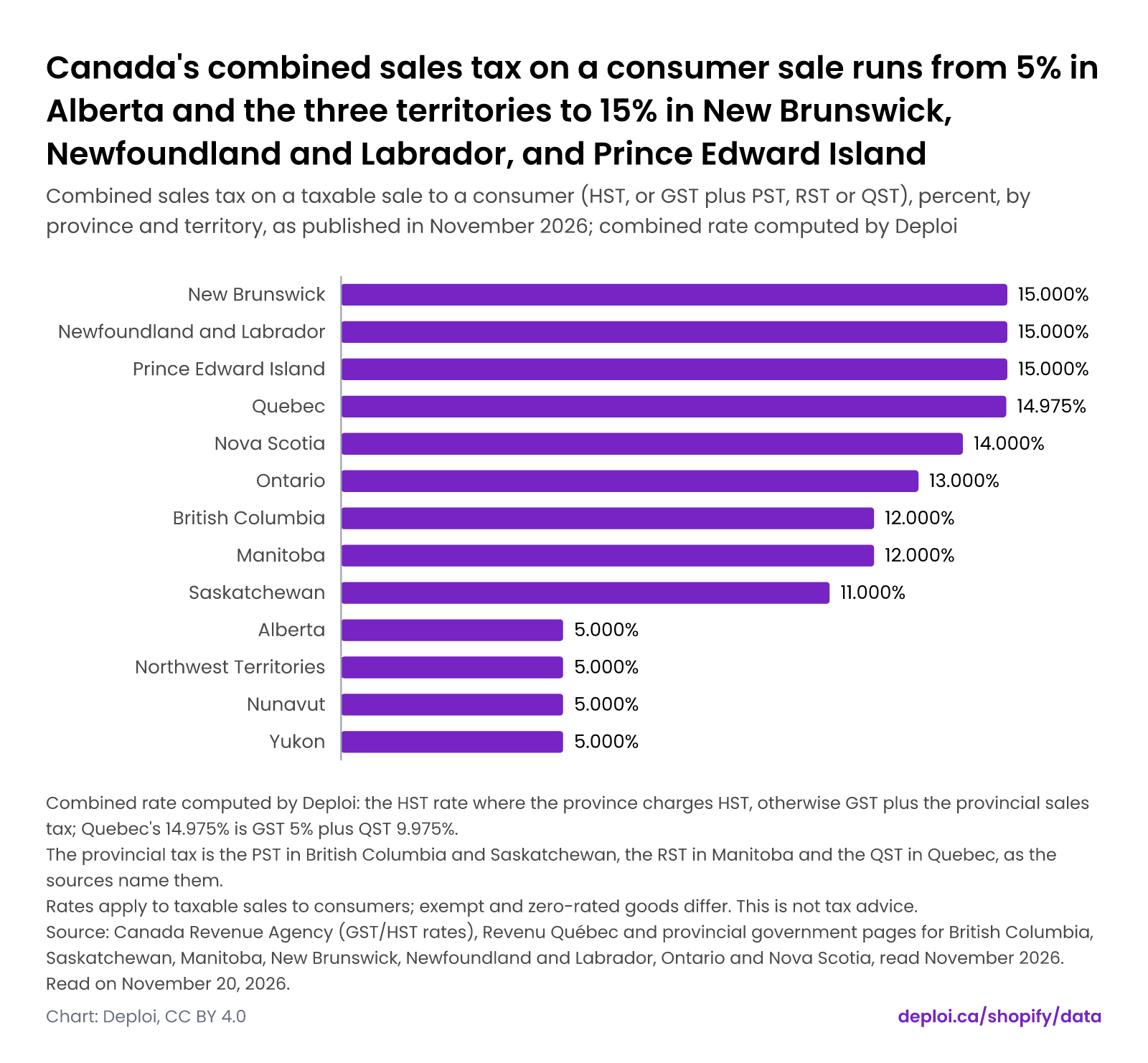
Canada's combined sales tax on a consumer sale runs from 5% in Alberta and the three territories to 15% in New Brunswick, Newfoundland and Labrador, and Prince Edward Island
Combined sales tax on a taxable sale to a consumer (HST, or GST plus PST, RST or QST), percent, by province and territory, as published in November 2026; combined rate computed by Deploi
- Combined rate computed by Deploi: the HST rate where the province charges HST, otherwise GST plus the provincial sales tax; Quebec's 14.975% is GST 5% plus QST 9.975%.
- The provincial tax is the PST in British Columbia and Saskatchewan, the RST in Manitoba and the QST in Quebec, as the sources name them.
- Rates apply to taxable sales to consumers; exempt and zero-rated goods differ. This is not tax advice.
Source: Canada Revenue Agency (GST/HST rates), Revenu Québec and provincial government pages for British Columbia, Saskatchewan, Manitoba, New Brunswick, Newfoundland and Labrador, Ontario and Nova Scotia, read November 2026. Read on .
What is the combined sales tax in each province and territory?
The combined sales tax on a taxable consumer sale is 15% in New Brunswick, Newfoundland and Labrador, and Prince Edward Island, 14.975% in Quebec, 14% in Nova Scotia, 13% in Ontario, 12% in British Columbia and Manitoba, 11% in Saskatchewan and 5% in Alberta and the three territories, as published in November 2026.
| Province or territory | Tax charged | Tax parts | Combined rate |
|---|---|---|---|
| New Brunswick | HST | HST 15% | 15% |
| Newfoundland and Labrador | HST | HST 15% | 15% |
| Prince Edward Island | HST | HST 15% | 15% |
| Quebec | GST + QST | GST 5% + QST 9.975% | 14.975% |
| Nova Scotia | HST | HST 14% | 14% |
| Ontario | HST | HST 13% | 13% |
| British Columbia | GST + PST | GST 5% + PST 7% | 12% |
| Manitoba | GST + RST | GST 5% + RST 7% | 12% |
| Saskatchewan | GST + PST | GST 5% + PST 6% | 11% |
| Alberta | GST only | GST 5% only | 5% |
| Northwest Territories | GST only | GST 5% only | 5% |
| Nunavut | GST only | GST 5% only | 5% |
| Yukon | GST only | GST 5% only | 5% |
Combined rate is computed by Deploi: the HST rate where the province charges HST, otherwise GST plus the provincial sales tax. This is not tax advice.
Which provinces charge HST?
Five provinces charge a single harmonized sales tax, as published in November 2026: 15% in New Brunswick, Newfoundland and Labrador, and Prince Edward Island, 14% in Nova Scotia and 13% in Ontario. The HST includes the 5% federal GST, and the Canada Revenue Agency's rate table lists no separate provincial tax for these provinces.
Nova Scotia's HST fell to 14% on April 1, 2025. Per its news release of March 31, 2025, the province "cuts its portion of the harmonized sales tax (HST) by one per cent, lowering the overall tax rate to 14 per cent". Sources: the CRA GST/HST rates table and the government pages of New Brunswick, Newfoundland and Labrador, Nova Scotia and Ontario.
Which provinces charge GST plus a separate provincial tax?
Four provinces charge GST of 5% plus a separate provincial tax, as published in November 2026: British Columbia 7% PST for 12%, Manitoba 7% RST for 12%, Saskatchewan 6% PST for 11%, and Quebec 9.975% QST for 14.975%. The provincial tax is named PST, RST or QST by each source.
Revenu Québec publishes the GST and QST rates; the other three provincial taxes come from the British Columbia, Manitoba and Saskatchewan government pages.
Where is only GST charged?
Alberta, Yukon, the Northwest Territories and Nunavut charge only the 5% federal GST on a taxable consumer sale, as published in November 2026 in the Canada Revenue Agency's GST/HST rate table. None of the four has a provincial or territorial sales tax in the dataset, so the combined rate is 5%.
The CRA table gives Alberta and the three territories a rate of 5% under GST and HST and 0% under PST.
How are the combined rates computed, and what do they not cover?
Deploi computes each combined rate from the published component rates: the HST rate where a province charges HST, otherwise the 5% GST plus the provincial sales tax, with Quebec's 14.975% being GST 5% plus QST 9.975%. Rates are as published in November 2026 and apply to taxable sales to consumers.
Exempt and zero-rated goods differ, and registration thresholds are not covered. This page states rates only and is not tax advice. Each rate names its source in the dataset. The sources are the CRA GST/HST rates table, Revenu Québec, and the government pages of British Columbia, Saskatchewan, Manitoba, New Brunswick, Newfoundland and Labrador, Ontario and Nova Scotia.
The data
Each chart on this page is drawn from the numbers below. Units are in the column headers.
| Province or territory | Tax charged | GST (%) | HST (%) | Provincial sales tax (%) | Combined rate (%) |
|---|---|---|---|---|---|
| Alberta | GST only | 5.000 | Not stated | Not stated | 5.000 |
| British Columbia | GST + PST | 5.000 | Not stated | 7.000 | 12.000 |
| Manitoba | GST + RST | 5.000 | Not stated | 7.000 | 12.000 |
| New Brunswick | HST | Not stated | 15.000 | Not stated | 15.000 |
| Newfoundland and Labrador | HST | Not stated | 15.000 | Not stated | 15.000 |
| Nova Scotia | HST | Not stated | 14.000 | Not stated | 14.000 |
| Northwest Territories | GST only | 5.000 | Not stated | Not stated | 5.000 |
| Nunavut | GST only | 5.000 | Not stated | Not stated | 5.000 |
| Ontario | HST | Not stated | 13.000 | Not stated | 13.000 |
| Prince Edward Island | HST | Not stated | 15.000 | Not stated | 15.000 |
| Quebec | GST + QST | 5.000 | Not stated | 9.975 | 14.975 |
| Saskatchewan | GST + PST | 5.000 | Not stated | 6.000 | 11.000 |
| Yukon | GST only | 5.000 | Not stated | Not stated | 5.000 |
Download Sales tax rates charged to consumers by Canadian province and territory, 2026 as CSV · All 8 columns on the dataset page
Methodology
Reading the chart: Canada's combined sales tax on a consumer sale runs from 5% in Alberta and the three territories to 15% in New Brunswick, Newfoundland and Labrador, and Prince Edward Island
- Combined rate computed by Deploi: the HST rate where the province charges HST, otherwise GST plus the provincial sales tax; Quebec's 14.975% is GST 5% plus QST 9.975%.
- The provincial tax is the PST in British Columbia and Saskatchewan, the RST in Manitoba and the QST in Quebec, as the sources name them.
- Rates apply to taxable sales to consumers; exempt and zero-rated goods differ. This is not tax advice.
Caveats: Sales tax rates charged to consumers by Canadian province and territory, 2026
- Rates apply to taxable sales to consumers; exempt and zero-rated goods differ, and registration thresholds are not covered.
- Nova Scotia's HST is 14% from April 1, 2025: the province 'cuts its portion of the harmonized sales tax (HST) by one per cent, lowering the overall tax rate to 14 per cent', per its news release of March 31, 2025.
- Combined rate is computed by Deploi: the HST rate where a province charges HST, otherwise GST plus the provincial sales tax.
- Not tax advice; each rate names its source.
Deploi's charts and compilation are licensed CC BY 4.0. The underlying facts belong to their sources, which are named on every page. How Deploi Shopify Data works.
Sources
Tier A sources are primary documents: filings, official releases and official price pages. How sources are ranked.
Show all 9 sources
- Tier AB.C. provincial sales tax (PST)
Province of British Columbia, Ministry of Finance · HTML · Read on
- Tier AGST/HST calculator (and rates), Canada Revenue Agency, snapshot 2026-11-20
Canada Revenue Agency · HTML · Read on
- Tier ARetail Sales Tax (RST), Government of Manitoba, snapshot 2026-11-20
Government of Manitoba, Finance · HTML · Read on
- Tier AHarmonized Sales Tax (HST), New Brunswick
Government of New Brunswick, Finance and Treasury Board · HTML · Read on
- Tier AHarmonized Sales Tax (HST), Newfoundland and Labrador
Government of Newfoundland and Labrador, Finance · HTML · Read on
- Tier AProvince Lowers HST, Raises Income Thresholds for Nova Scotians
Government of Nova Scotia · HTML · Read on
- Tier AHarmonized Sales Tax (HST), Ontario
Government of Ontario · HTML · Read on
- Tier ATables of GST and QST Rates, Revenu Quebec, WebFetch text 2026-11-20
Revenu Quebec · TEXT · Read on
- Tier AProvincial Sales Tax (PST), Government of Saskatchewan, snapshot 2026-11-20
Government of Saskatchewan · HTML · Read on
Cite and reuse
Deploi's charts and compilation are licensed CC BY 4.0. The underlying facts belong to their sources, which are named on every page.
APA
Deploi. (2026). What sales tax does a customer pay in each Canadian province and territory in 2026: GST, HST, PST, RST or QST, and what is the combined rate? [Web page]. https://deploi.ca/shopify/data/canada-sales-tax-by-province Retrieved November 20, 2026.
BibTeX
@misc{deploi_canada_sales_tax_by_province_2026,
  author = {{Deploi}},
  title = {What sales tax does a customer pay in each Canadian province and territory in 2026: GST, HST, PST, RST or QST, and what is the combined rate?},
  year = {2026},
  url = {https://deploi.ca/shopify/data/canada-sales-tax-by-province},
  note = {Accessed 2026-11-20}
}
Embed this chart
Embed code
<iframe src="https://deploi.ca/embed/shopify/data/canada-sales-tax-combined-rate" title="Canada's combined sales tax on a consumer sale runs from 5% in Alberta and the three territories to 15% in New Brunswick, Newfoundland and Labrador, and Prince Edward Island" loading="lazy" style="width:100%;height:580px;border:0"></iframe> <p style="font:12px/1.4 Arial,sans-serif;margin:4px 0 0">Source: <a href="https://deploi.ca/shopify/data/charts/canada-sales-tax-combined-rate">Deploi, Canada's combined sales tax on a consumer sale runs from 5% in Alberta and the three territories to 15% in New Brunswick, Newfoundland and Labrador, and Prince Edward Island</a></p>
Keep the credit line under the embed. It is the license condition.
Questions
What is the sales tax in Ontario?
Ontario charges 13% HST on a taxable consumer sale, as published in November 2026, per the Canada Revenue Agency's GST/HST rate table and the Ontario government's HST page. It combines the 5% federal GST with a provincial part.
Which Canadian province has the highest sales tax?
New Brunswick, Newfoundland and Labrador, and Prince Edward Island have the highest sales tax, 15% HST, as published in November 2026 in the Canada Revenue Agency's GST/HST rate table. Quebec follows at 14.975%, which is GST 5% plus QST 9.975%, computed by Deploi.
Which provinces and territories charge only GST?
Alberta, Yukon, the Northwest Territories and Nunavut charge only the 5% federal GST on a taxable consumer sale, with no HST and no provincial or territorial sales tax, as published in November 2026 in the Canada Revenue Agency's GST/HST rate table.
What is the difference between HST, PST, RST and QST?
HST is one tax that combines the 5% federal GST with a provincial part, as the New Brunswick, Newfoundland and Labrador and Ontario government pages describe it. PST in British Columbia and Saskatchewan, RST in Manitoba and QST in Quebec are separate provincial taxes charged in addition to the 5% GST, per those provinces and Revenu Québec, November 2026.
Did any provincial rate change recently?
Nova Scotia lowered its HST from 15% to 14% on April 1, 2025, per the Nova Scotia government's news release of March 31, 2025. The other rates are as published in November 2026.
More on Canada
- How do CASL and CAN-SPAM differ on consent, unsubscribe deadlines and penalties?
CASL requires consent before the first commercial email and CAN-SPAM does not, while both require an unsubscribe request honored within 10 business days, per the statutes read November 20, 2026. Updated November 20, 2026.
- How exposed are Canadian retailers to Canadian tariffs on US goods, and how much of what they buy comes from US suppliers?
In Statistics Canada's survey for the third quarter of 2026, 14.9% of Canadian retailers had made 60% to 79% of their purchases over the last 12 months directly from US suppliers, against 6.9% of all businesses, and 61.9% of retailers that buy from US suppliers said Canada imposed tariffs on goods they bought. Updated November 20, 2026.
- How large is the Canada Post fuel surcharge on a domestic parcel now, and how does it move with the diesel price?
Canada Post's domestic fuel surcharge is 47.0% for the week of November 16, 2026, or 39.9% after temporary relief, a 15% discount that runs to January 3, 2027, per its fuel surcharge page read November 20, 2026. Updated November 20, 2026.
- How long does Shopify Payments take to pay out a Canadian store compared with a US store and other countries, and in which currencies?
Shopify Payments pays out in a minimum of 3 business days in Canada and the US, 2 in Australia, 5 in Japan and 7 in Mexico, per the Shopify Help Center, read November 20, 2026. Updated November 20, 2026.
- How many language complaints does the Office québécois de la langue française receive each year, and what share concern websites and social media?
The Office québécois de la langue française received 10,371 complaints or reports in fiscal 2024-2025, up from 6,292 in 2021-2022, and 19% concerned websites and social media, per its annual management reports and complaint statistics. Updated November 20, 2026.
- How much does a Canadian online shopper spend a year on goods and services ordered online?
Canadian online shoppers spent an average of C$3,376 online in 2020, against C$2,554 in 2018, with those aged 25 to 44 highest at C$4,552, per Statistics Canada's Canadian Internet Use Survey. Updated November 20, 2026.
Changes
- · Sales tax rates charged to consumers by Canadian province and territory, 2026
First release. 13 rows, one for each province and territory, from the CRA rates table and provincial government pages read November 2026.