
What must a Canadian clothing or textile seller disclose under the Textile Labelling Act?
A prescribed consumer textile article must carry a label with its fibre content and the dealer's name and postal address or a CA number; the advertising and mail order catalogue rules apply with conditions, per Justice Laws read November 21, 2026. Updated November 22, 2026.
By Martin DejnickiUpdated
Short answer
Under the Textile Labelling Act and its Regulations, read on the Justice Laws Website on November 21, 2026, a prescribed consumer textile article must carry a label showing fibre content (Act ss. 3 and 6) and the dealer's name and postal address, or a CA identification number in their place (Regulations ss. 11(1)(b) and 12(1)).
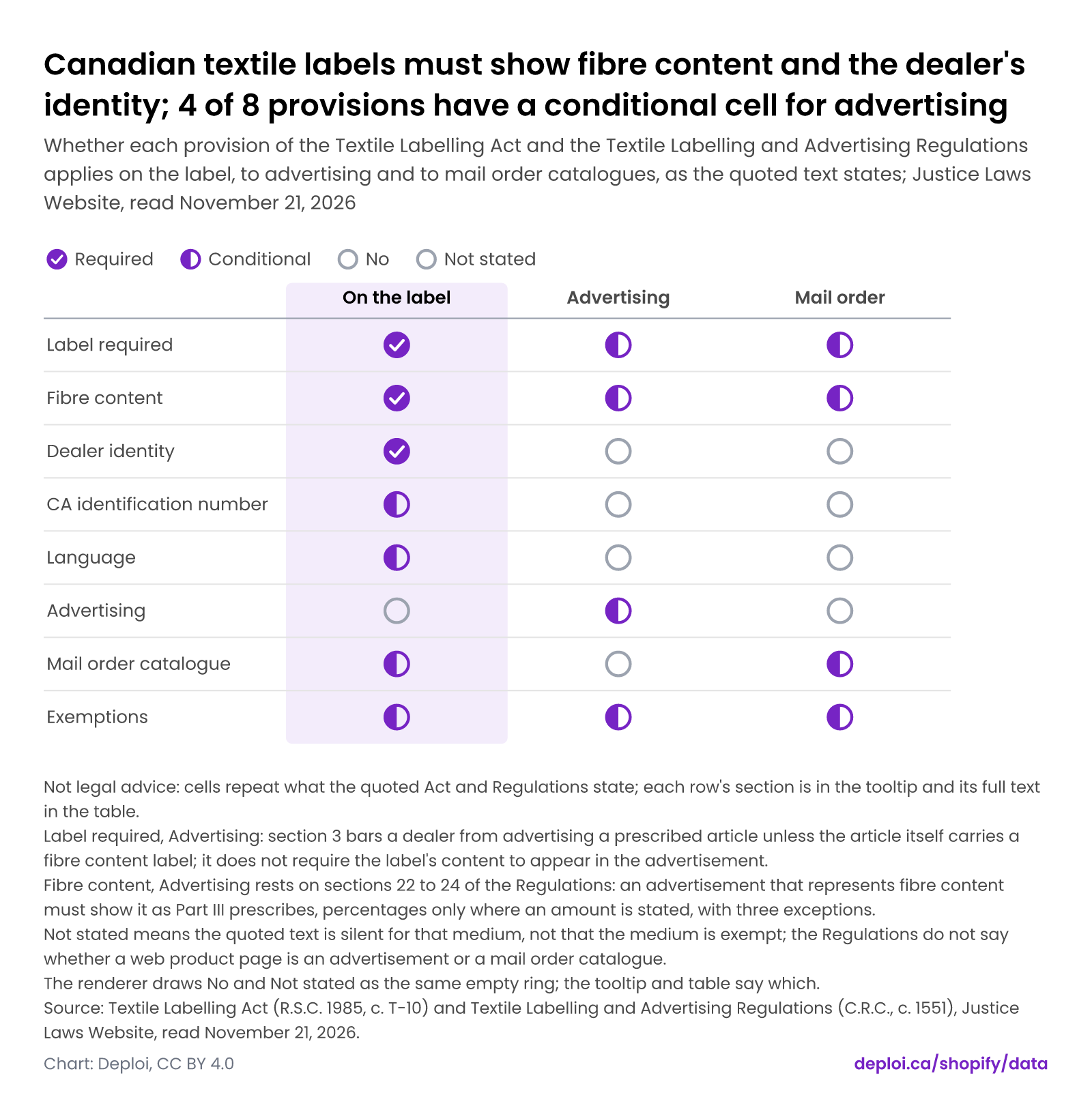
Canadian textile labels must show fibre content and the dealer's identity; 4 of 8 provisions have a conditional cell for advertising
Whether each provision of the Textile Labelling Act and the Textile Labelling and Advertising Regulations applies on the label, to advertising and to mail order catalogues, as the quoted text states; Justice Laws Website, read November 21, 2026
- Not legal advice: cells repeat what the quoted Act and Regulations state; each row's section is in the tooltip and its full text in the table.
- Label required, Advertising: section 3 bars a dealer from advertising a prescribed article unless the article itself carries a fibre content label; it does not require the label's content to appear in the advertisement.
- Fibre content, Advertising rests on sections 22 to 24 of the Regulations: an advertisement that represents fibre content must show it as Part III prescribes, percentages only where an amount is stated, with three exceptions.
- Not stated means the quoted text is silent for that medium, not that the medium is exempt; the Regulations do not say whether a web product page is an advertisement or a mail order catalogue.
- The renderer draws No and Not stated as the same empty ring; the tooltip and table say which.
Source: Textile Labelling Act (R.S.C. 1985, c. T-10) and Textile Labelling and Advertising Regulations (C.R.C., c. 1551), Justice Laws Website, read November 21, 2026. Read on .
What must a Canadian textile label show?
The label on a prescribed consumer textile article must give the generic name of each fibre of 5% or more by mass, its percentage subject to the regulations, and the dealer's name and postal address or a CA number, under Textile Labelling Act s. 6 and Regulations ss. 11(1)(b) and 12(1), read on Justice Laws on November 21, 2026.
| Provision | On the label | In advertising | In a mail order catalogue |
|---|---|---|---|
| Label required (Act s. 3) | Required | With conditions | With conditions |
| Fibre content (Act s. 6) | Required | With conditions | With conditions |
| Dealer identity (Regulations s. 11(1)(b)) | Required | Not stated | Not stated |
| CA identification number (s. 12(1)) | With conditions | Not stated | Not stated |
| Language (s. 11(3) and (4)) | With conditions | Not stated | Not stated |
| Advertising (ss. 22 to 24) | Not required | With conditions | Not stated |
| Mail order catalogue (s. 9.1) | With conditions | Not stated | With conditions |
| Exemptions (Regulations s. 6) | With conditions | With conditions | With conditions |
"Not stated" means the quoted text is silent for that medium, not that the medium is exempt. In the advertising column, the label required row rests on section 3 of the Act, which bars advertising a prescribed article unless the article carries the label; it does not require the label's content in the advertisement. The fibre content cells for advertising and mail order rest on Regulations sections 22 to 24 and 9.1, not on Act section 6. The dealer identity rule in paragraph 11(1)(b) is also subject to subsection 11(2), which the dataset does not quote. Source: Textile Labelling Act (R.S.C. 1985, c. T-10) and Textile Labelling and Advertising Regulations (C.R.C., c. 1551), Justice Laws Website, read November 21, 2026.
Does the Act require fibre content to appear in advertising?
Not unless the advertisement represents fibre content. Section 3 of the Act, read on Justice Laws on November 21, 2026, bars a dealer from advertising a prescribed article unless the article itself carries the label, and Regulations sections 22 to 24 set how an advertisement must show fibre content when it makes a representation about it.
Under sections 22 to 24, a fibre content representation in advertising must show the content as Part III prescribes, with each fibre's amount required only where an amount is represented, plus the country of origin where the article, or any fabric or fibre in it, is represented as imported. The information must appear together and in type of equal size and prominence.
Section 22 lists three exceptions: articles in Schedule II or not prescribed, advertisements in periodicals published for and distributed to dealers, and advertising by means other than written words, depiction, television or radio. Source: Textile Labelling and Advertising Regulations, ss. 22 to 24.
What do the Regulations say about mail order catalogues?
Section 9.1 of the Textile Labelling and Advertising Regulations, read on Justice Laws on November 21, 2026, lifts the Act's section 3(a) label requirement for a mail order sale of piece goods, including narrow fabrics, if the information required by paragraphs 11(1)(a) and (c) is shown in the prescribed manner in the dealer's catalogue when the article is ordered.
The exception covers only consumer textile articles that are piece goods. Paragraph 11(1)(a) is the fibre content shown as Part III prescribes; this page does not quote paragraph (c). The text does not say whether a web product page is a mail order catalogue or an advertisement, and this page does not either. Source: Textile Labelling and Advertising Regulations, s. 9.1.
Must the fibre content on a label be in English and French?
Yes, with one exception. Section 11(3) of the Regulations, read on Justice Laws on November 21, 2026, requires the fibre content information to be shown on the label in both English and French, and section 11(4) lifts that where the article is sold in an area where only one official language is in use continuously for purchases.
In that case the information must be shown in that one official language. The two-language rule in the quoted text applies to the information required by paragraph 11(1)(a), the fibre content; the quoted text does not extend it to the dealer's name and address. Source: Textile Labelling and Advertising Regulations, s. 11(3) and (4).
When can a CA identification number replace the dealer's name and address?
Section 12(1) of the Regulations, read on Justice Laws on November 21, 2026, lets a dealer who resides in Canada apply to the Commissioner for an identification number to replace its name and postal address on the label, if it manufactures or has manufactured, processes, finishes or sells at retail, imports, or owns and distributes consumer textile articles in Canada.
The dataset records the label column for this provision as "with conditions": the number is an option only for a dealer who resides in Canada, has applied for it and falls within one of the three listed cases. Source: Textile Labelling and Advertising Regulations, s. 12(1).
Which articles and sales are exempt from section 3?
Section 6 of the Regulations, read on Justice Laws on November 21, 2026, exempts a consumer textile article from section 3 of the Act in six cases, among them articles in Schedule II or not prescribed, sales to a dealer outside Canada or to or by a duty-free store, and articles made up for or sold to listed entities.
The other cases are articles received by a dealer from the manufacturer before December 1, 1972, imported articles labelled before resale under section 8, and sales by the manufacturer to an employee. The listed entities are commercial or industrial enterprises, federal, provincial or municipal departments or agencies, public utilities, educational institutions, religious orders or organizations and health care facilities. The article must be for the entity's own use or for use by or resale to its employees, students or, for a religious order, its members. Each exemption has its own conditions in the text, so the dataset records the row as "with conditions" in every column. Source: Textile Labelling and Advertising Regulations, s. 6(a) to (f).
What are the maximum fines under the Textile Labelling Act?
Section 12 of the Textile Labelling Act, read on Justice Laws on November 21, 2026, sets a fine of up to C$5,000 on summary conviction, or C$10,000 on indictment, for a dealer who contravenes section 3, 4 or 5, and lower fines, with imprisonment possible, for contravening other provisions of the Act or the regulations.
For other provisions, section 12(2) sets a fine of up to C$1,000 or imprisonment of up to six months or both on summary conviction, and up to C$3,000 or imprisonment of up to one year or both on indictment. Amounts are in Canadian dollars as the Act states them. Source: Textile Labelling Act, s. 12(1) and (2).
What does this page leave out?
This page leaves out Schedule II, the Part III rules on how fibre content is shown and any government guidance, and it is not legal advice. It quotes the Textile Labelling Act and the Textile Labelling and Advertising Regulations as consolidated on the Justice Laws Website and read on November 21, 2026.
Each cell repeats what the quoted text states and does not apply it to a product. Deploi is not affiliated with the Department of Justice Canada.
The data
Each chart on this page is drawn from the numbers below. Units are in the column headers.
| Provision | On the label (yes, no, conditions or not stated) | Advertising (yes, no, conditions or not stated) | Mail order (yes, no, conditions or not stated) | Section | Text as stated |
|---|---|---|---|---|---|
| Label required | Required | Conditional | Conditional | Textile Labelling Act, s. 3(a) and (b) | 3 No dealer shall sell, import into Canada or advertise
(a) a prescribed consumer textile article unless the article has applied to it a label containing a representation with respect to the textile fibre content of the article; or
(b) any consumer textile article that has applied to it a label containing a representation with respect to the textile fibre content of the article unless the label is applied to it in accordance with and complies with all applicable provisions of this Act. |
| Fibre content | Required | Conditional | Conditional | Textile Labelling Act, s. 6(b)(i) and (ii) | 6 Each label containing a representation with respect to the textile fibre content of the consumer textile article to which it is applied shall
(a) be applied to the article in such form and manner as may be prescribed; and
(b) show, in such form and manner as may be prescribed,
(i) the generic name of each textile fibre comprising five per cent or more by mass of the total fibre mass of the article,
(ii) subject to the regulations, such percentage by mass of the total fibre mass of the article as each textile fibre named pursuant to subparagraph (i) comprises, |
| Dealer identity | Required | Not stated | Not stated | Textile Labelling and Advertising Regulations, s. 11(1)(b) | 11 (1) Every representation label that is required to meet the requirements for a disclosure label shall show
(a) the textile fibre content of the article in the manner prescribed in Part III;
(b) subject to subsections (2) and 12(1), the name and postal address of the dealer; and |
| CA identification number | Conditional | Not stated | Not stated | Textile Labelling and Advertising Regulations, s. 12(1) | 12 (1) A dealer who resides in Canada may apply to the Commissioner for an identification number for use on the label of a consumer textile article in place of the dealer’s name and postal address if the dealer
(a) manufactures or has manufactured on his or her behalf, processes, finishes or sells at retail consumer textile articles in Canada;
(b) imports consumer textile articles into Canada; or
(c) owns and distributes consumer textile articles in Canada. |
| Language | Conditional | Not stated | Not stated | Textile Labelling and Advertising Regulations, s. 11(3) and (4) | (3) The information required by paragraph (1)(a) shall be shown in the label in both the English and French languages.
(4) Subsection (3) does not apply where the consumer textile article is or is to be sold to the public in an area where only one of the official languages is in use continuously by the public for the purpose of making consumer purchases and the information required by paragraph (1)(a) is shown in that official language. |
| Advertising | No | Conditional | Not stated | Textile Labelling and Advertising Regulations, ss. 22 to 24 | 22 Any representation as to the textile fibre content of a consumer textile article by a dealer in advertising the article shall be made in accordance with sections 23 and 24 unless
(a) the consumer textile article is included in Schedule II or is not prescribed;
(b) the advertisement appears in a newspaper, magazine or other periodical that is published for and distributed to dealers; or
(c) the advertising is done by means other than written words, depiction, television or radio.
SOR/87-247, s. 9
SOR/94-247, s. 10
23 A representation that is subject to the requirement in section 22 shall show
(a) the textile fibre content of the consumer textile article in the manner prescribed in Part III except that the amount in which each textile fibre is present in the article is not required to be shown, but where any representation as to any such amount is made, the amount shall be shown in the manner prescribed in the said Part; and
(b) where there is a representation that the article or any fabric or fibre therein is imported, the name of the country of origin.
24 The information that is required by section 23 to be shown in an advertisement shall be shown together and in type of equal size and prominence. |
| Mail order catalogue | Conditional | Not stated | Conditional | Textile Labelling and Advertising Regulations, s. 9.1 | 9.1 The prohibition in paragraph 3(a) of the Act does not apply to a sale by mail order of any consumer textile article that is piece goods (including narrow fabrics) if the information in respect of the article required by paragraphs 11(1)(a) and (c) is shown in the prescribed manner, at the time the article is ordered, in the mail order catalogue of the dealer who sells the article. |
| Exemptions | Conditional | Conditional | Conditional | Textile Labelling and Advertising Regulations, s. 6(a) to (f) | 6 A consumer textile article is exempt from section 3 of the Act where that article is
(a) included in Schedule II or is not prescribed;
(b) sold or advertised by a dealer if the article was, prior to December 1, 1972, received by or in transit to him or any other dealer from the dealer who manufactured or made the article;
(c) sold
(i) to a dealer outside Canada, or
(ii) to or by a duty-free store in Canada;
(d) imported into Canada and labelled before resale in accordance with section 8;
(e) made up for or sold to one of the following entities:
(i) a commercial or industrial enterprise,
(ii) a federal, provincial or municipal department or agency,
(iii) a public utility,
(iv) an educational institution,
(v) a religious order or organization, or
(vi) a health care facility,
for use by the entity or for use by or resale to its employees or students or, in the case of a religious order or organization, for use by or resale to members of the order or organization; or
(f) sold by the manufacturer to an employee. |
Download Canada's Textile Labelling Act and Textile Labelling and Advertising Regulations: label, fibre content, dealer identity, CA number, language, advertising, mail order catalogue and exemption provisions, whether each applies on the label, in advertising and in a mail order catalogue, and the offence and fine provisions as CSV · All 9 columns on the dataset page
Methodology
Reading the chart: Canadian textile labels must show fibre content and the dealer's identity; 4 of 8 provisions have a conditional cell for advertising
- Not legal advice: cells repeat what the quoted Act and Regulations state; each row's section is in the tooltip and its full text in the table.
- Label required, Advertising: section 3 bars a dealer from advertising a prescribed article unless the article itself carries a fibre content label; it does not require the label's content to appear in the advertisement.
- Fibre content, Advertising rests on sections 22 to 24 of the Regulations: an advertisement that represents fibre content must show it as Part III prescribes, percentages only where an amount is stated, with three exceptions.
- Not stated means the quoted text is silent for that medium, not that the medium is exempt; the Regulations do not say whether a web product page is an advertisement or a mail order catalogue.
- The renderer draws No and Not stated as the same empty ring; the tooltip and table say which.
Caveats: Canada's Textile Labelling Act and Textile Labelling and Advertising Regulations: label, fibre content, dealer identity, CA number, language, advertising, mail order catalogue and exemption provisions, whether each applies on the label, in advertising and in a mail order catalogue, and the offence and fine provisions
- Not legal advice. The dataset quotes the Act and Regulations as consolidated on the Justice Laws Website and read on November 21, 2026; a cell only repeats what the quoted text states.
- Not stated means the quoted text is silent for that medium, not that the medium is exempt. The Regulations speak of advertisements and mail order catalogues; the dataset does not say whether a web product page is one and quotes the text as written.
- The advertising cell of the label required row rests on section 3 of the Act, which bars advertising a prescribed article unless the article carries a fibre content label; it does not require the label's content to appear in the advertisement.
- The mail order catalogue cells are conditional: section 9.1 of the Regulations lifts the section 3(a) requirement for piece goods sold by mail order if the information is shown in the dealer's catalogue at the time of ordering.
- The Fibre content cells for advertising and mail order rest on sections 22 to 24 and 9.1 of the Regulations, not on the row's quoted section 6 of the Act.
- Fines are in Canadian dollars as the Act states them, in words; the penalty row has no value in the label, advertising or catalogue columns.
Deploi's charts and compilation are licensed CC BY 4.0. The underlying facts belong to their sources, which are named on every page. How Deploi Shopify Data works.
Sources
Tier A sources are primary documents: filings, official releases and official price pages. How sources are ranked.
- Tier ATextile Labelling Act (R.S.C. 1985, c. T-10), full text
Department of Justice Canada (Justice Laws Website) · HTML · Read on
- Tier ATextile Labelling and Advertising Regulations (C.R.C., c. 1551), full text
Department of Justice Canada (Justice Laws Website) · HTML · Read on
Cite and reuse
Deploi's charts and compilation are licensed CC BY 4.0. The underlying facts belong to their sources, which are named on every page.
APA
Deploi. (2026). What must a Canadian clothing or textile seller disclose under the Textile Labelling Act? [Web page]. https://deploi.ca/shopify/data/canada-textile-labelling-rules-apparel Retrieved November 22, 2026.
BibTeX
@misc{deploi_canada_textile_labelling_rules_apparel_2026,
  author = {{Deploi}},
  title = {What must a Canadian clothing or textile seller disclose under the Textile Labelling Act?},
  year = {2026},
  url = {https://deploi.ca/shopify/data/canada-textile-labelling-rules-apparel},
  note = {Accessed 2026-11-22}
}
Embed this chart
Embed code
<iframe src="https://deploi.ca/embed/shopify/data/canada-textile-disclosures-by-medium" title="Canadian textile labels must show fibre content and the dealer's identity; 4 of 8 provisions have a conditional cell for advertising" loading="lazy" style="width:100%;height:620px;border:0"></iframe> <p style="font:12px/1.4 Arial,sans-serif;margin:4px 0 0">Source: <a href="https://deploi.ca/shopify/data/charts/canada-textile-disclosures-by-medium">Deploi, Canadian textile labels must show fibre content and the dealer's identity; 4 of 8 provisions have a conditional cell for advertising</a></p>
Keep the credit line under the embed. It is the license condition.
Downloads
- Chart: Canadian textile labels must show fibre content and the dealer's identity; 4 of 8 provisions have a conditional cell for advertising PNG
- Data: Canada's Textile Labelling Act and Textile Labelling and Advertising Regulations: label, fibre content, dealer identity, CA number, language, advertising, mail order catalogue and exemption provisions, whether each applies on the label, in advertising and in a mail order catalogue, and the offence and fine provisions CSV
Questions
What must a Canadian clothing label show under the Textile Labelling Act?
Fibre content and the dealer's identity: the generic name of each fibre of 5% or more by mass and, subject to the regulations, its percentage, and the dealer's name and postal address, or a CA number, per the Act and Regulations read on Justice Laws on November 21, 2026.
Does fibre content have to appear in an online product listing?
The quoted text does not say. Section 3 of the Act bars advertising a prescribed article unless the article carries the label, and Regulations sections 22 to 24 govern a fibre content representation in advertising, but whether a web product page counts is not stated, per Justice Laws read November 21, 2026.
Can a CA number replace a business name on a textile label?
Yes, for a dealer who resides in Canada and has applied to the Commissioner, under section 12(1) of the Regulations, read on Justice Laws on November 21, 2026, if the dealer manufactures or has manufactured, processes, finishes or sells at retail, imports, or owns and distributes consumer textile articles in Canada.
Does a Canadian textile label have to be in French?
The fibre content information must be in both English and French, except where only one official language is in use continuously in the sales area, under section 11(3) and (4) of the Regulations, read on Justice Laws on November 21, 2026.
What is the maximum fine for breaking the textile labelling rules?
Up to C$5,000 on summary conviction or C$10,000 on indictment for contravening section 3, 4 or 5 of the Textile Labelling Act, per section 12(1) as read on Justice Laws on November 21, 2026.
More on Compliance
- How long must a gift card sold in the US stay valid, and when may a store charge an inactivity fee?
US federal rules bar gift card funds from expiring within 5 years of issue or the last load and allow an inactivity fee only after 12 months without activity, once a month at most, as the eCFR states. Updated November 22, 2026.
- Must a US online apparel listing show fiber content and country of origin under the FTC's Textile Rules?
US textile labels must carry fiber content, a name or RN number and the country of origin, and mail order catalogs and promotional material must state made in USA, imported or both, per 16 CFR Part 303 in the eCFR for November 1, 2026. Updated November 22, 2026.
- What lead limits apply to consumer products, children's jewellery and surface coatings in Canada, and how do they compare with the US?
Canada limits lead to 90 mg/kg in accessible parts of consumer products containing lead, children's jewellery and surface coatings; US texts set 100 parts per million for children's products, unless found not technologically feasible, and 0.009 percent for paint, as read on November 21, 2026. Updated November 22, 2026.
- What size limits does 49 CFR 173.185 set for small lithium batteries shipped in the United States, and what conditions apply by air?
To qualify for the 49 CFR 173.185(c) exception for smaller cells or batteries, a lithium ion cell may not exceed 20 Wh and a battery 100 Wh, or 60 Wh and 300 Wh for highway or rail only, as the eCFR stated on November 22, 2026. By air, under (c)(5)(i), a package of cells or batteries not packed with, or contained in, equipment stays subject to all applicable requirements, with relief only from UN performance packaging within set quantities. Updated November 22, 2026.
- Which businesses must file an annual forced labour report in Canada, and by when?
Entities meeting at least two of three tests (at least C$20 million in assets, at least C$40 million in revenue, an average of at least 250 employees), listed entities and prescribed entities must report to the Minister by May 31 each year if they produce, sell, distribute or import goods or control an entity that does, per the Act read on Justice Laws on November 21, 2026. Updated November 22, 2026.
- Which details on a Canadian consumer product label must be in English and French, and in what units must net quantity be shown?
Label information the Act and Regulations require must be in English and French except the dealer's identity, and local, test market and specialty products have exemptions, per Justice Laws read November 21, 2026. Updated November 22, 2026.
Changes
- · Canada's Textile Labelling Act and Textile Labelling and Advertising Regulations: label, fibre content, dealer identity, CA number, language, advertising, mail order catalogue and exemption provisions, whether each applies on the label, in advertising and in a mail order catalogue, and the offence and fine provisions
First release. 9 rows, 8 fields read from 2 sources; each value agreed by extractor and verifier or ruled by the judge.