
What size limits does 49 CFR 173.185 set for small lithium batteries shipped in the United States, and what conditions apply by air?
To qualify for the 49 CFR 173.185(c) exception for smaller cells or batteries, a lithium ion cell may not exceed 20 Wh and a battery 100 Wh, or 60 Wh and 300 Wh for highway or rail only, as the eCFR stated on November 22, 2026. By air, under (c)(5)(i), a package of cells or batteries not packed with, or contained in, equipment stays subject to all applicable requirements, with relief only from UN performance packaging within set quantities. Updated November 22, 2026.
By Martin DejnickiUpdated
Short answer
The size limits in 49 CFR 173.185(c)(1), conditions of the exception for smaller cells or batteries, are 20 Wh for a lithium ion cell and 100 Wh for a battery, or 60 Wh and 300 Wh for highway or rail only, according to the eCFR on November 22, 2026. By air, (c)(5)(i) keeps a package without equipment subject to all applicable requirements except UN performance packaging, within set quantities.
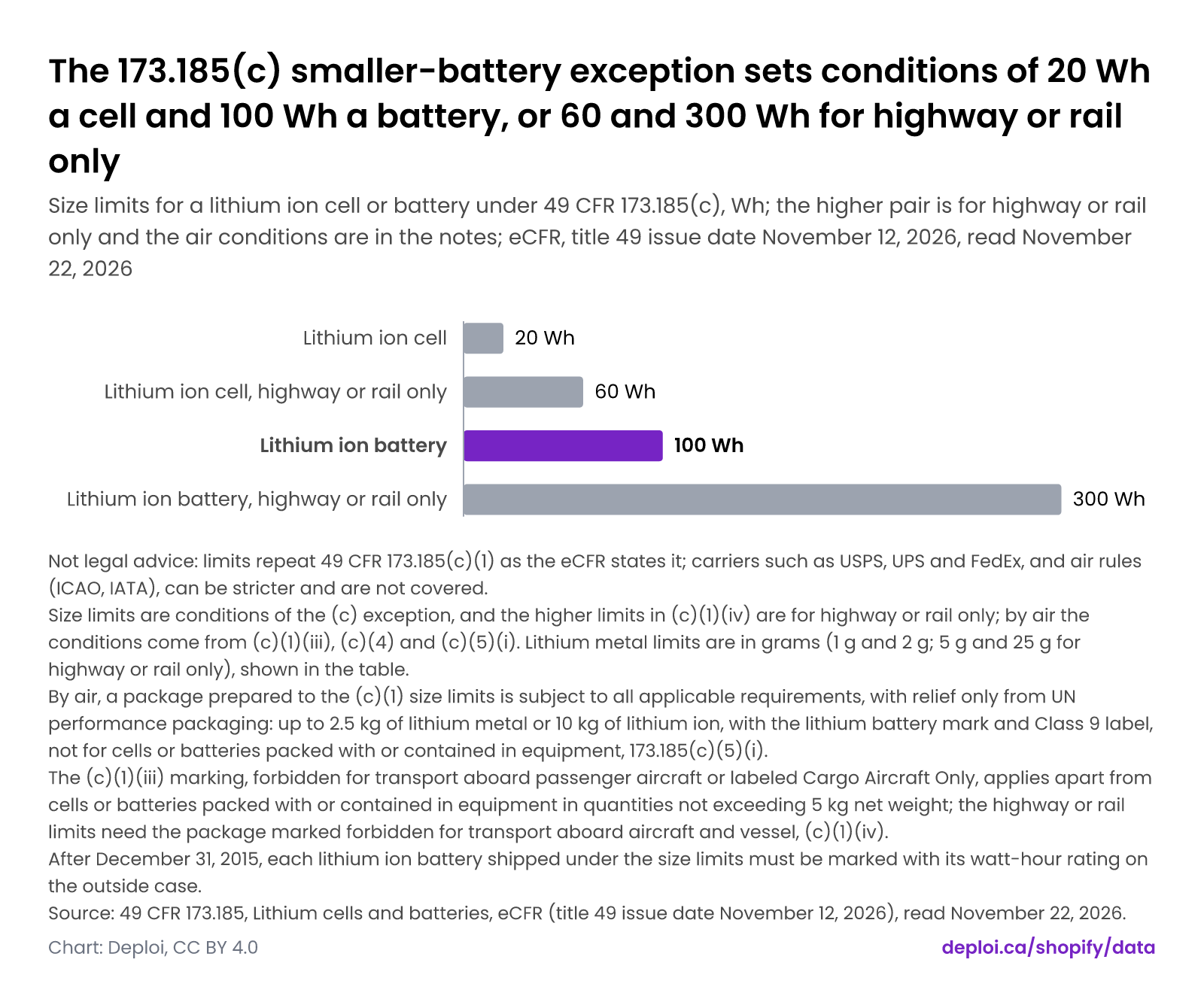
The 173.185(c) smaller-battery exception sets conditions of 20 Wh a cell and 100 Wh a battery, or 60 and 300 Wh for highway or rail only
Size limits for a lithium ion cell or battery under 49 CFR 173.185(c), Wh; the higher pair is for highway or rail only and the air conditions are in the notes; eCFR, title 49 issue date November 12, 2026, read November 22, 2026
- Not legal advice: limits repeat 49 CFR 173.185(c)(1) as the eCFR states it; carriers such as USPS, UPS and FedEx, and air rules (ICAO, IATA), can be stricter and are not covered.
- Size limits are conditions of the (c) exception, and the higher limits in (c)(1)(iv) are for highway or rail only; by air the conditions come from (c)(1)(iii), (c)(4) and (c)(5)(i). Lithium metal limits are in grams (1 g and 2 g; 5 g and 25 g for highway or rail only), shown in the table.
- By air, a package prepared to the (c)(1) size limits is subject to all applicable requirements, with relief only from UN performance packaging: up to 2.5 kg of lithium metal or 10 kg of lithium ion, with the lithium battery mark and Class 9 label, not for cells or batteries packed with or contained in equipment, 173.185(c)(5)(i).
- The (c)(1)(iii) marking, forbidden for transport aboard passenger aircraft or labeled Cargo Aircraft Only, applies apart from cells or batteries packed with or contained in equipment in quantities not exceeding 5 kg net weight; the highway or rail limits need the package marked forbidden for transport aboard aircraft and vessel, (c)(1)(iv).
- After December 31, 2015, each lithium ion battery shipped under the size limits must be marked with its watt-hour rating on the outside case.
Source: 49 CFR 173.185, Lithium cells and batteries, eCFR (title 49 issue date November 12, 2026), read November 22, 2026. Read on .
How many watt-hours can a lithium ion battery have under the size limits?
The Watt-hour rating may not exceed 20 Wh for a lithium ion cell or 100 Wh for a battery under 49 CFR 173.185(c)(1)(i), a condition of the exception for smaller cells or batteries, per the eCFR on November 22, 2026. Paragraph (c)(1)(iv) raises these to 60 Wh and 300 Wh for highway or rail only, if the outer package is marked.
Paragraph (c) is headed "Exceptions for smaller cells or batteries", and the size limits in (c)(1) are among its conditions. The (c)(1)(iv) condition for highway or rail only requires the outer package to be marked as forbidden for transport aboard aircraft and vessel. After December 31, 2015, each lithium ion battery subject to the size limit must be marked with the Watt-hour rating on the outside case.
| Item | Size limit, (c)(1)(i) | Highway or rail only, (c)(1)(iv) |
|---|---|---|
| Lithium ion cell | 20 Wh | 60 Wh |
| Lithium ion battery | 100 Wh | 300 Wh |
Source: 49 CFR 173.185, Lithium cells and batteries, eCFR (title 49 issue date November 12, 2026), read November 22, 2026.
How much lithium may a lithium metal cell or battery contain under the size limits?
The lithium content may not exceed 1 g for a lithium metal cell or 2 g for a battery under 49 CFR 173.185(c)(1)(ii), a condition of the exception for smaller cells or batteries, per the eCFR on November 22, 2026. Paragraph (c)(1)(iv) raises these to 5 g and 25 g for highway or rail only. The watt-hour limits apply to lithium ion cells and batteries.
The higher highway or rail only limits come from (c)(1)(iv), the paragraph that also raises the lithium ion limits, and carry the same outer package marking condition.
| Item | Size limit, (c)(1)(ii) | Highway or rail only, (c)(1)(iv) |
|---|---|---|
| Lithium metal cell | 1 g | 5 g |
| Lithium metal battery | 2 g | 25 g |
Source: 49 CFR 173.185, Lithium cells and batteries, eCFR (title 49 issue date November 12, 2026), read November 22, 2026.
What conditions apply to lithium battery packages shipped by air?
By air, 49 CFR 173.185(c)(5)(i) keeps a package prepared to the (c)(1) size limits subject to all applicable requirements except UN performance packaging, for up to 2.5 kg lithium metal or 10 kg lithium ion with the lithium battery mark and Class 9 label, per the eCFR on November 22, 2026. Equipment packages come under (c)(4)(i) instead, up to 5 kg net.
| Condition | Limit or requirement | Paragraph |
|---|---|---|
| Without UN performance packaging, lithium metal | Up to 2.5 kg per package | 173.185(c)(5)(i) |
| Without UN performance packaging, lithium ion | Up to 10 kg per package | 173.185(c)(5)(i) |
| Packed with, or contained in, equipment | Minimum number needed to power the equipment plus two spare sets; no more than 5 kg net | 173.185(c)(4)(i) |
The (c)(5)(i) relief applies when the package displays both the lithium battery mark in (c)(3)(i) and the Class 9 Lithium Battery label specified in 172.447. It does not apply to batteries or cells packed with, or contained in, equipment. Every other applicable requirement of the subchapter stays in place.
Under (c)(1)(iii), the outer package must be marked as forbidden for transport aboard passenger aircraft, or labeled with a CARGO AIRCRAFT ONLY label specified in 172.448. The exception is cells or batteries packed with or contained in equipment in quantities not exceeding 5 kg net weight. For equipment packages under (c)(4)(i), a set is the number of individual cells or batteries required to power each piece of equipment.
Source: 49 CFR 173.185, Lithium cells and batteries, eCFR (title 49 issue date November 12, 2026), read November 22, 2026.
How large must the lithium battery mark be?
The lithium battery mark is a rectangle or square with hatched edging at least 100 mm wide by 100 mm high, with hatching at least 5 mm wide, or 100 mm by 70 mm on a package too small for the larger mark, under 49 CFR 173.185(c)(3)(i)(A) as the eCFR stated it on November 22, 2026.
The paragraph gives the sizes as 100 mm (3.9 inches), 5 mm (0.2 inches) and 70 mm (2.8 inches).
The lettering heights in (c)(1)(v) govern a different item, the text markings in paragraphs (c)(1)(iii) and (iv), not the lithium battery mark. The letters in those markings must be at least 6 mm (0.25 inch) high on packages with a gross weight of 30 kg (66 pounds) or less. On heavier packages, the letters must be at least 12 mm (0.5 inch) high. Smaller font is permitted on the lighter packages when package dimensions require it.
Source: 49 CFR 173.185, Lithium cells and batteries, eCFR (title 49 issue date November 12, 2026), read November 22, 2026.
Who must provide a lithium battery test summary?
Each manufacturer and later distributor of lithium cells or batteries made on or after January 1, 2008 must make a test summary available, except for button cells installed in equipment, under 49 CFR 173.185(a)(3) as the eCFR stated it on November 22, 2026.
The test summary must name the cell, battery or product manufacturer and the test laboratory, with contact details, and give a unique test report number and the report date. It must also describe the cell or battery, list the tests and their pass or fail results, give its testing references, and name a responsible person.
Source: 49 CFR 173.185, Lithium cells and batteries, eCFR (title 49 issue date November 12, 2026), read November 22, 2026.
What does this page leave out?
The page leaves out carrier rules from USPS, UPS and FedEx and air rules from ICAO and IATA, which can be stricter, and it does not list every air condition in paragraphs (c)(4) and (c)(5). It follows 49 CFR 173.185 as the eCFR stated it, issue date November 12, 2026, read November 22, 2026.
The dataset covers the federal Hazardous Materials Regulations only. This page states what the regulation says and cites the paragraph; it is not legal advice, and it does not say which carrier accepts which battery.
Deploi is not affiliated with the US Department of Transportation or any carrier named here.
The data
Each chart on this page is drawn from the numbers below. Units are in the column headers.
| Item | Condition | Watt-hour limit (Wh) | Lithium content limit (g) | Net mass limit per package (kg) | Paragraph |
|---|---|---|---|---|---|
| Lithium ion cell | size limit | 20 | Not stated | Not stated | 173.185(c)(1)(i) |
| Lithium ion battery | size limit | 100 | Not stated | Not stated | 173.185(c)(1)(i) |
| Lithium ion cell, highway or rail only | highway or rail only | 60 | Not stated | Not stated | 173.185(c)(1)(iv) |
| Lithium ion battery, highway or rail only | highway or rail only | 300 | Not stated | Not stated | 173.185(c)(1)(iv) |
| Lithium metal cell | size limit | Not stated | 1 | Not stated | 173.185(c)(1)(ii) |
| Lithium metal battery | size limit | Not stated | 2 | Not stated | 173.185(c)(1)(ii) |
| Lithium metal cell, highway or rail only | highway or rail only | Not stated | 5 | Not stated | 173.185(c)(1)(iv) |
| Lithium metal battery, highway or rail only | highway or rail only | Not stated | 25 | Not stated | 173.185(c)(1)(iv) |
| Net mass of cells or batteries per package, packed with, or contained in, equipment, by air | air | Not stated | Not stated | 5 | 173.185(c)(4)(i) |
| Lithium metal cells or batteries by air, most per package without UN performance packaging (all other applicable requirements apply; lithium battery mark and Class 9 label; (c)(5)(i) does not apply to batteries or cells packed with, or contained in, equipment, which come under (c)(4), up to 5 kg net) | air | Not stated | Not stated | 2.5 | 173.185(c)(5)(i) |
| Lithium ion cells or batteries by air, most per package without UN performance packaging (all other applicable requirements apply; lithium battery mark and Class 9 label; (c)(5)(i) does not apply to batteries or cells packed with, or contained in, equipment, which come under (c)(4), up to 5 kg net) | air | Not stated | Not stated | 10 | 173.185(c)(5)(i) |
Download US hazardous materials rules for small lithium batteries under 49 CFR 173.185: the watt-hour and lithium-content limits of the paragraph (c) exception for smaller cells or batteries, the higher limits for highway or rail only, the passenger aircraft marking, the air package limits, the lithium battery mark size, the letter height of the aircraft markings, and the test-summary and equipment conditions as CSV · All 10 columns on the dataset page
Methodology
Reading the chart: The 173.185(c) smaller-battery exception sets conditions of 20 Wh a cell and 100 Wh a battery, or 60 and 300 Wh for highway or rail only
- Not legal advice: limits repeat 49 CFR 173.185(c)(1) as the eCFR states it; carriers such as USPS, UPS and FedEx, and air rules (ICAO, IATA), can be stricter and are not covered.
- Size limits are conditions of the (c) exception, and the higher limits in (c)(1)(iv) are for highway or rail only; by air the conditions come from (c)(1)(iii), (c)(4) and (c)(5)(i). Lithium metal limits are in grams (1 g and 2 g; 5 g and 25 g for highway or rail only), shown in the table.
- By air, a package prepared to the (c)(1) size limits is subject to all applicable requirements, with relief only from UN performance packaging: up to 2.5 kg of lithium metal or 10 kg of lithium ion, with the lithium battery mark and Class 9 label, not for cells or batteries packed with or contained in equipment, 173.185(c)(5)(i).
- The (c)(1)(iii) marking, forbidden for transport aboard passenger aircraft or labeled Cargo Aircraft Only, applies apart from cells or batteries packed with or contained in equipment in quantities not exceeding 5 kg net weight; the highway or rail limits need the package marked forbidden for transport aboard aircraft and vessel, (c)(1)(iv).
- After December 31, 2015, each lithium ion battery shipped under the size limits must be marked with its watt-hour rating on the outside case.
Caveats: US hazardous materials rules for small lithium batteries under 49 CFR 173.185: the watt-hour and lithium-content limits of the paragraph (c) exception for smaller cells or batteries, the higher limits for highway or rail only, the passenger aircraft marking, the air package limits, the lithium battery mark size, the letter height of the aircraft markings, and the test-summary and equipment conditions
- Federal Hazardous Materials Regulations only; carriers (USPS, UPS, FedEx) and air rules (ICAO, IATA) can be stricter and are not covered.
- Watt-hours, grams, kilograms and millimetres never share an axis, so each limit sits in its own column.
- The size limits in 173.185(c)(1) are conditions of the exception in paragraph (c) for smaller cells or batteries, and the higher limits in (c)(1)(iv) are for highway or rail only. By air, the conditions come from (c)(1)(iii), (c)(4) and (c)(5)(i). Under (c)(5)(i), a package prepared to the (c)(1) size limits is subject to all applicable requirements of the subchapter, with relief only from the UN performance packaging requirements in (b)(3)(ii) when it holds no more than 2.5 kg lithium metal or 10 kg lithium ion cells or batteries and displays both the lithium battery mark and the Class 9 Lithium Battery label; that paragraph does not apply to batteries or cells packed with, or contained in, equipment.
- By air, a package of cells or batteries packed with, or contained in, equipment stays within the paragraph (c) exception up to 5 kg net of cells or batteries, with no more than the minimum number needed to power the equipment plus two spare sets, 173.185(c)(4)(i). Unless the cells or batteries are packed with or contained in equipment in quantities up to 5 kg net, the outer package must be marked forbidden for transport aboard passenger aircraft or labeled Cargo Aircraft Only, 173.185(c)(1)(iii); a package marked for highway or rail only under (c)(1)(iv) does not need that marking.
- The dataset is not legal advice.
Deploi's charts and compilation are licensed CC BY 4.0. The underlying facts belong to their sources, which are named on every page. How Deploi Shopify Data works.
Sources
Tier A sources are primary documents: filings, official releases and official price pages. How sources are ranked.
- Tier A49 CFR 173.185, Lithium cells and batteries (eCFR XML, title 49 issue date 2026-11-12)
Office of the Federal Register and U.S. Government Publishing Office (eCFR) · TEXT · Read on
Cite and reuse
Deploi's charts and compilation are licensed CC BY 4.0. The underlying facts belong to their sources, which are named on every page.
APA
Deploi. (2026). What size limits does 49 CFR 173.185 set for small lithium batteries shipped in the United States, and what conditions apply by air? [Web page]. https://deploi.ca/shopify/data/lithium-battery-shipping-limits-us Retrieved November 22, 2026.
BibTeX
@misc{deploi_lithium_battery_shipping_limits_us_2026,
  author = {{Deploi}},
  title = {What size limits does 49 CFR 173.185 set for small lithium batteries shipped in the United States, and what conditions apply by air?},
  year = {2026},
  url = {https://deploi.ca/shopify/data/lithium-battery-shipping-limits-us},
  note = {Accessed 2026-11-22}
}
Embed this chart
Embed code
<iframe src="https://deploi.ca/embed/shopify/data/lithium-ion-watt-hour-limits-by-mode" title="The 173.185(c) smaller-battery exception sets conditions of 20 Wh a cell and 100 Wh a battery, or 60 and 300 Wh for highway or rail only" loading="lazy" style="width:100%;height:390px;border:0"></iframe>
<p style="font:12px/1.4 Arial,sans-serif;margin:4px 0 0">Source: <a href="https://deploi.ca/shopify/data/charts/lithium-ion-watt-hour-limits-by-mode">Deploi, The 173.185(c) smaller-battery exception sets conditions of 20 Wh a cell and 100 Wh a battery, or 60 and 300 Wh for highway or rail only</a></p>
Keep the credit line under the embed. It is the license condition.
Downloads
- Chart: The 173.185(c) smaller-battery exception sets conditions of 20 Wh a cell and 100 Wh a battery, or 60 and 300 Wh for highway or rail only PNG
- Data: US hazardous materials rules for small lithium batteries under 49 CFR 173.185: the watt-hour and lithium-content limits of the paragraph (c) exception for smaller cells or batteries, the higher limits for highway or rail only, the passenger aircraft marking, the air package limits, the lithium battery mark size, the letter height of the aircraft markings, and the test-summary and equipment conditions CSV
Questions
What are the watt-hour size limits for lithium batteries in 49 CFR 173.185?
To qualify for the paragraph (c) exception for smaller cells or batteries, a lithium ion cell may not exceed 20 Wh and a battery 100 Wh under 49 CFR 173.185(c)(1)(i), as the eCFR stated on November 22, 2026. For highway or rail only, (c)(1)(iv) raises the limits to 60 Wh and 300 Wh with a marked outer package.
How much lithium can a lithium metal battery contain under the size limits?
To qualify for the paragraph (c) exception for smaller cells or batteries, the lithium content may not exceed 2 g for a lithium metal battery or 1 g for a cell under 49 CFR 173.185(c)(1)(ii), as the eCFR stated on November 22, 2026. For highway or rail only, with a marked outer package, (c)(1)(iv) raises these to 25 g and 5 g.
What applies by air to a package within the size limits?
By air, 49 CFR 173.185(c)(5)(i) keeps a package prepared to the (c)(1) size limits subject to all applicable requirements, with relief from UN performance packaging up to 2.5 kg lithium metal or 10 kg lithium ion, but not for cells or batteries packed with, or contained in, equipment. Under (c)(1)(iii), the outer package must be marked forbidden for transport aboard passenger aircraft or labeled Cargo Aircraft Only, unless cells or batteries are packed with or contained in equipment up to 5 kg net, per the eCFR on November 22, 2026.
How many batteries can go in one air package with equipment?
The minimum number needed to power the equipment plus two spare sets, with a total net mass of the cells or batteries of no more than 5 kg, under 49 CFR 173.185(c)(4)(i) as the eCFR stated it on November 22, 2026.
How big is the lithium battery mark?
At least 100 mm wide by 100 mm high with hatching at least 5 mm wide, or 100 mm by 70 mm for a package too small for the larger mark, under 49 CFR 173.185(c)(3)(i)(A) as the eCFR stated it on November 22, 2026.
What does 49 CFR 173.185(b)(4) require for batteries contained in equipment?
An outer packaging, when used, must be of suitable material and adequate strength unless the equipment gives the cells or batteries equivalent protection, under 49 CFR 173.185(b)(4) as the eCFR stated it on November 22, 2026. The equipment must be secured to prevent damage from shifting and packed to prevent accidental operation, spare cells or batteries packed with it follow (b)(3), and by aircraft, pieces of equipment in the same outer packaging must be packed to prevent contact with each other.
More on Compliance
- How long must a gift card sold in the US stay valid, and when may a store charge an inactivity fee?
US federal rules bar gift card funds from expiring within 5 years of issue or the last load and allow an inactivity fee only after 12 months without activity, once a month at most, as the eCFR states. Updated November 22, 2026.
- Must a US online apparel listing show fiber content and country of origin under the FTC's Textile Rules?
US textile labels must carry fiber content, a name or RN number and the country of origin, and mail order catalogs and promotional material must state made in USA, imported or both, per 16 CFR Part 303 in the eCFR for November 1, 2026. Updated November 22, 2026.
- What lead limits apply to consumer products, children's jewellery and surface coatings in Canada, and how do they compare with the US?
Canada limits lead to 90 mg/kg in accessible parts of consumer products containing lead, children's jewellery and surface coatings; US texts set 100 parts per million for children's products, unless found not technologically feasible, and 0.009 percent for paint, as read on November 21, 2026. Updated November 22, 2026.
- What must a Canadian clothing or textile seller disclose under the Textile Labelling Act?
A prescribed consumer textile article must carry a label with its fibre content and the dealer's name and postal address or a CA number; the advertising and mail order catalogue rules apply with conditions, per Justice Laws read November 21, 2026. Updated November 22, 2026.
- Which businesses must file an annual forced labour report in Canada, and by when?
Entities meeting at least two of three tests (at least C$20 million in assets, at least C$40 million in revenue, an average of at least 250 employees), listed entities and prescribed entities must report to the Minister by May 31 each year if they produce, sell, distribute or import goods or control an entity that does, per the Act read on Justice Laws on November 21, 2026. Updated November 22, 2026.
- Which details on a Canadian consumer product label must be in English and French, and in what units must net quantity be shown?
Label information the Act and Regulations require must be in English and French except the dealer's identity, and local, test market and specialty products have exemptions, per Justice Laws read November 21, 2026. Updated November 22, 2026.
Changes
- · US hazardous materials rules for small lithium batteries under 49 CFR 173.185: the watt-hour and lithium-content limits of the paragraph (c) exception for smaller cells or batteries, the higher limits for highway or rail only, the passenger aircraft marking, the air package limits, the lithium battery mark size, the letter height of the aircraft markings, and the test-summary and equipment conditions
First release. 18 rows, 9 fields read from 1 sources; each value agreed by extractor and verifier or ruled by the judge.