
Which mechanical hazard limits must a toy meet to be sold in Canada?
Of the 9 mechanical requirements this page takes from Canada's Toys Regulations, only small parts is limited to an age group, children under 3, as read on Justice Laws on November 25, 2026. Updated November 25, 2026.
By Martin DejnickiUpdated
Short answer
Canada's Toys Regulations (SOR/2011-17), read on the Justice Laws Website on November 25, 2026, set mechanical limits including a 4.45 N small parts force test for toys likely used by children under 3, a stretchable cord limit below 500 mm and a magnet flux index under 0.5 T²mm². Of the 9 requirements this page covers, only small parts is limited to an age group.
Only 1 of the 9 mechanical rules charted from Canada's Toys Regulations is limited to an age group: small parts, under 3
Whether 9 mechanical hazard requirements of the Toys Regulations (SOR/2011-17) are limited to an age group, prescribe a test or template, and require a warning; Justice Laws text current to October 29, 2026
- Small parts applies to a toy likely to be used by a child under 3 and uses the small parts cylinder with a force of not more than 4.45 N.
- Film bags need the printed warning only when they rely on film at least 0.019 mm thick; no warning is stated for bags with an opening under 356 mm in circumference.
- Section 43 states no warning for magnets. Section 44(1)(b) exempts educational magnetism and electricity kits for a child of at least 8 from section 43, and section 44(2) requires a warning on those kits.
- Design limits as written on November 25, 2026; testing standards and lab methods are not covered, and this is not legal advice.
Source: Department of Justice Canada, Toys Regulations (SOR/2011-17), Justice Laws Website. Read on .
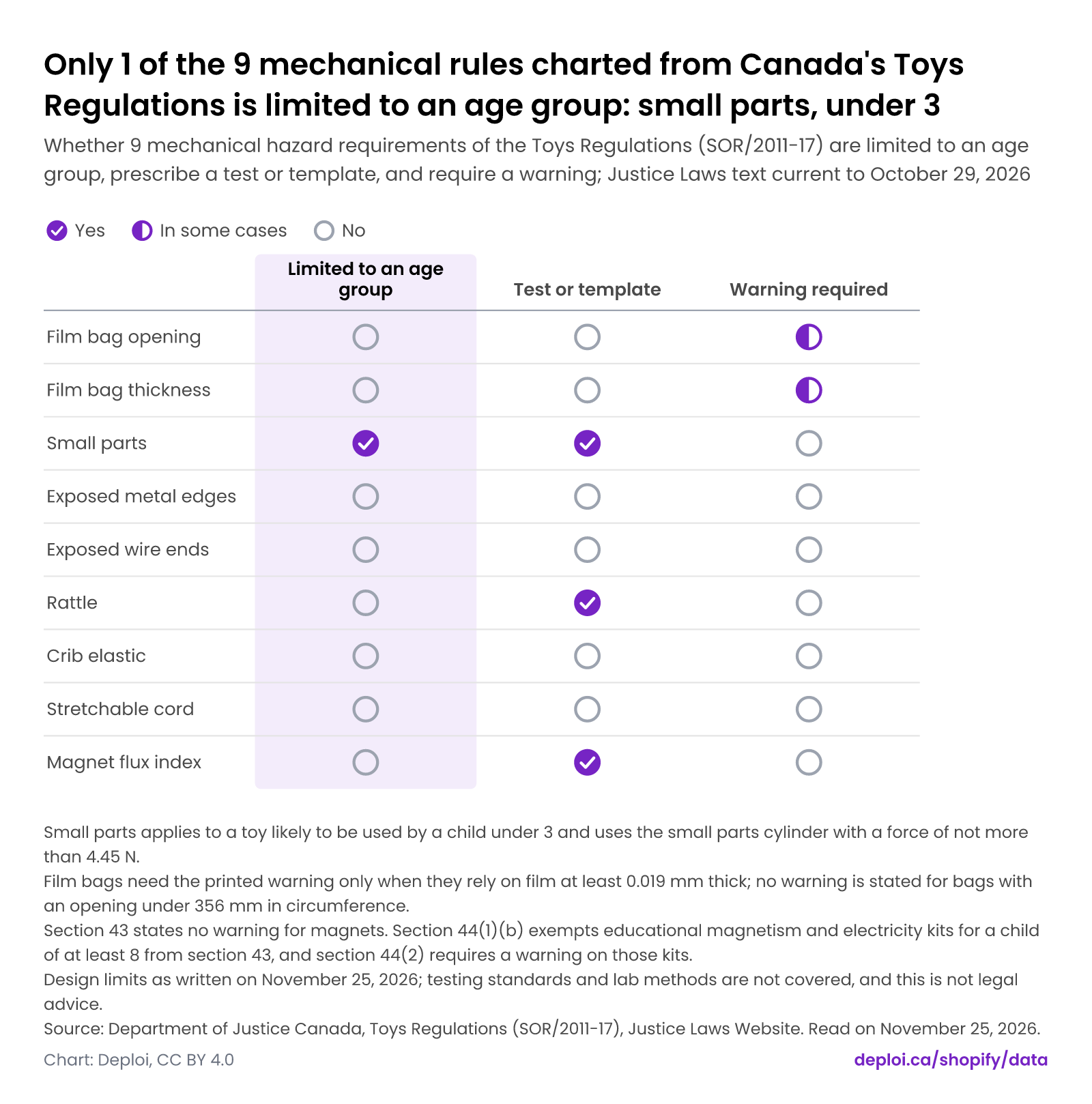
Which mechanical limits in Canada's Toys Regulations are tied to a child's age?
Of the 9 requirements on this page, only the small parts requirement in section 7 of the Toys Regulations (SOR/2011-17) is limited to an age group: it applies to a toy likely to be used by a child of less than 3 years, as read on Justice Laws on November 25, 2026. The other 8 set no age limit.
The dataset has 9 requirement rows from 8 sections, because section 4 on film bags has one row for the opening and one for the thickness. The 8 sections are a selection, not every requirement in the regulations. Section 44(1)(b) takes educational magnetism and electricity kits intended for a child of at least 8 out of section 43, and section 44(2) requires a warning on those kits. Neither sets an age limit for the magnet rule. Source: Department of Justice Canada, Toys Regulations (SOR/2011-17), read November 25, 2026.
What is the small parts limit for toys for children under 3?
A toy likely to be used by a child of less than 3 years must not contain a part that is meant to be separable or may become separated with reasonably foreseeable use and that can be totally enclosed in the small parts cylinder in Schedule 1 using a force of not more than 4.45 N, according to section 7 of SOR/2011-17, read November 25, 2026.
The section covers a part meant to be separable or one that may become separated with reasonably foreseeable use of the toy. Subsection 7(2) says the rule does not apply to parts constructed entirely of soft textile fiber material. No warning is stated for this requirement. Source: Toys Regulations (SOR/2011-17), read November 25, 2026.
How long can a stretchable cord or crib elastic be on a toy?
A stretchable cord on a yo-yo type ball, or a soft pliable cord attached to a ball or other object, must not be capable of extending to 500 mm (20 inches) or greater, according to section 42 of SOR/2011-17, read on November 25, 2026. A crib elastic must stretch no more than 75% of its unstretched length or reach no more than 750 mm fully stretched, under section 41.
Section 41 sets a separate rule for an elastic that attaches a toy across a baby carriage, crib or playpen. It must meet at least one of two requirements: extensibility of not more than 75% of its unstretched length, or a fully stretched length of not more than 750 mm (30 inches). Source: Toys Regulations (SOR/2011-17), read November 25, 2026.
What must a plastic film bag that packages a toy meet?
A flexible film bag that packages a toy must have an opening of less than 356 mm (14 inches) in circumference, or be made from film at least 0.019 mm (0.75 mil) thick and carry a printed warning in both official languages, according to section 4 of SOR/2011-17, read November 25, 2026.
The warning is required only for the thick film route. The section states no warning for a bag with an opening under 356 mm in circumference. The regulation allows the warning or an equivalent, printed legibly on the bag. Source: Toys Regulations (SOR/2011-17), read November 25, 2026.
What is the magnet flux index limit for toys?
A magnetic toy and any of its magnetic components that can be totally enclosed in the small parts cylinder using a force of not more than 4.45 N must have a magnetic flux index of less than 0.5 T²mm², according to section 43 of SOR/2011-17, read November 25, 2026.
The section covers components that become separated when the toy is tested under Schedule 9, and the index is measured under Schedule 10. Section 43 states no warning. Section 44(2) requires a warning on the container and instructions of the educational magnetism and electricity kits for a child of at least 8, which section 44(1)(b) exempts. Source: Toys Regulations (SOR/2011-17), read November 25, 2026.
What other limits apply to rattles, metal edges and wire ends?
A rattle must keep a part, and any component removable with a force of 50 N or less or a torque of less than 1 N-m, from impinging on the Schedule 8 template, according to section 40 of SOR/2011-17, read November 25, 2026. Sections 8 and 9 state no number for exposed metal edges or wire ends.
Section 40 also requires that a sharp wire not become exposed with reasonably foreseeable use of the rattle. Section 8 says exposed metal edges must be folded back, painted, dipped or otherwise treated so that all sharpness and burrs are eliminated. Section 9 says embedded wire ends must be covered, turned in or turned back. Source: Toys Regulations (SOR/2011-17), read November 25, 2026.
The data
Each chart on this page is drawn from the numbers below. Units are in the column headers.
| Requirement | Limited to an age group (yes/no) | Test or template (yes/no) | Warning required (yes/no/conditions) | Scope | Section | Limit (number in the unit column) | Unit | Applies under age (years) | Warning required (yes/no/conditions) |
|---|---|---|---|---|---|---|---|---|---|
| Film bag opening | No | No | In some cases | A flexible film bag that packages a toy | 4 | 356.000 | mm | Not stated | conditions: no warning is stated for route (a), an opening of less than 356 mm in circumference; the printed warning is required only for route (b), film at least 0.019 mm thick |
| Film bag thickness | No | No | In some cases | A flexible film bag that packages a toy | 4 | 0.019 | mm | Not stated | conditions: the printed warning is required where the bag relies on route (b), film at least 0.019 mm thick; no warning is stated for route (a), an opening of less than 356 mm in circumference |
| Small parts | Yes | Yes | No | A toy that is likely to be used by a child of less than three years of age | 7 | 4.450 | N | 3 | no |
| Exposed metal edges | No | No | No | A toy’s exposed metal edges | 8 | Not stated | none | Not stated | no |
| Exposed wire ends | No | No | No | A wire frame or structure that is embedded in a toy | 9 | Not stated | none | Not stated | no |
| Rattle | No | Yes | No | A rattle | 40 | 50.000 | N | Not stated | no |
| Crib elastic | No | No | No | An elastic that is used to attach a toy across a baby carriage, crib or playpen | 41 | 750.000 | mm | Not stated | no |
| Stretchable cord | No | No | No | (1) The stretchable cord of a yo-yo type ball; (2) A stretchable cord that is made of a soft pliable material and that is attached to a ball, or to an object of any other shape | 42 | 500.000 | mm | Not stated | no |
| Magnet flux index | No | Yes | No | Every magnetic toy and any of its magnetic components, including those magnetic components that become separated from the magnetic toy or magnetic component when tested in accordance with Schedule 9, that can be totally enclosed in the small parts cylinder, as illustrated in Schedule 1, using a force of not more than 4.45 N | 43 | 0.500 | T²mm² | Not stated | no: s. 43 states no warning; s. 44(2) requires a warning on the container and instructions of the kits that s. 44(1)(b) exempts from s. 43 (educational magnetism-and-electricity kits for a child of at least 8 years of age) |
Download Canada's Toys Regulations mechanical hazard limits as CSV · All 13 columns on the dataset page
Methodology
Reading the chart: Only 1 of the 9 mechanical rules charted from Canada's Toys Regulations is limited to an age group: small parts, under 3
- Small parts applies to a toy likely to be used by a child under 3 and uses the small parts cylinder with a force of not more than 4.45 N.
- Film bags need the printed warning only when they rely on film at least 0.019 mm thick; no warning is stated for bags with an opening under 356 mm in circumference.
- Section 43 states no warning for magnets. Section 44(1)(b) exempts educational magnetism and electricity kits for a child of at least 8 from section 43, and section 44(2) requires a warning on those kits.
- Design limits as written on November 25, 2026; testing standards and lab methods are not covered, and this is not legal advice.
Caveats: Canada's Toys Regulations mechanical hazard limits
- Design limits as written in the regulations on November 25, 2026; testing standards and lab methods are not covered.
- The film bag section has two rows, one for the opening and one for the film thickness, because the section offers two routes.
- The limit and unit columns give the number as the section states it, so units differ by row (N, mm, T²mm²).
- The dataset is not legal advice.
Deploi's charts and compilation are licensed CC BY 4.0. The underlying facts belong to their sources, which are named on every page. How Deploi Shopify Data works.
Sources
Tier A sources are primary documents: filings, official releases and official price pages. How sources are ranked.
- Tier AToys Regulations, SOR/2011-17 (Justice Laws Website), read 2026-11-25
Department of Justice Canada (Justice Laws Website) · HTML · Read on
Cite and reuse
Deploi's charts and compilation are licensed CC BY 4.0. The underlying facts belong to their sources, which are named on every page.
APA
Deploi. (2026). Which mechanical hazard limits must a toy meet to be sold in Canada? [Web page]. https://deploi.ca/shopify/data/canada-toy-mechanical-hazard-limits Retrieved November 25, 2026.
BibTeX
@misc{deploi_canada_toy_mechanical_hazard_limits_2026,
  author = {{Deploi}},
  title = {Which mechanical hazard limits must a toy meet to be sold in Canada?},
  year = {2026},
  url = {https://deploi.ca/shopify/data/canada-toy-mechanical-hazard-limits},
  note = {Accessed 2026-11-25}
}
Embed this chart
Embed code
<iframe src="https://deploi.ca/embed/shopify/data/canada-toy-mechanical-requirements" title="Only 1 of the 9 mechanical rules charted from Canada's Toys Regulations is limited to an age group: small parts, under 3" loading="lazy" style="width:100%;height:670px;border:0"></iframe> <p style="font:12px/1.4 Arial,sans-serif;margin:4px 0 0">Source: <a href="https://deploi.ca/shopify/data/charts/canada-toy-mechanical-requirements">Deploi, Only 1 of the 9 mechanical rules charted from Canada's Toys Regulations is limited to an age group: small parts, under 3</a></p>
Keep the credit line under the embed. It is the license condition.
Questions
What is the small parts rule for toys in Canada?
A toy likely to be used by a child under 3 must not contain a part that is meant to be separable or may become separated with reasonably foreseeable use and that fits totally inside the small parts cylinder using a force of not more than 4.45 N, per section 7 of the Toys Regulations (SOR/2011-17), read November 25, 2026. Parts made entirely of soft textile fiber are excluded.
What is the cord length limit for toys in Canada?
A stretchable cord on a yo-yo type ball, or a soft pliable cord attached to a ball or other object, must not be capable of extending to 500 mm (20 inches) or more, per section 42 of SOR/2011-17, read on Justice Laws on November 25, 2026.
Do toy film bags in Canada need a warning?
Only on one route. Section 4 of SOR/2011-17, read November 25, 2026, states no warning for a bag with an opening under 356 mm in circumference. A bag made from film at least 0.019 mm thick must carry the printed warning in both official languages.
What is the magnet limit for toys in Canada?
Section 43 of SOR/2011-17, read November 25, 2026, requires a magnetic flux index of less than 0.5 T²mm² for a magnetic toy and its magnetic components that fit in the small parts cylinder under a force of not more than 4.45 N.
Does this page cover testing standards or other countries?
No. The dataset records design limits as written in the Toys Regulations on November 25, 2026. It does not cover every section of the regulations, testing standards, lab methods or US rules, and it is not legal advice. Section 44(2) is included only for its warning rule.
More on Canada
- Does a higher Shopify plan buy a bigger shipping discount in Canada?
Shopify's Canadian pricing page lists Shipping discounts of up to 45% on Basic, 50% on Grow and 53% on Advanced and Plus, against up to 87% on every US plan, as captured November 21, 2026. Updated November 22, 2026.
- Does Canadian duty apply to the shipping cost?
Section 48 of the Customs Act counts transport to the place of direct shipment in the value for duty and takes out transport from that place to Canada when the price includes it, as read on the Justice Laws Website on November 22, 2026. Updated November 22, 2026.
- Which prepackaged foods sold in Canada must carry the front-of-package 'high in' symbol, and at what percent of daily value?
Prepackaged foods sold in Canada must show the 'high in' symbol at or above 15% of the daily value, 10% for reference amounts of 30 g or 30 mL or less and 30% for main dishes of 200 g or more, unless exempt, under section B.01.350 of the Food and Drug Regulations; the CFIA's compliance deadline was January 1, 2026. Updated November 22, 2026.
- Can a Canadian online store let a gift card expire or charge fees on it, and how do the rules differ by province?
The official pages of the nine provinces covered state that gift cards may not carry an expiry date, with listed exceptions, and cap mall card dormancy fees at C$2.50 a month where they state an amount, read November 21, 2026. Updated November 21, 2026.
- Do British Columbia, Saskatchewan and Manitoba make an online store a packaging producer, and what line exempts a small seller?
British Columbia takes a small packaging producer out of its Part 2 plan rules and Saskatchewan exempts one, under C$1,000,000 in revenue or 1 tonne of packaging a year, and Manitoba's regulation states no such line, per provincial texts read November 21, 2026. Updated November 21, 2026.
- Does a Canadian store charge GST or HST on an order shipped outside Canada, and what changes for a pickup in Canada?
Goods a supplier ships to a destination outside Canada, or mails or couriers to an address outside Canada, are zero-rated under Schedule VI, Part V, section 12 of the Excise Tax Act, consolidated to October 29, 2026, and goods delivered or made available in Canada are supplied in Canada under section 142(1)(a). Updated November 21, 2026.
Changes
- · Canada's Toys Regulations mechanical hazard limits
First release: 9 mechanical requirement rows from the Toys Regulations (SOR/2011-17), read on the Justice Laws Website on November 25, 2026.