
On mobile, 35.4% of AudioEye sites pass all three Core Web Vitals against 53.0% of all sites; UserWay sites pass more often, at 57.8%
Correlation only: share of mobile origins with good Core Web Vitals (overall, LCP, CLS or INP) by detected technology, against all origins, %, Chrome UX Report via HTTP Archive, October 2026
By Martin DejnickiUpdated Data through October 1, 2026
Short answer
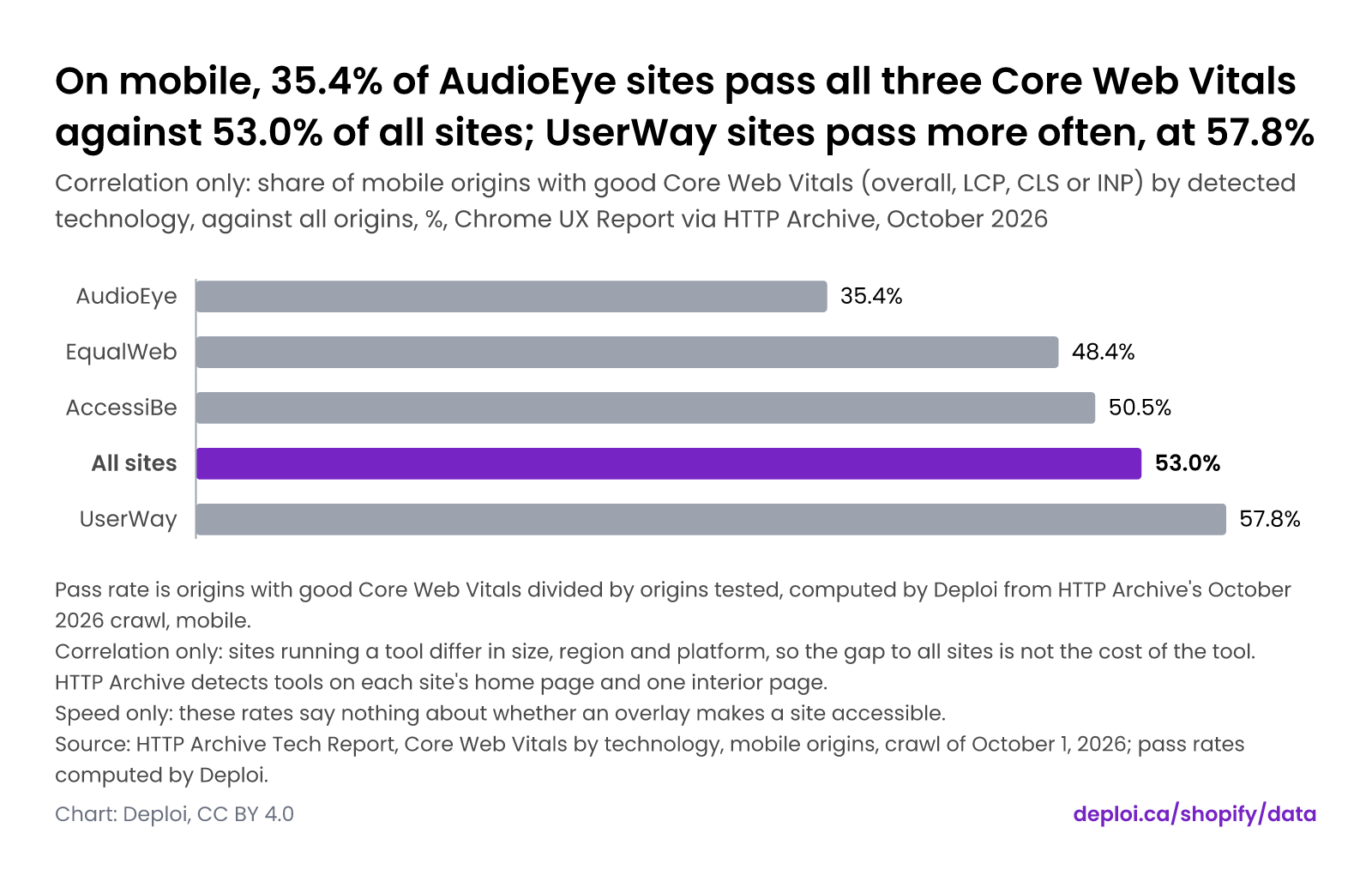
In HTTP Archive's October 2026 crawl, 35.4% of mobile origins running AudioEye passed all three Core Web Vitals, against 53.0% of all origins; EqualWeb 48.4%, AccessiBe 50.5% and UserWay 57.8%. On CLS alone, AudioEye sites passed 61.4% against 83.4%. Pass rates computed by Deploi; correlation only, and speed only, no accessibility verdict.
On mobile, 35.4% of AudioEye sites pass all three Core Web Vitals against 53.0% of all sites; UserWay sites pass more often, at 57.8%
Correlation only: share of mobile origins with good Core Web Vitals (overall, LCP, CLS or INP) by detected technology, against all origins, %, Chrome UX Report via HTTP Archive, October 2026
Mobile pass rate by overlay: All three pass, October 2026
Lowest AudioEye at 35.4%, highest UserWay at 57.8%; correlation only, not the cost of a tool.
Showing: Core Web Vital: All three pass. Reset
- Pass rate is origins with good Core Web Vitals divided by origins tested, computed by Deploi from HTTP Archive's October 2026 crawl, mobile.
- Correlation only: sites running a tool differ in size, region and platform, so the gap to all sites is not the cost of the tool.
- HTTP Archive detects tools on each site's home page and one interior page.
- Speed only: these rates say nothing about whether an overlay makes a site accessible.
Source: HTTP Archive Tech Report, Core Web Vitals by technology, mobile origins, crawl of October 1, 2026; pass rates computed by Deploi. Read on .
The data
Each chart on this page is drawn from the numbers below. Units are in the column headers.
| Technology | Measure | Origins passing | Origins tested | Pass rate (% of origins) | Gap to all sites (percentage points) |
|---|---|---|---|---|---|
| UserWay | overall | 31,876 | 55,151 | 57.8 | 4.749 |
| UserWay | LCP | 38,572 | 55,211 | 69.9 | 3.771 |
| UserWay | CLS | 45,939 | 55,928 | 82.1 | -1.233 |
| UserWay | INP | 40,931 | 45,619 | 89.7 | 10.849 |
| AccessiBe | overall | 17,094 | 33,881 | 50.5 | -2.596 |
| AccessiBe | LCP | 24,397 | 33,901 | 72.0 | 5.873 |
| AccessiBe | CLS | 24,939 | 34,267 | 72.8 | -10.594 |
| AccessiBe | INP | 25,236 | 29,956 | 84.2 | 5.369 |
| AudioEye | overall | 8,302 | 23,443 | 35.4 | -17.635 |
| AudioEye | LCP | 15,469 | 23,472 | 65.9 | -0.188 |
| AudioEye | CLS | 14,554 | 23,706 | 61.4 | -21.979 |
| AudioEye | INP | 13,531 | 20,584 | 65.7 | -13.139 |
| EqualWeb | overall | 1,797 | 3,713 | 48.4 | -4.651 |
| EqualWeb | LCP | 2,329 | 3,716 | 62.7 | -3.417 |
| EqualWeb | CLS | 3,051 | 3,760 | 81.1 | -2.229 |
| EqualWeb | INP | 2,694 | 3,278 | 82.2 | 3.309 |
| All sites | overall | 4,400,082 | 8,294,416 | 53.0 | 0 |
| All sites | LCP | 5,492,926 | 8,311,002 | 66.1 | 0 |
| All sites | CLS | 7,027,436 | 8,428,978 | 83.4 | 0 |
| All sites | INP | 5,068,844 | 6,426,445 | 78.9 | 0 |
Download Share of mobile origins passing Core Web Vitals, LCP, CLS and INP by accessibility overlay, October 2026 as CSV · All 9 columns on the dataset page
Methodology
Reading the chart: On mobile, 35.4% of AudioEye sites pass all three Core Web Vitals against 53.0% of all sites; UserWay sites pass more often, at 57.8%
- Pass rate is origins with good Core Web Vitals divided by origins tested, computed by Deploi from HTTP Archive's October 2026 crawl, mobile.
- Correlation only: sites running a tool differ in size, region and platform, so the gap to all sites is not the cost of the tool.
- HTTP Archive detects tools on each site's home page and one interior page.
- Speed only: these rates say nothing about whether an overlay makes a site accessible.
Caveats: Share of mobile origins passing Core Web Vitals, LCP, CLS and INP by accessibility overlay, October 2026
- Correlation only: sites that run a given accessibility overlay differ in size, region and platform; the gap is not the cost of the tool.
- Origins with Chrome UX Report data only; mobile only. Crawl month October 2026; the all-sites rate includes sites with and without the tools shown, so it is a reference, not a no-tool baseline.
- Technology detection is HTTP Archive's; its Technology Report says 'technologies are identified by HTTP Archive on the home page and one interior page', so a tool used only on other pages of a site is not counted.
- A pass on all three Core Web Vitals means a good result on Largest Contentful Paint (LCP), Cumulative Layout Shift (CLS) and Interaction to Next Paint (INP) for the origin; the tested count differs by vital.
- Interaction to Next Paint needs enough interaction data: 22.5% of all-sites origins tested in the overall assessment have no INP rating (6,426,445 INP-tested of 8,294,416), against 11.6% (AccessiBe) to 17.3% (UserWay) for the accessibility overlays, computed by Deploi from the tested counts. Google's assessment judges such origins on LCP and CLS alone: 'Some pages may not have sufficient INP data, in which case the page is assessed on the other two Core Web Vitals metrics.'
- Pass rates and gaps to all sites are computed by Deploi from the HTTP Archive counts and stored unrounded.
- Speed only: the pass rates say nothing about whether an overlay makes a site accessible.
- Sample sizes differ: EqualWeb has the smallest tested count and UserWay the largest. Origins can run more than one tool, so the groups overlap.
Deploi's charts and compilation are licensed CC BY 4.0. The underlying facts belong to their sources, which are named on every page. How Deploi Shopify Data works.
Sources
Tier A sources are primary documents: filings, official releases and official price pages. How sources are ranked.
Show all 10 sources
- Tier AChrome for Developers: How to view Chrome UX Report data on PageSpeed Insights (Core Web Vitals assessment)
Google (Chrome for Developers) · TEXT · Read on
- Tier AChrome UX Report methodology (eligibility of users, pages and origins), retrieved 2026-11-21
Google (Chrome for Developers) · HTML · Read on
- Tier B
- Tier B
- Tier B
- Tier B
- Tier BHTTP Archive: Tech Report (landing page and method statement), retrieved 2026-11-21
HTTP Archive · HTML · Read on
- Tier AInteraction to Next Paint (INP), web.dev, retrieved 2026-11-21
Google (web.dev) · HTML · Read on
- Tier AWeb Vitals (Core Web Vitals definitions and thresholds), web.dev, retrieved 2026-11-21
Google (web.dev) · HTML · Read on
Cite and reuse
Deploi's charts and compilation are licensed CC BY 4.0. The underlying facts belong to their sources, which are named on every page.
APA
Deploi. (2026). On mobile, 35.4% of AudioEye sites pass all three Core Web Vitals against 53.0% of all sites; UserWay sites pass more often, at 57.8% (Version 1) [Chart]. https://deploi.ca/shopify/data/charts/overlay-cwv-by-vendor Retrieved November 21, 2026.
BibTeX
@misc{deploi_overlay_cwv_by_vendor_2026,
  author = {{Deploi}},
  title = {On mobile, 35.4\% of AudioEye sites pass all three Core Web Vitals against 53.0\% of all sites; UserWay sites pass more often, at 57.8\%},
  year = {2026},
  version = {1},
  url = {https://deploi.ca/shopify/data/charts/overlay-cwv-by-vendor},
  note = {Accessed 2026-11-21}
}
Embed this chart
Embed code
<iframe src="https://deploi.ca/embed/shopify/data/overlay-cwv-by-vendor" title="On mobile, 35.4% of AudioEye sites pass all three Core Web Vitals against 53.0% of all sites; UserWay sites pass more often, at 57.8%" loading="lazy" style="width:100%;height:530px;border:0"></iframe>
<p style="font:12px/1.4 Arial,sans-serif;margin:4px 0 0">Source: <a href="https://deploi.ca/shopify/data/charts/overlay-cwv-by-vendor">Deploi, On mobile, 35.4% of AudioEye sites pass all three Core Web Vitals against 53.0% of all sites; UserWay sites pass more often, at 57.8%</a></p>
Keep the credit line under the embed. It is the license condition.
Changes
- · Share of mobile origins passing Core Web Vitals, LCP, CLS and INP by accessibility overlay, October 2026
First release. 20 rows, 8 fields read from 5 sources; each value agreed by extractor and verifier or ruled by the judge.