
Do sites running a consent management platform (OneTrust, Cookiebot, Usercentrics, Didomi, CookieYes) pass Core Web Vitals less often than the average site?
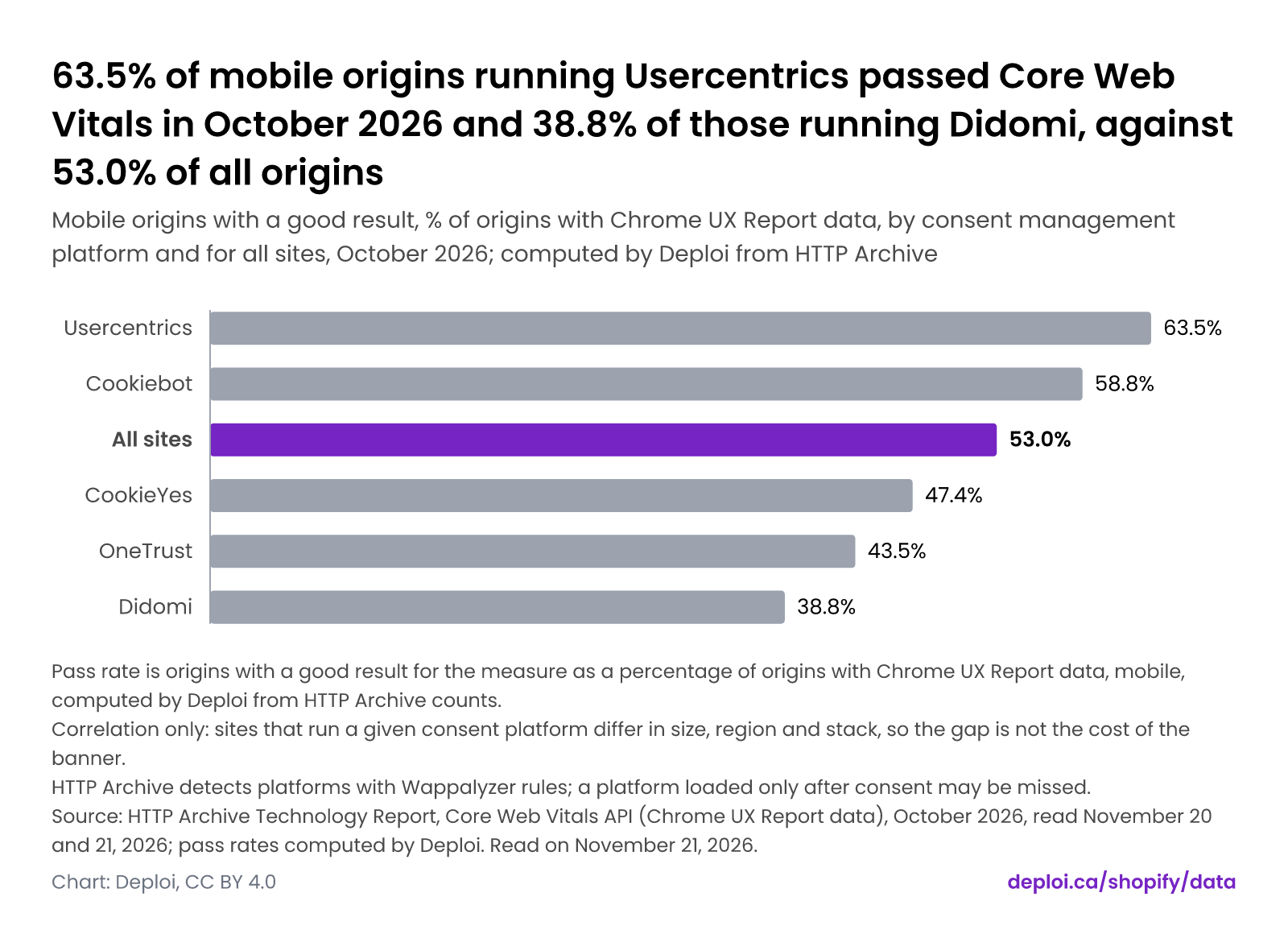
In October 2026, 63.5% of mobile origins running Usercentrics passed Core Web Vitals and 38.8% of those running Didomi, against 53.0% of all origins, computed by Deploi from HTTP Archive. Updated November 21, 2026.
By Martin DejnickiUpdated Data through October 1, 2026
Short answer
Three of five consent management platforms had Core Web Vitals pass rates below the all-sites rate of 53.0% on mobile in October 2026, computed by Deploi from HTTP Archive: CookieYes at 47.4%, OneTrust at 43.5% and Didomi at 38.8%. Usercentrics passed at 63.5% and Cookiebot at 58.8%. The gap is correlation, not the cost of a banner.
63.5% of mobile origins running Usercentrics passed Core Web Vitals in October 2026 and 38.8% of those running Didomi, against 53.0% of all origins
Mobile origins with a good result, % of origins with Chrome UX Report data, by consent management platform and for all sites, October 2026; computed by Deploi from HTTP Archive
Mobile pass rate by consent platform, Core Web Vitals, October 2026
Core Web Vitals overall: Usercentrics 63.5%, Cookiebot 58.8%, CookieYes 47.4%, OneTrust 43.5% and Didomi 38.8% of mobile origins passed, against 53.0% of all origins.
Showing: Measure: Core Web Vitals. Reset
- Pass rate is origins with a good result for the measure as a percentage of origins with Chrome UX Report data, mobile, computed by Deploi from HTTP Archive counts.
- Correlation only: sites that run a given consent platform differ in size, region and stack, so the gap is not the cost of the banner.
- HTTP Archive detects platforms with Wappalyzer rules; a platform loaded only after consent may be missed.
Source: HTTP Archive Technology Report, Core Web Vitals API (Chrome UX Report data), October 2026, read November 20 and 21, 2026; pass rates computed by Deploi. Read on .
What share of sites running each consent platform pass Core Web Vitals?
On mobile in October 2026, Usercentrics origins passed Core Web Vitals at 63.5%, Cookiebot at 58.8%, CookieYes at 47.4%, OneTrust at 43.5% and Didomi at 38.8%, against 53.0% for all origins, computed by Deploi from HTTP Archive and the Chrome UX Report. Two platforms were above the all-sites rate and three were below it.
Pass rate is the share of origins with Chrome UX Report data that have a good result for the measure, mobile. The chart has a control to switch between Core Web Vitals overall, Largest Contentful Paint (LCP) and Interaction to Next Paint (INP).
Which consent platforms pass the loading measure, LCP?
On Largest Contentful Paint, Usercentrics origins passed at 75.1% on mobile in October 2026, Cookiebot at 70.7%, Didomi at 69.4%, OneTrust at 64.4% and CookieYes at 54.0%, against 66.1% for all origins, computed by Deploi from HTTP Archive. OneTrust and CookieYes were below the all-sites rate.
CookieYes was 12.1 percentage points below the all-sites LCP rate, the widest LCP gap in the data. Didomi was 3.4 points above it. Both gaps are computed by Deploi from the unrounded rates.
Which consent platforms pass the responsiveness measure, INP?
On Interaction to Next Paint, CookieYes origins passed at 91.7% on mobile in October 2026, Usercentrics at 90.6%, Cookiebot at 88.3%, OneTrust at 75.0% and Didomi at 43.7%, against 78.9% for all origins, computed by Deploi from HTTP Archive. Didomi was 35.2 points below the all-sites rate.
Didomi's INP result is the widest gap in the dataset. Its LCP result, 69.4%, was above the all-sites rate of 66.1%, so the low overall pass rate of 38.8% goes with its INP result; the dataset does not show cause.
The HTTP Archive Web Almanac 2024 CMS chapter, read November 18, 2026, states that INP officially replaced First Input Delay on March 12, 2024.
How large are the samples behind the consent platform rates?
The consent platform rates rest on tens or hundreds of thousands of origins: HTTP Archive's October 2026 mobile data tests 201,664 CookieYes origins, 131,885 Cookiebot, 100,963 OneTrust, 57,136 Didomi and 41,991 Usercentrics for Core Web Vitals overall, against 8,294,416 for all sites. Pass rates are computed by Deploi from these counts.
| Consent platform | Origins tested, overall | Origins passing, overall | Pass rate, overall |
|---|---|---|---|
| CookieYes | 201,664 | 95,533 | 47.4% |
| Cookiebot | 131,885 | 77,583 | 58.8% |
| OneTrust | 100,963 | 43,924 | 43.5% |
| Didomi | 57,136 | 22,141 | 38.8% |
| Usercentrics | 41,991 | 26,644 | 63.5% |
Source: HTTP Archive Technology Report, Core Web Vitals API, October 2026, mobile, pass rate computed by Deploi.
Does the gap measure what a consent banner costs a site?
The gap does not measure the cost of a consent banner. Sites that run a given platform differ in size, region and stack, so the October 2026 mobile pass rates computed by Deploi from HTTP Archive show correlation only. A platform loaded only after consent may also be missed by HTTP Archive's technology detection.
HTTP Archive detects platforms with Wappalyzer rules. Only origins with Chrome UX Report data are counted, and this page covers mobile.
Sites without any of the five platforms are in the all-sites rate, so the all-sites rate is a reference, not a no-banner baseline.
The data
Each chart on this page is drawn from the numbers below. Units are in the column headers.
| Technology | Measure | Pass rate (% of origins) | Origins passing | Origins tested | Gap to all sites (percentage points) |
|---|---|---|---|---|---|
| OneTrust | overall | 43.5 | 43,924 | 100,963 | -9.544 |
| OneTrust | LCP | 64.4 | 65,090 | 101,050 | -1.679 |
| OneTrust | INP | 75.0 | 68,779 | 91,686 | -3.859 |
| Cookiebot | overall | 58.8 | 77,583 | 131,885 | 5.778 |
| Cookiebot | LCP | 70.7 | 93,304 | 132,032 | 4.575 |
| Cookiebot | INP | 88.3 | 105,096 | 119,006 | 9.437 |
| Usercentrics | overall | 63.5 | 26,644 | 41,991 | 10.403 |
| Usercentrics | LCP | 75.1 | 31,571 | 42,057 | 8.975 |
| Usercentrics | INP | 90.6 | 33,704 | 37,217 | 11.686 |
| Didomi | overall | 38.8 | 22,141 | 57,136 | -14.297 |
| Didomi | LCP | 69.4 | 39,703 | 57,174 | 3.350 |
| Didomi | INP | 43.7 | 20,429 | 46,784 | -35.208 |
| CookieYes | overall | 47.4 | 95,533 | 201,664 | -5.676 |
| CookieYes | LCP | 54.0 | 109,080 | 201,988 | -12.089 |
| CookieYes | INP | 91.7 | 153,867 | 167,747 | 12.851 |
| All sites | overall | 53.0 | 4,400,082 | 8,294,416 | 0 |
| All sites | LCP | 66.1 | 5,492,926 | 8,311,002 | 0 |
| All sites | INP | 78.9 | 5,068,844 | 6,426,445 | 0 |
Download Share of mobile origins passing Core Web Vitals, LCP and INP by consent management platform, October 2026 as CSV · All 9 columns on the dataset page
Methodology
Reading the chart: 63.5% of mobile origins running Usercentrics passed Core Web Vitals in October 2026 and 38.8% of those running Didomi, against 53.0% of all origins
- Pass rate is origins with a good result for the measure as a percentage of origins with Chrome UX Report data, mobile, computed by Deploi from HTTP Archive counts.
- Correlation only: sites that run a given consent platform differ in size, region and stack, so the gap is not the cost of the banner.
- HTTP Archive detects platforms with Wappalyzer rules; a platform loaded only after consent may be missed.
Caveats: Share of mobile origins passing Core Web Vitals, LCP and INP by consent management platform, October 2026
- Correlation only: sites that run a given consent platform differ in size, region and stack; the gap is not the cost of the banner.
- Origins with Chrome UX Report data only; mobile only.
- Technology detection by HTTP Archive (Wappalyzer rules); a platform loaded only after consent may be missed.
- The all-sites rate includes sites with and without a consent platform, so it is a reference, not a no-banner baseline.
- The HTTP Archive Web Almanac 2024 (CMS chapter, read November 18, 2026) states that Interaction to Next Paint officially replaced First Input Delay as the interactivity Core Web Vitals metric on March 12, 2024; the October 2026 counts use INP.
- Pass rates and gaps to all sites are computed by Deploi from the API counts and stored unrounded.
Deploi's charts and compilation are licensed CC BY 4.0. The underlying facts belong to their sources, which are named on every page. How Deploi Shopify Data works.
Sources
Tier A sources are primary documents: filings, official releases and official price pages. How sources are ranked.
- Tier BCMS | 2024 | The Web Almanac by HTTP Archive
HTTP Archive (Web Almanac) · HTML · Read on
- Tier B
- Tier B
- Tier B
- Tier B
- Tier B
Cite and reuse
Deploi's charts and compilation are licensed CC BY 4.0. The underlying facts belong to their sources, which are named on every page.
APA
Deploi. (2026). Do sites running a consent management platform (OneTrust, Cookiebot, Usercentrics, Didomi, CookieYes) pass Core Web Vitals less often than the average site? [Web page]. https://deploi.ca/shopify/data/consent-platform-core-web-vitals Retrieved November 21, 2026.
BibTeX
@misc{deploi_consent_platform_core_web_vitals_2026,
  author = {{Deploi}},
  title = {Do sites running a consent management platform (OneTrust, Cookiebot, Usercentrics, Didomi, CookieYes) pass Core Web Vitals less often than the average site?},
  year = {2026},
  url = {https://deploi.ca/shopify/data/consent-platform-core-web-vitals},
  note = {Accessed 2026-11-21}
}
Embed this chart
Embed code
<iframe src="https://deploi.ca/embed/shopify/data/consent-platform-cwv-by-measure" title="63.5% of mobile origins running Usercentrics passed Core Web Vitals in October 2026 and 38.8% of those running Didomi, against 53.0% of all origins" loading="lazy" style="width:100%;height:570px;border:0"></iframe>
<p style="font:12px/1.4 Arial,sans-serif;margin:4px 0 0">Source: <a href="https://deploi.ca/shopify/data/charts/consent-platform-cwv-by-measure">Deploi, 63.5% of mobile origins running Usercentrics passed Core Web Vitals in October 2026 and 38.8% of those running Didomi, against 53.0% of all origins</a></p>
Keep the credit line under the embed. It is the license condition.
Questions
Does OneTrust slow down Core Web Vitals?
The data does not show that. In October 2026, 43.5% of mobile origins running OneTrust passed Core Web Vitals, against 53.0% of all origins, computed by Deploi from HTTP Archive. Sites that run OneTrust differ in size, region and stack, so the gap is correlation.
Which consent management platform has the best Core Web Vitals?
Usercentrics had the highest overall pass rate on mobile in October 2026, at 63.5% of origins, against 53.0% for all sites, computed by Deploi from HTTP Archive. CookieYes was highest on INP at 91.7%. Usercentrics had the fewest tested origins, 41,991.
Why is Didomi's Core Web Vitals pass rate lower than the others?
The data does not say why; it shows where the gap is. Didomi origins passed INP at 43.7% on mobile in October 2026, against 78.9% for all origins, while they passed LCP at 69.4%, above the 66.1% all-sites rate, computed by Deploi from HTTP Archive.
Does CookieYes pass Core Web Vitals?
Fewer than half of the origins running it do. In October 2026, 47.4% of mobile origins running CookieYes passed Core Web Vitals overall, against 53.0% for all sites, computed by Deploi from HTTP Archive. It passed INP at 91.7% but LCP at 54.0%, against 66.1% for all sites.
Are these pass rates for mobile or desktop?
Mobile only. The October 2026 counts come from the HTTP Archive Technology Report and Chrome UX Report for origins on mobile with field data, and pass rates are computed by Deploi. Desktop pass rates are not in this dataset.
More on Performance and technology
- Do accessibility overlay widgets (UserWay, AccessiBe, AudioEye, EqualWeb) slow a site down on real-user Core Web Vitals?
In October 2026, 35.4% of mobile origins running AudioEye passed all three Core Web Vitals and 57.8% of those running UserWay, against 53.0% of all origins, computed by Deploi from HTTP Archive. Updated November 21, 2026.
- Do heavier pages pass Core Web Vitals less often, and at what page weight does the pass rate fall below half?
Mobile home pages passed Core Web Vitals at 57% up to 1 MB and 30% at 5 MB or more in the July 2025 crawl, per the Web Almanac 2025 from HTTP Archive. Updated November 21, 2026.
- Do sites running a live chat widget pass Core Web Vitals less often: Gorgias, Zendesk, Intercom, Tidio, LiveChat or Tawk.to?
In October 2026, 27.7% of mobile origins running LiveChat passed all three Core Web Vitals and 69.5% of those running Gorgias, against 53.0% of all origins, computed by Deploi from HTTP Archive. Updated November 21, 2026.
- Do sites running an A/B testing tool pass Core Web Vitals less often: Optimizely, VWO, AB Tasty, Convert, Kameleoon or Adobe Target?
In October 2026, 19.4% of mobile origins running AB Tasty and 20.0% of those running Adobe Target passed all three Core Web Vitals, against 53.0% of all origins, computed by Deploi from HTTP Archive. Updated November 21, 2026.
- Do sites running the Meta Pixel, the TikTok Pixel or the Google Ads tag pass Core Web Vitals less often than the average site?
On mobile in October 2026, 31.8% of TikTok Pixel origins and 49.4% of Meta Pixel origins passed Core Web Vitals, against 53.0% of all origins, computed by Deploi from HTTP Archive. Updated November 21, 2026.
- How many accessibility errors does the average home page have in the WebAIM Million, and which six failure types are the most common?
The average home page among the top 1,000,000 had 56.1 detected accessibility errors in the 2026 WebAIM Million, up from 51.0 in 2025, and low contrast text was found on 83.9% of pages. Updated November 21, 2026.
Changes
- · Share of mobile origins passing Core Web Vitals, LCP and INP by consent management platform, October 2026
First release. 18 rows, one for each of five platforms and all sites on three measures, from the HTTP Archive Technology Report for October 2026.