
Do EU businesses sell more online to businesses or to consumers, and how much of their ecommerce runs on EDI?
EDI-type sales made up 56.9% of EU e-commerce turnover in Eurostat's 2025 survey, and over half in 17 member states. Updated November 20, 2026.
By Martin DejnickiUpdated
Short answer
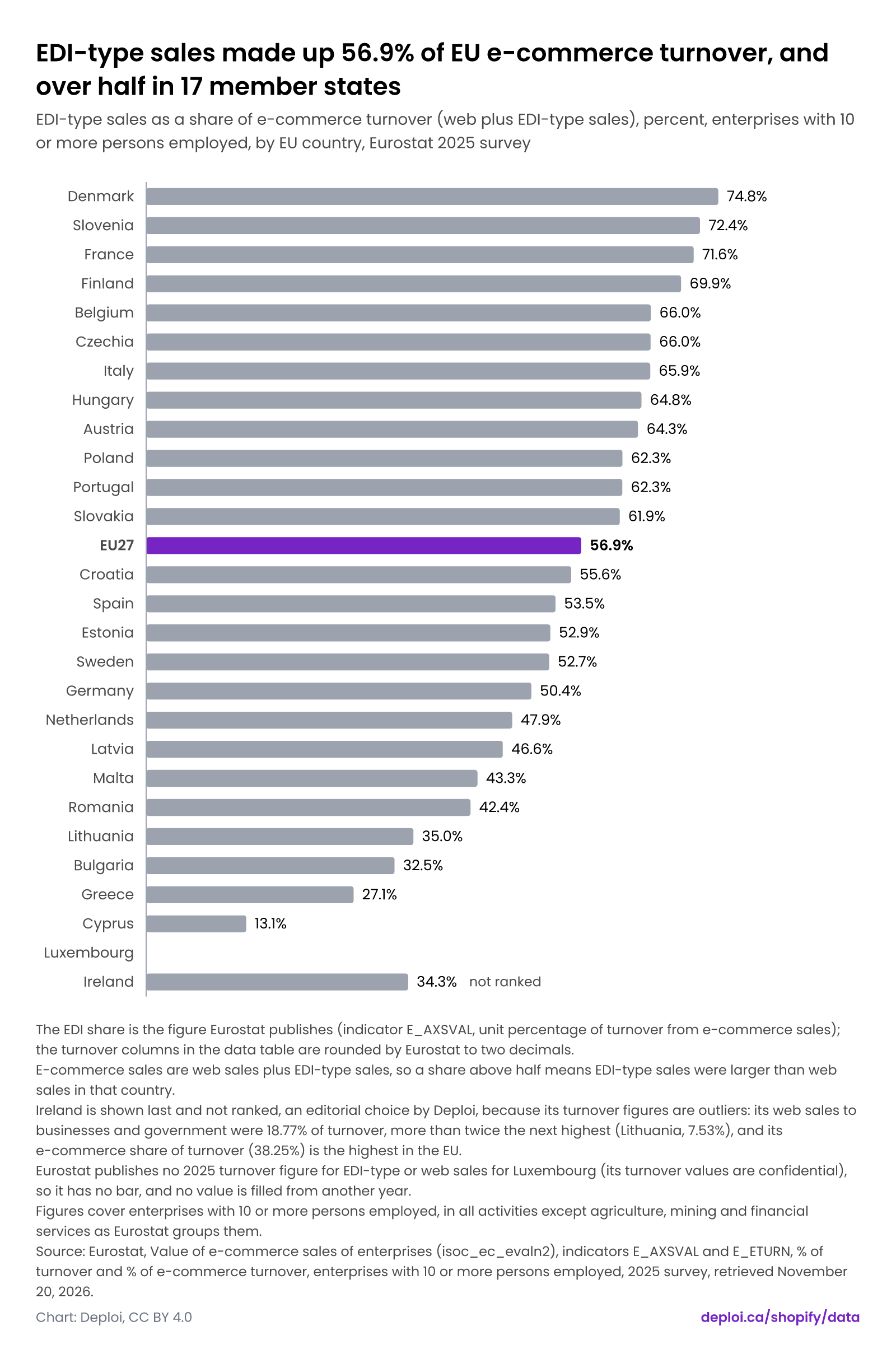
EDI-type sales made up 56.9% of EU e-commerce turnover in Eurostat's 2025 survey, for enterprises with 10 or more persons employed. EDI-type sales were 11.07% of total turnover and all e-commerce 19.49%. Web sales to businesses and government were 4.34% of turnover and web sales to consumers 4.04%, so EDI-type sales were larger than either.
EDI-type sales made up 56.9% of EU e-commerce turnover, and over half in 17 member states
EDI-type sales as a share of e-commerce turnover (web plus EDI-type sales), percent, enterprises with 10 or more persons employed, by EU country, Eurostat 2025 survey
- The EDI share is the figure Eurostat publishes (indicator E_AXSVAL, unit percentage of turnover from e-commerce sales); the turnover columns in the data table are rounded by Eurostat to two decimals.
- E-commerce sales are web sales plus EDI-type sales, so a share above half means EDI-type sales were larger than web sales in that country.
- Ireland is shown last and not ranked, an editorial choice by Deploi, because its turnover figures are outliers: its web sales to businesses and government were 18.77% of turnover, more than twice the next highest (Lithuania, 7.53%), and its e-commerce share of turnover (38.25%) is the highest in the EU.
- Eurostat publishes no 2025 turnover figure for EDI-type or web sales for Luxembourg (its turnover values are confidential), so it has no bar, and no value is filled from another year.
- Figures cover enterprises with 10 or more persons employed, in all activities except agriculture, mining and financial services as Eurostat groups them.
Source: Eurostat, Value of e-commerce sales of enterprises (isoc_ec_evaln2), indicators E_AXSVAL and E_ETURN, % of turnover and % of e-commerce turnover, enterprises with 10 or more persons employed, 2025 survey, retrieved November 20, 2026. Read on .
Do more EU firms sell on the web to consumers or to businesses?
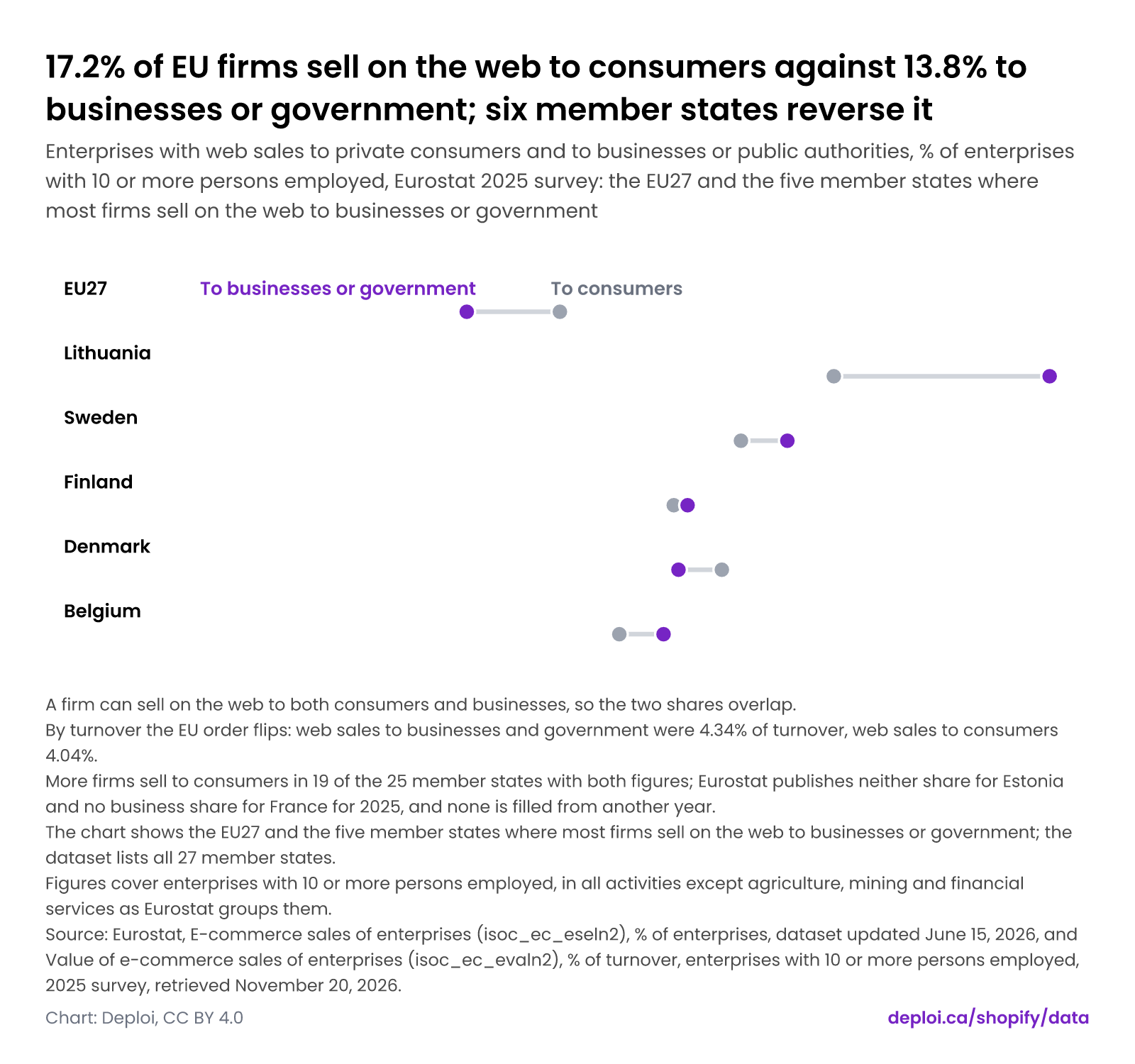
More EU enterprises sell on the web to consumers than to businesses or government: 17.17% against 13.80% of enterprises with 10 or more persons employed in Eurostat's 2025 survey. By turnover the order flips: web sales to businesses and government were 4.34% of turnover, against 4.04% to consumers. In 6 member states more firms sell to businesses, led by Lithuania at 34.89% against 27.08%.
| Country, 2025 survey | Firms with web sales to consumers | Firms with web sales to businesses or government | Consumer web sales, % of turnover | Business and government web sales, % of turnover |
|---|---|---|---|---|
| EU27 | 17.17% | 13.80% | 4.04% | 4.34% |
| Lithuania | 27.08% | 34.89% | 4.76% | 7.53% |
| Sweden | 23.72% | 25.40% | 6.17% | 6.28% |
| Finland | 21.29% | 21.79% | 3.68% | 5.38% |
| Denmark | 23.03% | 21.46% | 2.94% | 5.46% |
| Belgium | 19.32% | 20.92% | 3.11% | 6.93% |
The table shows the EU27 and the 5 member states where most firms sell on the web to businesses or government. A firm can sell to both groups, so the two shares of firms overlap.
17.2% of EU firms sell on the web to consumers against 13.8% to businesses or government; six member states reverse it
Enterprises with web sales to private consumers and to businesses or public authorities, % of enterprises with 10 or more persons employed, Eurostat 2025 survey: the EU27 and the five member states where most firms sell on the web to businesses or government
- A firm can sell on the web to both consumers and businesses, so the two shares overlap.
- By turnover the EU order flips: web sales to businesses and government were 4.34% of turnover, web sales to consumers 4.04%.
- More firms sell to consumers in 19 of the 25 member states with both figures; Eurostat publishes neither share for Estonia and no business share for France for 2025, and none is filled from another year.
- The chart shows the EU27 and the five member states where most firms sell on the web to businesses or government; the dataset lists all 27 member states.
- Figures cover enterprises with 10 or more persons employed, in all activities except agriculture, mining and financial services as Eurostat groups them.
Source: Eurostat, E-commerce sales of enterprises (isoc_ec_eseln2), % of enterprises, dataset updated June 15, 2026, and Value of e-commerce sales of enterprises (isoc_ec_evaln2), % of turnover, enterprises with 10 or more persons employed, 2025 survey, retrieved November 20, 2026. Read on .
How many EU firms use EDI-type sales?
In Eurostat's 2025 survey, 5.60% of EU enterprises with 10 or more persons employed had EDI-type sales, against 13.80% with web sales to businesses or government and 17.17% with web sales to consumers, yet EDI-type sales carried 11.07% of turnover. Denmark has the highest share of firms with EDI-type sales at 15.65%, followed by Belgium at 12.85%, and Greece the lowest at 1.35%.
Finland (11.29%) and Sweden (11.18%) follow Belgium. Fewer firms use EDI-type sales than web sales, but they carry more turnover.
The figures cover enterprises with 10 or more persons employed, in all activities except agriculture, mining and financial services as Eurostat groups them.
What do EDI-type sales and e-commerce turnover count?
Eurostat's e-commerce turnover is web sales plus EDI-type sales, so an EDI share above half means EDI-type sales were larger than web sales in that country. In the EU27, e-commerce sales were 19.49% of enterprises' turnover in the 2025 survey and EDI-type sales 11.07%, per Eurostat dataset isoc_ec_evaln2.
EDI is electronic data interchange. Eurostat reports it as EDI-type sales, indicator E_AXSVAL.
The EDI share of e-commerce turnover is the figure Eurostat publishes (indicator E_AXSVAL, unit percentage of turnover from e-commerce sales), not a ratio worked out by Deploi from the 2 turnover columns. Eurostat rounds those columns to 2 decimals, so dividing one by the other can give a figure slightly different from the published share.
Why is Ireland not ranked, and which figures are not published?
Deploi shows Ireland but, as an editorial choice, does not rank it on EDI share. Its web sales to businesses and government were 18.77% of turnover in Eurostat's 2025 survey, more than twice the next highest, Lithuania's 7.53%, and its e-commerce sales 38.25%, the EU's highest. Ranked, its EDI share of 34.26% would be the fourth lowest. Luxembourg has no published 2025 turnover figure for EDI-type or web sales.
Eurostat published no 2025 figures for Estonia's web sales to consumers or to businesses, as shares of firms or of turnover, and withheld the 2025 share of French firms selling on the web to businesses or government as low reliability (flag u). These values are not published, and none is filled from another year. Eurostat marks the Netherlands' 2025 e-commerce, EDI-type, total web sales and business web sales turnover values as a break in series (flag b).
Ireland's web sales to businesses and government were 18.77% of turnover against 6.38% to consumers.
The data
Each chart on this page is drawn from the numbers below. Units are in the column headers.
EDI-type sales made up 56.9% of EU e-commerce turnover, and over half in 17 member states
| Country | EDI share of ecommerce turnover (% of e-commerce turnover) | EDI-type sales, share of turnover (% of turnover) | Ecommerce, share of turnover (% of turnover) | Web sales to businesses and government, share of turnover (% of turnover) | Web sales to consumers, share of turnover (% of turnover) |
|---|---|---|---|---|---|
| EU27 | 56.9 | 11.07 | 19.49 | 4.34 | 4.04 |
| Belgium | 66.0 | 19.48 | 29.51 | 6.93 | 3.11 |
| Bulgaria | 32.5 | 2.48 | 7.63 | 2.88 | 2.28 |
| Czechia | 66.0 | 16.92 | 25.65 | 4.64 | 4.1 |
| Denmark | 74.8 | 24.92 | 33.31 | 5.46 | 2.94 |
| Germany | 50.4 | 9.59 | 19.05 | 3.96 | 5.48 |
| Estonia | 52.9 | 8.82 | 16.69 | Not stated | Not stated |
| Ireland | 34.3 | 13.1 | 38.25 | 18.77 | 6.38 |
| Greece | 27.1 | 2.57 | 9.49 | 2.57 | 4.34 |
| Spain | 53.5 | 9.78 | 18.27 | 3.59 | 4.91 |
| France | 71.6 | 10.2 | 14.25 | 1.96 | 2.09 |
| Croatia | 55.6 | 10.27 | 18.48 | 5 | 3.21 |
| Italy | 65.9 | 10.32 | 15.66 | 3.16 | 2.18 |
| Cyprus | 13.1 | 1.75 | 13.36 | 4.53 | 7.08 |
| Latvia | 46.6 | 5.67 | 12.17 | 2.93 | 3.56 |
| Lithuania | 35.0 | 6.6 | 18.89 | 7.53 | 4.76 |
| Luxembourg | Not published | Not stated | 23.86 | Not stated | Not stated |
| Hungary | 64.8 | 13.83 | 21.35 | 5.4 | 2.12 |
| Malta | 43.3 | 6.85 | 15.81 | 3.26 | 5.7 |
| Netherlands | 47.9 | 10.39 | 21.72 | 6 | 5.32 |
| Austria | 64.3 | 12.19 | 18.96 | 3.43 | 3.34 |
| Poland | 62.3 | 11 | 17.66 | 4.42 | 2.24 |
| Portugal | 62.3 | 12.8 | 20.56 | 3.53 | 4.22 |
| Romania | 42.4 | 5.62 | 13.24 | 3.38 | 4.25 |
| Slovenia | 72.4 | 12.15 | 16.78 | 3.05 | 1.58 |
| Slovakia | 61.9 | 16.99 | 27.43 | 7.09 | 3.35 |
| Finland | 69.9 | 21.07 | 30.13 | 5.38 | 3.68 |
| Sweden | 52.7 | 13.87 | 26.32 | 6.28 | 6.17 |
Download EU e-commerce by channel and customer, by country: web sales to consumers and to businesses, and EDI-type sales, share of turnover and of enterprises, 2025 (Eurostat isoc_ec_evaln2 and isoc_ec_eseln2) as CSV · All 11 columns on the dataset page
17.2% of EU firms sell on the web to consumers against 13.8% to businesses or government; six member states reverse it
| Country | Firms with web sales to businesses or government (% of enterprises) | Firms with web sales to consumers (% of enterprises) | Firms with EDI-type sales (% of enterprises) | Web sales to businesses and government, share of turnover (% of turnover) | Web sales to consumers, share of turnover (% of turnover) |
|---|---|---|---|---|---|
| EU27 | 13.8 | 17.2 | 5.6 | 4.34 | 4.04 |
| Belgium | 20.9 | 19.3 | 12.9 | 6.93 | 3.11 |
| Denmark | 21.5 | 23.0 | 15.7 | 5.46 | 2.94 |
| Lithuania | 34.9 | 27.1 | 5.9 | 7.53 | 4.76 |
| Finland | 21.8 | 21.3 | 11.3 | 5.38 | 3.68 |
| Sweden | 25.4 | 23.7 | 11.2 | 6.28 | 6.17 |
Download EU e-commerce by channel and customer, by country: web sales to consumers and to businesses, and EDI-type sales, share of turnover and of enterprises, 2025 (Eurostat isoc_ec_evaln2 and isoc_ec_eseln2) as CSV · All 11 columns on the dataset page
Methodology
Reading the chart: EDI-type sales made up 56.9% of EU e-commerce turnover, and over half in 17 member states
- The EDI share is the figure Eurostat publishes (indicator E_AXSVAL, unit percentage of turnover from e-commerce sales); the turnover columns in the data table are rounded by Eurostat to two decimals.
- E-commerce sales are web sales plus EDI-type sales, so a share above half means EDI-type sales were larger than web sales in that country.
- Ireland is shown last and not ranked, an editorial choice by Deploi, because its turnover figures are outliers: its web sales to businesses and government were 18.77% of turnover, more than twice the next highest (Lithuania, 7.53%), and its e-commerce share of turnover (38.25%) is the highest in the EU.
- Eurostat publishes no 2025 turnover figure for EDI-type or web sales for Luxembourg (its turnover values are confidential), so it has no bar, and no value is filled from another year.
- Figures cover enterprises with 10 or more persons employed, in all activities except agriculture, mining and financial services as Eurostat groups them.
Reading the chart: 17.2% of EU firms sell on the web to consumers against 13.8% to businesses or government; six member states reverse it
- A firm can sell on the web to both consumers and businesses, so the two shares overlap.
- By turnover the EU order flips: web sales to businesses and government were 4.34% of turnover, web sales to consumers 4.04%.
- More firms sell to consumers in 19 of the 25 member states with both figures; Eurostat publishes neither share for Estonia and no business share for France for 2025, and none is filled from another year.
- The chart shows the EU27 and the five member states where most firms sell on the web to businesses or government; the dataset lists all 27 member states.
- Figures cover enterprises with 10 or more persons employed, in all activities except agriculture, mining and financial services as Eurostat groups them.
Caveats: EU e-commerce by channel and customer, by country: web sales to consumers and to businesses, and EDI-type sales, share of turnover and of enterprises, 2025 (Eurostat isoc_ec_evaln2 and isoc_ec_eseln2)
- Ireland's web sales to businesses and government (18.77% of turnover) are far above its web sales to consumers (6.38% of turnover), and its e-commerce is 38.25% of turnover, the highest in the EU. Deploi shows Ireland's figures but does not rank Ireland on EDI share. Excluding Ireland from the ranking is Deploi's editorial choice: no source in this dataset says why Ireland's figures differ. Ranked, Ireland's EDI share (34.26%) would be the fourth lowest.
- Eurostat flags the Netherlands' 2025 e-commerce, EDI-type, total web and business web sales turnover values as a break in series (b). France's share of firms selling on the web to businesses or government is withheld as low reliability (u), as is Greece's total web-sales turnover. Luxembourg's 2025 EDI-type and web sales turnover values are confidential (C).
Deploi's charts and compilation are licensed CC BY 4.0. The underlying facts belong to their sources, which are named on every page. How Deploi Shopify Data works.
Sources
Tier A sources are primary documents: filings, official releases and official price pages. How sources are ranked.
Cite and reuse
Deploi's charts and compilation are licensed CC BY 4.0. The underlying facts belong to their sources, which are named on every page.
APA
Deploi. (2026). Do EU businesses sell more online to businesses or to consumers, and how much of their ecommerce runs on EDI? [Web page]. https://deploi.ca/shopify/data/eu-b2b-vs-b2c-ecommerce-and-edi Retrieved November 20, 2026.
BibTeX
@misc{deploi_eu_b2b_vs_b2c_ecommerce_and_edi_2026,
  author = {{Deploi}},
  title = {Do EU businesses sell more online to businesses or to consumers, and how much of their ecommerce runs on EDI?},
  year = {2026},
  url = {https://deploi.ca/shopify/data/eu-b2b-vs-b2c-ecommerce-and-edi},
  note = {Accessed 2026-11-20}
}
Embed a chart
Embed: EDI-type sales made up 56.9% of EU e-commerce turnover, and over half in 17 member states
Embed code
<iframe src="https://deploi.ca/embed/shopify/data/eu-ecommerce-turnover-web-vs-edi" title="EDI-type sales made up 56.9% of EU e-commerce turnover, and over half in 17 member states" loading="lazy" style="width:100%;height:940px;border:0"></iframe>
<p style="font:12px/1.4 Arial,sans-serif;margin:4px 0 0">Source: <a href="https://deploi.ca/shopify/data/charts/eu-ecommerce-turnover-web-vs-edi">Deploi, EDI-type sales made up 56.9% of EU e-commerce turnover, and over half in 17 member states</a></p>
Embed: 17.2% of EU firms sell on the web to consumers against 13.8% to businesses or government; six member states reverse it
Embed code
<iframe src="https://deploi.ca/embed/shopify/data/eu-b2c-vs-b2b-web-sellers" title="17.2% of EU firms sell on the web to consumers against 13.8% to businesses or government; six member states reverse it" loading="lazy" style="width:100%;height:610px;border:0"></iframe>
<p style="font:12px/1.4 Arial,sans-serif;margin:4px 0 0">Source: <a href="https://deploi.ca/shopify/data/eu-b2b-vs-b2c-ecommerce-and-edi#chart-eu-b2c-vs-b2b-web-sellers">Deploi, 17.2% of EU firms sell on the web to consumers against 13.8% to businesses or government; six member states reverse it</a></p>
Keep the credit line under the embed. It is the license condition.
Downloads
- Chart: EDI-type sales made up 56.9% of EU e-commerce turnover, and over half in 17 member states PNG
- Chart: 17.2% of EU firms sell on the web to consumers against 13.8% to businesses or government; six member states reverse it PNG
- Data: EU e-commerce by channel and customer, by country: web sales to consumers and to businesses, and EDI-type sales, share of turnover and of enterprises, 2025 (Eurostat isoc_ec_evaln2 and isoc_ec_eseln2) CSV
Questions
What share of EU e-commerce turnover is EDI-type sales?
56.9% in Eurostat's 2025 survey, for enterprises with 10 or more persons employed. EDI-type sales were 11.07% of turnover and all e-commerce 19.49%, per Eurostat dataset isoc_ec_evaln2.
Do EU firms sell more online to businesses or to consumers?
More firms sell to consumers: 17.17% of enterprises with 10 or more persons employed, against 13.80% selling to businesses or government, in Eurostat's 2025 survey. By turnover it reverses: web sales to businesses and government were 4.34% of turnover, and to consumers 4.04%.
Which EU country relies most on EDI-type sales?
Denmark, where EDI-type sales were 74.8% of e-commerce turnover in Eurostat's 2025 survey, followed by Slovenia at 72.4% and France at 71.6%, per Eurostat dataset isoc_ec_evaln2.
Which EU country relies least on EDI-type sales?
Cyprus, where EDI-type sales were 13.1% of e-commerce turnover in Eurostat's 2025 survey, followed by Greece at 27.1% and Bulgaria at 32.5%. Ireland is not ranked, by Deploi's editorial choice.
Why is Ireland shown but not ranked?
Deploi shows Ireland for reference but does not rank it. That is Deploi's editorial choice, made because its turnover figures are outliers: in Eurostat's 2025 survey its web sales to businesses and government were 18.77% of turnover, more than twice the next highest, Lithuania's 7.53%, and its e-commerce share of turnover, 38.25%, was the EU's highest. Ranked with the others, its EDI share of 34.26% would be the fourth lowest.
More on Merchant benchmarks
- Do EU businesses sell through their own websites or marketplaces, and how much web-sales turnover goes through marketplaces?
Marketplaces carried 15.5% of EU businesses' web-sales turnover in Eurostat's 2025 survey, from 42.4% in Lithuania to 2.9% in Estonia. Updated November 20, 2026.
- How do official online shares of retail compare in the US, UK, Japan and Australia?
Official online shares of retail run from 9.8% in Japan (2024) to 28.3% in the UK (September 2026), with the US at 17.9% (Q3 2026) and Australia at 12.7% (June 2025, final release), but each office counts differently. Updated November 20, 2026.
- How large can a privacy fine get for an online store under GDPR, UK GDPR, CCPA, Law 25 and PIPEDA?
Privacy fines can reach €20,000,000 under GDPR, £17,500,000 under UK GDPR and C$25,000,000 under Quebec's Law 25, and all three also allow 4% of a business's worldwide turnover if greater, as written in the statutes read November 20, 2026. Updated November 20, 2026.
- Which EU countries have the most online shoppers, overall and in each product category?
In 2025, 73.6% of people aged 16 to 74 in the EU had bought online in the last 12 months, from 95.1% in Ireland to 51.2% in Bulgaria, per Eurostat. Updated November 20, 2026.
- How much of US wholesale and manufacturing sales go through ecommerce?
E-commerce was 66.6% of US manufacturing shipments and 35.1% of merchant wholesale sales in 2024, on a Census definition that counts EDI orders. Updated November 19, 2026.
- What are the B2B limits on each Shopify plan?
Seven of the 24 B2B features Shopify marks by plan are not on Basic: 5 are Plus only and 2 are on Advanced and Plus, per Shopify's Help Center read October 18, 2026. Basic, Grow and Advanced allow up to 3 active B2B catalogs. Updated November 19, 2026.
Changes
- · EU e-commerce by channel and customer, by country: web sales to consumers and to businesses, and EDI-type sales, share of turnover and of enterprises, 2025 (Eurostat isoc_ec_evaln2 and isoc_ec_eseln2)
First release. 28 rows, 9 fields read from 2 sources; each value agreed by extractor and verifier or ruled by the judge.