
Which parts of Shopify's developer platform are versioned with at least 12 months of support, and which are not?
Of 16 developer surfaces taken from Shopify's versioning pages, read October 18, 2026, 8 are versioned with a minimum 12 months of support and 7, including Liquid and the Ajax API, are not versioned and might change at any time. Updated November 20, 2026.
By Martin DejnickiUpdated Data through October 18, 2026
Short answer
Of 16 developer surfaces taken from Shopify's versioning pages, read October 18, 2026, 8 are versioned, each released quarterly with at least 12 months of support, and 7 are not versioned, including Liquid, the Ajax API, OAuth and the Catalog API. Events is listed as versioned but is currently available in the unstable version.
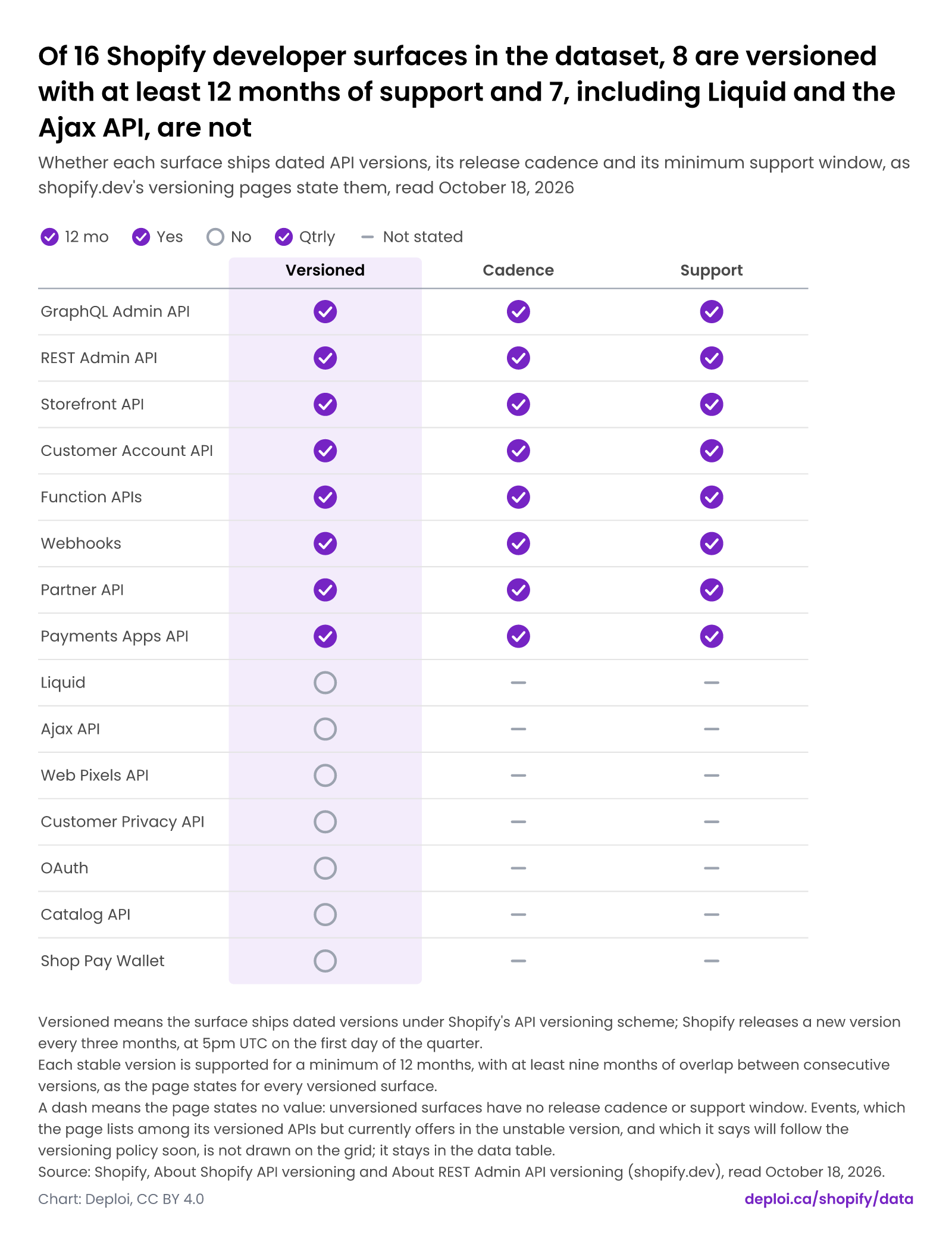
Of 16 Shopify developer surfaces in the dataset, 8 are versioned with at least 12 months of support and 7, including Liquid and the Ajax API, are not
Whether each surface ships dated API versions, its release cadence and its minimum support window, as shopify.dev's versioning pages state them, read October 18, 2026
- Versioned means the surface ships dated versions under Shopify's API versioning scheme; Shopify releases a new version every three months, at 5pm UTC on the first day of the quarter.
- Each stable version is supported for a minimum of 12 months, with at least nine months of overlap between consecutive versions, as the page states for every versioned surface.
- A dash means the page states no value: unversioned surfaces have no release cadence or support window. Events, which the page lists among its versioned APIs but currently offers in the unstable version, and which it says will follow the versioning policy soon, is not drawn on the grid; it stays in the data table.
Source: Shopify, About Shopify API versioning and About REST Admin API versioning (shopify.dev), read October 18, 2026. Read on .
Which Shopify developer surfaces are versioned?
8 of the 16 Shopify developer surfaces in this dataset are versioned, per About Shopify API versioning and About REST Admin API versioning on shopify.dev, read October 18, 2026: the GraphQL Admin, REST Admin, Storefront, Customer Account, Function, Partner and Payments Apps APIs, plus webhooks. Each follows the quarterly release schedule with a 12-month minimum support window.
| Surface | Versioned | Release cadence | Minimum support |
|---|---|---|---|
| GraphQL Admin API | Yes | Quarterly | 12 months |
| REST Admin API | Yes | Quarterly | 12 months |
| Storefront API | Yes | Quarterly | 12 months |
| Customer Account API | Yes | Quarterly | 12 months |
| Function APIs | Yes | Quarterly | 12 months |
| Webhooks | Yes | Quarterly | 12 months |
| Partner API | Yes | Quarterly | 12 months |
| Payments Apps API | Yes | Quarterly | 12 months |
The page says webhook payloads are versioned the same way as API responses.
Shopify's REST Admin API versioning page says the REST Admin API is a legacy API as of October 1, 2024. It adds that all apps and integrations should be built with the GraphQL Admin API.
Which Shopify developer surfaces are not versioned?
7 of the 16 Shopify developer surfaces in this dataset are not versioned, per Shopify's API versioning page read October 18, 2026: Liquid, the Ajax API, the Web Pixels API, the Customer Privacy API, OAuth, the Catalog API and Shop Pay Wallet. The page says all of them aren't versioned and might change at any time.
For OAuth, the list item names the OAuth endpoints, including AccessScope.
Unversioned surfaces have no release cadence or support window, so the dataset shows no value for either, not zero.
How long does Shopify support a stable API version?
Each stable version is supported for a minimum of 12 months, with at least nine months of overlap between consecutive versions, per Shopify's API versioning page read October 18, 2026. Shopify releases a new version every three months, at 5pm UTC on the first day of the quarter.
The page states the same support window for every versioned surface.
The REST Admin API page says it is versioned so that developers can better plan their development cycle.
What is the status of the Events surface?
Shopify's API versioning page, read October 18, 2026, lists Events in its Versioned APIs table and says it is currently available in the unstable version and will follow Shopify's API versioning policy soon. With no stable version stated, the dataset counts Events in neither group and leaves its cadence and support window empty.
Events is neither counted among the 8 versioned surfaces nor among the 7 unversioned ones in this dataset. A later reading of the versioning page may change that.
Which Shopify pages were read for the versioning record?
Two shopify.dev pages were read on October 18, 2026: About Shopify API versioning, which gives the release schedule and support windows, and About REST Admin API versioning. Each value is as those pages state it, with no value shown where the pages state none.
The dataset holds 16 surfaces. The versioning pages list further surfaces that it does not include, such as ShopifyQL, Hydrogen and Shop Minis. Shopify's documentation changes, so a later reading can differ from this one.
The data
Each chart on this page is drawn from the numbers below. Units are in the column headers.
| Surface | Versioned (yes/no) | Cadence | Support (months) | Note |
|---|---|---|---|---|
| GraphQL Admin API | Yes | Qtrly | 12 mo | Versioned API; follows the quarterly release schedule |
| REST Admin API | Yes | Qtrly | 12 mo | Versioned so that developers can better plan their development cycle |
| Storefront API | Yes | Qtrly | 12 mo | Versioned API; follows the quarterly release schedule |
| Customer Account API | Yes | Qtrly | 12 mo | Versioned API; follows the quarterly release schedule |
| Function APIs | Yes | Qtrly | 12 mo | Versioned API; follows the quarterly release schedule |
| Webhooks | Yes | Qtrly | 12 mo | Webhook payloads are versioned the same way as API responses |
| Partner API | Yes | Qtrly | 12 mo | Versioned API; follows the quarterly release schedule |
| Payments Apps API | Yes | Qtrly | 12 mo | Versioned API; follows the quarterly release schedule |
| Liquid | No | Not stated | Not stated | Not versioned; might change at any time |
| Ajax API | No | Not stated | Not stated | Not versioned; might change at any time |
| Web Pixels API | No | Not stated | Not stated | Not versioned; might change at any time |
| Customer Privacy API | No | Not stated | Not stated | Not versioned; might change at any time |
| OAuth | No | Not stated | Not stated | OAuth endpoints, including AccessScope |
| Catalog API | No | Not stated | Not stated | Not versioned; might change at any time |
| Shop Pay Wallet | No | Not stated | Not stated | Not versioned; might change at any time |
| Events | Not stated | Not stated | Not stated | Available in the unstable version; will follow Shopify's API versioning policy soon |
| Stable version support (policy) | Not stated | Qtrly | 12 mo | Each stable version is supported for a minimum of 12 months, with at least nine months of overlap between consecutive versions |
Download Which Shopify developer surfaces are versioned and which are not, shopify.dev, read October 18, 2026 as CSV · All 6 columns on the dataset page
Methodology
Reading the chart: Of 16 Shopify developer surfaces in the dataset, 8 are versioned with at least 12 months of support and 7, including Liquid and the Ajax API, are not
- Versioned means the surface ships dated versions under Shopify's API versioning scheme; Shopify releases a new version every three months, at 5pm UTC on the first day of the quarter.
- Each stable version is supported for a minimum of 12 months, with at least nine months of overlap between consecutive versions, as the page states for every versioned surface.
- A dash means the page states no value: unversioned surfaces have no release cadence or support window. Events, which the page lists among its versioned APIs but currently offers in the unstable version, and which it says will follow the versioning policy soon, is not drawn on the grid; it stays in the data table.
Caveats: Which Shopify developer surfaces are versioned and which are not, shopify.dev, read October 18, 2026
- The dataset holds 16 surfaces. The versioning pages list further surfaces it does not include, among them ShopifyQL, Hydrogen, Shop Minis and Storefront Web Components, and the unversioned list ends 'Any other resources not explicitly listed as versioned', so the counts of 8 and 7 are counts of these 16 rows, not totals for Shopify.
- Shopify's REST Admin API versioning page says the REST Admin API is a legacy API as of October 1, 2024, and that all apps and integrations should be built with the GraphQL Admin API.
- Unversioned surfaces have no release cadence or support window, so those values are empty, not zero.
- Events is listed under Versioned APIs but is currently available in the unstable version and, the page says, will follow Shopify's API versioning policy soon, so it is counted in neither group and its cadence and support window are not published.
- The note column is the versioning page's own wording for each surface, in short form.
- Shopify's documentation changes, so a later reading can differ from this one.
Deploi's charts and compilation are licensed CC BY 4.0. The underlying facts belong to their sources, which are named on every page. How Deploi Shopify Data works.
Sources
Tier A sources are primary documents: filings, official releases and official price pages. How sources are ranked.
- Tier AAbout REST Admin API versioning, markdown rendering
Shopify Inc. · TEXT · Read on
- Tier AAbout Shopify API versioning (release schedule and support windows), markdown rendering, retrieved 2026-10-18
Shopify Inc. · TEXT · Read on
Cite and reuse
Deploi's charts and compilation are licensed CC BY 4.0. The underlying facts belong to their sources, which are named on every page.
APA
Deploi. (2026). Which parts of Shopify's developer platform are versioned with at least 12 months of support, and which are not? [Web page]. https://deploi.ca/shopify/data/shopify-api-versioned-vs-unversioned Retrieved November 20, 2026.
BibTeX
@misc{deploi_shopify_api_versioned_vs_unversioned_2026,
  author = {{Deploi}},
  title = {Which parts of Shopify's developer platform are versioned with at least 12 months of support, and which are not?},
  year = {2026},
  url = {https://deploi.ca/shopify/data/shopify-api-versioned-vs-unversioned},
  note = {Accessed 2026-11-20}
}
Embed this chart
Embed code
<iframe src="https://deploi.ca/embed/shopify/data/shopify-versioned-surfaces" title="Of 16 Shopify developer surfaces in the dataset, 8 are versioned with at least 12 months of support and 7, including Liquid and the Ajax API, are not" loading="lazy" style="width:100%;height:850px;border:0"></iframe>
<p style="font:12px/1.4 Arial,sans-serif;margin:4px 0 0">Source: <a href="https://deploi.ca/shopify/data/charts/shopify-versioned-surfaces">Deploi, Of 16 Shopify developer surfaces in the dataset, 8 are versioned with at least 12 months of support and 7, including Liquid and the Ajax API, are not</a></p>
Keep the credit line under the embed. It is the license condition.
Questions
Is Liquid versioned by Shopify?
No. Shopify's versioning pages, read October 18, 2026, list Liquid as not versioned and say it might change at any time, so it has no release cadence or support window.
Which Shopify APIs are versioned?
8 of the 16 surfaces in this dataset: the GraphQL Admin, REST Admin, Storefront, Customer Account, Function, Partner and Payments Apps APIs and webhooks, per Shopify's versioning pages read October 18, 2026. Each has quarterly releases and a 12-month minimum support window.
How long is a Shopify API version supported?
At least 12 months, with at least nine months of overlap between consecutive versions, per Shopify's API versioning page read October 18, 2026. New versions are released every three months.
Is the Ajax API versioned?
No. Shopify's versioning pages, read October 18, 2026, list the Ajax API as not versioned and say it might change at any time, so it has no release cadence or support window.
Is the Web Pixels API versioned?
No. Shopify's versioning pages, read October 18, 2026, list the Web Pixels API as not versioned and say it might change at any time, so it has no release cadence or support window.
More on Performance and technology
- Do the largest Shopify stores pass Core Web Vitals as often as the largest stores on other platforms?
Shopify's mobile Core Web Vitals pass rate falls from 76.5% of all origins to 38.4% in the top 100k by popularity, while its median home page grows from 4.1 MB to 6.4 MB, HTTP Archive crawl of October 2026. Updated November 20, 2026.
- How many public Oxygen environments does each Shopify plan get for a Hydrogen storefront, and how long are deployments and logs kept?
Shopify Plus stores can have 25 public Oxygen environments for a Hydrogen storefront, nine other plans and store types 1 each, and development stores and trial plans 0, per shopify.dev read November 20, 2026. Updated November 20, 2026.
- How often does the Universal Commerce Protocol ship dated versions and breaking changes, and how much notice is given?
The Universal Commerce Protocol listed four dated protocol releases in 2026, on January 11, January 23, April 8 and August 25, and GitHub release notes mark three of them as breaking, per ucp.dev and GitHub pages read November 20, 2026. UCP's versioning guide says a breaking change is announced 2 weeks before it is merged. Updated November 20, 2026.
- In which visitor countries do Shopify stores pass Core Web Vitals most and least often?
Shopify stores pass mobile Core Web Vitals more often than all sites in all 21 visitor countries charted, from 31.2% of origins in Indonesia to 89.6% in Norway, HTTP Archive crawl of October 2026. Updated November 20, 2026.
- Is Shopify's Core Web Vitals pass rate slipping in 2026, and on which vital, device and tier of Shopify sites?
Shopify's mobile Interaction to Next Paint (INP) pass rate fell from 91.0% in February 2026 to 85.9% in October, and the overall mobile pass rate from 79.5% in March to 76.5%, as computed by Deploi from HTTP Archive data retrieved November 20, 2026. Updated November 20, 2026.
- What does a Shopify store expose to AI shopping agents by default, and what can an agent do at each identity tier?
Anonymous AI agents get 2 of 5 capabilities on a Shopify store and signed agents 3, and only a token granted permission can complete a purchase, per Shopify's agent documentation captured November 20, 2026. Updated November 20, 2026.
Changes
- · Which Shopify developer surfaces are versioned and which are not, shopify.dev, read October 18, 2026
First release. Sixteen surfaces and one support policy row from Shopify's versioning pages.