
What do Gmail, Yahoo and Microsoft Outlook require of stores that send marketing email at volume?
Gmail and Outlook set bulk-sender rules above 5,000 messages a day, and Gmail and Yahoo both name a 0.3% spam rate and 2 days to honor unsubscribes, per provider pages read November 21, 2026. Updated November 21, 2026.
By Martin DejnickiUpdated Data through November 21, 2026
Short answer
Gmail requires senders of more than 5,000 messages a day to set up SPF, DKIM and DMARC, support one-click unsubscribe and keep spam rates below 0.3%, from February 1, 2024, per Google's sender guidelines. Yahoo sets similar rules from February 2024 with no volume threshold. Outlook requires SPF, DKIM and DMARC above 5,000 emails a day from May 5, 2025.
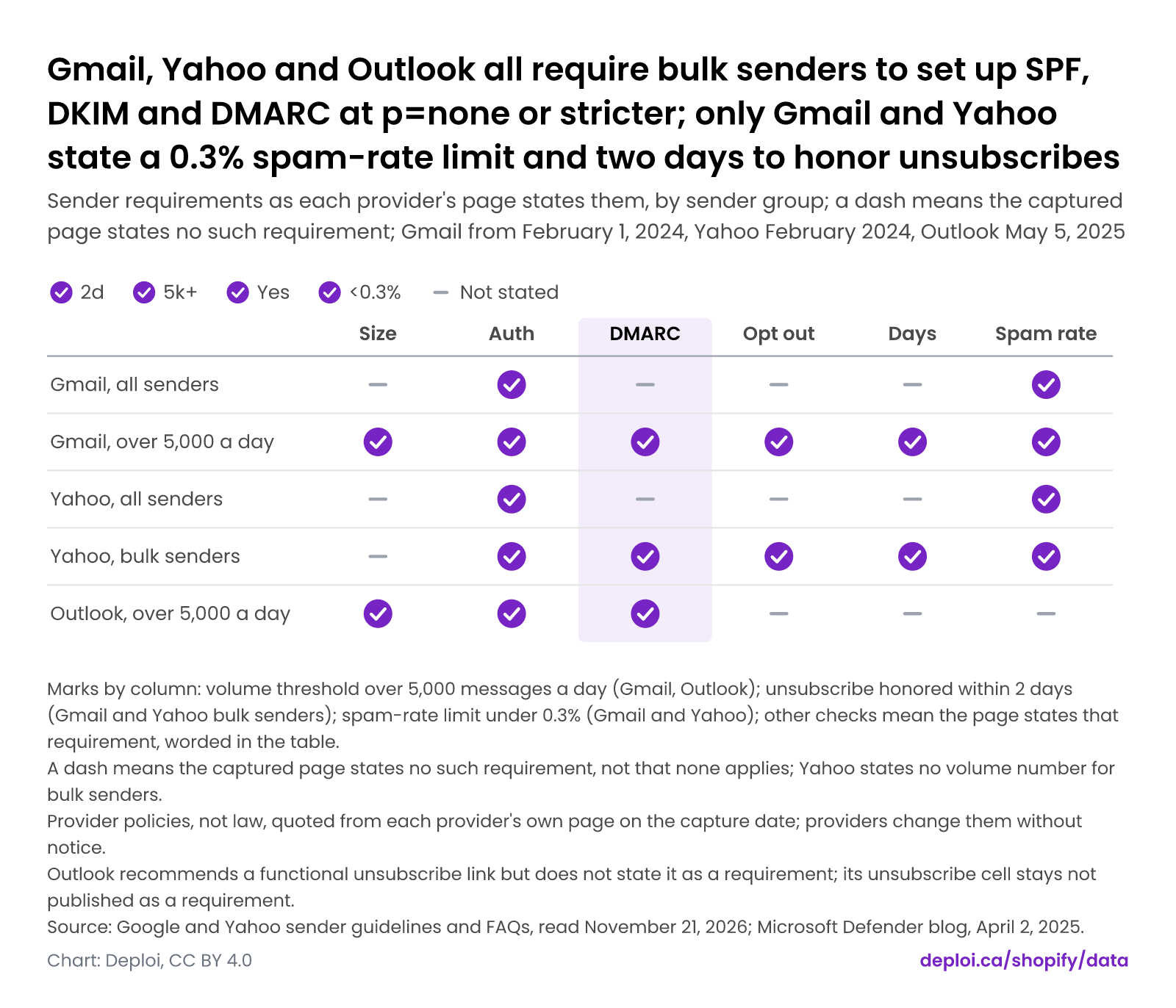
Gmail, Yahoo and Outlook all require bulk senders to set up SPF, DKIM and DMARC at p=none or stricter; only Gmail and Yahoo state a 0.3% spam-rate limit and two days to honor unsubscribes
Sender requirements as each provider's page states them, by sender group; a dash means the captured page states no such requirement; Gmail from February 1, 2024, Yahoo February 2024, Outlook May 5, 2025
- Marks by column: volume threshold over 5,000 messages a day (Gmail, Outlook); unsubscribe honored within 2 days (Gmail and Yahoo bulk senders); spam-rate limit under 0.3% (Gmail and Yahoo); other checks mean the page states that requirement, worded in the table.
- A dash means the captured page states no such requirement, not that none applies; Yahoo states no volume number for bulk senders.
- Provider policies, not law, quoted from each provider's own page on the capture date; providers change them without notice.
- Outlook recommends a functional unsubscribe link but does not state it as a requirement; its unsubscribe cell stays not published as a requirement.
Source: Google and Yahoo sender guidelines and FAQs, read November 21, 2026; Microsoft Defender blog, April 2, 2025. Read on .
What volume of email triggers the bulk-sender rules at Gmail, Yahoo and Outlook?
Gmail's bulk-sender rules apply to senders of more than 5,000 messages per day to Gmail accounts from February 1, 2024, and Outlook's to domains sending over 5,000 emails per day from May 5, 2025, per Google and Microsoft pages read on November 21, 2026. Yahoo's pages set bulk-sender requirements and state no volume number.
| Provider | Group | Volume threshold | In force from |
|---|---|---|---|
| Gmail | All senders | not published | February 1, 2024 |
| Gmail | Bulk senders | more than 5,000 messages a day | February 1, 2024 |
| Yahoo | All senders | not published | February 2024 |
| Yahoo | Bulk senders | not published | February 2024 |
| Outlook | High-volume senders | over 5,000 emails a day | May 5, 2025 |
Gmail's sender guidelines apply the bulk rules to senders of more than 5,000 messages a day. Its sender FAQ defines a bulk sender as one that sends close to 5,000 messages or more a day to personal Gmail accounts. Messages from the same primary domain count toward the 5,000.
Microsoft's rules are from its Defender blog post of April 2, 2025, which says Outlook "will soon require" compliance.
What email authentication do Gmail, Yahoo and Outlook require?
Gmail and Yahoo require all senders to set up SPF or DKIM and bulk senders both SPF and DKIM plus DMARC, where p=none is allowed, per Google and Yahoo pages read on November 21, 2026. Outlook requires SPF and DKIM to pass and DMARC at least p=none, aligned with SPF or DKIM, for domains over 5,000 emails a day.
Gmail states that for direct email the domain in the From: header must be aligned with either the SPF domain or the DKIM domain, which DMARC alignment requires. Yahoo says DMARC must pass and relaxed alignment is acceptable.
Outlook states that SPF must pass for the sending domain and DKIM must pass to validate message integrity. DMARC must be at least p=none and align with either SPF or DKIM, preferably both.
Do the providers require one-click unsubscribe, and how fast must unsubscribes be honored?
Gmail and Yahoo require bulk senders to support one-click unsubscribe on marketing and subscribed messages, per their pages read November 21, 2026. Yahoo requires unsubscribes honored within 2 days, as does the requirements table in Gmail's sender FAQ. Outlook's post recommends, but does not require, a functional unsubscribe link, and states no one-click requirement and no deadline to honor unsubscribes.
Gmail's two-day figure rests on the Gmail sender FAQ's table of current requirements, which lists "Unsubscribe requests aren’t honored within 48 hours" as a requirement issue. Where the same FAQ answers how long senders have to remove recipients, it says "we recommend that you fulfill unsubscribe requests within 48 hours".
Gmail points to RFC 8058 for the headers. Yahoo says the Post (RFC 8058) method is highly recommended and the mail-to method is acceptable.
Microsoft's post lists "Functional Unsubscribe Links" under "Additional Email Hygiene Recommendations" and states no deadline for honoring unsubscribes.
What spam rate do Gmail and Yahoo say senders must stay under?
Gmail and Yahoo both give a spam rate of 0.3% for senders to stay under, per Google's sender guidelines and Yahoo's Sender Hub pages read on November 21, 2026, and both list it for all senders. Outlook's captured post states no spam-rate limit.
Yahoo lists the 0.3% figure for all senders and for bulk senders, though it states no volume threshold for the bulk group. Gmail lists 0.3% for both of its groups, and its sender FAQ says to "keep your user-reported spam rate below 0.1% and prevent it from reaching 0.3% or higher".
A dash in the chart, or not published in a table, means the captured page states no such requirement, not that none applies.
What happens to email from senders that do not comply?
Gmail says messages that fail its requirements will experience disruptions, including temporary and permanent rejections, as enforcement ramps up from November 2025, and Yahoo says non-compliant mail may go to the spam folder or be rejected, per pages read on November 21, 2026. Outlook's post says Microsoft decided to reject messages that fail authentication, but also describes Junk delivery.
Gmail's sender FAQ says messages from bulk senders that do not meet the requirements might be rejected or delivered to spam folders.
In its April 29 update, Microsoft's page states the reject decision and an error code for rejected messages. The same page also says that after May 5, 2025 non-compliant messages go to the Junk folder, with rejection starting on a date to be announced. The data records the stated reject text and notes the contradiction.
What do these provider rules not cover?
Gmail, Yahoo and Outlook sender requirements are mailbox providers' own policies, quoted from each provider's page on November 21, 2026, not law, and providers can change them without notice. The data covers Gmail, Yahoo and Outlook sender requirements only, not the legal rules for marketing email in Canada or the US.
Legal rules for marketing email are a separate topic, covered on the CASL versus CAN-SPAM page.
Text cells in the dataset are quoted from the pages. The data states no volume threshold for Yahoo, no unsubscribe requirement or spam-rate figure for Outlook, and no DMARC policy for Gmail and Yahoo all-sender groups.
The data
Each chart on this page is drawn from the numbers below. Units are in the column headers.
| Provider and senders | Size (messages per day) | Auth | DMARC | Opt out | Days | Spam rate (% of messages) | Authentication | DMARC policy | Unsubscribe | In force from | What happens otherwise |
|---|---|---|---|---|---|---|---|---|---|---|---|
| Gmail, all senders | Not stated | Yes | Not stated | Not stated | Not stated | <0.3% | Set up SPF or DKIM email authentication for your sending domains. | Feb 1, 2024 | Starting November 2025, Gmail is ramping up its enforcement on non-compliant traffic. Messages that fail to meet the email sender requirements will experience disruptions, including temporary and permanent rejections. | ||
| Gmail, over 5,000 a day | 5k+ | Yes | Yes | Yes | 2d | <0.3% | Set up SPF and DKIM email authentication for your domain. Set up DMARC email authentication for your sending domain. Your DMARC enforcement policy can be set to none. | Set up DMARC email authentication for your sending domain. Your DMARC enforcement policy can be set to none. | For direct email, the domain in the sender's From: header must be aligned with either the SPF domain or the DKIM domain. This is required to pass DMARC alignment. | Marketing messages and subscribed messages must support one-click unsubscribe, and include a clearly visible unsubscribe link in the message body. | To meet RFC 8058 requirements, add List-Unsubscribe headers to all outgoing marketing and promotional messages, as described in our Email sender guidelines. | Feb 1, 2024 | To ensure messages are delivered as expected, bulk senders should comply with our Email sender guidelines. If senders don’t meet these requirements, messages might be rejected or delivered to recipients’ spam folders. |
| Yahoo, all senders | Not stated | Yes | Not stated | Not stated | Not stated | <0.3% | Implement SPF or DKIM at a minimum | 2024-02 | If you do not meet the requirements, your mail may be sent to the spam folder or rejected. | ||
| Yahoo, bulk senders | Not stated | Yes | Yes | Yes | 2d | <0.3% | Implement both SPF & DKIM Publish a valid DMARC policy with at least p=none - DMARC must pass | Publish a valid DMARC policy with at least p=none - DMARC must pass | Relaxed alignment is acceptable | Ensure the domain in the From: header is aligned with either the SPF domain or the DKIM domain. This is required for DMARC alignment. | Implement a functioning list-unsubscribe header, which supports one-click unsubscribe for marketing and subscribed messages The Post (RFC 8058) method is highly recommended The mail-to: method is acceptable | 2024-02 | If you do not meet the requirements, your mail may be sent to the spam folder or rejected. |
| Outlook, over 5,000 a day | 5k+ | Yes | Yes | Not stated | Not stated | Not stated | SPF (Sender Policy Framework) Must Pass for the sending domain. Your domain's DNS record should accurately list authorized IP addresses/hosts. DKIM (DomainKeys Identified Mail) Must Pass to validate email integrity and authenticity. DMARC (Domain-based Message Authentication, Reporting, and Conformance) At least p=none and align with either SPF or DKIM (preferably both). | At least p=none and align with either SPF or DKIM (preferably both). | May 5, 2025 | After careful consideration and to ensure the protection of users and remove any confusion on why a message was in the junk folder for both the recipient and sender, we have made a decision to reject messages that don't pass the required authentication requirements detailed above. The rejected messages will be designated as "550; 5.7.515 Access denied, sending domain [SendingDomain] does not meet the required authentication level. |
Download What Gmail, Yahoo and Microsoft Outlook require of senders of marketing email: volume threshold, authentication, one-click unsubscribe and spam rate, 2026 as CSV · All 15 columns on the dataset page
Methodology
Reading the chart: Gmail, Yahoo and Outlook all require bulk senders to set up SPF, DKIM and DMARC at p=none or stricter; only Gmail and Yahoo state a 0.3% spam-rate limit and two days to honor unsubscribes
- Marks by column: volume threshold over 5,000 messages a day (Gmail, Outlook); unsubscribe honored within 2 days (Gmail and Yahoo bulk senders); spam-rate limit under 0.3% (Gmail and Yahoo); other checks mean the page states that requirement, worded in the table.
- A dash means the captured page states no such requirement, not that none applies; Yahoo states no volume number for bulk senders.
- Provider policies, not law, quoted from each provider's own page on the capture date; providers change them without notice.
- Outlook recommends a functional unsubscribe link but does not state it as a requirement; its unsubscribe cell stays not published as a requirement.
Caveats: What Gmail, Yahoo and Microsoft Outlook require of senders of marketing email: volume threshold, authentication, one-click unsubscribe and spam rate, 2026
- Provider policies, not law, quoted from each provider's own page on the capture date; providers change them without notice. Legal rules for marketing email are a separate topic.
- Gmail's two-day unsubscribe figure comes from the Gmail sender FAQ's table of current requirements ('Unsubscribe requests aren't honored within 48 hours'); Google's sender guidelines page states no 48-hour figure.
- Microsoft's page states a decision to reject messages that fail authentication, and also says that after May 5, 2025 non-compliant messages go to the Junk folder, with rejection at a date to be announced. The stated reject text is recorded.
- Yahoo states no volume threshold for bulk senders. The captured Microsoft post recommends, but does not require, a functional unsubscribe link ('Functional Unsubscribe Links: Provide an easy, clearly visible way for recipients to opt out of further messages, particularly for marketing or bulk mail.'), and states no one-click requirement, no deadline to honor unsubscribes and no spam-rate limit; those cells are not published as requirements.
- Gmail's sender guidelines apply the bulk rules to senders of 'more than 5,000 messages per day'. Gmail's sender FAQ defines a bulk sender as 'any email sender that sends close to 5,000 messages or more to personal Gmail accounts within a 24-hour period. Messages sent from the same primary domain count toward the 5,000 limit.' The FAQ also says 'keep your user-reported spam rate below 0.1% and prevent it from reaching 0.3% or higher'; the spam-rate cells hold the 0.3% limit.
Deploi's charts and compilation are licensed CC BY 4.0. The underlying facts belong to their sources, which are named on every page. How Deploi Shopify Data works.
Sources
Tier A sources are primary documents: filings, official releases and official price pages. How sources are ranked.
- Tier AEmail sender guidelines FAQ - Gmail Help
Google (Gmail Help) · HTML · Read on
- Tier AEmail sender guidelines - Gmail Help
Google (Gmail Help) · HTML · Read on
- Tier AStrengthening Email Ecosystem: Outlook's New Requirements for High-Volume Senders
Microsoft (Defender for Office 365 blog, Tech Community) · HTML · Read on
- Tier ASender Best Practices (Sender Requirements and Recommendations), Yahoo Sender Hub
Yahoo (Sender Hub) · HTML · Read on
- Tier AFAQs, Yahoo Sender Hub (2024 Email Sender Requirements)
Yahoo (Sender Hub) · HTML · Read on
Cite and reuse
Deploi's charts and compilation are licensed CC BY 4.0. The underlying facts belong to their sources, which are named on every page.
APA
Deploi. (2026). What do Gmail, Yahoo and Microsoft Outlook require of stores that send marketing email at volume? [Web page]. https://deploi.ca/shopify/data/bulk-email-sender-rules-gmail-yahoo-microsoft Retrieved November 21, 2026.
BibTeX
@misc{deploi_bulk_email_sender_rules_gmail_yahoo_microsoft_2026,
  author = {{Deploi}},
  title = {What do Gmail, Yahoo and Microsoft Outlook require of stores that send marketing email at volume?},
  year = {2026},
  url = {https://deploi.ca/shopify/data/bulk-email-sender-rules-gmail-yahoo-microsoft},
  note = {Accessed 2026-11-21}
}
Embed this chart
Embed code
<iframe src="https://deploi.ca/embed/shopify/data/inbox-sender-rules-matrix" title="Gmail, Yahoo and Outlook all require bulk senders to set up SPF, DKIM and DMARC at p=none or stricter; only Gmail and Yahoo state a 0.3% spam-rate limit and two days to honor unsubscribes" loading="lazy" style="width:100%;height:510px;border:0"></iframe>
<p style="font:12px/1.4 Arial,sans-serif;margin:4px 0 0">Source: <a href="https://deploi.ca/shopify/data/charts/inbox-sender-rules-matrix">Deploi, Gmail, Yahoo and Outlook all require bulk senders to set up SPF, DKIM and DMARC at p=none or stricter; only Gmail and Yahoo state a 0.3% spam-rate limit and two days to honor unsubscribes</a></p>
Keep the credit line under the embed. It is the license condition.
Downloads
- Chart: Gmail, Yahoo and Outlook all require bulk senders to set up SPF, DKIM and DMARC at p=none or stricter; only Gmail and Yahoo state a 0.3% spam-rate limit and two days to honor unsubscribes PNG
- Data: What Gmail, Yahoo and Microsoft Outlook require of senders of marketing email: volume threshold, authentication, one-click unsubscribe and spam rate, 2026 CSV
Questions
What are Gmail's requirements for bulk email senders?
From February 1, 2024, senders of more than 5,000 messages per day to Gmail accounts must set up SPF, DKIM and DMARC, support one-click unsubscribe and keep spam rates below 0.3%, per Google's sender guidelines read on November 21, 2026. Google's sender FAQ also lists "Unsubscribe requests aren’t honored within 48 hours" as a requirement issue.
Does Yahoo state how many emails make a bulk sender?
No. Yahoo's Sender Hub pages, read on November 21, 2026, list requirements for all senders and for bulk senders from February 2024 but state no volume threshold for bulk senders. Gmail and Outlook both state 5,000 messages or emails per day.
Does Outlook require one-click unsubscribe or a spam-rate limit?
No. The Microsoft post of April 2, 2025 recommends, but does not require, a functional unsubscribe link, and states no one-click requirement, no deadline to honor unsubscribes and no spam-rate limit. It requires SPF, DKIM and DMARC at least p=none from domains sending over 5,000 emails per day, from May 5, 2025.
What DMARC policy do Gmail, Yahoo and Outlook require?
Bulk senders need DMARC at p=none or stricter: Gmail says the enforcement policy can be set to none, Yahoo requires at least p=none with DMARC passing, and Outlook requires at least p=none, per pages read on November 21, 2026.
Are these rules laws?
No. They are mailbox providers' own sender requirements, quoted from Google, Yahoo and Microsoft pages read on November 21, 2026, and providers can change them without notice. Marketing email law is a separate topic.
More on Merchant benchmarks
- At what annual sales must an online store register for VAT or GST in the UK and New Zealand, and what is the low-value import line in each?
As the tax authorities state it on November 21, 2026, the UK threshold is £90,000 of taxable turnover for businesses, and New Zealand's NZ$60,000 applies to overseas sellers supplying low value goods of NZ$1,000 or less each to New Zealand consumers in 12 months. Updated November 21, 2026.
- How long does a shopper have to cancel an online order in the EU, UK, US, Ontario, Quebec and British Columbia, and how fast must the store refund?
As the official pages read on November 21, 2026 state it, the EU and UK give 14 days to cancel for any reason, while Ontario, Quebec and British Columbia give a store 15 days to refund. Updated November 21, 2026.
- What are the maximum penalties for fake reviews in the US, UK and Canada, and for misleading price claims in the UK and Canada?
As written on the pages read on November 20 and 21, 2026, the maximum is the higher of £300,000 or 10% of turnover in the UK, the greater of C$10 million or three times the benefit for a corporation's first violation in Canada, and $53,088 in the US under FTC Act section 5(m)(1)(A). Updated November 21, 2026.
- What does it cost to ship a 1, 5 and 10 lb parcel to Zone 5 with UPS Ground and USPS Ground Advantage at 2026 list rates?
At 2026 list rates, a 1 lb parcel to Zone 5 costs $11.70 by USPS Ground Advantage retail and $14.10 by UPS Ground; at 10 lb UPS is cheaper, $20.46 against $24.25. FedEx is not covered. Updated November 21, 2026.
- Do EU businesses sell more online to businesses or to consumers, and how much of their ecommerce runs on EDI?
EDI-type sales made up 56.9% of EU e-commerce turnover in Eurostat's 2025 survey, and over half in 17 member states. Updated November 20, 2026.
- Do EU businesses sell through their own websites or marketplaces, and how much web-sales turnover goes through marketplaces?
Marketplaces carried 15.5% of EU businesses' web-sales turnover in Eurostat's 2025 survey, from 42.4% in Lithuania to 2.9% in Estonia. Updated November 20, 2026.
Changes
- · What Gmail, Yahoo and Microsoft Outlook require of senders of marketing email: volume threshold, authentication, one-click unsubscribe and spam rate, 2026
First release. 5 rows, 10 fields read from 5 sources; each value agreed by extractor and verifier or ruled by the judge.