
What are the maximum penalties for fake reviews in the US, UK and Canada, and for misleading price claims in the UK and Canada?
As written on the pages read on November 20 and 21, 2026, the maximum is the higher of £300,000 or 10% of turnover in the UK, the greater of C$10 million or three times the benefit for a corporation's first violation in Canada, and $53,088 in the US under FTC Act section 5(m)(1)(A). Updated November 21, 2026.
By Martin DejnickiUpdated Data through November 21, 2026
Short answer
The maximum penalty is the higher of £300,000 or 10% of turnover under the UK Digital Markets, Competition and Consumers Act 2024 and, for a corporation's first violation, the greater of C$10 million or three times the benefit under Canada's Competition Act, as written on pages read on November 20 and 21, 2026. The US figure is $53,088 under 16 CFR 1.98(d); the captured sources do not tie it to the FTC reviews rule.
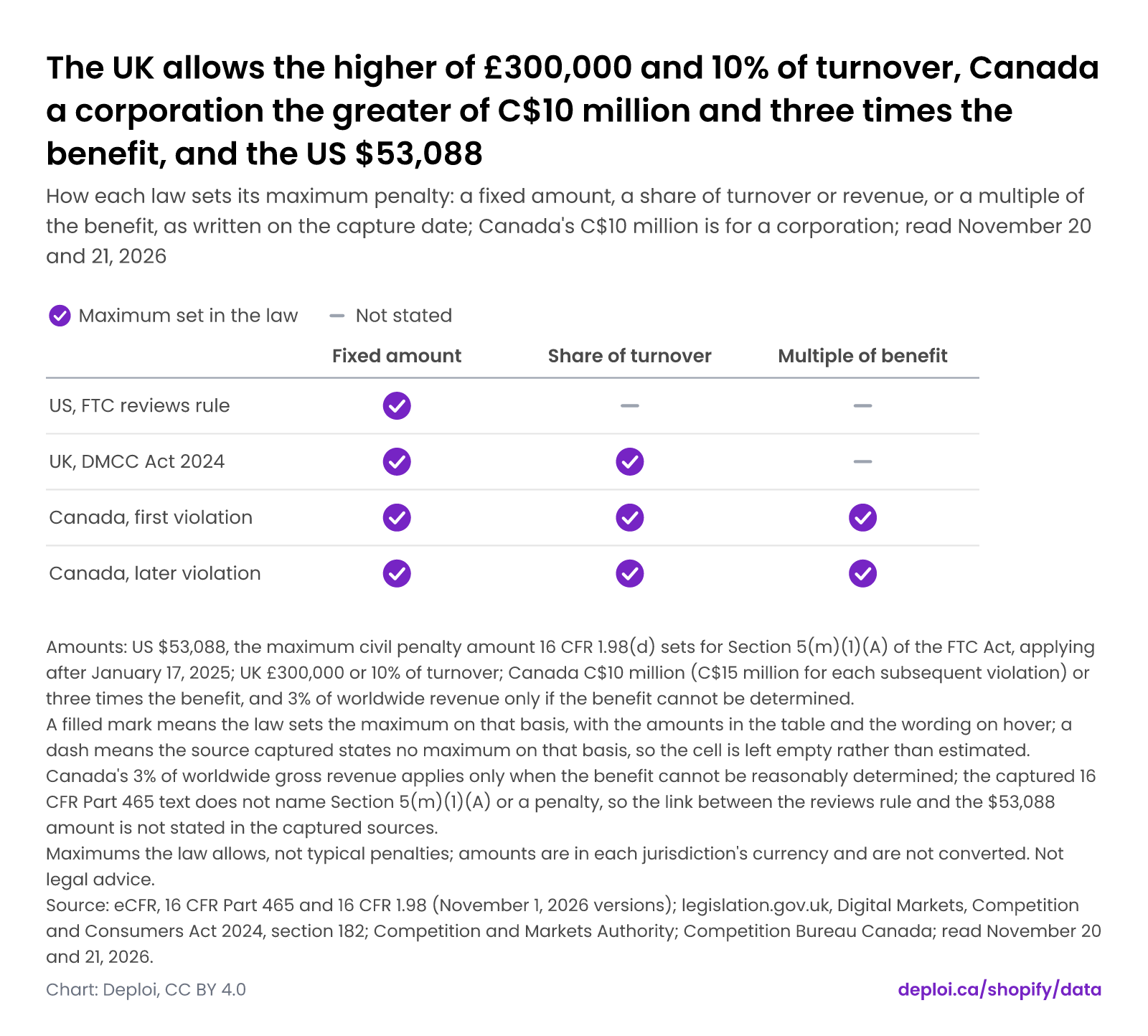
The UK allows the higher of £300,000 and 10% of turnover, Canada a corporation the greater of C$10 million and three times the benefit, and the US $53,088
How each law sets its maximum penalty: a fixed amount, a share of turnover or revenue, or a multiple of the benefit, as written on the capture date; Canada's C$10 million is for a corporation; read November 20 and 21, 2026
- Amounts: US $53,088, the maximum civil penalty amount 16 CFR 1.98(d) sets for Section 5(m)(1)(A) of the FTC Act, applying after January 17, 2025; UK £300,000 or 10% of turnover; Canada C$10 million (C$15 million for each subsequent violation) or three times the benefit, and 3% of worldwide revenue only if the benefit cannot be determined.
- A filled mark means the law sets the maximum on that basis, with the amounts in the table and the wording on hover; a dash means the source captured states no maximum on that basis, so the cell is left empty rather than estimated.
- Canada's 3% of worldwide gross revenue applies only when the benefit cannot be reasonably determined; the captured 16 CFR Part 465 text does not name Section 5(m)(1)(A) or a penalty, so the link between the reviews rule and the $53,088 amount is not stated in the captured sources.
- Maximums the law allows, not typical penalties; amounts are in each jurisdiction's currency and are not converted. Not legal advice.
Source: eCFR, 16 CFR Part 465 and 16 CFR 1.98 (November 1, 2026 versions); legislation.gov.uk, Digital Markets, Competition and Consumers Act 2024, section 182; Competition and Markets Authority; Competition Bureau Canada; read November 20 and 21, 2026. Read on .
How does each law set the maximum penalty?
The US sets a fixed amount, the UK a fixed amount or a share of turnover and Canada a fixed amount or a multiple of the benefit, as written on pages read on November 20 and 21, 2026. The US turnover share and the US and UK benefit multiples are not published.
| Law | Fixed amount | Share of turnover | Multiple of benefit |
|---|---|---|---|
| US, FTC reviews rule | $53,088 | not published | not published |
| UK, DMCC Act 2024 | £300,000 | 10% | not published |
| Canada, first violation | C$10 million | 3% | 3 times |
| Canada, later violation | C$15 million | 3% | 3 times |
Amounts are in each jurisdiction's currency and are not converted. They are maximums the law allows, not typical penalties. Canada's amounts are for a corporation; its 3% is of annual worldwide gross revenue and applies only where the benefit cannot be reasonably determined.
What is the maximum penalty under the US FTC reviews rule?
The US figure is $53,088, the amount 16 CFR 1.98(d) sets for section 5(m)(1)(A) of the FTC Act, applying to penalties assessed after January 17, 2025, per the eCFR version of November 1, 2026. The captured text of 16 CFR Part 465, the FTC's Rule on the Use of Consumer Reviews and Testimonials, names neither that section nor a penalty.
The link between the reviews rule and the $53,088 amount is not stated in the captured sources. A turnover share, a multiple of the benefit and the date the rule took effect are not published. The dataset states no US maximum for misleading price claims.
What is the maximum penalty under the UK DMCC Act?
Under the UK Digital Markets, Competition and Consumers Act 2024, a monetary penalty on a business must be a fixed amount not exceeding £300,000 or, if higher, 10% of the total value of its turnover, per section 182 on legislation.gov.uk, read on November 21, 2026. Section 182 came into force on April 6, 2025.
The Act's wording is "a fixed amount not exceeding £300,000 or, if higher, 10% of the total value of the turnover (if any) of the respondent". A multiple of the benefit is not published for the UK.
What is the maximum penalty under Canada's Competition Act?
Canada's Competition Act caps a corporation's penalty for deceptive marketing at the greater of C$10 million for a first violation (C$15 million for each subsequent violation) and three times the benefit derived from the conduct, per Competition Bureau Canada, read on November 21, 2026. If the benefit cannot be reasonably determined, 3% of annual worldwide gross revenue takes its place.
The Bureau's penalties page states the first-violation maximum as the greater of $10 million and three times the benefit, with $15 million for each subsequent violation.
It gives 3% of annual worldwide gross revenue where the benefit cannot be reasonably determined. The start date is not published in the source captured.
What do these maximums not tell a merchant?
The figures are maximums the law allows as written on November 20 and 21, 2026, not typical penalties, and they are in US dollars, pounds and Canadian dollars that Deploi has not converted. The dataset covers the US FTC amount, the UK Act and the Competition Act only, and it is not legal advice.
The Competition Bureau states Canada's maximum per violation. The UK amount is a monetary penalty under section 182 of the Act.
This page does not list every rule on reviews or pricing in each market; it states how each of the three named laws sets its maximum.
The data
Each chart on this page is drawn from the numbers below. Units are in the column headers.
| Law | Fixed amount | Share of turnover | Multiple of benefit | Basis | Maximum amount (local currency) | Currency | Turnover-based maximum (% of turnover or revenue) | Multiple of the benefit (times) | In force from |
|---|---|---|---|---|---|---|---|---|---|
| US, FTC reviews rule | Maximum set in the law | Not stated | Not stated | 53,088 | $ | Not stated | Not stated | ||
| UK, DMCC Act 2024 | Maximum set in the law | Maximum set in the law | Not stated | The amount of a monetary penalty imposed under subsection (4)(b) must be a fixed amount not exceeding £300,000 or, if higher, 10% of the total value of the turnover (if any) of the respondent. | 300,000 | £ | 10 | Not stated | Apr 6, 2025 |
| Canada, first violation | Maximum set in the law | Maximum set in the law | Maximum set in the law | For corporations, the penalty for a first-time violation is up to the greater of:
$10 million ($15 million for each subsequent violation); and
three times the value of the benefit derived from the deceptive conduct, or, if that amount cannot be reasonably determined, 3% of the corporation’s annual worldwide gross revenue. | 10,000,000 | $ | 3 | 3 | |
| Canada, later violation | Maximum set in the law | Maximum set in the law | Maximum set in the law | For corporations, the penalty for a first-time violation is up to the greater of:
$10 million ($15 million for each subsequent violation); and
three times the value of the benefit derived from the deceptive conduct, or, if that amount cannot be reasonably determined, 3% of the corporation’s annual worldwide gross revenue. | 15,000,000 | $ | 3 | 3 |
Download Maximum penalties for fake reviews and misleading price claims: US FTC rule, UK Digital Markets, Competition and Consumers Act, and Canada's Competition Act, 2026 as CSV · All 12 columns on the dataset page
Methodology
Reading the chart: The UK allows the higher of £300,000 and 10% of turnover, Canada a corporation the greater of C$10 million and three times the benefit, and the US $53,088
- Amounts: US $53,088, the maximum civil penalty amount 16 CFR 1.98(d) sets for Section 5(m)(1)(A) of the FTC Act, applying after January 17, 2025; UK £300,000 or 10% of turnover; Canada C$10 million (C$15 million for each subsequent violation) or three times the benefit, and 3% of worldwide revenue only if the benefit cannot be determined.
- A filled mark means the law sets the maximum on that basis, with the amounts in the table and the wording on hover; a dash means the source captured states no maximum on that basis, so the cell is left empty rather than estimated.
- Canada's 3% of worldwide gross revenue applies only when the benefit cannot be reasonably determined; the captured 16 CFR Part 465 text does not name Section 5(m)(1)(A) or a penalty, so the link between the reviews rule and the $53,088 amount is not stated in the captured sources.
- Maximums the law allows, not typical penalties; amounts are in each jurisdiction's currency and are not converted. Not legal advice.
Caveats: Maximum penalties for fake reviews and misleading price claims: US FTC rule, UK Digital Markets, Competition and Consumers Act, and Canada's Competition Act, 2026
- Maximums the law allows, not typical penalties.
- $53,088 is the maximum civil penalty amount 16 CFR 1.98(d) sets for Section 5(m)(1)(A) of the FTC Act, 15 U.S.C. 45(m)(1)(A), and applies to penalties assessed after January 17, 2025, as 16 CFR 1.98 states in its November 2026 text. The captured 16 CFR Part 465 text calls each listed practice 'an unfair or deceptive act or practice and a violation of this part' but does not name Section 5(m)(1)(A) or a penalty, so the link between the reviews rule and that amount is not stated in the captured sources. The US row states no maximum for misleading price claims.
- Not published: the US turnover share and benefit multiple, the UK benefit multiple, and the start date for the US and Canada.
- Canada's 3% of annual worldwide gross revenue applies where the benefit cannot be reasonably determined.
- Amounts are in each jurisdiction's currency and are not converted; not legal advice.
Deploi's charts and compilation are licensed CC BY 4.0. The underlying facts belong to their sources, which are named on every page. How Deploi Shopify Data works.
Sources
Tier A sources are primary documents: filings, official releases and official price pages. How sources are ranked.
- Tier APenalties and remedies for non-compliance (deceptive marketing practices)
Competition Bureau Canada · HTML · Read on
- Tier A16 CFR 1.98 Adjustment of civil monetary penalty amounts (eCFR XML, 2026-11-01 version)
Office of the Federal Register and U.S. Government Publishing Office (eCFR) · TEXT · Read on
- Tier ACMA to boost consumer and business confidence as new consumer protection regime comes into force
Competition and Markets Authority (GOV.UK) · HTML · Read on
- Tier ADigital Markets, Competition and Consumers Act 2024, section 182 (final infringement notice)
UK Government (legislation.gov.uk) · HTML · Read on
- Tier A16 CFR Part 465 Rule on the Use of Consumer Reviews and Testimonials (eCFR 2026-11-01)
Office of the Federal Register (eCFR) · HTML · Read on
Cite and reuse
Deploi's charts and compilation are licensed CC BY 4.0. The underlying facts belong to their sources, which are named on every page.
APA
Deploi. (2026). What are the maximum penalties for fake reviews in the US, UK and Canada, and for misleading price claims in the UK and Canada? [Web page]. https://deploi.ca/shopify/data/fake-review-and-price-claim-penalties Retrieved November 21, 2026.
BibTeX
@misc{deploi_fake_review_and_price_claim_penalties_2026,
  author = {{Deploi}},
  title = {What are the maximum penalties for fake reviews in the US, UK and Canada, and for misleading price claims in the UK and Canada?},
  year = {2026},
  url = {https://deploi.ca/shopify/data/fake-review-and-price-claim-penalties},
  note = {Accessed 2026-11-21}
}
Embed this chart
Embed code
<iframe src="https://deploi.ca/embed/shopify/data/fake-review-penalties-matrix" title="The UK allows the higher of £300,000 and 10% of turnover, Canada a corporation the greater of C$10 million and three times the benefit, and the US $53,088" loading="lazy" style="width:100%;height:490px;border:0"></iframe>
<p style="font:12px/1.4 Arial,sans-serif;margin:4px 0 0">Source: <a href="https://deploi.ca/shopify/data/charts/fake-review-penalties-matrix">Deploi, The UK allows the higher of £300,000 and 10% of turnover, Canada a corporation the greater of C$10 million and three times the benefit, and the US $53,088</a></p>
Keep the credit line under the embed. It is the license condition.
Downloads
- Chart: The UK allows the higher of £300,000 and 10% of turnover, Canada a corporation the greater of C$10 million and three times the benefit, and the US $53,088 PNG
- Data: Maximum penalties for fake reviews and misleading price claims: US FTC rule, UK Digital Markets, Competition and Consumers Act, and Canada's Competition Act, 2026 CSV
Questions
What is the penalty for fake reviews in the US?
The US figure is $53,088, the amount 16 CFR 1.98(d) sets for section 5(m)(1)(A) of the FTC Act, applying to penalties assessed after January 17, 2025, per the eCFR version of November 1, 2026. The captured text of the FTC's reviews rule, 16 CFR Part 465, names neither that section nor a penalty.
What is the maximum fine for fake reviews in the UK?
The maximum UK penalty for a business is a fixed amount not exceeding £300,000 or, if higher, 10% of the total value of the respondent's turnover, under the Digital Markets, Competition and Consumers Act 2024, section 182, as read on November 21, 2026. Section 182 came into force on April 6, 2025.
What is the maximum penalty for deceptive marketing in Canada?
For a corporation, Canada's maximum penalty for deceptive marketing is the greater of C$10 million for a first violation (C$15 million for each subsequent violation) and three times the benefit derived, with 3% of annual worldwide gross revenue in place of the benefit if it cannot be reasonably determined, per Competition Bureau Canada, read on November 21, 2026.
Do these maximums cover misleading price claims as well as fake reviews?
Not for the US, where the dataset states no maximum for misleading price claims and shows the FTC Act section 5(m)(1)(A) amount beside the reviews rule. The UK row gives the Act's maximum for a business and the Canadian rows the Bureau's maximum for a corporation, read on November 20 and 21, 2026.
Why are some cells shown as not published?
The source captured states no maximum on that basis, so the cell is left empty rather than estimated. The US turnover share and benefit multiple and the UK benefit multiple are not published. Sources were read on November 20 and 21, 2026.
More on Merchant benchmarks
- At what annual sales must an online store register for VAT or GST in the UK and New Zealand, and what is the low-value import line in each?
As the tax authorities state it on November 21, 2026, the UK threshold is £90,000 of taxable turnover for businesses, and New Zealand's NZ$60,000 applies to overseas sellers supplying low value goods of NZ$1,000 or less each to New Zealand consumers in 12 months. Updated November 21, 2026.
- How long does a shopper have to cancel an online order in the EU, UK, US, Ontario, Quebec and British Columbia, and how fast must the store refund?
As the official pages read on November 21, 2026 state it, the EU and UK give 14 days to cancel for any reason, while Ontario, Quebec and British Columbia give a store 15 days to refund. Updated November 21, 2026.
- What does it cost to ship a 1, 5 and 10 lb parcel to Zone 5 with UPS Ground and USPS Ground Advantage at 2026 list rates?
At 2026 list rates, a 1 lb parcel to Zone 5 costs $11.70 by USPS Ground Advantage retail and $14.10 by UPS Ground; at 10 lb UPS is cheaper, $20.46 against $24.25. FedEx is not covered. Updated November 21, 2026.
- Do EU businesses sell more online to businesses or to consumers, and how much of their ecommerce runs on EDI?
EDI-type sales made up 56.9% of EU e-commerce turnover in Eurostat's 2025 survey, and over half in 17 member states. Updated November 20, 2026.
- Do EU businesses sell through their own websites or marketplaces, and how much web-sales turnover goes through marketplaces?
Marketplaces carried 15.5% of EU businesses' web-sales turnover in Eurostat's 2025 survey, from 42.4% in Lithuania to 2.9% in Estonia. Updated November 20, 2026.
- Has the UK online share of retail settled back since the pandemic, and how big is the November spike?
Online sales were 27.5% of UK retail sales in 2025, below the 2021 peak of 30.7%, and November 2025 reached 32.5% against 29.6% in December, per the Office for National Statistics, release of November 20, 2026. Updated November 20, 2026.
Changes
- · Maximum penalties for fake reviews and misleading price claims: US FTC rule, UK Digital Markets, Competition and Consumers Act, and Canada's Competition Act, 2026
First release. 4 rows: the US FTC reviews rule, the UK Act and the Competition Act for a first and a subsequent violation, read November 20 and 21, 2026.