
Which provinces' retail sales have grown fastest since September 2019 after inflation and population growth?
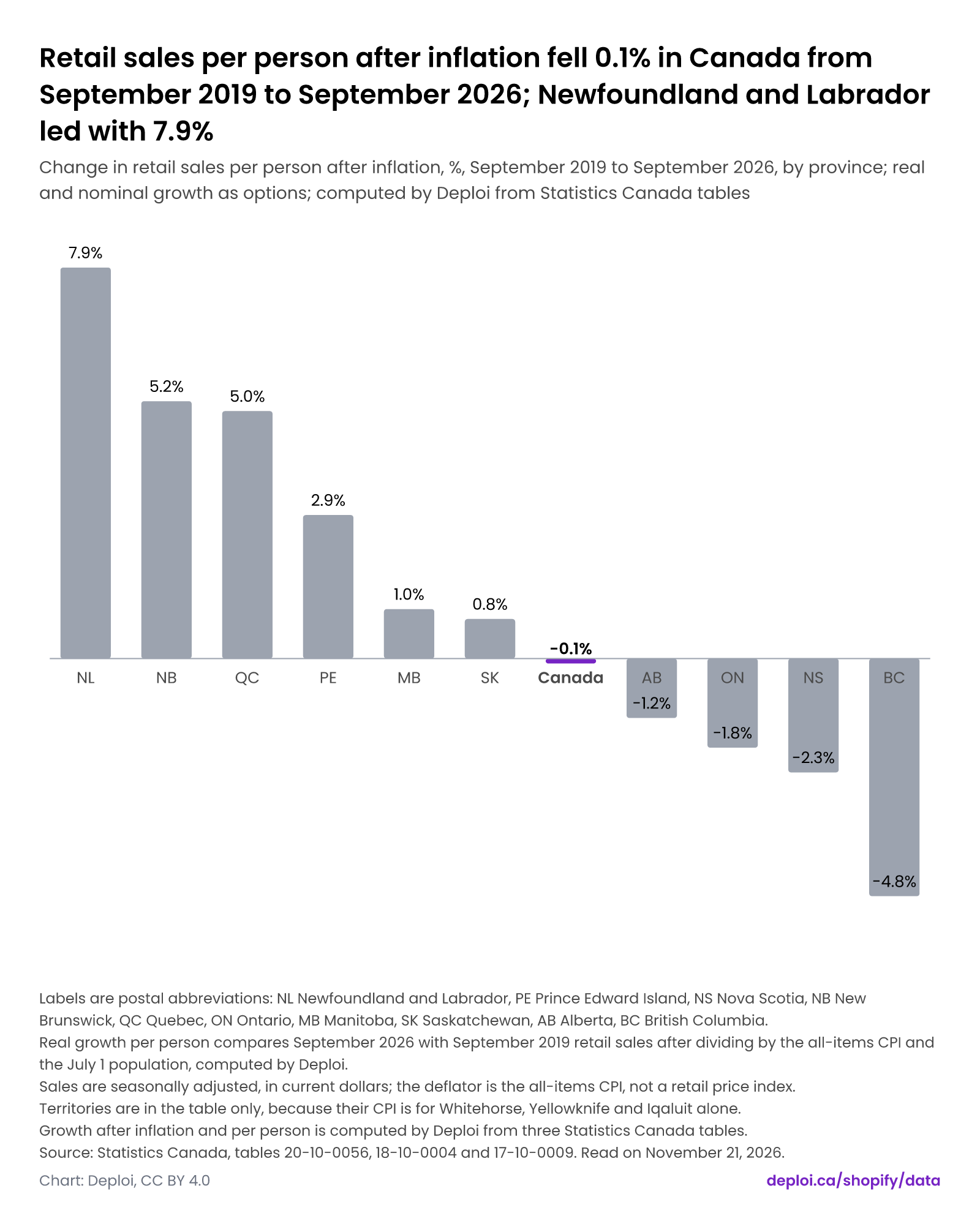
After inflation and population growth, retail sales per person rose 7.9% in Newfoundland and Labrador from September 2019 to September 2026 and fell 0.1% in Canada, computed by Deploi from Statistics Canada tables. Updated November 21, 2026.
By Martin DejnickiUpdated Data through September 2026
Short answer
After inflation and population growth, retail sales per person rose 7.9% in Newfoundland and Labrador, 5.2% in New Brunswick and 5.0% in Quebec from September 2019 to September 2026, computed by Deploi from Statistics Canada tables. Canada fell 0.1% and British Columbia 4.8%. Sales are seasonally adjusted and deflated by each province's all-items consumer price index.
Retail sales per person after inflation fell 0.1% in Canada from September 2019 to September 2026; Newfoundland and Labrador led with 7.9%
Change in retail sales per person after inflation, %, September 2019 to September 2026, by province; real and nominal growth as options; computed by Deploi from Statistics Canada tables
Retail sales growth by province, September 2019 to September 2026: Nominal
In current dollars, retail sales rose 55.3% in Prince Edward Island and 31.7% in British Columbia from September 2019 to September 2026; Canada: 38.5%. Computed by Deploi.
Showing: Growth measure: Nominal. Reset
Canada's retail sales growth, September 2019 to September 2026
- Real, per person
- -0.1%After inflation and population growth, retail sales per person changed 7.9% in Newfoundland and Labrador and -4.8% in British Columbia from September 2019 to September 2026; Canada: -0.1%. Computed by Deploi.
- Real
- 11.0%After inflation, retail sales rose 20.8% in Prince Edward Island and 6.3% in British Columbia from September 2019 to September 2026; Canada: 11.0%. Computed by Deploi.
- Nominal
- 38.5%In current dollars, retail sales rose 55.3% in Prince Edward Island and 31.7% in British Columbia from September 2019 to September 2026; Canada: 38.5%. Computed by Deploi.
- Labels are postal abbreviations: NL Newfoundland and Labrador, PE Prince Edward Island, NS Nova Scotia, NB New Brunswick, QC Quebec, ON Ontario, MB Manitoba, SK Saskatchewan, AB Alberta, BC British Columbia.
- Real growth per person compares September 2026 with September 2019 retail sales after dividing by the all-items CPI and the July 1 population, computed by Deploi.
- Sales are seasonally adjusted, in current dollars; the deflator is the all-items CPI, not a retail price index.
- Territories are in the table only, because their CPI is for Whitehorse, Yellowknife and Iqaluit alone.
- Growth after inflation and per person is computed by Deploi from three Statistics Canada tables.
Source: Statistics Canada, tables 20-10-0056, 18-10-0004 and 17-10-0009. Read on .
Which provinces' retail sales grew fastest after inflation and population growth?
Newfoundland and Labrador led, with retail sales per person up 7.9% after inflation from September 2019 to September 2026, ahead of New Brunswick at 5.2% and Quebec at 5.0%, computed by Deploi from Statistics Canada tables. Alberta fell 1.2%, Ontario 1.8%, Nova Scotia 2.3% and British Columbia 4.8%. Canada as a whole fell 0.1%.
| Province or Canada | Nominal growth | Growth after inflation | Population growth | Growth after inflation, per person |
|---|---|---|---|---|
| Newfoundland and Labrador | 40.6% | 13.0% | 4.7% | 7.9% |
| New Brunswick | 51.1% | 19.6% | 13.7% | 5.2% |
| Quebec | 42.5% | 12.2% | 6.9% | 5.0% |
| Prince Edward Island | 55.3% | 20.8% | 17.5% | 2.9% |
| Manitoba | 40.7% | 11.9% | 10.8% | 1.0% |
| Saskatchewan | 36.3% | 10.7% | 9.8% | 0.8% |
| Alberta | 44.7% | 15.7% | 17.1% | -1.2% |
| Ontario | 35.7% | 9.5% | 11.6% | -1.8% |
| Nova Scotia | 42.1% | 10.5% | 13.1% | -2.3% |
| British Columbia | 31.7% | 6.3% | 11.7% | -4.8% |
| Canada | 38.5% | 11.0% | 11.1% | -0.1% |
Growth is September 2026 against September 2019. Real per person compares sales after dividing by the geography's all-items consumer price index and its July 1 population, computed by Deploi.
How much of retail sales growth since 2019 is inflation?
Retail sales in Canada rose 38.5% in current dollars from September 2019 to September 2026 but 11.0% after inflation, computed by Deploi from Statistics Canada tables 20-10-0056 and 18-10-0004. Prince Edward Island rose 55.3% in current dollars and 20.8% after inflation. British Columbia rose 31.7% and 6.3%.
Sales are seasonally adjusted and in current dollars. The deflator is each geography's all-items consumer price index, not a retail price index.
Which provinces grew fastest after inflation before adjusting for population?
Before adjusting for population, Prince Edward Island led the provinces with real retail sales growth of 20.8% from September 2019 to September 2026, then New Brunswick at 19.6% and Alberta at 15.7%, computed by Deploi from Statistics Canada tables. British Columbia was lowest among the provinces at 6.3%, then Ontario at 9.5%. Canada grew 11.0%.
The real growth column in the table above shows every province. Newfoundland and Labrador grew 13.0% and Quebec 12.2% in the same terms.
How much does population growth change the picture?
Population growth changes the ranking. Alberta's real retail sales grew 15.7% but its population grew 17.1%, so sales per person fell 1.2%, per Statistics Canada tables as computed by Deploi for September 2019 to September 2026. Prince Edward Island's population grew 17.5% against sales growth of 20.8%, leaving 2.9% per person.
Canada's population grew 11.1% between July 1, 2019 and July 1, 2026, almost the same as the 11.0% growth in real sales, so Canadian sales per person were nearly flat. Newfoundland and Labrador's population grew 4.7%, the lowest among the provinces in the data.
What happened to retail sales per person in the territories?
Nunavut's retail sales per person rose 32.0% after inflation from September 2019 to September 2026, the Northwest Territories' rose 2.9% and Yukon's fell 9.2%, computed by Deploi from Statistics Canada tables. Each territory's consumer price index covers one city, and Nunavut's figure rests on Iqaluit's index alone, so it should be read with caution.
| Territory | Nominal growth | Growth after inflation | Population growth | Growth after inflation, per person | CPI, September 2019 | CPI, September 2026 |
|---|---|---|---|---|---|---|
| Yukon | 45.0% | 11.0% | 22.3% | -9.2% | 133.5 | 174.4 |
| Northwest Territories | 30.7% | 6.2% | 3.3% | 2.9% | 138.2 | 170.0 |
| Nunavut | 66.9% | 46.4% | 10.9% | 32.0% | 131.2 | 149.6 |
The territorial index is for Whitehorse, Yellowknife and Iqaluit only. Iqaluit's index rose from 131.2 to 149.6 over the period, a smaller rise than in any province or other territory in the data, which lifts Nunavut's result after inflation. The territories are in the table only, not in the chart.
How are these growth figures calculated?
Deploi computed each growth rate from three Statistics Canada tables: retail trade sales (20-10-0056), the all-items Consumer Price Index (18-10-0004) and quarterly population estimates (17-10-0009), comparing September 2026 with September 2019. Statistics Canada does not publish the real per person measure. The sales are seasonally adjusted and in current dollars.
Real growth divides each month's sales by the geography's CPI. Per person growth also divides by the July 1 population of 2019 and 2026.
The data
Each chart on this page is drawn from the numbers below. Units are in the column headers.
| Province or territory | Short name | Geography type | Growth, current dollars (%) | Growth after inflation (%) | Population growth (%) | Growth after inflation, per person (%) |
|---|---|---|---|---|---|---|
| Canada | Canada | national | 38.5 | 11.0 | 11.1 | -0.1 |
| Newfoundland and Labrador | NL | province | 40.6 | 13.0 | 4.7 | 7.9 |
| Prince Edward Island | PE | province | 55.3 | 20.8 | 17.5 | 2.9 |
| Nova Scotia | NS | province | 42.1 | 10.5 | 13.1 | -2.3 |
| New Brunswick | NB | province | 51.1 | 19.6 | 13.7 | 5.2 |
| Quebec | QC | province | 42.5 | 12.2 | 6.9 | 5.0 |
| Ontario | ON | province | 35.7 | 9.5 | 11.6 | -1.8 |
| Manitoba | MB | province | 40.7 | 11.9 | 10.8 | 1.0 |
| Saskatchewan | SK | province | 36.3 | 10.7 | 9.8 | 0.8 |
| Alberta | AB | province | 44.7 | 15.7 | 17.1 | -1.2 |
| British Columbia | BC | province | 31.7 | 6.3 | 11.7 | -4.8 |
| Yukon | YT | territory | 45.0 | 11.0 | 22.3 | -9.2 |
| Northwest Territories | NT | territory | 30.7 | 6.2 | 3.3 | 2.9 |
| Nunavut | NU | territory | 66.9 | 46.4 | 10.9 | 32.0 |
Download Retail sales growth by province and territory, September 2019 to September 2026: nominal, after inflation and per person as CSV · All 14 columns on the dataset page
Methodology
Reading the chart: Retail sales per person after inflation fell 0.1% in Canada from September 2019 to September 2026; Newfoundland and Labrador led with 7.9%
- Labels are postal abbreviations: NL Newfoundland and Labrador, PE Prince Edward Island, NS Nova Scotia, NB New Brunswick, QC Quebec, ON Ontario, MB Manitoba, SK Saskatchewan, AB Alberta, BC British Columbia.
- Real growth per person compares September 2026 with September 2019 retail sales after dividing by the all-items CPI and the July 1 population, computed by Deploi.
- Sales are seasonally adjusted, in current dollars; the deflator is the all-items CPI, not a retail price index.
- Territories are in the table only, because their CPI is for Whitehorse, Yellowknife and Iqaluit alone.
- Growth after inflation and per person is computed by Deploi from three Statistics Canada tables.
Caveats: Retail sales growth by province and territory, September 2019 to September 2026: nominal, after inflation and per person
- Sales are seasonally adjusted and in current dollars; the deflator is the all-items CPI, not a retail price index.
- Territorial CPI is for Whitehorse, Yellowknife and Iqaluit only; Nunavut's growth after inflation of 46.4% and 32.0% per person rests on Iqaluit's index alone and the territories are shown in the table, not the chart.
- Growth after inflation and per person is computed by Deploi from three Statistics Canada tables; Statistics Canada does not publish this measure.
- Population is the July 1 estimate (third quarter) for 2019 and 2026, while sales and CPI are for September.
Deploi's charts and compilation are licensed CC BY 4.0. The underlying facts belong to their sources, which are named on every page. How Deploi Shopify Data works.
Sources
Tier A sources are primary documents: filings, official releases and official price pages. How sources are ranked.
- Tier ATable 17-10-0009-01 Population estimates, quarterly (full-table CSV, 1946 to 2026-07-01)
Statistics Canada · TEXT · Read on
- Tier A
- Tier A
Cite and reuse
Deploi's charts and compilation are licensed CC BY 4.0. The underlying facts belong to their sources, which are named on every page.
APA
Deploi. (2026). Which provinces' retail sales have grown fastest since September 2019 after inflation and population growth? [Web page]. https://deploi.ca/shopify/data/canada-retail-sales-growth-by-province-after-inflation Retrieved November 21, 2026.
BibTeX
@misc{deploi_canada_retail_sales_growth_by_province_after_inflation_2026,
  author = {{Deploi}},
  title = {Which provinces' retail sales have grown fastest since September 2019 after inflation and population growth?},
  year = {2026},
  url = {https://deploi.ca/shopify/data/canada-retail-sales-growth-by-province-after-inflation},
  note = {Accessed 2026-11-21}
}
Embed this chart
Embed code
<iframe src="https://deploi.ca/embed/shopify/data/province-retail-growth-real-per-person" title="Retail sales per person after inflation fell 0.1% in Canada from September 2019 to September 2026; Newfoundland and Labrador led with 7.9%" loading="lazy" style="width:100%;height:940px;border:0"></iframe>
<p style="font:12px/1.4 Arial,sans-serif;margin:4px 0 0">Source: <a href="https://deploi.ca/shopify/data/charts/province-retail-growth-real-per-person">Deploi, Retail sales per person after inflation fell 0.1% in Canada from September 2019 to September 2026; Newfoundland and Labrador led with 7.9%</a></p>
Keep the credit line under the embed. It is the license condition.
Questions
Which Canadian province has the fastest retail sales growth?
Prince Edward Island grew fastest in current dollars and after inflation, at 55.3% and 20.8% from September 2019 to September 2026. After inflation and population growth, Newfoundland and Labrador led at 7.9% per person. Deploi computed the figures from Statistics Canada tables.
Is Alberta's retail growth the strongest in Canada?
No. Alberta's retail sales grew 44.7% in current dollars and 15.7% after inflation from September 2019 to September 2026, behind Prince Edward Island and New Brunswick on both measures. Its population grew 17.1%, so retail sales per person fell 1.2% after inflation, computed by Deploi from Statistics Canada tables.
Did Canadian retail sales grow after inflation?
Yes in total, not per person. Canadian retail sales rose 38.5% in current dollars and 11.0% after inflation from September 2019 to September 2026, while population grew 11.1%, so per person growth was -0.1%, computed by Deploi from Statistics Canada tables.
Is Nunavut's 32% retail growth real?
The figure is 32.0% per person after inflation, September 2019 to September 2026, but it rests on Iqaluit's consumer price index alone. Each territorial index covers one city, and Iqaluit's rose less than any other consumer price index in the data, which lifts Nunavut's result. Deploi computed the figure from Statistics Canada tables.
Does this measure online or in-store retail sales?
The figures cover total retail trade sales (NAICS 44-45) in Statistics Canada table 20-10-0056, seasonally adjusted, for September 2019 and September 2026. The data does not split online from in-store sales, so growth in either channel alone cannot be read from it.
More on Canada
- Can a Canadian online store let a gift card expire or charge fees on it, and how do the rules differ by province?
The official pages of the nine provinces covered state that gift cards may not carry an expiry date, with listed exceptions, and cap mall card dormancy fees at C$2.50 a month where they state an amount, read November 21, 2026. Updated November 21, 2026.
- Do British Columbia, Saskatchewan and Manitoba make an online store a packaging producer, and what line exempts a small seller?
British Columbia takes a small packaging producer out of its Part 2 plan rules and Saskatchewan exempts one, under C$1,000,000 in revenue or 1 tonne of packaging a year, and Manitoba's regulation states no such line, per provincial texts read November 21, 2026. Updated November 21, 2026.
- Does a Canadian store charge GST or HST on an order shipped outside Canada, and what changes for a pickup in Canada?
Goods a supplier ships to a destination outside Canada, or mails or couriers to an address outside Canada, are zero-rated under Schedule VI, Part V, section 12 of the Excise Tax Act, consolidated to October 29, 2026, and goods delivered or made available in Canada are supplied in Canada under section 142(1)(a). Updated November 21, 2026.
- Does an online store shipping to Ontario owe Blue Box packaging duties, and below what Ontario revenue is it exempt?
Ontario exempts a producer whose revenue in a calendar year in Ontario from products and services is less than C$2,000,000 from Parts IV, VI, VII (other than section 66) and VIII for the next 2 calendar years under section 73 of O. Reg. 391/21, read November 21, 2026. Updated November 21, 2026.
- How do Canadians pay: what share of purchases is cash, debit, credit and tap?
Credit cards paid for 46% of Canadian purchases by number in 2024, debit cards 23% and cash 21%, per the Bank of Canada's 2024 Methods-of-Payment Survey. Updated November 21, 2026.
- How fast must a store report a product safety incident in Canada, the US and the EU, and what fines follow in Canada?
Canada sets a 2-day incident report, the US 24 hours after a firm has reportable information and the EU no fixed period, with Canadian fines up to C$5,000,000 under s. 41(1) and a court-set fine on indictment under s. 41(3), per the Canada Consumer Product Safety Act, 16 CFR 1115.14 and Regulation (EU) 2023/988, read November 21, 2026. Updated November 21, 2026.
Changes
- · Retail sales growth by province and territory, September 2019 to September 2026: nominal, after inflation and per person
First release. 14 rows read from 3 sources; each value agreed by extractor and verifier or ruled by the judge.