
Which payment methods do Canadian retailers accept, and why do some refuse a method?
92.5% of Canadian retail businesses accepted credit cards and 50.5% accepted Interac e-transfer in the third quarter of 2023, per Statistics Canada's Canadian Survey on Business Conditions. Updated November 21, 2026.
By Martin DejnickiUpdated
Short answer
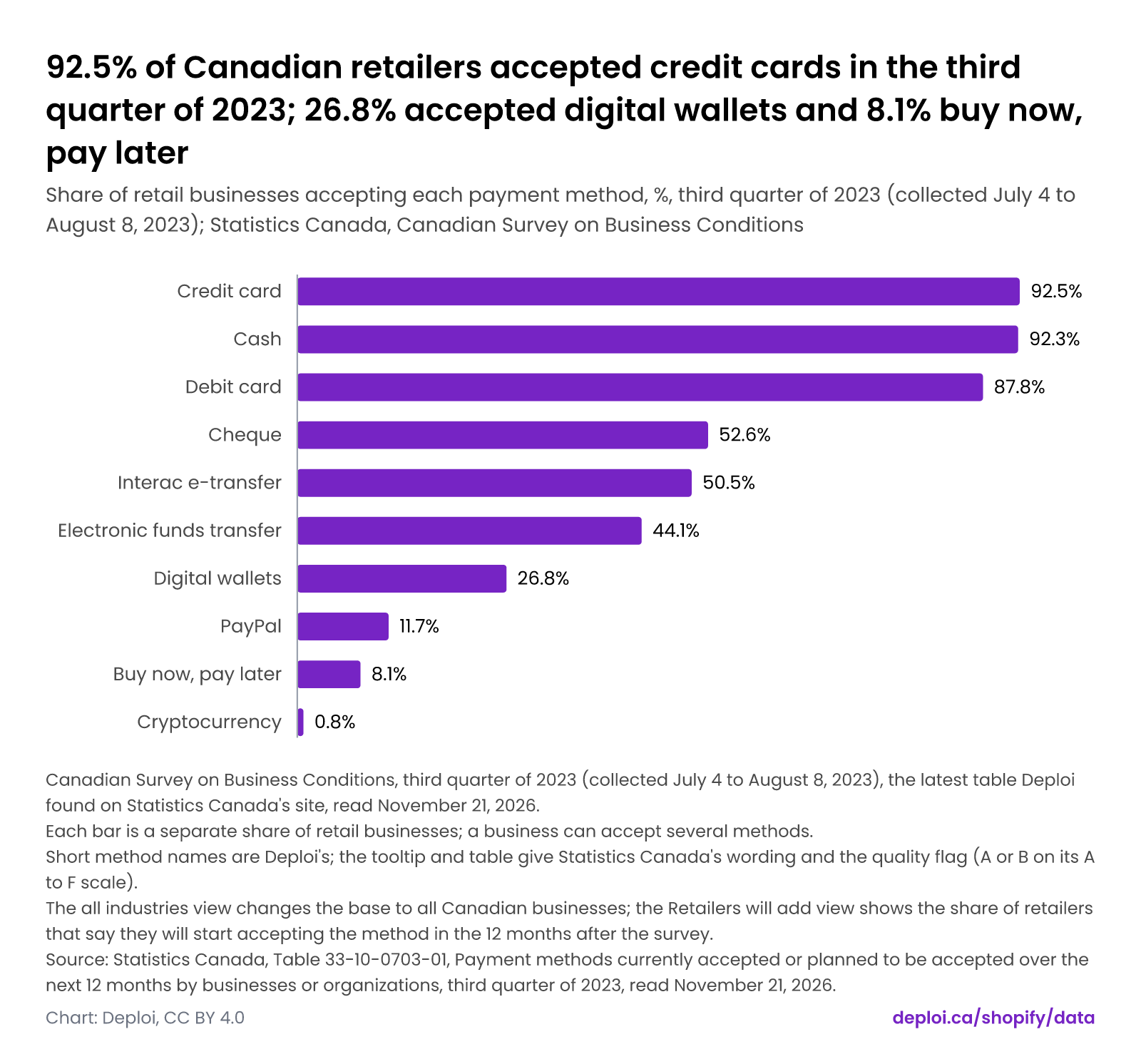
Canadian retail businesses accepted credit cards (92.5%), cash (92.3%) and debit cards (87.8%) most often in the third quarter of 2023, per the Canadian Survey on Business Conditions, in the latest table Deploi found on Statistics Canada's site, read November 21, 2026. Retailers' reasons for not accepting certain methods included incompatible equipment or software (27.7%) and service fees (27.6%), on a base Statistics Canada does not state.
92.5% of Canadian retailers accepted credit cards in the third quarter of 2023; 26.8% accepted digital wallets and 8.1% buy now, pay later
Share of retail businesses accepting each payment method, %, third quarter of 2023 (collected July 4 to August 8, 2023); Statistics Canada, Canadian Survey on Business Conditions
Payment methods, share of Canadian businesses, Q3 2023: All industries accept
Across all industries in the third quarter of 2023, 70.1% of Canadian businesses accepted cheques, 60.8% electronic funds transfers, 53.4% cash and 52.4% credit cards; this view changes the base from retailers to all businesses.
Showing: View: All industries accept. Reset
Interac e-transfer, share of businesses by view, Q3 2023
- Retailers accept
- 50.5%In the third quarter of 2023, 92.5% of Canadian retail businesses accepted credit cards, 50.5% Interac e-transfer, 26.8% digital wallets, 11.7% PayPal and 8.1% buy now, pay later.
- All industries accept
- 50.0%Across all industries in the third quarter of 2023, 70.1% of Canadian businesses accepted cheques, 60.8% electronic funds transfers, 53.4% cash and 52.4% credit cards; this view changes the base from retailers to all businesses.
- Retailers will add
- 14.4%In the third quarter of 2023, 14.4% of Canadian retailers said they would start accepting Interac e-transfer within 12 months, 14.1% electronic funds transfers, 8.1% digital wallets and 6.8% buy now, pay later.
- Canadian Survey on Business Conditions, third quarter of 2023 (collected July 4 to August 8, 2023), the latest table Deploi found on Statistics Canada's site, read November 21, 2026.
- Each bar is a separate share of retail businesses; a business can accept several methods.
- Short method names are Deploi's; the tooltip and table give Statistics Canada's wording and the quality flag (A or B on its A to F scale).
- The all industries view changes the base to all Canadian businesses; the Retailers will add view shows the share of retailers that say they will start accepting the method in the 12 months after the survey.
Source: Statistics Canada, Table 33-10-0703-01, Payment methods currently accepted or planned to be accepted over the next 12 months by businesses or organizations, third quarter of 2023, read November 21, 2026. Read on .
Which payment methods do Canadian retailers accept?
In the third quarter of 2023, 92.5% of Canadian retail businesses accepted credit cards, 92.3% cash and 87.8% debit cards, while 52.6% accepted cheques, 44.1% electronic funds transfers and 0.8% cryptocurrency, per Statistics Canada's Canadian Survey on Business Conditions, table 33-10-0703-01, collected July 4 to August 8, 2023.
Each share is a separate percentage of retail businesses, and a business can accept several methods, so the shares do not add to 100%.
| Method, Q3 2023 | Retail trade, accept | All industries, accept | Retail, will start within 12 months |
|---|---|---|---|
| Credit card | 92.5% | 52.4% | 1.1% |
| Cash | 92.3% | 53.4% | 1.1% |
| Debit card | 87.8% | 40.9% | 1.3% |
| Cheque | 52.6% | 70.1% | 0.6% |
| Interac e-transfer | 50.5% | 50.0% | 14.4% |
| Electronic funds transfer (EFT) | 44.1% | 60.8% | 14.1% |
| Digital wallets | 26.8% | 9.2% | 8.1% |
| PayPal | 11.7% | 6.8% | 5.9% |
| Buy now, pay later | 8.1% | 2.0% | 6.8% |
| Cryptocurrency | 0.8% | 0.3% | 2.8% |
Statistics Canada's own wording for each method is in the dataset table.
How do retailers compare with all Canadian businesses?
Canadian retail businesses accepted credit cards at 92.5% against 52.4% across all industries in the third quarter of 2023, a gap of 40.1 percentage points computed by Deploi, while cheques ran the other way, 52.6% against 70.1%, per Statistics Canada's Canadian Survey on Business Conditions. Interac e-transfer was nearly level, 50.5% against 50.0%.
The gap column in the dataset is retail minus all industries, computed by Deploi. Retail led on debit cards by 46.9 points, digital wallets by 17.6 points and buy now, pay later by 6.1 points.
Retail trailed all industries on cheques by 17.5 points, and its electronic funds transfer share was 44.1% against 60.8%. The all industries figure covers every industry in the survey, not only businesses that sell to consumers.
Which methods do retailers plan to start accepting within 12 months?
In the third quarter of 2023, 14.4% of Canadian retailers said they would start accepting Interac e-transfer within 12 months and 14.1% electronic funds transfers, against 8.1% for digital wallets, 6.8% for buy now, pay later and 5.9% for PayPal, per Statistics Canada's Canadian Survey on Business Conditions.
For cryptocurrency the figure was 2.8%, and for credit cards and cash 1.1% each.
These are stated intentions for the 12 months after the survey. The table does not say whether the retailers went on to add the method.
Why do some Canadian retailers not accept a payment method?
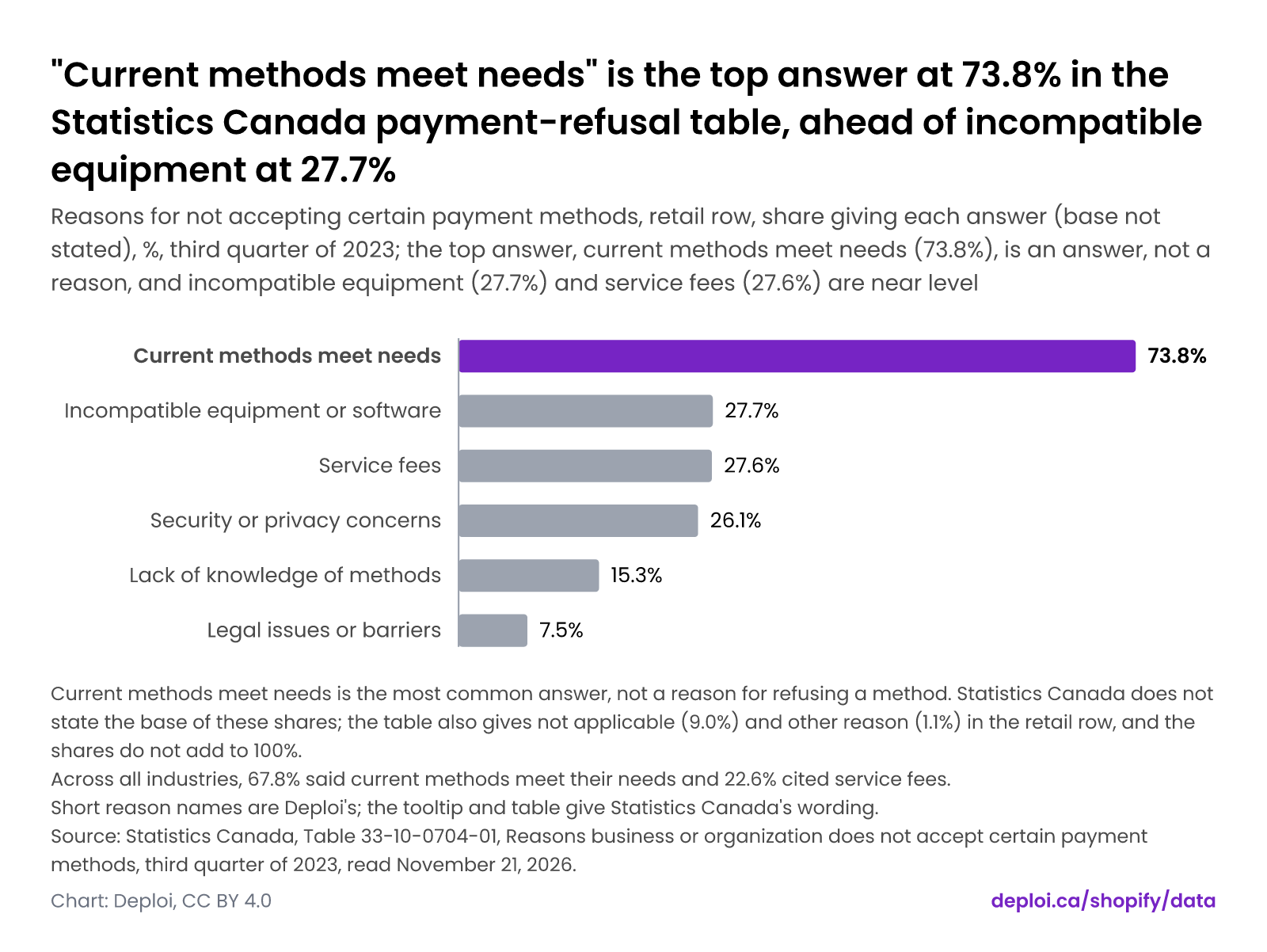
Canadian retailers cited incompatible equipment or software (27.7%) and service fees (27.6%) when asked why they did not accept certain payment methods in the third quarter of 2023, per Statistics Canada, table 33-10-0704-01, which gives no base for the shares. The top answer, 73.8%, was that current methods meet the needs of the business and its customers, naming no barrier.
| Answer, Q3 2023 | Retail | All industries |
|---|---|---|
| Current methods meet needs | 73.8% | 67.8% |
| Incompatible equipment or software | 27.7% | 13.0% |
| Service fees | 27.6% | 22.6% |
| Security or privacy concerns | 26.1% | 15.1% |
| Lack of knowledge of methods | 15.3% | 9.3% |
| Legal issues or barriers | 7.5% | 5.7% |
Statistics Canada asked businesses which payment methods they accepted and, if not all, why they did not accept certain methods. Statistics Canada does not state the base of these shares. Besides the answers above, table 33-10-0704-01 gives "not applicable" at 9.0% for retail and 16.2% for all industries, and "other reason" at 1.1% and 2.7% respectively. The shares do not add to 100%.
"Current methods meet needs" is the top answer at 73.8% in the Statistics Canada payment-refusal table, ahead of incompatible equipment at 27.7%
Reasons for not accepting certain payment methods, retail row, share giving each answer (base not stated), %, third quarter of 2023; the top answer, current methods meet needs (73.8%), is an answer, not a reason, and incompatible equipment (27.7%) and service fees (27.6%) are near level
- Current methods meet needs is the most common answer, not a reason for refusing a method. Statistics Canada does not state the base of these shares; the table also gives not applicable (9.0%) and other reason (1.1%) in the retail row, and the shares do not add to 100%.
- Across all industries, 67.8% said current methods meet their needs and 22.6% cited service fees.
- Short reason names are Deploi's; the tooltip and table give Statistics Canada's wording.
Source: Statistics Canada, Table 33-10-0704-01, Reasons business or organization does not accept certain payment methods, third quarter of 2023, read November 21, 2026. Read on .
How recent and how reliable are these figures?
The figures come from the Canadian Survey on Business Conditions for the third quarter of 2023, collected July 4 to August 8, 2023, in the latest table Deploi found on Statistics Canada's site, read November 21, 2026. Each retail value carries a quality flag, A or B on the table's A to F scale.
On that scale F means too unreliable to be published (data suppressed). The accepted-methods table gives flag A for credit cards, cash, PayPal, buy now, pay later and cryptocurrency, and B for the other methods.
The dataset holds retail trade as a whole. It has no online-only breakdown, and it does not cover which methods shoppers use.
The data
Each chart on this page is drawn from the numbers below. Units are in the column headers.
92.5% of Canadian retailers accepted credit cards in the third quarter of 2023; 26.8% accepted digital wallets and 8.1% buy now, pay later
| Short name | Retail trade (% of businesses) | All industries (% of businesses) | Retail, will start within 12 months (% of businesses) | Quality indicator | Method or reason |
|---|---|---|---|---|---|
| Credit card | 92.5 | 52.4 | 1.1 | A | Credit card |
| Cash | 92.3 | 53.4 | 1.1 | A | Cash |
| Debit card | 87.8 | 40.9 | 1.3 | B | Debit card |
| Interac e-transfer | 50.5 | 50.0 | 14.4 | B | Interac e-transfer |
| Cheque | 52.6 | 70.1 | 0.6 | B | Cheque |
| Electronic funds transfer | 44.1 | 60.8 | 14.1 | B | Electronic funds transfer (EFT) |
| Digital wallets | 26.8 | 9.2 | 8.1 | B | Digital wallet or electronic wallet (eWallet) methods |
| PayPal | 11.7 | 6.8 | 5.9 | A | PayPal |
| Buy now, pay later | 8.1 | 2.0 | 6.8 | A | Buy now, pay later payment service |
| Cryptocurrency | 0.8 | 0.3 | 2.8 | A | Cryptocurrency or crypto wallets |
Download Payment methods Canadian retail businesses accept, plan to start accepting and give reasons for not accepting, third quarter of 2023, against all industries as CSV · All 9 columns on the dataset page
"Current methods meet needs" is the top answer at 73.8% in the Statistics Canada payment-refusal table, ahead of incompatible equipment at 27.7%
| Short name | Retail trade (% of businesses) | All industries (% of businesses) | Quality indicator | Method or reason |
|---|---|---|---|---|
| Current methods meet needs | 73.8 | 67.8 | B | Current payment methods meet the needs of the business or organization and its clients or customers |
| Incompatible equipment or software | 27.7 | 13.0 | B | Incompatibility with existing equipment or software |
| Service fees | 27.6 | 22.6 | B | Service fees |
| Security or privacy concerns | 26.1 | 15.1 | B | Security or privacy concerns |
| Lack of knowledge of methods | 15.3 | 9.3 | B | Lack knowledge of available payment methods |
| Legal issues or barriers | 7.5 | 5.7 | A | Legal issues, barriers or concerns |
Download Payment methods Canadian retail businesses accept, plan to start accepting and give reasons for not accepting, third quarter of 2023, against all industries as CSV · All 9 columns on the dataset page
Methodology
Reading the chart: 92.5% of Canadian retailers accepted credit cards in the third quarter of 2023; 26.8% accepted digital wallets and 8.1% buy now, pay later
- Canadian Survey on Business Conditions, third quarter of 2023 (collected July 4 to August 8, 2023), the latest table Deploi found on Statistics Canada's site, read November 21, 2026.
- Each bar is a separate share of retail businesses; a business can accept several methods.
- Short method names are Deploi's; the tooltip and table give Statistics Canada's wording and the quality flag (A or B on its A to F scale).
- The all industries view changes the base to all Canadian businesses; the Retailers will add view shows the share of retailers that say they will start accepting the method in the 12 months after the survey.
Reading the chart: "Current methods meet needs" is the top answer at 73.8% in the Statistics Canada payment-refusal table, ahead of incompatible equipment at 27.7%
- Current methods meet needs is the most common answer, not a reason for refusing a method. Statistics Canada does not state the base of these shares; the table also gives not applicable (9.0%) and other reason (1.1%) in the retail row, and the shares do not add to 100%.
- Across all industries, 67.8% said current methods meet their needs and 22.6% cited service fees.
- Short reason names are Deploi's; the tooltip and table give Statistics Canada's wording.
Caveats: Payment methods Canadian retail businesses accept, plan to start accepting and give reasons for not accepting, third quarter of 2023, against all industries
- The survey is the Canadian Survey on Business Conditions for the third quarter of 2023, collected July 4 to August 8, 2023, the latest table on this question Deploi found on Statistics Canada's site, read November 21, 2026; 'will start to accept' covers the 12 months after the survey.
- Statistics Canada does not state the base of the reason shares. Respondents were asked which payment methods the business accepted and, if not all, why it did not accept certain methods (table note 8). The table gives each answer as a percent and also publishes 'other reason' (1.1% of retail, 2.7% of all industries) and 'not applicable' (9.0% of retail, 16.2% of all industries) in the same distribution; this dataset does not carry those two as rows. The shares do not add to 100%.
- The answer 'current payment methods meet the needs of the business' is the most common answer but is not a reason for not accepting a method.
- The quality indicator is shown for every retail value, on the table's A to F scale (F means too unreliable to be published, and the value is suppressed). Retail trade is shown as a whole; the table has no online-only breakdown.
- Gap in percentage points is retail minus all industries, computed by Deploi.
Deploi's charts and compilation are licensed CC BY 4.0. The underlying facts belong to their sources, which are named on every page. How Deploi Shopify Data works.
Sources
Tier A sources are primary documents: filings, official releases and official price pages. How sources are ranked.
Cite and reuse
Deploi's charts and compilation are licensed CC BY 4.0. The underlying facts belong to their sources, which are named on every page.
APA
Deploi. (2026). Which payment methods do Canadian retailers accept, and why do some refuse a method? [Web page]. https://deploi.ca/shopify/data/payment-methods-canadian-retailers-accept Retrieved November 21, 2026.
BibTeX
@misc{deploi_payment_methods_canadian_retailers_accept_2026,
  author = {{Deploi}},
  title = {Which payment methods do Canadian retailers accept, and why do some refuse a method?},
  year = {2026},
  url = {https://deploi.ca/shopify/data/payment-methods-canadian-retailers-accept},
  note = {Accessed 2026-11-21}
}
Embed a chart
Embed: 92.5% of Canadian retailers accepted credit cards in the third quarter of 2023; 26.8% accepted digital wallets and 8.1% buy now, pay later
Embed code
<iframe src="https://deploi.ca/embed/shopify/data/retailer-payment-methods-accepted" title="92.5% of Canadian retailers accepted credit cards in the third quarter of 2023; 26.8% accepted digital wallets and 8.1% buy now, pay later" loading="lazy" style="width:100%;height:690px;border:0"></iframe>
<p style="font:12px/1.4 Arial,sans-serif;margin:4px 0 0">Source: <a href="https://deploi.ca/shopify/data/charts/retailer-payment-methods-accepted">Deploi, 92.5% of Canadian retailers accepted credit cards in the third quarter of 2023; 26.8% accepted digital wallets and 8.1% buy now, pay later</a></p>
Embed: "Current methods meet needs" is the top answer at 73.8% in the Statistics Canada payment-refusal table, ahead of incompatible equipment at 27.7%
Embed code
<iframe src="https://deploi.ca/embed/shopify/data/retailer-payment-refusal-reasons" title=""Current methods meet needs" is the top answer at 73.8% in the Statistics Canada payment-refusal table, ahead of incompatible equipment at 27.7%" loading="lazy" style="width:100%;height:450px;border:0"></iframe> <p style="font:12px/1.4 Arial,sans-serif;margin:4px 0 0">Source: <a href="https://deploi.ca/shopify/data/charts/retailer-payment-refusal-reasons">Deploi, "Current methods meet needs" is the top answer at 73.8% in the Statistics Canada payment-refusal table, ahead of incompatible equipment at 27.7%</a></p>
Keep the credit line under the embed. It is the license condition.
Downloads
- Chart: 92.5% of Canadian retailers accepted credit cards in the third quarter of 2023; 26.8% accepted digital wallets and 8.1% buy now, pay later PNG
- Chart: "Current methods meet needs" is the top answer at 73.8% in the Statistics Canada payment-refusal table, ahead of incompatible equipment at 27.7% PNG
- Data: Payment methods Canadian retail businesses accept, plan to start accepting and give reasons for not accepting, third quarter of 2023, against all industries CSV
Questions
What share of Canadian retailers accept Interac e-transfer?
50.5% of Canadian retail businesses accepted Interac e-transfer in the third quarter of 2023, against 50.0% across all industries, per Statistics Canada's Canadian Survey on Business Conditions. Separately, 14.4% of retailers said they would start accepting it within 12 months.
What share of Canadian retailers accept buy now, pay later?
8.1% of Canadian retail businesses accepted a buy now, pay later payment service in the third quarter of 2023, against 2.0% across all industries, and 6.8% of retailers said they would start accepting one within 12 months, per Statistics Canada, table 33-10-0703-01.
Do Canadian retailers accept digital wallets?
26.8% of Canadian retail businesses accepted digital wallet or eWallet methods in the third quarter of 2023, against 9.2% across all industries, per Statistics Canada's Canadian Survey on Business Conditions. Separately, 8.1% of retailers said they would start within 12 months.
Why do retailers refuse some payment methods?
Canadian retailers cited incompatible equipment or software (27.7%), service fees (27.6%) and security or privacy concerns (26.1%) as reasons for not accepting certain methods in the third quarter of 2023, per Statistics Canada, table 33-10-0704-01. The top answer, 73.8%, was that current methods meet the needs of the business and its customers. Statistics Canada does not state the base of these shares.
Is there newer data than the third quarter of 2023?
Deploi found none on Statistics Canada's site, read November 21, 2026. The latest table it found covers the Canadian Survey on Business Conditions for the third quarter of 2023, collected July 4 to August 8, 2023, so the figures describe 2023 and not the current year.
More on Canada
- Does a higher Shopify plan buy a bigger shipping discount in Canada?
Shopify's Canadian pricing page lists Shipping discounts of up to 45% on Basic, 50% on Grow and 53% on Advanced and Plus, against up to 87% on every US plan, as captured November 21, 2026. Updated November 22, 2026.
- Does Canadian duty apply to the shipping cost?
Section 48 of the Customs Act counts transport to the place of direct shipment in the value for duty and takes out transport from that place to Canada when the price includes it, as read on the Justice Laws Website on November 22, 2026. Updated November 22, 2026.
- Which prepackaged foods sold in Canada must carry the front-of-package 'high in' symbol, and at what percent of daily value?
Prepackaged foods sold in Canada must show the 'high in' symbol at or above 15% of the daily value, 10% for reference amounts of 30 g or 30 mL or less and 30% for main dishes of 200 g or more, unless exempt, under section B.01.350 of the Food and Drug Regulations; the CFIA's compliance deadline was January 1, 2026. Updated November 22, 2026.
- Can a Canadian online store let a gift card expire or charge fees on it, and how do the rules differ by province?
The official pages of the nine provinces covered state that gift cards may not carry an expiry date, with listed exceptions, and cap mall card dormancy fees at C$2.50 a month where they state an amount, read November 21, 2026. Updated November 21, 2026.
- Do British Columbia, Saskatchewan and Manitoba make an online store a packaging producer, and what line exempts a small seller?
British Columbia takes a small packaging producer out of its Part 2 plan rules and Saskatchewan exempts one, under C$1,000,000 in revenue or 1 tonne of packaging a year, and Manitoba's regulation states no such line, per provincial texts read November 21, 2026. Updated November 21, 2026.
- Does a Canadian store charge GST or HST on an order shipped outside Canada, and what changes for a pickup in Canada?
Goods a supplier ships to a destination outside Canada, or mails or couriers to an address outside Canada, are zero-rated under Schedule VI, Part V, section 12 of the Excise Tax Act, consolidated to October 29, 2026, and goods delivered or made available in Canada are supplied in Canada under section 142(1)(a). Updated November 21, 2026.
Changes
- · Payment methods Canadian retail businesses accept, plan to start accepting and give reasons for not accepting, third quarter of 2023, against all industries
First release. 16 rows, 7 fields read from 4 sources; each value agreed by extractor and verifier or ruled by the judge.