
What must a Canadian product be to carry a 'Product of Canada' or 'Made in Canada' label, and how do 98% and 51% work?
For non-food goods, the Competition Bureau's guidance sets at least 98% of total direct costs in Canada for 'Product of Canada' and at least 51% plus a qualifying statement for 'Made in Canada', each with the last substantial transformation in Canada, read November 2026. Updated November 21, 2026.
By Martin DejnickiUpdated Data through November 21, 2026
Short answer
Competition Bureau Canada will generally not challenge a non-food 'Product of Canada' claim when at least 98% of total direct costs are incurred in Canada, or a 'Made in Canada' claim at 51% or more with a qualifying statement, if the last substantial transformation occurred in Canada, per its guidance read November 21, 2026. Food claims follow CFIA's separate tests.
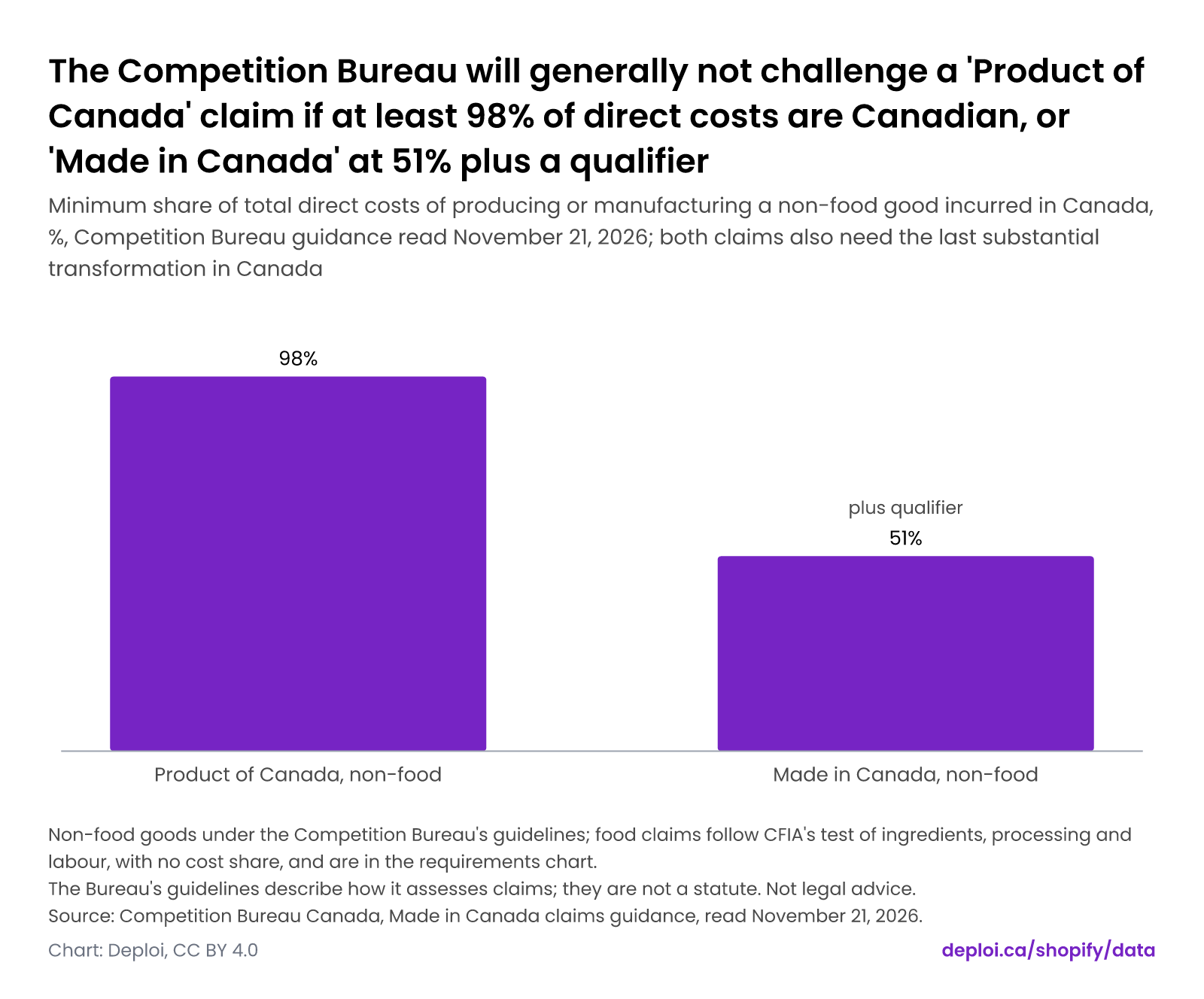
The Competition Bureau will generally not challenge a 'Product of Canada' claim if at least 98% of direct costs are Canadian, or 'Made in Canada' at 51% plus a qualifier
Minimum share of total direct costs of producing or manufacturing a non-food good incurred in Canada, %, Competition Bureau guidance read November 21, 2026; both claims also need the last substantial transformation in Canada
- Non-food goods under the Competition Bureau's guidelines; food claims follow CFIA's test of ingredients, processing and labour, with no cost share, and are in the requirements chart.
- The Bureau's guidelines describe how it assesses claims; they are not a statute. Not legal advice.
Source: Competition Bureau Canada, Made in Canada claims guidance, read November 21, 2026. Read on .
How does the 98% cost test for 'Product of Canada' work on non-food goods?
The 98% test asks that at least 98% of the total direct costs of producing or manufacturing a non-food good be incurred in Canada, with its last substantial transformation also in Canada; Competition Bureau Canada says it will generally not challenge a 'Product of Canada' claim that meets both, per its guidance read on November 21, 2026.
The Bureau's guidelines describe how it assesses claims. They are not a statute. The 98% test sits beside the transformation test, and the Bureau lists both as conditions.
What does 'Made in Canada' require beyond 51% of costs?
A non-food 'Made in Canada' claim needs at least 51% of total direct costs incurred in Canada, the last substantial transformation in Canada and an appropriate qualifying statement, per Competition Bureau Canada guidance read on November 21, 2026. Examples of qualifying statements are 'Made in Canada with imported parts' and 'Made in Canada with domestic and imported parts'.
| Non-food claim | Minimum Canadian share of direct costs | Last substantial transformation in Canada | Qualifying statement |
|---|---|---|---|
| Product of Canada | 98% | required | not published |
| Made in Canada | 51% | required | required |
A cell marked not published means the guidance states no such requirement for that claim.
What must a food product meet for 'Product of Canada' or 'Made in Canada'?
For food, the Canadian Food Inspection Agency allows 'Product of Canada' when all or virtually all major ingredients, processing and labour used to make the food are Canadian, and 'Made in Canada' with a qualifying statement when the last substantial transformation occurred in Canada, per CFIA's origin claims page read on November 21, 2026.
CFIA's qualifying statements for food include 'Made in Canada from domestic and imported ingredients' and 'Made in Canada from imported ingredients'. A 'Made in Canada' food claim can be used even if some ingredients are from other countries.
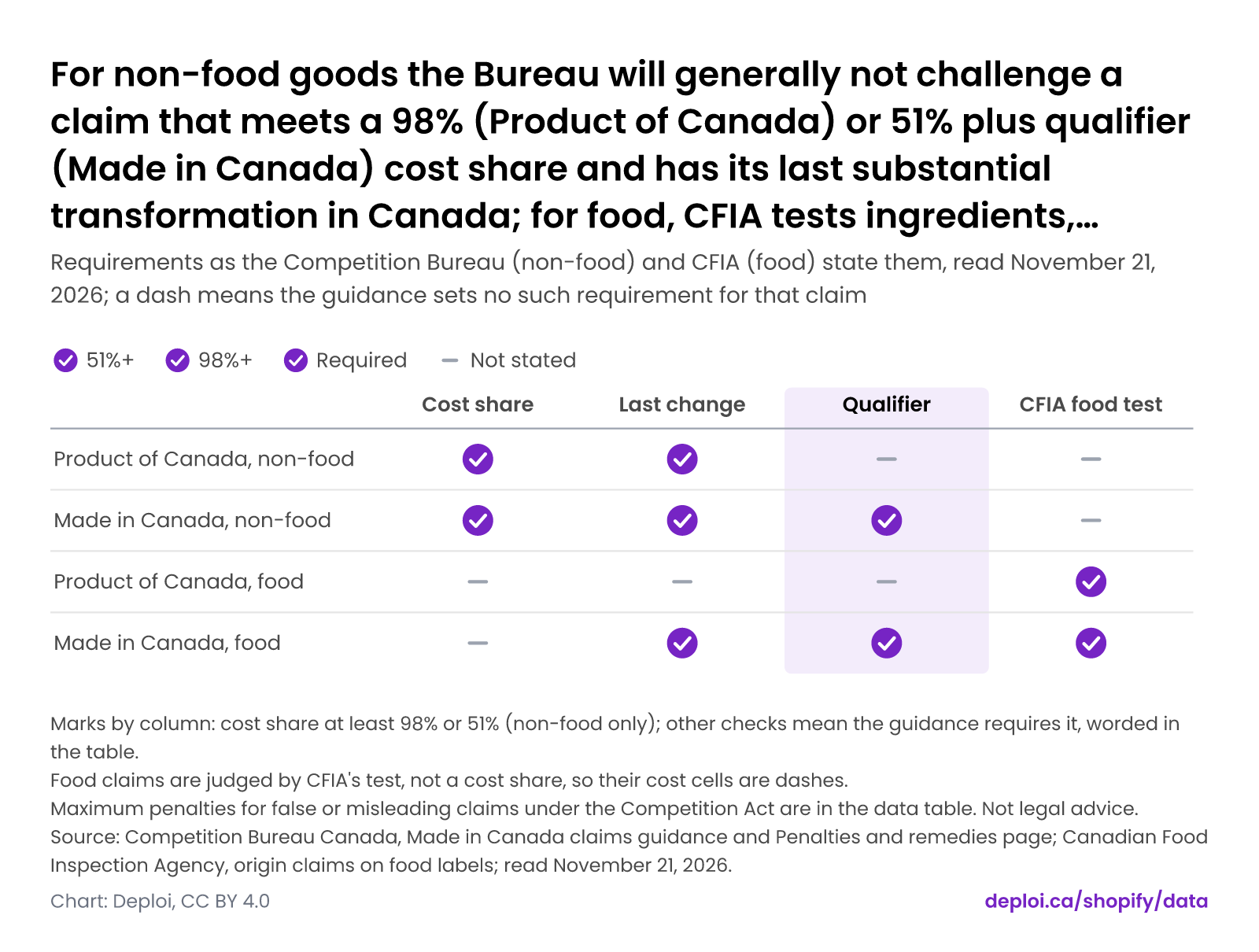
For non-food goods the Bureau will generally not challenge a claim that meets a 98% (Product of Canada) or 51% plus qualifier (Made in Canada) cost share and has its last substantial transformation in Canada; for food, CFIA tests ingredients, processing and labour
Requirements as the Competition Bureau (non-food) and CFIA (food) state them, read November 21, 2026; a dash means the guidance sets no such requirement for that claim
- Marks by column: cost share at least 98% or 51% (non-food only); other checks mean the guidance requires it, worded in the table.
- Food claims are judged by CFIA's test, not a cost share, so their cost cells are dashes.
- Maximum penalties for false or misleading claims under the Competition Act are in the data table. Not legal advice.
Source: Competition Bureau Canada, Made in Canada claims guidance and Penalties and remedies page; Canadian Food Inspection Agency, origin claims on food labels; read November 21, 2026. Read on .
What is the maximum penalty for a false or misleading origin claim?
For a corporation, a first-time civil deceptive marketing violation can bring a penalty of up to the greater of C$10 million (C$15 million for each subsequent violation) and three times the benefit derived, or 3% of annual worldwide gross revenue if the benefit cannot be reasonably determined, per Competition Bureau Canada's penalties page read on November 21, 2026.
For individuals, the first-time penalty is up to the greater of C$750,000 (C$1 million for each subsequent violation) and three times the benefit derived, if it can be reasonably determined.
The same page lists criminal consequences for knowingly or recklessly making a false or misleading representation. On summary conviction the penalty is a fine of up to C$200,000, imprisonment for up to one year, or both. On indictment fines are at the court's discretion and imprisonment can be up to 14 years. The Bureau's penalties page covers deceptive marketing practices in general, not origin claims only.
What does this page not cover?
The page covers the Competition Bureau's non-food guidance, CFIA's food origin rules and the Bureau's penalty maximums, as read on November 21, 2026. It is not legal advice, and the guidelines describe how the Bureau assesses claims rather than a statute.
The Bureau's page does not list which costs count as total direct costs of producing or manufacturing the good. Cost shares are stated for non-food goods only, so the food rows have no cost share and the cells are not published.
The data
Each chart on this page is drawn from the numbers below. Units are in the column headers.
For non-food goods the Bureau will generally not challenge a claim that meets a 98% (Product of Canada) or 51% plus qualifier (Made in Canada) cost share and has its last substantial transformation in Canada; for food, CFIA tests ingredients, processing and labour
| Claim | Cost share (% of total direct costs) | Last change | Qualifier | CFIA food test | Last substantial transformation | Qualifying statement | Food test |
|---|---|---|---|---|---|---|---|
| Product of Canada, non-food | 98%+ | Required | Not stated | Not stated | the last substantial transformation of the good occurred in Canada. | ||
| Made in Canada, non-food | 51%+ | Required | Required | Not stated | the last substantial transformation of the good occurred in Canada; | the claim is accompanied by an appropriate qualifying statement, such as "Made in Canada with imported parts" or "Made in Canada with domestic and imported parts | |
| Product of Canada, food | Not stated | Not stated | Not stated | Required | A food product may use the claim "Product of Canada" when all or virtually all major ingredients, processing, and labour used to make the food product are Canadian. | ||
| Made in Canada, food | Not stated | Required | Required | Required | A "Made in Canada" claim with a qualifying statement can be used on a food product when the last substantial transformation of the product occurred in Canada, even if some ingredients are from other countries. | If the "Made in Canada" claim is used, it must also include a qualifying statement to indicate that the food product is made in Canada from imported ingredients or a combination of imported and domestic ingredients. The qualifying statements that can be used include "Made in Canada from domestic and imported ingredients" or "Made in Canada from imported ingredients". | A "Made in Canada" claim with a qualifying statement can be used on a food product when the last substantial transformation of the product occurred in Canada, even if some ingredients are from other countries. |
Download 'Product of Canada' and 'Made in Canada' claims: Canadian share of direct costs, last substantial transformation, qualifying statements and penalties, Competition Bureau and CFIA, 2026 as CSV · All 12 columns on the dataset page
Methodology
Reading the chart: The Competition Bureau will generally not challenge a 'Product of Canada' claim if at least 98% of direct costs are Canadian, or 'Made in Canada' at 51% plus a qualifier
- Non-food goods under the Competition Bureau's guidelines; food claims follow CFIA's test of ingredients, processing and labour, with no cost share, and are in the requirements chart.
- The Bureau's guidelines describe how it assesses claims; they are not a statute. Not legal advice.
Reading the chart: For non-food goods the Bureau will generally not challenge a claim that meets a 98% (Product of Canada) or 51% plus qualifier (Made in Canada) cost share and has its last substantial transformation in Canada; for food, CFIA tests ingredients, processing and labour
- Marks by column: cost share at least 98% or 51% (non-food only); other checks mean the guidance requires it, worded in the table.
- Food claims are judged by CFIA's test, not a cost share, so their cost cells are dashes.
- Maximum penalties for false or misleading claims under the Competition Act are in the data table. Not legal advice.
Caveats: 'Product of Canada' and 'Made in Canada' claims: Canadian share of direct costs, last substantial transformation, qualifying statements and penalties, Competition Bureau and CFIA, 2026
- Not legal advice. Guidance as the Competition Bureau and CFIA state it on the capture date.
- The Bureau's guidelines describe how it assesses claims; they are not a statute.
- The Competition Bureau introduces its conditions with 'We will generally not challenge a claim that states that a good is ... if these ... conditions are met': the cost shares and transformation tests are the conditions under which the Bureau generally will not challenge a claim, not a license or a statute.
- Cost shares are stated for non-food goods only; the food rows follow CFIA's test and their cost share is not published.
- The penalty row is the Bureau's summary for deceptive marketing practices in general, not for origin claims only.
- CFIA: 'Generally, the percentage referred to as very little or minor is considered to be less than a total of 2% of the product' (very low levels of ingredients not generally produced in Canada do not disqualify a food from a 'Product of Canada' claim).
Deploi's charts and compilation are licensed CC BY 4.0. The underlying facts belong to their sources, which are named on every page. How Deploi Shopify Data works.
Sources
Tier A sources are primary documents: filings, official releases and official price pages. How sources are ranked.
- Tier AMade in Canada claims
Competition Bureau Canada · HTML · Read on
- Tier APenalties and remedies for non-compliance (deceptive marketing practices)
Competition Bureau Canada · HTML · Read on
- Tier AOrigin claims on food labels (Product of Canada and Made in Canada guidelines)
Canadian Food Inspection Agency · HTML · Read on
Cite and reuse
Deploi's charts and compilation are licensed CC BY 4.0. The underlying facts belong to their sources, which are named on every page.
APA
Deploi. (2026). What must a Canadian product be to carry a 'Product of Canada' or 'Made in Canada' label, and how do 98% and 51% work? [Web page]. https://deploi.ca/shopify/data/product-of-canada-made-in-canada-rules Retrieved November 21, 2026.
BibTeX
@misc{deploi_product_of_canada_made_in_canada_rules_2026,
  author = {{Deploi}},
  title = {What must a Canadian product be to carry a 'Product of Canada' or 'Made in Canada' label, and how do 98\% and 51\% work?},
  year = {2026},
  url = {https://deploi.ca/shopify/data/product-of-canada-made-in-canada-rules},
  note = {Accessed 2026-11-21}
}
Embed a chart
Embed: The Competition Bureau will generally not challenge a 'Product of Canada' claim if at least 98% of direct costs are Canadian, or 'Made in Canada' at 51% plus a qualifier
Embed code
<iframe src="https://deploi.ca/embed/shopify/data/canada-claim-cost-share" title="The Competition Bureau will generally not challenge a 'Product of Canada' claim if at least 98% of direct costs are Canadian, or 'Made in Canada' at 51% plus a qualifier" loading="lazy" style="width:100%;height:550px;border:0"></iframe> <p style="font:12px/1.4 Arial,sans-serif;margin:4px 0 0">Source: <a href="https://deploi.ca/shopify/data/charts/canada-claim-cost-share">Deploi, The Competition Bureau will generally not challenge a 'Product of Canada' claim if at least 98% of direct costs are Canadian, or 'Made in Canada' at 51% plus a qualifier</a></p>
Embed: For non-food goods the Bureau will generally not challenge a claim that meets a 98% (Product of Canada) or 51% plus qualifier (Made in Canada) cost share and has its last substantial transformation in Canada; for food, CFIA tests ingredients, processing and labour
Embed code
<iframe src="https://deploi.ca/embed/shopify/data/canada-claim-requirements" title="For non-food goods the Bureau will generally not challenge a claim that meets a 98% (Product of Canada) or 51% plus qualifier (Made in Canada) cost share and has its last substantial transformation in Canada; for food, CFIA tests ingredients, processing and labour" loading="lazy" style="width:100%;height:490px;border:0"></iframe>
<p style="font:12px/1.4 Arial,sans-serif;margin:4px 0 0">Source: <a href="https://deploi.ca/shopify/data/charts/canada-claim-requirements">Deploi, For non-food goods the Bureau will generally not challenge a claim that meets a 98% (Product of Canada) or 51% plus qualifier (Made in Canada) cost share and has its last substantial transformation in Canada; for food, CFIA tests ingredients, processing and labour</a></p>
Keep the credit line under the embed. It is the license condition.
Downloads
- Chart: The Competition Bureau will generally not challenge a 'Product of Canada' claim if at least 98% of direct costs are Canadian, or 'Made in Canada' at 51% plus a qualifier PNG
- Chart: For non-food goods the Bureau will generally not challenge a claim that meets a 98% (Product of Canada) or 51% plus qualifier (Made in Canada) cost share and has its last substantial transformation in Canada; for food, CFIA tests ingredients, processing and labour PNG
- Data: 'Product of Canada' and 'Made in Canada' claims: Canadian share of direct costs, last substantial transformation, qualifying statements and penalties, Competition Bureau and CFIA, 2026 CSV
Questions
What percentage of a product must be Canadian to say 'Product of Canada'?
For non-food goods, Competition Bureau Canada will generally not challenge the claim when at least 98% of total direct costs of producing or manufacturing the good are incurred in Canada and the last substantial transformation occurred there, per its guidance read on November 21, 2026. Food follows a separate CFIA test.
What percentage is needed for 'Made in Canada'?
For non-food goods, the Competition Bureau's guidance asks for at least 51% of total direct costs incurred in Canada, the last substantial transformation in Canada and a qualifying statement such as 'Made in Canada with imported parts', per its page read on November 21, 2026.
Do the 98% and 51% tests apply to food?
No. For food, CFIA's 'Product of Canada' test is that all or virtually all major ingredients, processing and labour are Canadian, and no cost share is stated, per CFIA's origin claims page read on November 21, 2026.
What is the maximum penalty for a misleading claim in Canada?
Under the Competition Act's civil provisions, a corporation faces up to the greater of C$10 million for a first violation (C$15 million for each subsequent one) and three times the benefit, or 3% of annual worldwide gross revenue if the benefit cannot be reasonably determined. On indictment under the criminal provisions, fines are at the court's discretion, per the Competition Bureau, read November 21, 2026.
Are the Competition Bureau's guidelines law?
No. The Bureau's guidelines describe how it assesses claims; they are not a statute. Its page, read on November 21, 2026, says it will generally not challenge a claim that meets the stated conditions. This page is not legal advice.
More on Canada
- Can a Canadian online store let a gift card expire or charge fees on it, and how do the rules differ by province?
The official pages of the nine provinces covered state that gift cards may not carry an expiry date, with listed exceptions, and cap mall card dormancy fees at C$2.50 a month where they state an amount, read November 21, 2026. Updated November 21, 2026.
- How do CASL and CAN-SPAM differ on consent, unsubscribe deadlines and penalties?
CASL requires consent before the first commercial email and CAN-SPAM does not, while both require an unsubscribe request honored within 10 business days, per the statutes read November 20, 2026. Updated November 20, 2026.
- How exposed are Canadian retailers to Canadian tariffs on US goods, and how much of what they buy comes from US suppliers?
In Statistics Canada's survey for the third quarter of 2026, 14.9% of Canadian retailers had made 60% to 79% of their purchases over the last 12 months directly from US suppliers, against 6.9% of all businesses, and 61.9% of retailers that buy from US suppliers said Canada imposed tariffs on goods they bought. Updated November 20, 2026.
- How large is the Canada Post fuel surcharge on a domestic parcel now, and how does it move with the diesel price?
Canada Post's domestic fuel surcharge is 47.0% for the week of November 16, 2026, or 39.9% after temporary relief, a 15% discount that runs to January 3, 2027, per its fuel surcharge page read November 20, 2026. Updated November 20, 2026.
- How long does Shopify Payments take to pay out a Canadian store compared with a US store and other countries, and in which currencies?
Shopify Payments pays out in a minimum of 3 business days in Canada and the US, 2 in Australia, 5 in Japan and 7 in Mexico, per the Shopify Help Center, read November 20, 2026. Updated November 20, 2026.
- How many language complaints does the Office québécois de la langue française receive each year, and what share concern websites and social media?
The Office québécois de la langue française received 10,371 complaints or reports in fiscal 2024-2025, up from 6,292 in 2021-2022, and 19% concerned websites and social media, per its annual management reports and complaint statistics. Updated November 20, 2026.
Changes
- · 'Product of Canada' and 'Made in Canada' claims: Canadian share of direct costs, last substantial transformation, qualifying statements and penalties, Competition Bureau and CFIA, 2026
First release. 5 rows, 7 fields read from 3 sources; each value agreed by extractor and verifier or ruled by the judge.