
How much Canadian and US web traffic comes from Safari and Firefox, which have built-in tracking protection?
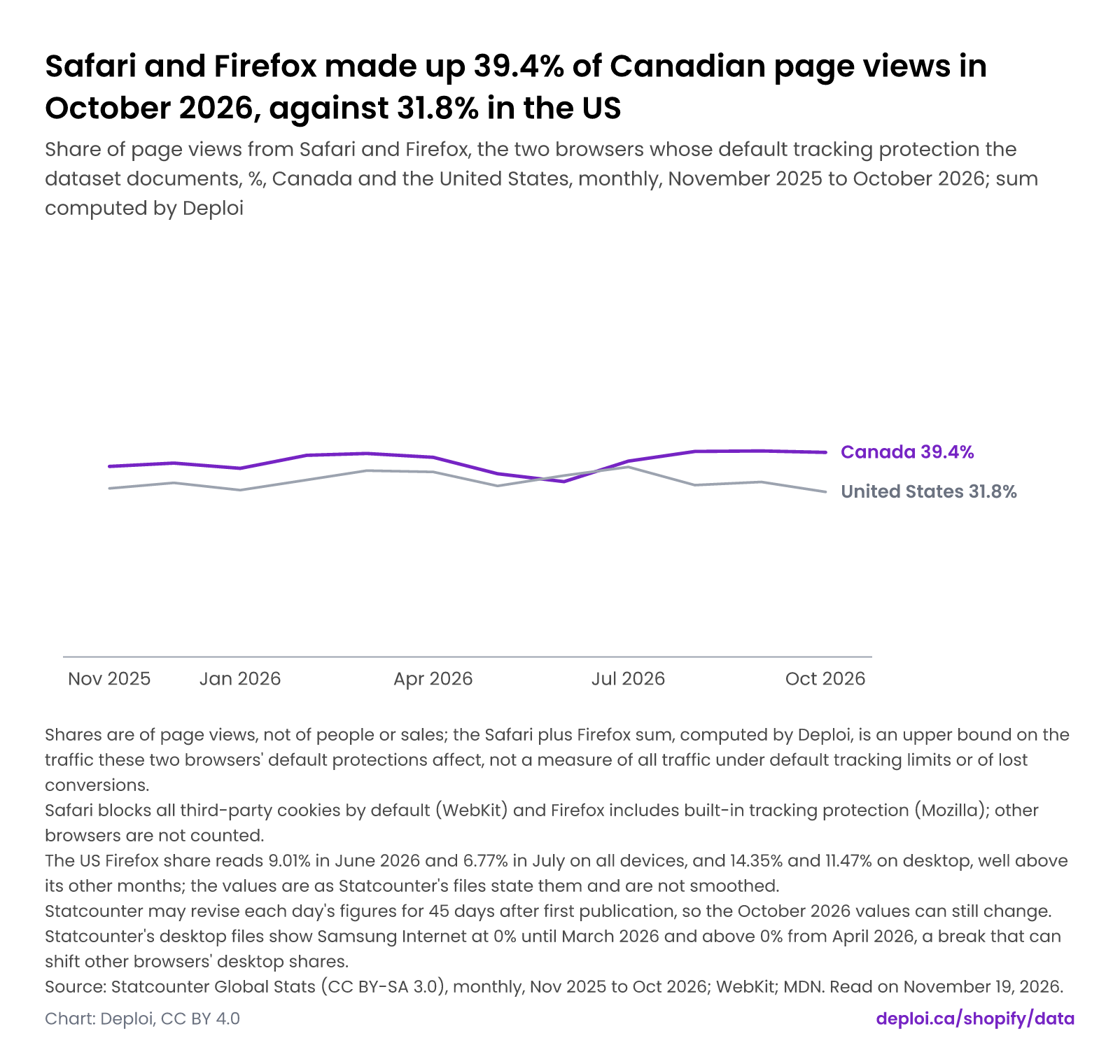
Safari and Firefox made up 39.4% of Canadian page views in October 2026, against 31.8% in the US, per Statcounter Global Stats, with the sums computed by Deploi. Updated November 19, 2026.
By Martin DejnickiUpdated Data through October 2026
Short answer
Safari and Firefox together made up 39.4% of Canadian page views and 31.8% of US page views on all devices in October 2026, computed by Deploi from Statcounter Global Stats monthly browser shares. Canada was above the US in every month from November 2025 to October 2026 except June 2026. The sum is an upper bound on the traffic these two browsers' defaults affect, not a count of lost conversions.
Safari and Firefox made up 39.4% of Canadian page views in October 2026, against 31.8% in the US
Share of page views from Safari and Firefox, the two browsers whose default tracking protection the dataset documents, %, Canada and the United States, monthly, November 2025 to October 2026; sum computed by Deploi
Desktop: Safari and Firefox share of page views, Canada and the US
Canada, October 2026: Safari and Firefox share of page views by device
- All devices
- 39.4%On all devices, Safari and Firefox made up 39.4% of page views in Canada and 31.8% in the United States in October 2026.
- Mobile
- 56.2%On mobile, Safari and Firefox made up 56.2% of page views in Canada and 46.1% in the United States in October 2026.
- Desktop
- 23.8%On desktop, Safari and Firefox made up 23.8% of page views in Canada and 19.2% in the United States in October 2026.
- Shares are of page views, not of people or sales; the Safari plus Firefox sum, computed by Deploi, is an upper bound on the traffic these two browsers' default protections affect, not a measure of all traffic under default tracking limits or of lost conversions.
- Safari blocks all third-party cookies by default (WebKit) and Firefox includes built-in tracking protection (Mozilla); other browsers are not counted.
- The US Firefox share reads 9.01% in June 2026 and 6.77% in July on all devices, and 14.35% and 11.47% on desktop, well above its other months; the values are as Statcounter's files state them and are not smoothed.
- Statcounter may revise each day's figures for 45 days after first publication, so the October 2026 values can still change.
- Statcounter's desktop files show Samsung Internet at 0% until March 2026 and above 0% from April 2026, a break that can shift other browsers' desktop shares.
Source: Statcounter Global Stats (CC BY-SA 3.0), monthly, Nov 2025 to Oct 2026; WebKit; MDN. Read on .
What share of Canadian and US page views come from Safari and Firefox?
Safari and Firefox together made up 39.4% of Canadian page views and 31.8% of US page views on all devices in October 2026, computed by Deploi from Statcounter Global Stats. Safari alone was 35.9% in Canada and 28.1% in the US, and Firefox 3.4% and 3.6%. The sum is an upper bound on page views these two browsers' defaults affect, not a count of lost conversions.
Shares are of page views, not of people or sales. The sum counts no other browser. In October 2026 Chrome had 46.3% of Canadian page views and 55.9% of US page views on all devices.
Statcounter may revise each day's figures for 45 days after first publication, so the October 2026 values can still change.
How much higher is the share on mobile than on desktop?
On mobile, Safari and Firefox made up 56.2% of Canadian page views and 46.1% of US page views in October 2026, against 23.8% and 19.2% on desktop, per Statcounter Global Stats, with the sums computed by Deploi. Mobile is more than double desktop in both countries. Safari is 55.1% of Canadian mobile page views and 17.9% of Canadian desktop page views.
In October 2026 Firefox was 1.07% of Canadian mobile page views and 5.82% of Canadian desktop page views, and 1.3% and 5.8% in the US. Safari carries most of the mobile figure.
The chart's device control switches between the three views.
Is Canada's share always above the US share?
Canada's Safari and Firefox share was above the US share on all devices in every month from November 2025 to October 2026 except June 2026, when it was 33.74% against 34.91%, per Statcounter Global Stats, with the sums computed by Deploi. The gap was widest in October 2026, at 7.6 percentage points, and narrowest, among the months Canada was ahead, in July 2026 at 1.13 points.
On mobile, Canada was below the US in November 2025 (51.4% against 51.89%) and January 2026 (51.98% against 52.24%) and above in the other 10 months. On desktop, Canada was below the US in June 2026 (19.21% against 23.35%) and July (22.62% against 22.73%) and above in the other 10.
The gap in October 2026 was 10.1 points on mobile and 4.53 points on desktop.
How did the share move from November 2025 to October 2026?
Canada's Safari and Firefox share on all devices went from 36.67% in November 2025 to 39.37% in October 2026, with a low of 33.74% in June 2026 and a high of 39.65% in September, per Statcounter Global Stats. The US share went from 32.44% to 31.76%, with a high of 36.56% in July 2026. The sums are computed by Deploi.
The US share was lowest in October 2026 at 31.76%. US mobile Safari was 52.87% of page views in August 2026 and 46.31% in September, and the US mobile sum fell from 54.33% to 47.6% between those months. The dataset does not state a cause.
Statcounter can revise recent months, so the latest values are the least settled.
How large is the US Firefox jump in June and July 2026?
Statcounter's US files show Firefox at 9.01% of page views on all devices in June 2026 and 6.77% in July, against 3.32% to 4.17% in the other 10 months from November 2025 to October 2026. On US desktop the figures are 14.35% and 11.47%, against 5.2% to 6.9%. Deploi reports the values as the files state them and does not smooth them.
Canada shows a smaller rise in July 2026, when Firefox was 5.02% of page views on all devices against 3.29% to 4.02% in the other months.
The dataset states no cause for the June and July values. The US Safari and Firefox sum on all devices was 34.91% in June and 36.56% in July.
What changed in Statcounter's desktop figures in April 2026?
Statcounter's desktop files show Samsung Internet at 0% in Canada and the US from November 2025 to March 2026 and above 0% from April 2026, when it was 1.03% in Canada and 0.58% in the US, per Statcounter Global Stats files retrieved November 19, 2026. The break can shift other browsers' desktop shares, so desktop trends across April 2026 need care.
By October 2026 Samsung Internet was 0.37% of Canadian desktop page views and 0.2% of US desktop page views. The dataset states no reason for the change.
Mobile and all devices series show Samsung Internet above 0% in every month.
What do Safari and Firefox block by default?
WebKit documents that Safari's Intelligent Tracking Prevention by default blocks all third-party cookies, with no exceptions, per its Tracking Prevention in WebKit page read November 19, 2026. MDN says Firefox Desktop and Firefox for Android include built-in tracking protection, and that Private Browsing windows block content loaded from domains that track users across sites.
WebKit says third-party cookie access can only be granted through the Storage Access API and a temporary compatibility fix for popups.
The MDN text recorded in the dataset does not state what Firefox blocks in standard windows. For that reason the Safari and Firefox sum is an upper bound on the traffic these two browsers' defaults affect, not an exact measure. The dataset documents no other browser's defaults.
The data
Each chart on this page is drawn from the numbers below. Units are in the column headers.
Methodology
Reading the chart: Safari and Firefox made up 39.4% of Canadian page views in October 2026, against 31.8% in the US
- Shares are of page views, not of people or sales; the Safari plus Firefox sum, computed by Deploi, is an upper bound on the traffic these two browsers' default protections affect, not a measure of all traffic under default tracking limits or of lost conversions.
- Safari blocks all third-party cookies by default (WebKit) and Firefox includes built-in tracking protection (Mozilla); other browsers are not counted.
- The US Firefox share reads 9.01% in June 2026 and 6.77% in July on all devices, and 14.35% and 11.47% on desktop, well above its other months; the values are as Statcounter's files state them and are not smoothed.
- Statcounter may revise each day's figures for 45 days after first publication, so the October 2026 values can still change.
- Statcounter's desktop files show Samsung Internet at 0% until March 2026 and above 0% from April 2026, a break that can shift other browsers' desktop shares.
Caveats: Share of web traffic from Safari and Firefox, which document built-in tracking protection, Canada and the US, monthly, November 2025 to October 2026
- Shares are of page views as Statcounter measures them, not of people or sales. Only the five browsers in the table are listed, so the shares do not add to 100%.
- The Safari plus Firefox sum is computed by Deploi. It is an upper bound on the traffic these two browsers' default protections affect, not a measure of all traffic under default tracking limits or of lost conversions. The dataset documents no other browser's defaults.
- WebKit documents that Safari's Intelligent Tracking Prevention by default blocks all third-party cookies. MDN says Firefox Desktop and Firefox for Android include built-in tracking protection and that Private Browsing windows block content from domains that track users across sites. The MDN text recorded here does not state what Firefox blocks in standard windows.
- Statcounter's US Firefox share reads 9.01% in June 2026 and 6.77% in July on all devices, and 14.35% and 11.47% on desktop, well above other months. Canada's Firefox share is 5.02% in July 2026 on all devices. The values are as Statcounter's files state them and are not smoothed. The dataset states no cause.
- Statcounter's desktop files show Samsung Internet at 0% until March 2026 and above 0% from April 2026, a break that can shift other browsers' desktop shares.
- Statcounter may revise each day's figures for 45 days after first publication, so the October 2026 values can still change.
- Canada's all devices sum is above the US sum in every month except June 2026. On mobile Canada is below the US in November 2025 and January 2026, and on desktop in June and July 2026.
Deploi's charts and compilation are licensed CC BY 4.0. The underlying facts belong to their sources, which are named on every page. How Deploi Shopify Data works.
Sources
Tier A sources are primary documents: filings, official releases and official price pages. How sources are ranked.
Cite and reuse
Deploi's charts and compilation are licensed CC BY 4.0. The underlying facts belong to their sources, which are named on every page.
APA
Deploi. (2026). How much Canadian and US web traffic comes from Safari and Firefox, which have built-in tracking protection? [Web page]. https://deploi.ca/shopify/data/tracking-prevention-browser-share Retrieved November 19, 2026.
BibTeX
@misc{deploi_tracking_prevention_browser_share_2026,
  author = {{Deploi}},
  title = {How much Canadian and US web traffic comes from Safari and Firefox, which have built-in tracking protection?},
  year = {2026},
  url = {https://deploi.ca/shopify/data/tracking-prevention-browser-share},
  note = {Accessed 2026-11-19}
}
Embed this chart
Embed code
<iframe src="https://deploi.ca/embed/shopify/data/tracking-prevention-share-canada-us" title="Safari and Firefox made up 39.4% of Canadian page views in October 2026, against 31.8% in the US" loading="lazy" style="width:100%;height:680px;border:0"></iframe>
<p style="font:12px/1.4 Arial,sans-serif;margin:4px 0 0">Source: <a href="https://deploi.ca/shopify/data/charts/tracking-prevention-share-canada-us">Deploi, Safari and Firefox made up 39.4% of Canadian page views in October 2026, against 31.8% in the US</a></p>
Keep the credit line under the embed. It is the license condition.
Questions
What share of Canadian web traffic comes from Safari?
Safari had 35.9% of Canadian page views on all devices in October 2026, and Firefox 3.4%, per Statcounter Global Stats. Together they made up 39.4%, against 31.8% in the US, computed by Deploi.
Does Safari block third-party cookies by default?
Yes. WebKit documents that Intelligent Tracking Prevention by default blocks all third-party cookies, with no exceptions, per its Tracking Prevention in WebKit page read November 19, 2026. Access can only be granted through the Storage Access API and a temporary compatibility fix for popups.
Is the Safari and Firefox share higher on mobile?
Yes. In October 2026 the sum was 56.2% of Canadian and 46.1% of US mobile page views, against 23.8% and 19.2% on desktop, per Statcounter Global Stats, with the sums computed by Deploi.
Does the Safari and Firefox share equal lost conversions?
No. The Safari and Firefox sum is a share of page views, not of people or sales, computed by Deploi from Statcounter Global Stats for November 2025 to October 2026. It is an upper bound on the traffic these two browsers' defaults affect, and the dataset documents no other browser's defaults.
Why did Firefox jump in the US in June 2026?
The dataset records no cause. Statcounter's files show Firefox at 9.01% of US page views on all devices in June 2026 and 6.77% in July, against 3.32% to 4.17% in other months, and Deploi does not smooth the values.
More on Performance and technology
- How much JavaScript and how many image bytes does a Shopify page ship compared with other platforms?
Shopify's median mobile page ships 1,549 KB of JavaScript, second only to Wix among the six platforms charted and 2.7 times WordPress, and 762 KB of images, in the HTTP Archive Web Almanac 2025 CMS results. The dataset holds no earlier Shopify figure, so growth cannot be shown. Updated November 19, 2026.
- What are Shopify's platform limits, and which are higher on Plus?
Plus raises 5 of the 18 Shopify limits compared and has no cap on 2 more; the other 11, including 2,048 variants and 3 options per product, are the same on every plan, per Shopify's Help Center and shopify.dev read November 19, 2026. Updated November 19, 2026.
- How often does Hydrogen ship releases and breaking changes, and how long do older versions stay supported?
Hydrogen published 9 stable releases in 2025 and 34 in 2024, then 14 in the first quarter of 2026, according to npm publish dates read November 18, 2026. Of 12 majors with a stated API version, 3 still targeted a supported Storefront API version on that date. Updated November 18, 2026.
- What do published studies actually show about page speed and retail conversion, and how large are the effects?
Five published speed results state gains of 1% to 42% and only two come from controlled tests; Farfetch also estimates a 1.3% fall in conversion per extra 100 ms. Updated November 18, 2026.
- How do the agentic commerce protocols compare on launch dates, backers, surfaces and merchant requirements?
UCP, ACP, Shopify Catalog and Shopify Agentic Storefronts launched between May 21, 2025 and January 11, 2026; ACP listed 5 spec versions and UCP 4 on October 18, 2026. Updated October 19, 2026.
- Which Shopify deprecations and deadlines land in the next 12 months, and which have already passed?
Five dated Shopify deadlines in Deploi's dataset fall in the next 12 months, from January 16 to October 16, 2027; the other 12 have passed. Updated October 19, 2026.
Changes
- · Share of web traffic from Safari and Firefox, which document built-in tracking protection, Canada and the US, monthly, November 2025 to October 2026
First release. Seventy-two monthly rows (two countries, three device views, twelve months) and two rows of browser documentation. Reworded the scope of the Safari plus Firefox sum to the two browsers whose defaults the dataset documents.