
How must a store prove a 'was' price when advertising a sale: the EU 30-day lowest price rule versus Canada's ordinary selling price tests?
The EU sets a look-back of at least 30 days for the prior price; Canada's Competition Bureau tests more than 50% of sales or a substantial period, usually within a year; the US guide says a reasonably substantial period, per texts read November 2026. Updated November 21, 2026.
By Martin DejnickiUpdated Data through November 21, 2026
Short answer
An EU 'was' price must be the lowest price applied in at least the 30 days before the reduction (Directive 98/6/EC, Article 6a); Canada's Competition Bureau tests for more than 50% of sales at that price or higher, or a good-faith offer for a substantial period, usually within a year. The US FTC guide says a reasonably substantial period, per texts read November 2026.
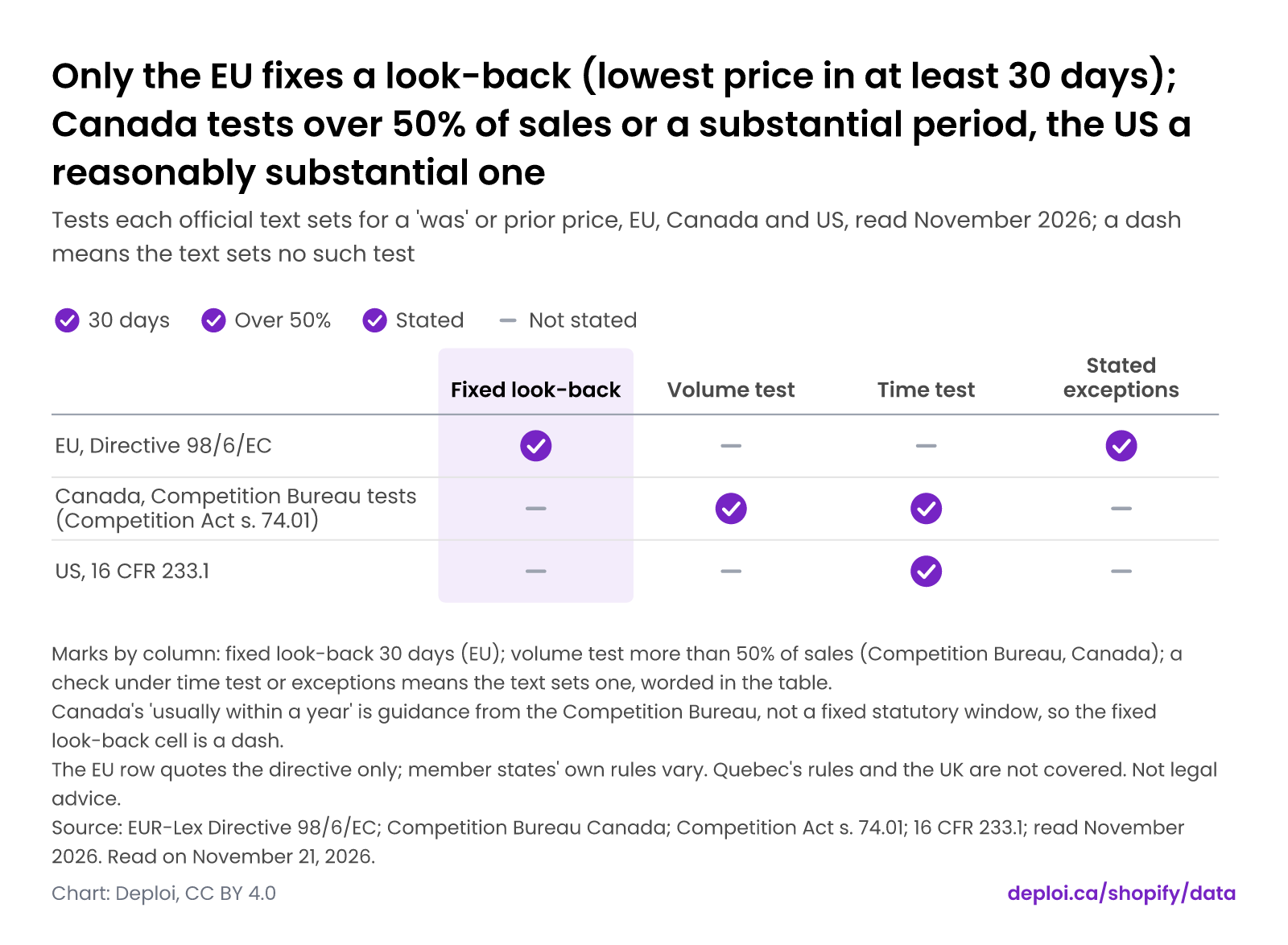
Only the EU fixes a look-back (lowest price in at least 30 days); Canada tests over 50% of sales or a substantial period, the US a reasonably substantial one
Tests each official text sets for a 'was' or prior price, EU, Canada and US, read November 2026; a dash means the text sets no such test
- Marks by column: fixed look-back 30 days (EU); volume test more than 50% of sales (Competition Bureau, Canada); a check under time test or exceptions means the text sets one, worded in the table.
- Canada's 'usually within a year' is guidance from the Competition Bureau, not a fixed statutory window, so the fixed look-back cell is a dash.
- The EU row quotes the directive only; member states' own rules vary. Quebec's rules and the UK are not covered. Not legal advice.
Source: EUR-Lex Directive 98/6/EC; Competition Bureau Canada; Competition Act s. 74.01; 16 CFR 233.1; read November 2026. Read on .
What is the EU rule for showing a 'was' price?
Article 6a of Directive 98/6/EC requires any announcement of a price reduction to show the prior price, defined as the lowest price the trader applied during a period not shorter than 30 days before the reduction, per the consolidated text of May 28, 2022 on EUR-Lex read on November 21, 2026.
The directive reads: "Any announcement of a price reduction shall indicate the prior price applied by the trader for a determined period of time prior to the application of the price reduction."
EUR-Lex states that the consolidated text is a documentation tool with no legal effect. Member States' own rules vary and are not covered here.
What are the exceptions to the EU 30-day rule?
Article 6a of Directive 98/6/EC lets Member States provide different rules for goods liable to deteriorate or expire rapidly, and a shorter period where a product has been on the market for less than 30 days, per the consolidated text read on November 21, 2026. It also covers progressive price reductions.
Where a price reduction is progressively increased, Member States may provide that the prior price is the price without the price reduction before the first application of the reduction.
These are options for Member States, so whether a given exception applies depends on the national law of the market a store sells into.
How does Canada test an ordinary selling price?
Canada's Competition Bureau says a sale's regular price must be a price the item is genuinely sold at, proven by one of two legal tests under subsections 74.01(2) and 74.01(3) of the Competition Act: more than 50% of sales at that price or higher, or a good-faith offer for a substantial period, per its page read November 21, 2026.
The volume test: more than 50% of sales of the product were at that price or higher within a reasonable period, usually within a year, before or after the promotion.
The time test: the product was offered for sale in good faith at that price or higher for a substantial period of time, usually within a year, immediately before or after the promotion.
The 50% share and the one-year window, "usually within a year", are the Bureau's guidance, not figures in the Act. The Act says "a substantial volume" sold "within a reasonable period of time", or an offer "in good faith for a substantial period of time". Neither test sets a fixed number of months.
What does the US federal guide say about former price comparisons?
The US Federal Trade Commission's Guides Against Deceptive Pricing, 16 CFR 233.1, say a former price is a legitimate basis for a price comparison if it was the actual, bona fide price at which the article was offered to the public on a regular basis for a reasonably substantial period of time, per the eCFR as of November 1, 2026.
The guide states no number of days or months and no sales-volume share, so the table shows those cells as not published.
The EU's minimum of 30 days is the only look-back in this comparison stated in days.
Which of these markets state a look-back period in days?
Only the EU states a look-back in days, at least 30 days under Article 6a of Directive 98/6/EC, per texts read on November 20 and 21, 2026. Canada's Competition Bureau tests are more than 50% of sales or a substantial period, usually within a year, and the US guide says a reasonably substantial period.
| Market | Rule | Look-back in days | Sales-volume test |
|---|---|---|---|
| EU, Directive 98/6/EC | Lowest price in the period before the reduction | at least 30 | not published |
| Canada, Competition Bureau tests (Competition Act s. 74.01) | Volume test or time test | not published | more than 50% of sales |
| US, 16 CFR 233.1 | Reasonably substantial period | not published | not published |
What do these rules not cover?
The page covers the EU directive's prior price rule, Canada's ordinary selling price tests and the US federal guide, as read on November 20 and 21, 2026. It does not cover the UK, Quebec's own rules or any EU Member State's national rules, and it is not legal advice.
The UK is not covered. Quebec's legislation site could not be captured.
Maximum penalties for misleading price claims are on the fake review and price claim penalties page.
The data
Each chart on this page is drawn from the numbers below. Units are in the column headers.
| Jurisdiction and text | Fixed look-back (days) | Volume test (% of sales) | Time test | Stated exceptions | Rule | Volume test | Time test | Exceptions |
|---|---|---|---|---|---|---|---|---|
| EU, Directive 98/6/EC | 30 days | Not stated | Not stated | Stated | Any announcement of a price reduction shall indicate the prior price applied by the trader for a determined period of time prior to the application of the price reduction. 2. The prior price means the lowest price applied by the trader during a period of time not shorter than 30 days prior to the application of the price reduction. | Member States may provide for different rules for goods which are liable to deteriorate or expire rapidly. 4. Where the product has been on the market for less than 30 days, Member States may also provide for a shorter period of time than the period specified in paragraph 2. 5. Member States may provide that, when the price reduction is progressively increased, the prior price is the price without the price reduction before the first application of the price reduction. | ||
| Canada, Competition Bureau tests (Competition Act s. 74.01) | Not stated | Over 50% | Stated | Not stated | When promoting a sale, the regular price must be a price the item is genuinely sold at, and businesses must be able to prove it. | Volume test: More than 50% of sales of the product were at that price or higher within a reasonable period (usually within a year) before or after the promotion; or | Time test: The product was offered for sale, in good faith, at that price or higher for a substantial period of time (usually within a year) immediately before or after the promotion. | |
| US, 16 CFR 233.1 | Not stated | Not stated | Stated | Not stated | If the former price is the actual, bona fide price at which the article was offered to the public on a regular basis for a reasonably substantial period of time, it provides a legitimate basis for the advertising of a price comparison. | If the former price is the actual, bona fide price at which the article was offered to the public on a regular basis for a reasonably substantial period of time, it provides a legitimate basis for the advertising of a price comparison. |
Download Rules for a 'was' price in a sale: the EU 30-day lowest price rule, Canada's ordinary selling price tests and the US federal guide, 2026 as CSV · All 14 columns on the dataset page
Methodology
Reading the chart: Only the EU fixes a look-back (lowest price in at least 30 days); Canada tests over 50% of sales or a substantial period, the US a reasonably substantial one
- Marks by column: fixed look-back 30 days (EU); volume test more than 50% of sales (Competition Bureau, Canada); a check under time test or exceptions means the text sets one, worded in the table.
- Canada's 'usually within a year' is guidance from the Competition Bureau, not a fixed statutory window, so the fixed look-back cell is a dash.
- The EU row quotes the directive only; member states' own rules vary. Quebec's rules and the UK are not covered. Not legal advice.
Caveats: Rules for a 'was' price in a sale: the EU 30-day lowest price rule, Canada's ordinary selling price tests and the US federal guide, 2026
- Not legal advice. Rules as the official texts state them on the capture date; Quebec's own rules and the UK are not covered.
- Text cells are verbatim; months are not converted to days anywhere.
- Competition Bureau Canada states a one-year window as guidance ('usually within a year'), not as a fixed statutory window, so no number of months is published for either test.
- The Canada row's tests are quoted from Competition Bureau Canada's explanation of subsections 74.01(2) and (3) of the Competition Act: 'More than 50%' and 'usually within a year' are the Bureau's wording. The Act itself says 'a substantial volume of the product at that price or a higher price within a reasonable period of time' and 'in good faith for a substantial period of time'.
- The EU row quotes the directive only; Member States' own rules vary, and EUR-Lex states that the consolidated text has no legal effect.
Deploi's charts and compilation are licensed CC BY 4.0. The underlying facts belong to their sources, which are named on every page. How Deploi Shopify Data works.
Sources
Tier A sources are primary documents: filings, official releases and official price pages. How sources are ranked.
- Tier AOrdinary selling price
Competition Bureau Canada · HTML · Read on
- Tier A16 CFR Part 233 Guides Against Deceptive Pricing (section 233.1 Former price comparisons)
U.S. Government (Electronic Code of Federal Regulations) · HTML · Read on
- Tier ADirective 98/6/EC on consumer protection in the indication of the prices of products offered to consumers, consolidated text of 28.05.2022 (Article 6a)
European Union (EUR-Lex) · HTML · Read on
- Tier ACompetition Act, R.S.C. 1985, c. C-34, full text
Department of Justice Canada · HTML · Read on
Cite and reuse
Deploi's charts and compilation are licensed CC BY 4.0. The underlying facts belong to their sources, which are named on every page.
APA
Deploi. (2026). How must a store prove a 'was' price when advertising a sale: the EU 30-day lowest price rule versus Canada's ordinary selling price tests? [Web page]. https://deploi.ca/shopify/data/was-price-rules-eu-canada-us Retrieved November 21, 2026.
BibTeX
@misc{deploi_was_price_rules_eu_canada_us_2026,
  author = {{Deploi}},
  title = {How must a store prove a 'was' price when advertising a sale: the EU 30-day lowest price rule versus Canada's ordinary selling price tests?},
  year = {2026},
  url = {https://deploi.ca/shopify/data/was-price-rules-eu-canada-us},
  note = {Accessed 2026-11-21}
}
Embed this chart
Embed code
<iframe src="https://deploi.ca/embed/shopify/data/reference-price-rules-matrix" title="Only the EU fixes a look-back (lowest price in at least 30 days); Canada tests over 50% of sales or a substantial period, the US a reasonably substantial one" loading="lazy" style="width:100%;height:440px;border:0"></iframe>
<p style="font:12px/1.4 Arial,sans-serif;margin:4px 0 0">Source: <a href="https://deploi.ca/shopify/data/charts/reference-price-rules-matrix">Deploi, Only the EU fixes a look-back (lowest price in at least 30 days); Canada tests over 50% of sales or a substantial period, the US a reasonably substantial one</a></p>
Keep the credit line under the embed. It is the license condition.
Downloads
- Chart: Only the EU fixes a look-back (lowest price in at least 30 days); Canada tests over 50% of sales or a substantial period, the US a reasonably substantial one PNG
- Data: Rules for a 'was' price in a sale: the EU 30-day lowest price rule, Canada's ordinary selling price tests and the US federal guide, 2026 CSV
Questions
Which price can a store show as the 'was' price in the EU?
The prior price shown must be the lowest price the trader applied during a period not shorter than 30 days before the reduction, under Article 6a of Directive 98/6/EC, per the consolidated text read on November 21, 2026.
What are Canada's ordinary selling price tests?
The Competition Bureau says a regular price must meet one of two legal tests: more than 50% of sales at that price or higher, or an offer in good faith at that price or higher for a substantial period, both usually within a year, per its page read on November 21, 2026.
Is there a fixed number of days for a 'was' price in Canada or the US?
No. Canada's one-year window is Competition Bureau guidance, "usually within a year", and the US guide at 16 CFR 233.1 says a reasonably substantial period, with no number, per sources read on November 20 and 21, 2026.
Does the EU 30-day rule have exceptions?
Yes, as options for Member States. They may provide different rules for goods liable to deteriorate or expire rapidly and a shorter period for products on the market for less than 30 days, per Article 6a of Directive 98/6/EC as read on November 21, 2026.
Does this page cover the UK or Quebec?
No. The page does not cover the UK, Quebec's own rules or any EU Member State's national rules. It covers Article 6a of Directive 98/6/EC, the Competition Bureau's tests under Canada's Competition Act and the US federal guide at 16 CFR 233.1, as read in November 2026.
More on Merchant benchmarks
- At what annual sales must an online store register for VAT or GST in the UK and New Zealand, and what is the low-value import line in each?
As the tax authorities state it on November 21, 2026, the UK threshold is £90,000 of taxable turnover for businesses, and New Zealand's NZ$60,000 applies to overseas sellers supplying low value goods of NZ$1,000 or less each to New Zealand consumers in 12 months. Updated November 21, 2026.
- How long does a shopper have to cancel an online order in the EU, UK, US, Ontario, Quebec and British Columbia, and how fast must the store refund?
As the official pages read on November 21, 2026 state it, the EU and UK give 14 days to cancel for any reason, while Ontario, Quebec and British Columbia give a store 15 days to refund. Updated November 21, 2026.
- What are the maximum penalties for fake reviews in the US, UK and Canada, and for misleading price claims in the UK and Canada?
As written on the pages read on November 20 and 21, 2026, the maximum is the higher of £300,000 or 10% of turnover in the UK, the greater of C$10 million or three times the benefit for a corporation's first violation in Canada, and $53,088 in the US under FTC Act section 5(m)(1)(A). Updated November 21, 2026.
- What do Gmail, Yahoo and Microsoft Outlook require of stores that send marketing email at volume?
Gmail and Outlook set bulk-sender rules above 5,000 messages a day, and Gmail and Yahoo both name a 0.3% spam rate and 2 days to honor unsubscribes, per provider pages read November 21, 2026. Updated November 21, 2026.
- What does it cost to ship a 1, 5 and 10 lb parcel to Zone 5 with UPS Ground and USPS Ground Advantage at 2026 list rates?
At 2026 list rates, a 1 lb parcel to Zone 5 costs $11.70 by USPS Ground Advantage retail and $14.10 by UPS Ground; at 10 lb UPS is cheaper, $20.46 against $24.25. FedEx is not covered. Updated November 21, 2026.
- What is Visa's interchange on online card payments in Canada and the US, and how do US and EU laws cap interchange?
Visa's Card Not Present consumer credit interchange is 1.40% to 2.40% in Canada and 1.89% to 2.04% plus US$0.10 on the two US card tiers covered, against a 0.3% EU credit cap, as read on November 21, 2026. Updated November 21, 2026.
Changes
- · Rules for a 'was' price in a sale: the EU 30-day lowest price rule, Canada's ordinary selling price tests and the US federal guide, 2026
First release. 3 rows, 10 fields read from 4 sources; each value agreed by extractor and verifier or ruled by the judge. Updated: 2 values changed. Restated: ca|competition-act-74-01.timeWindowMonths was 12, now None; ca|competition-act-74-01.volumeWindowMonths was 12, now None.