
Which markets do Canadian online retailers sell to: Canada only, the US, or further?
In 2023, 19.8% of Canadian retail trade enterprises with online sales sold to the United States, against 97.0% that sold in Canada, according to Statistics Canada. Updated October 18, 2026.
By Martin DejnickiUpdated
Short answer
Canadian online retailers sell mainly at home: 97.0% of retail trade enterprises with online sales sold to customers in Canada in 2023, against 19.8% to the United States, 3.2% to the European Union and 0.8% to the United Kingdom, according to Statistics Canada table 22-10-0125-01, released September 17, 2024. One enterprise can sell to several markets, so the shares do not add up.
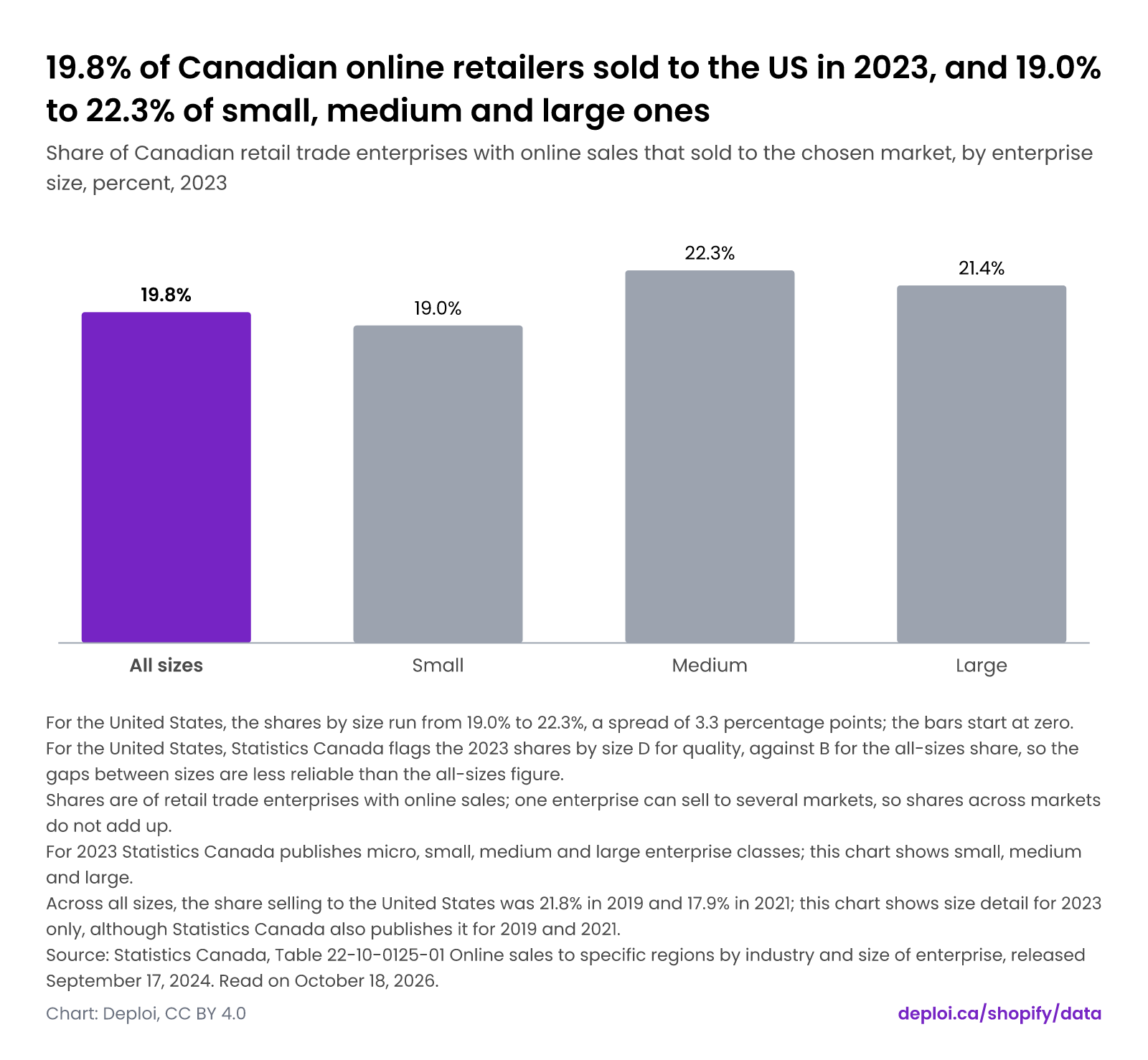
19.8% of Canadian online retailers sold to the US in 2023, and 19.0% to 22.3% of small, medium and large ones
Share of Canadian retail trade enterprises with online sales that sold to the chosen market, by enterprise size, percent, 2023
Canada: share of Canadian online retailers selling there, by size, 2023
In 2023, 97.0% of Canadian retailers with online sales sold to customers in Canada: 97.6% of small, 95.3% of medium and 95.7% of large enterprises.
Showing: Selling to: Canada. Reset
Share of Canadian online retailers selling to each market, all sizes, 2023
- United States
- 19.8%In 2023, 19.8% of Canadian retailers with online sales sold to the United States: 19.0% of small, 22.3% of medium and 21.4% of large enterprises.
- European Union
- 3.2%In 2023, 3.2% of Canadian retailers with online sales sold to the European Union: 3.8% of small, 1.9% of medium and 0.6% of large enterprises.
- United Kingdom
- 0.8%In 2023, 0.8% of Canadian retailers with online sales sold to the United Kingdom: 0.1% of small, 1.6% of medium and 8.4% of large enterprises.
- Canada
- 97.0%In 2023, 97.0% of Canadian retailers with online sales sold to customers in Canada: 97.6% of small, 95.3% of medium and 95.7% of large enterprises.
- For the United States, the shares by size run from 19.0% to 22.3%, a spread of 3.3 percentage points; the bars start at zero.
- For the United States, Statistics Canada flags the 2023 shares by size D for quality, against B for the all-sizes share, so the gaps between sizes are less reliable than the all-sizes figure.
- Shares are of retail trade enterprises with online sales; one enterprise can sell to several markets, so shares across markets do not add up.
- For 2023 Statistics Canada publishes micro, small, medium and large enterprise classes; this chart shows small, medium and large.
- Across all sizes, the share selling to the United States was 21.8% in 2019 and 17.9% in 2021; this chart shows size detail for 2023 only, although Statistics Canada also publishes it for 2019 and 2021.
Source: Statistics Canada, Table 22-10-0125-01 Online sales to specific regions by industry and size of enterprise, released September 17, 2024. Read on .
What this means for your decision
- Enabling US selling from day one? 19.8% of Canadian retail trade enterprises with online sales sold to the United States in 2023, against 97.0% that sold in Canada, according to Statistics Canada table 22-10-0125-01. Use it as a peer benchmark: about one in five sells to the US. The table counts enterprises and holds no sales values, so it does not show what US customers would add to one store's revenue.
- Judging by business size? In 2023, medium (22.3%) and large (21.4%) enterprises were only slightly more likely to sell to the US than small ones (19.0%), and Statistics Canada's 2019 and 2021 size rows put small enterprises ahead. The size pattern is not stable, so size alone says little about whether US selling fits a store.
- Reading the trend? The US share was 21.8% in 2019, 17.9% in 2021 and 19.8% in 2023. With only three reference years, treat it as a range, not a trend.
- Choosing between the US, Europe and the UK? In 2023, 3.2% sold to the European Union and 0.8% to the United Kingdom, though 8.4% of large enterprises sold to the UK. The US is by far the most common foreign market among Canadian online retailers; one enterprise can sell to several markets, so the shares do not add up.
- Setting up US selling on a Shopify store? For help with cross-border pricing, shipping and checkout, contact Deploi.
Has the share selling to the United States changed?
Across all enterprise sizes, 21.8% of Canadian retail trade enterprises with online sales sold to the United States in 2019, 17.9% in 2021 and 19.8% in 2023, according to Statistics Canada table 22-10-0125-01, released September 17, 2024. The reference years are 2019, 2021 and 2023; Statistics Canada publishes size detail for all three, and this page shows 2023.
The share selling to customers in Canada stayed close to 97%: 96.9% in 2019, 96.3% in 2021 and 97.0% in 2023.
Do Canadian online retailers sell to Europe?
Few Canadian online retailers sell to Europe: 3.2% of retail trade enterprises with online sales sold to the European Union and 0.8% to the United Kingdom in 2023, according to Statistics Canada table 22-10-0125-01. Large enterprises were the most likely to sell to the United Kingdom, at 8.4%, against 0.1% of small enterprises.
For the European Union the order reverses: 3.8% of small enterprises sold there in 2023, against 1.9% of medium and 0.6% of large enterprises. Across all sizes, the European Union share was 5.6% in 2019 and 4.3% in 2021, and the United Kingdom share was 5.8% in 2019 and 3.5% in 2021.
Should a Canadian store enable selling to the United States from day one?
About one in five Canadian retail trade enterprises with online sales sold to the United States in 2023 (19.8%), and 97.0% sold in Canada, according to Statistics Canada table 22-10-0125-01. The table counts enterprises and holds no sales values, so it does not show how much revenue US customers add. The shares inform the choice and do not settle it.
In 2023, medium enterprises (22.3%) and large enterprises (21.4%) were slightly more likely to sell to the United States than small ones (19.0%). Statistics Canada's 2019 and 2021 size rows put small enterprises ahead. For the cost of crossing the border, see duties and taxes on parcels into Canada, which covers parcels entering Canada only.
What does "sold to" count in this table?
The table counts retail trade enterprises with online sales that sold to a region, and holds no sales values, according to Statistics Canada table 22-10-0125-01, released September 17, 2024. This page shows Statistics Canada's small, medium and large classes; for 2023 the table also has a micro-size class. The reference years are 2019, 2021 and 2023, and 2023 is the latest year in the table.
Shares are of enterprises with online sales, not of all retailers. An enterprise that sells to the United States and to Canada counts in both shares.
The data
Each chart on this page is drawn from the numbers below. Units are in the column headers.
| Enterprise size | Sells to Canada (%) | Sells to the United States (%) | Sells to the European Union (%) | Sells to the United Kingdom (%) |
|---|---|---|---|---|
| All sizes | 97.0 | 19.8 | 3.2 | 0.8 |
| Small | 97.6 | 19.0 | 3.8 | 0.1 |
| Medium | 95.3 | 22.3 | 1.9 | 1.6 |
| Large | 95.7 | 21.4 | 0.6 | 8.4 |
Download Share of Canadian retailers selling online to each region, by size, 2019 to 2023 as CSV · All 7 columns on the dataset page
Methodology
Reading the chart: 19.8% of Canadian online retailers sold to the US in 2023, and 19.0% to 22.3% of small, medium and large ones
- For the United States, the shares by size run from 19.0% to 22.3%, a spread of 3.3 percentage points; the bars start at zero.
- For the United States, Statistics Canada flags the 2023 shares by size D for quality, against B for the all-sizes share, so the gaps between sizes are less reliable than the all-sizes figure.
- Shares are of retail trade enterprises with online sales; one enterprise can sell to several markets, so shares across markets do not add up.
- For 2023 Statistics Canada publishes micro, small, medium and large enterprise classes; this chart shows small, medium and large.
- Across all sizes, the share selling to the United States was 21.8% in 2019 and 17.9% in 2021; this chart shows size detail for 2023 only, although Statistics Canada also publishes it for 2019 and 2021.
Caveats: Share of Canadian retailers selling online to each region, by size, 2019 to 2023
- Shares are of retail trade enterprises with online sales. One enterprise can sell to several markets, so shares across markets do not add up.
- The table counts enterprises and holds no sales values.
- This dataset holds the size breakdown for 2023 only; Statistics Canada's table also gives it for 2019 and 2021. Size groups are Statistics Canada's small, medium and large enterprise classes; the micro-size class is not included.
- For the United States, Statistics Canada flags the 2023 shares by size D for quality (E for micro-size enterprises), against B for all sizes, so the gaps between sizes are less reliable than the all-sizes figure. For the other markets the 2023 size shares carry flags from A to D.
- The reference years are 2019, 2021 and 2023, and 2023 is the latest year in the table.
Deploi's charts and compilation are licensed CC BY 4.0. The underlying facts belong to their sources, which are named on every page. How Deploi Shopify Data works.
Sources
Tier A sources are primary documents: filings, official releases and official price pages. How sources are ranked.
Cite and reuse
Deploi's charts and compilation are licensed CC BY 4.0. The underlying facts belong to their sources, which are named on every page.
APA
Deploi. (2026). Which markets do Canadian online retailers sell to: Canada only, the US, or further? [Web page]. https://deploi.ca/shopify/data/canada-online-sales-by-destination Retrieved October 18, 2026.
BibTeX
@misc{deploi_canada_online_sales_by_destination_2026,
  author = {{Deploi}},
  title = {Which markets do Canadian online retailers sell to: Canada only, the US, or further?},
  year = {2026},
  url = {https://deploi.ca/shopify/data/canada-online-sales-by-destination},
  note = {Accessed 2026-10-18}
}
Embed this chart
Embed code
<iframe src="https://deploi.ca/embed/shopify/data/canada-retailers-selling-to-us" title="19.8% of Canadian online retailers sold to the US in 2023, and 19.0% to 22.3% of small, medium and large ones" loading="lazy" style="width:100%;height:680px;border:0"></iframe>
<p style="font:12px/1.4 Arial,sans-serif;margin:4px 0 0">Source: <a href="https://deploi.ca/shopify/data/canada-online-sales-by-destination#chart-canada-retailers-selling-to-us">Deploi, 19.8% of Canadian online retailers sold to the US in 2023, and 19.0% to 22.3% of small, medium and large ones</a></p>
Keep the credit line under the embed. It is the license condition.
Questions
What percentage of Canadian online retailers sell to the US?
19.8% of Canadian retail trade enterprises with online sales sold to the United States in 2023, against 21.8% in 2019 and 17.9% in 2021, according to Statistics Canada table 22-10-0125-01, released September 17, 2024. One enterprise can sell to several markets.
Do most Canadian online retailers sell abroad?
No. In 2023, 97.0% of Canadian retail trade enterprises with online sales sold to customers in Canada, and 19.8% to the United States, 3.2% to the European Union and 0.8% to the United Kingdom, according to Statistics Canada table 22-10-0125-01. Most sold to none of the three foreign regions.
Are larger Canadian retailers more likely to sell to the US?
In 2023, slightly: 22.3% of medium and 21.4% of large Canadian retail trade enterprises with online sales sold to the United States, against 19.0% of small ones, according to Statistics Canada table 22-10-0125-01. The same table's 2019 and 2021 rows, not held in this dataset, put small enterprises ahead, at 24.6% and 20.4%, so the size pattern is not stable.
What share of Canadian online retailers sell to the United Kingdom?
0.8% of Canadian retail trade enterprises with online sales sold to the United Kingdom in 2023, according to Statistics Canada table 22-10-0125-01, released September 17, 2024. The share was 8.4% for large enterprises and 0.1% for small ones.
Does this table show how much Canadian retailers sell abroad?
No. Statistics Canada table 22-10-0125-01 counts the share of retail trade enterprises with online sales that sold to each region in 2019, 2021 and 2023. It holds no sales values, so it does not show how much revenue each market brings in.
More on Canada
- At what value do duties and taxes apply to a parcel shipped into Canada, by origin country?
Courier parcels from the US or Mexico enter Canada free of duty and tax up to C$40, and parcels from other origins up to C$20, according to the Canada Border Services Agency. Updated October 18, 2026.
- How big is Canadian retail ecommerce, and what share of retail sales is online?
Retail ecommerce was 7.0% of Canada's retail sales in 2025, or C$59.2 billion, according to Statistics Canada's monthly retail trade data released September 24, 2026. Updated October 18, 2026.
- How large is the Quebec market compared with the rest of Canada, and does it justify a French storefront?
Quebec accounted for 22.2% of Canada's retail sales in 2025, second to Ontario, according to Statistics Canada, and 74.8% of its residents had French as their only mother tongue in the 2021 Census. Updated October 18, 2026.
- How much have courier prices in Canada risen since 2019?
Canada's courier and messenger price index rose from 99.1 in January 2019 to 160.5 in August 2026, a rise of 62.0% computed by Deploi from Statistics Canada data. Updated October 18, 2026.
- Is Shopify growing faster in Canada than Canadian ecommerce is?
Shopify's revenue from Canada grew 46.1% in US dollars from fiscal 2023 to 2025, against 31.4% in Canadian dollars for Canadian retail ecommerce, according to Shopify's Form 10-K and Statistics Canada. Updated October 18, 2026.
- When in the year do Canadians shop online, and how big is the November-December peak?
November and December brought in 21.5% of Canada's retail ecommerce sales in 2025, according to Statistics Canada monthly data released September 24, 2026. Updated October 18, 2026.
Changes
- · Share of Canadian retailers selling online to each region, by size, 2019 to 2023
First release on October 18, 2026.