
Does a small cosmetics brand have to register its facility and list or notify its products in the US, the EU and Canada?
A cosmetics business under the US small-business sales limit of $1,000,000, adjusted for inflation, is not subject to facility registration or product listing unless it manufactures or processes the products described in 21 U.S.C. 364h(b), but it still reports serious adverse events. The EU and Canadian texts read set no small-business exemption. Updated November 21, 2026.
By Martin DejnickiUpdated Data through November 21, 2026
Short answer
A cosmetics business with average gross annual US cosmetics sales under $1,000,000, adjusted for inflation, over the previous 3 years is not subject to facility registration or product listing under 21 U.S.C. 364h (2024 edition), unless it manufactures or processes the products described in 364h(b). It still reports serious adverse events within 15 business days of receiving a report. The EU and Canadian texts, read November 21, 2026, set no small-business exemption.
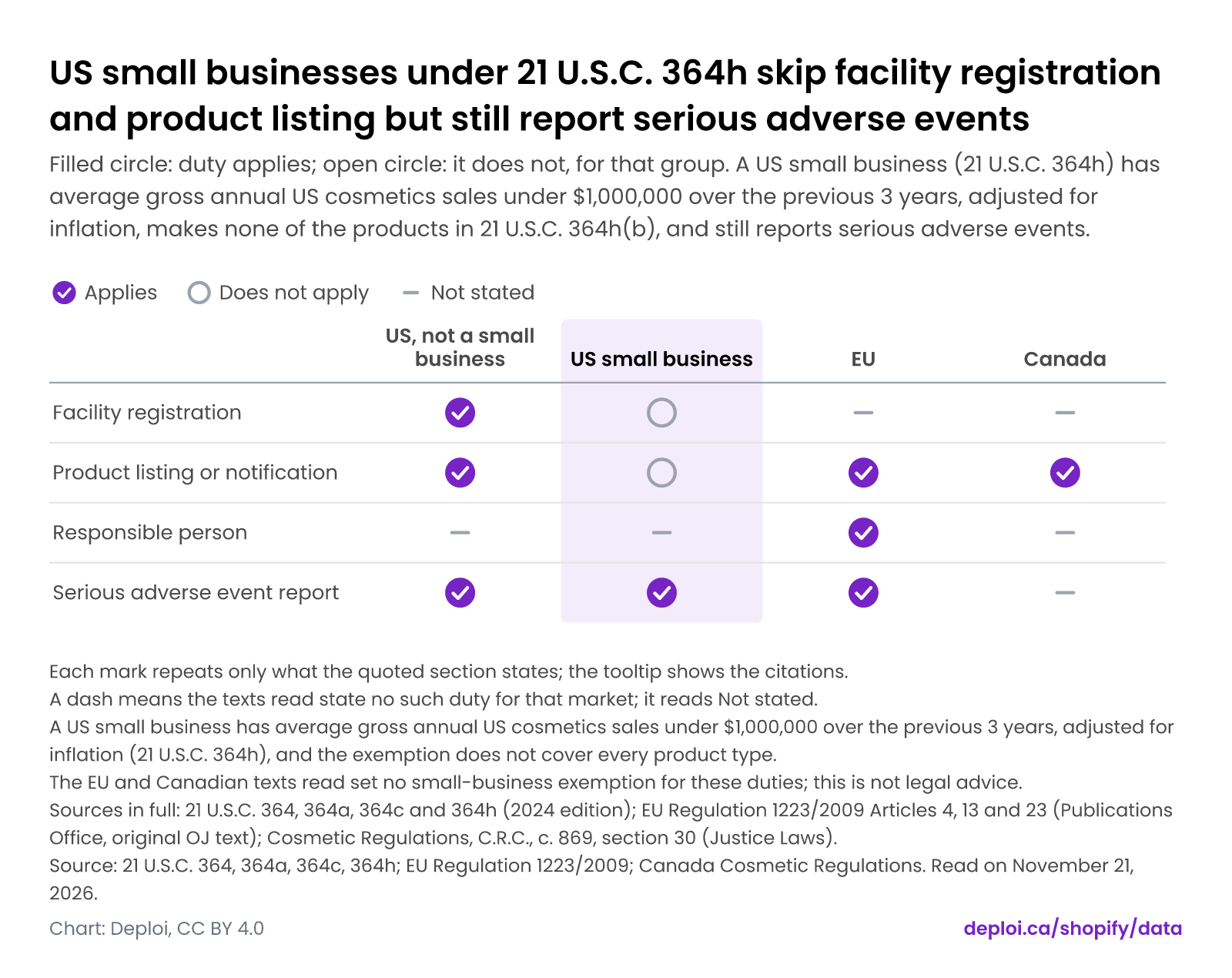
US small businesses under 21 U.S.C. 364h skip facility registration and product listing but still report serious adverse events
Filled circle: duty applies; open circle: it does not, for that group. A US small business (21 U.S.C. 364h) has average gross annual US cosmetics sales under $1,000,000 over the previous 3 years, adjusted for inflation, makes none of the products in 21 U.S.C. 364h(b), and still reports serious adverse events.
- Each mark repeats only what the quoted section states; the tooltip shows the citations.
- A dash means the texts read state no such duty for that market; it reads Not stated.
- A US small business has average gross annual US cosmetics sales under $1,000,000 over the previous 3 years, adjusted for inflation (21 U.S.C. 364h), and the exemption does not cover every product type.
- The EU and Canadian texts read set no small-business exemption for these duties; this is not legal advice.
- Sources in full: 21 U.S.C. 364, 364a, 364c and 364h (2024 edition); EU Regulation 1223/2009 Articles 4, 13 and 23 (Publications Office, original OJ text); Cosmetic Regulations, C.R.C., c. 869, section 30 (Justice Laws).
Source: 21 U.S.C. 364, 364a, 364c, 364h; EU Regulation 1223/2009; Canada Cosmetic Regulations. Read on .
Does a small cosmetics brand have to register its facility and list its products in the US?
Not if it is a small business under 21 U.S.C. 364h. Otherwise, under 21 U.S.C. 364c in the 2024 edition of the US Code, the owner or operator of each facility that manufactures or processes cosmetics for distribution in the United States must register it. The responsible person must list each product, and registration must be renewed every 2 years.
The statute counts each deadline from the activity that triggers it. A facility that first engages in manufacturing or processing after December 29, 2022 registers within 60 days of first engaging in it. A product first marketed after that date is listed within 120 days of marketing in interstate commerce, as 21 U.S.C. 364c states.
What size of cosmetics business is exempt in the US?
To be exempt from registration and listing as a small business under 21 U.S.C. 364h (2024 edition), a business must have average gross annual US cosmetics sales under $1,000,000, adjusted for inflation, over the previous 3-year period. It also must not manufacture or process the products described in subsection (b).
The statute states the limit as "less than $1,000,000, adjusted for inflation", and the text read does not state the adjusted amount. The exemption does not apply to a business engaged in manufacturing or processing the cosmetic products described in 21 U.S.C. 364h(b). This page does not list those product types, so read 364h(b) itself before relying on the exemption.
Does a small US cosmetics business still have to report adverse events?
Yes. 21 U.S.C. 364a requires the responsible person to submit to the Secretary any report it receives of a serious adverse event, with a copy of the label, no later than 15 business days after receipt, and 364h does not remove the duty for small businesses, per the 2024 edition of the US Code.
Small businesses are not exempted from this duty. The statute's record-keeping rules for adverse event reports are not covered here.
What does a cosmetics brand have to do in the EU?
Regulation (EC) No 1223/2009, in the original text read on November 21, 2026, requires a responsible person designated within the Community for each cosmetic product placed on the market, and that person must submit a notification electronically to the Commission before the product is placed on the market (Articles 4 and 13). The responsible person and distributors must also notify serious undesirable effects without delay (Article 23).
The texts read set no small-business exemption for these duties. The Regulation is read in its original 2009 text; later amendments are not reflected. The data does not state a facility registration duty in the EU text read, so that cell is empty and shown as not stated.
What does a cosmetics brand have to do in Canada?
Under section 30 of the Cosmetic Regulations (C.R.C., c. 869), every manufacturer and importer must provide the Minister with the listed documents at the latest 10 days after first selling a cosmetic, per the regulations as read on November 21, 2026. Canada's deadline falls after the first sale, not before it.
The Cosmetic Regulations text read sets no small-business exemption for this duty. It states no facility registration, responsible person or serious adverse event report duty, so those cells are empty and shown as not stated. Other Canadian laws are not covered.
How do the three markets compare for a small brand?
A US small business under 21 U.S.C. 364h skips registration and listing but not adverse event reporting, while the EU and Canada apply their duties with no small-business exemption in the texts read on November 21, 2026. The US sets a 15 business day report deadline, the EU a responsible person and a prior notification, and Canada a 10 day notification after first sale.
| Duty | US, not a small business | US small business | EU | Canada |
|---|---|---|---|---|
| Facility registration | Applies | Does not apply | Not stated | Not stated |
| Product listing or notification | Applies | Does not apply | Applies | Applies |
| Responsible person | Not stated | Not stated | Applies | Not stated |
| Serious adverse event report | Applies | Applies | Applies | Not stated |
Each cell repeats only what the quoted section states. The US defines a responsible person (21 U.S.C. 364(4)) but the sections read state no duty to designate one. The United Kingdom is not covered. This is not legal advice.
The data
Each chart on this page is drawn from the numbers below. Units are in the column headers.
| Duty | US, not a small business (yes or no) | US small business (yes or no) | EU (yes or no) | Canada (yes or no) | Sections cited | Canada notification deadline (days after first sale) | US serious adverse event deadline (business days) | US registration renewal (years) |
|---|---|---|---|---|---|---|---|---|
| Facility registration | Applies | Does not apply | Not stated | Not stated | 21 U.S.C. 364c(a); 21 U.S.C. 364h(a) | Not stated | Not stated | 2 |
| Product listing or notification | Applies | Does not apply | Applies | Applies | 21 U.S.C. 364c(c); 21 U.S.C. 364h(a); Regulation (EC) No 1223/2009 Art. 13; C.R.C., c. 869 s. 30 | 10 | Not stated | Not stated |
| Responsible person | Not stated | Not stated | Applies | Not stated | Regulation (EC) No 1223/2009 Art. 4; 21 U.S.C. 364(4) | Not stated | Not stated | Not stated |
| Serious adverse event report | Applies | Applies | Applies | Not stated | 21 U.S.C. 364a(a)-(b); 21 U.S.C. 364h(a); Regulation (EC) No 1223/2009 Art. 23 | Not stated | 15 | Not stated |
Download Cosmetics registration, product listing or notification, responsible person and adverse event duties in the US, the EU and Canada, with the US small-business exemption as CSV · All 16 columns on the dataset page
Methodology
Reading the chart: US small businesses under 21 U.S.C. 364h skip facility registration and product listing but still report serious adverse events
- Each mark repeats only what the quoted section states; the tooltip shows the citations.
- A dash means the texts read state no such duty for that market; it reads Not stated.
- A US small business has average gross annual US cosmetics sales under $1,000,000 over the previous 3 years, adjusted for inflation (21 U.S.C. 364h), and the exemption does not cover every product type.
- The EU and Canadian texts read set no small-business exemption for these duties; this is not legal advice.
- Sources in full: 21 U.S.C. 364, 364a, 364c and 364h (2024 edition); EU Regulation 1223/2009 Articles 4, 13 and 23 (Publications Office, original OJ text); Cosmetic Regulations, C.R.C., c. 869, section 30 (Justice Laws).
Caveats: Cosmetics registration, product listing or notification, responsible person and adverse event duties in the US, the EU and Canada, with the US small-business exemption
- The US small-business exemption does not cover every product type: 21 U.S.C. 364h(b) lists the product types excluded from it, and this dataset does not list them; only the exemption text of 364h(a) is quoted.
- The EU and Canadian texts read set no small-business exemption for these duties; the page says only what the texts state.
- Regulation (EC) No 1223/2009 is read in its original 2009 text; later amendments are not reflected.
- A yes or no cell repeats only what the quoted section states; an empty cell means the text read states no such duty and is shown as not stated.
- The US defines a responsible person (21 U.S.C. 364(4)) but the sections read state no duty to designate one; the US responsible-person cells are shown as not stated.
- The sales limit is the quoted statute's figure, adjusted for inflation; the dataset states the unadjusted $1,000,000.
- The United Kingdom is not covered.
- Rules are quoted from the official text with the publisher named; this is not legal advice.
Deploi's charts and compilation are licensed CC BY 4.0. The underlying facts belong to their sources, which are named on every page. How Deploi Shopify Data works.
Sources
Tier A sources are primary documents: filings, official releases and official price pages. How sources are ranked.
- Tier ARegulation (EC) No 1223/2009 on cosmetic products (OJ L 342, 22.12.2009, original text, Publications Office Cellar)
Publications Office of the European Union · HTML · Read on
- Tier A21 U.S.C. 364, cosmetics definitions (adverse event, responsible person, serious adverse event), United States Code 2024 Edition
U.S. Government Publishing Office (govinfo) · HTML · Read on
- Tier A21 U.S.C. 364a, United States Code 2024 Edition (cosmetics)
U.S. Government Publishing Office (govinfo) · HTML · Read on
- Tier A21 U.S.C. 364c, United States Code 2024 Edition (cosmetics)
U.S. Government Publishing Office (govinfo) · HTML · Read on
- Tier A21 U.S.C. 364h, United States Code 2024 Edition (cosmetics)
U.S. Government Publishing Office (govinfo) · HTML · Read on
- Tier ACosmetic Regulations, C.R.C., c. 869, full text
Department of Justice Canada · HTML · Read on
Cite and reuse
Deploi's charts and compilation are licensed CC BY 4.0. The underlying facts belong to their sources, which are named on every page.
APA
Deploi. (2026). Does a small cosmetics brand have to register its facility and list or notify its products in the US, the EU and Canada? [Web page]. https://deploi.ca/shopify/data/cosmetics-registration-us-eu-canada Retrieved November 21, 2026.
BibTeX
@misc{deploi_cosmetics_registration_us_eu_canada_2026,
  author = {{Deploi}},
  title = {Does a small cosmetics brand have to register its facility and list or notify its products in the US, the EU and Canada?},
  year = {2026},
  url = {https://deploi.ca/shopify/data/cosmetics-registration-us-eu-canada},
  note = {Accessed 2026-11-21}
}
Embed this chart
Embed code
<iframe src="https://deploi.ca/embed/shopify/data/cosmetics-duties-by-market" title="US small businesses under 21 U.S.C. 364h skip facility registration and product listing but still report serious adverse events" loading="lazy" style="width:100%;height:490px;border:0"></iframe>
<p style="font:12px/1.4 Arial,sans-serif;margin:4px 0 0">Source: <a href="https://deploi.ca/shopify/data/charts/cosmetics-duties-by-market">Deploi, US small businesses under 21 U.S.C. 364h skip facility registration and product listing but still report serious adverse events</a></p>
Keep the credit line under the embed. It is the license condition.
Downloads
- Chart: US small businesses under 21 U.S.C. 364h skip facility registration and product listing but still report serious adverse events PNG
- Data: Cosmetics registration, product listing or notification, responsible person and adverse event duties in the US, the EU and Canada, with the US small-business exemption CSV
Questions
Do small cosmetics companies have to register with the FDA?
Not if they are small businesses under 21 U.S.C. 364h, with average gross annual US cosmetics sales under $1,000,000 over the previous 3 years, adjusted for inflation, per the 2024 edition of the US Code. The exemption does not apply to a business that manufactures or processes the products described in 364h(b), and small businesses still report serious adverse events.
What is the US small business limit for cosmetics?
$1,000,000 in average gross annual US sales of cosmetic products over the previous 3-year period, adjusted for inflation, per 21 U.S.C. 364h in the 2024 edition of the US Code, which does not state the adjusted amount. Businesses that manufacture or process the products described in subsection (b) are excluded.
Does a small cosmetics brand still have to report serious adverse events in the US?
Yes. The responsible person must submit any serious adverse event report it receives no later than 15 business days after receipt, per 21 U.S.C. 364a in the 2024 edition of the US Code, and small businesses are not exempted from this duty.
Do I have to notify cosmetic products before selling them in the EU?
Yes. Under Regulation (EC) No 1223/2009 Article 13, in the original text read November 21, 2026, the responsible person submits a notification electronically to the Commission before placing the product on the market. Article 4 requires a responsible person designated within the Community.
When must a cosmetic be notified in Canada?
At the latest 10 days after the manufacturer or importer first sells it, under section 30 of the Cosmetic Regulations (C.R.C., c. 869), as read on November 21, 2026. The text sets no small-business exemption.
More on Merchant benchmarks
- At what annual sales must an online store register for VAT or GST in the UK and New Zealand, and what is the low-value import line in each?
As the tax authorities state it on November 21, 2026, the UK threshold is £90,000 of taxable turnover for businesses, and New Zealand's NZ$60,000 applies to overseas sellers supplying low value goods of NZ$1,000 or less each to New Zealand consumers in 12 months. Updated November 21, 2026.
- How long does a shopper have to cancel an online order in the EU, UK, US, Ontario, Quebec and British Columbia, and how fast must the store refund?
As the official pages read on November 21, 2026 state it, the EU and UK give 14 days to cancel for any reason, while Ontario, Quebec and British Columbia give a store 15 days to refund. Updated November 21, 2026.
- How long must a store stand behind a faulty product in the EU, the UK and the US?
EU sellers are liable for faults that appear within at least two years of delivery under Directive (EU) 2019/771, and the UK Consumer Rights Act 2015 gives a 30-day short-term right to reject faulty goods. US federal texts set no minimum period and state $15 and $10 price thresholds for written warranty rules. Updated November 21, 2026.
- How much of revenue do public online retailers spend on advertising, and how much gross margin is left after it?
Eight public online retailers spent between 6.5% and 29.7% of revenue on advertising or marketing in fiscal 2025, computed by Deploi from SEC 10-K facts. Updated November 21, 2026.
- How must a store prove a 'was' price when advertising a sale: the EU 30-day lowest price rule versus Canada's ordinary selling price tests?
The EU sets a look-back of at least 30 days for the prior price; Canada's Competition Bureau tests more than 50% of sales or a substantial period, usually within a year; the US guide says a reasonably substantial period, per texts read November 2026. Updated November 21, 2026.
- What are the maximum penalties for fake reviews in the US, UK and Canada, and for misleading price claims in the UK and Canada?
As written on the pages read on November 20 and 21, 2026, the maximum is the higher of £300,000 or 10% of turnover in the UK, the greater of C$10 million or three times the benefit for a corporation's first violation in Canada, and $53,088 in the US under FTC Act section 5(m)(1)(A). Updated November 21, 2026.
Changes
- · Cosmetics registration, product listing or notification, responsible person and adverse event duties in the US, the EU and Canada, with the US small-business exemption
First release. 5 rows read from 6 sources; each value agreed by extractor and verifier or ruled by the judge.