
How long must a store stand behind a faulty product in the EU, the UK and the US?
EU sellers are liable for faults that appear within at least two years of delivery under Directive (EU) 2019/771, and the UK Consumer Rights Act 2015 gives a 30-day short-term right to reject faulty goods. US federal texts set no minimum period and state $15 and $10 price thresholds for written warranty rules. Updated November 21, 2026.
By Martin DejnickiUpdated Data through November 21, 2026
Short answer
The EU makes sellers liable for faults that appear within at least two years of delivery under Directive (EU) 2019/771, and the UK Consumer Rights Act 2015 gives a 30-day short-term right to reject and, for some purposes, presumes faults in the first six months existed at delivery. The US federal texts read on November 21, 2026 set no minimum period and state $15 and $10 price thresholds for written warranty rules.
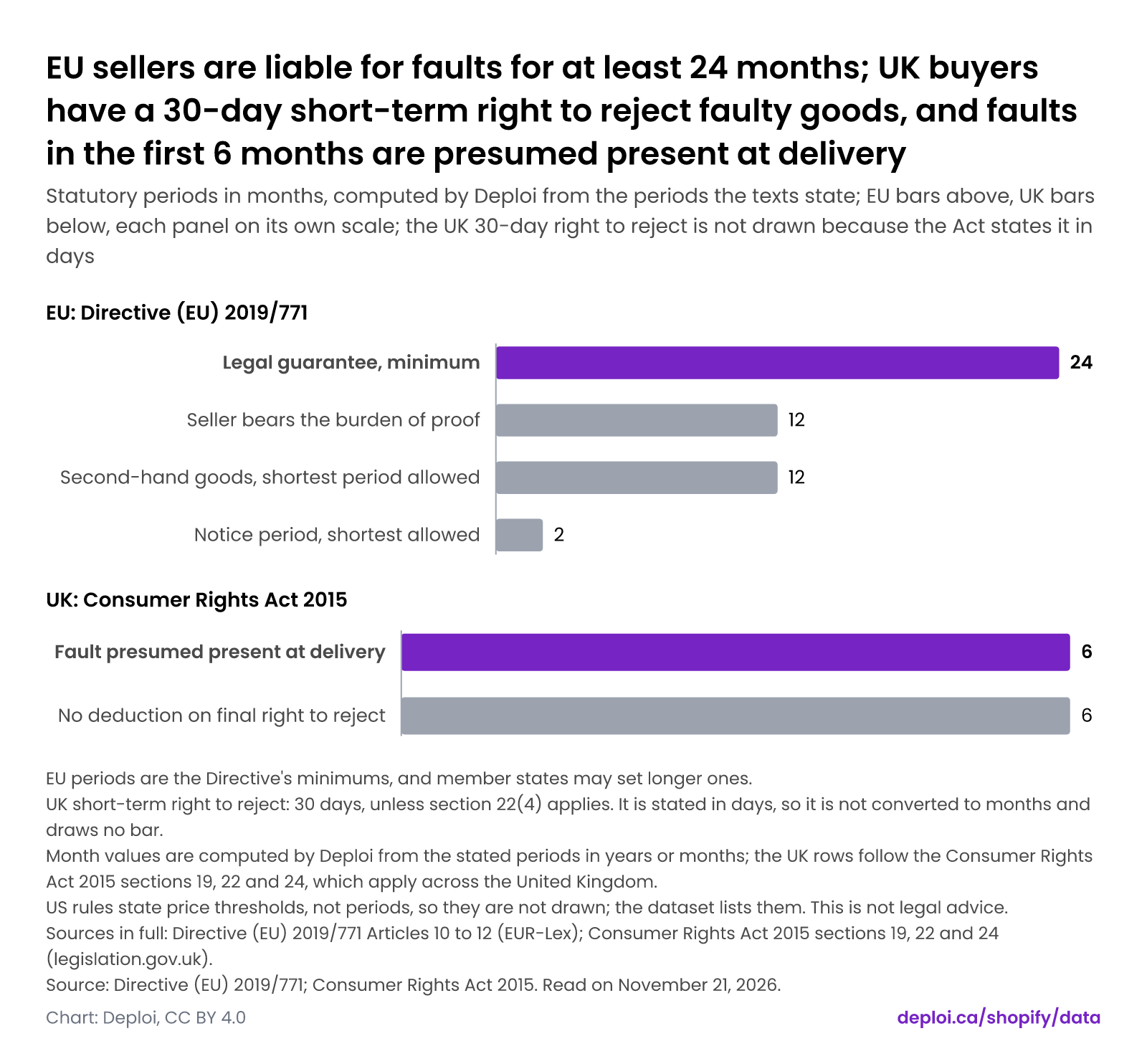
EU sellers are liable for faults for at least 24 months; UK buyers have a 30-day short-term right to reject faulty goods, and faults in the first 6 months are presumed present at delivery
Statutory periods in months, computed by Deploi from the periods the texts state; EU bars above, UK bars below, each panel on its own scale; the UK 30-day right to reject is not drawn because the Act states it in days
EU: Directive (EU) 2019/771
UK: Consumer Rights Act 2015
- EU periods are the Directive's minimums, and member states may set longer ones.
- UK short-term right to reject: 30 days, unless section 22(4) applies. It is stated in days, so it is not converted to months and draws no bar.
- Month values are computed by Deploi from the stated periods in years or months; the UK rows follow the Consumer Rights Act 2015 sections 19, 22 and 24, which apply across the United Kingdom.
- US rules state price thresholds, not periods, so they are not drawn; the dataset lists them. This is not legal advice.
- Sources in full: Directive (EU) 2019/771 Articles 10 to 12 (EUR-Lex); Consumer Rights Act 2015 sections 19, 22 and 24 (legislation.gov.uk).
Source: Directive (EU) 2019/771; Consumer Rights Act 2015. Read on .
How long is an EU seller liable for faulty goods?
An EU seller is liable for faults present at delivery that become apparent within at least two years, or 24 months computed by Deploi, under Article 10(1) of Directive (EU) 2019/771, read on EUR-Lex on November 21, 2026. A fault that becomes apparent within one year is presumed to have existed at delivery unless proved otherwise (Article 11(1)). Member states may set longer periods.
The Directive's periods are minimums. The Article 11(1) presumption does not apply where it is incompatible with the nature of the goods or of the fault. Article 10(6) lets member states allow a shorter agreed period for second-hand goods, of not less than one year. Article 12 lets member states require the consumer to notify the seller within a period of at least 2 months of detecting the fault.
| EU rule | Period | In months, computed by Deploi | Citation |
|---|---|---|---|
| Legal guarantee, minimum | 2 years | 24 | Article 10(1) |
| Seller bears the burden of proof | 1 year | 12 | Article 11(1) |
| Second-hand goods, shortest period allowed | 1 year | 12 | Article 10(6) |
| Notice period, shortest allowed | 2 months | 2 | Article 12 |
What are the UK periods for rejecting faulty goods?
The UK short-term right to reject faulty goods runs for 30 days under section 22(3) of the Consumer Rights Act 2015, as up to date on November 21, 2026 on legislation.gov.uk, unless section 22(4) applies. For the purposes of section 19(3)(b) and (c) and (4), goods that do not conform within six months of delivery are taken not to have conformed on the day of delivery (section 19(14)).
No deduction may be made if the final right to reject is exercised in the first 6 months, unless an exception in section 24(10) applies (section 24(10) and (11)). The dataset has no UK row for how long after delivery a claim may be brought.
What does US federal law require of written warranties?
US federal law requires the terms of a written warranty to be available before sale for consumer products costing more than $15.00 (16 CFR 702.3, eCFR as of November 1, 2026), and applies the full or limited designation rule to products costing more than $10 (15 U.S.C. 2303(d), 2024 edition). The texts read set no minimum guarantee period.
Under 15 U.S.C. 2308(b), implied warranties may be limited in duration to the duration of a written warranty of reasonable duration. The limitation must be conscionable, set out in clear and unmistakable language and prominently displayed on the face of the warranty. The rule applies for the purposes of the chapter other than section 2304(a)(2).
Under 16 CFR 702.3(a), except as paragraphs (c) through (d) provide, a seller of a consumer product with a written warranty must make the warranty text available before sale. The seller can display it close to the product, or furnish it on request and post signs advising buyers it is available. Either can be done through electronic or other means if the warrantor has elected the option in paragraph (b)(2). The dataset does not quote paragraphs (b)(2), (c) or (d).
Why do the US rules state both a $15 and a $10 threshold?
The two thresholds belong to different rules. The $15 threshold in 16 CFR 702.3 (eCFR as of November 1, 2026) governs when a seller must make the text of a written warranty available before sale, and the $10 threshold in 15 U.S.C. 2303(d) (2024 edition) governs when the full or limited designation duty applies. The page does not average or merge them.
Section 2303(d) applies subsections (a) and (c) only to warranties on consumer products actually costing the consumer more than $10 and not designated "full (statement of duration) warranties".
| US rule | Price threshold | Citation |
|---|---|---|
| Pre-sale availability of warranty terms | more than $15.00 | 16 CFR 702.3 |
| Full or limited warranty designation | more than $10 | 15 U.S.C. 2303(d) |
| Implied warranty duration limit | no amount stated | 15 U.S.C. 2308(b) |
What does this faulty goods comparison leave out?
Canada is not covered, because Quebec's legal warranty text was not reachable, and change-of-mind returns are not covered. The page covers Directive (EU) 2019/771 Articles 10 to 12, the Consumer Rights Act 2015 sections 19, 22 and 24, 16 CFR 702.3 and 15 U.S.C. 2303(d) and 2308(b), read November 21, 2026.
EU periods are the Directive's minimums and member states may set longer ones. Rules are quoted from the official text with the publisher named; this is not legal advice.
The data
Each chart on this page is drawn from the numbers below. Units are in the column headers.
EU sellers are liable for faults for at least 24 months; UK buyers have a 30-day short-term right to reject faulty goods, and faults in the first 6 months are presumed present at delivery
| Market | Rule | Period (as unit) | Unit | Period in months | Citation |
|---|---|---|---|---|---|
| eu | Legal guarantee, minimum | 2 | years | 24 | Directive (EU) 2019/771, Article 10(1) (Liability of the seller) |
| eu | Seller bears the burden of proof | 1 | years | 12 | Directive (EU) 2019/771, Article 11(1) and (2) (Burden of proof) |
| eu | Second-hand goods, shortest period allowed | 1 | years | 12 | Directive (EU) 2019/771, Article 10(6) (Liability of the seller) |
| eu | Notice period, shortest allowed | 2 | months | 2 | Directive (EU) 2019/771, Article 12 (Obligation to notify) |
| Market | Rule | Period (as unit) | Unit | Period in months | Citation |
|---|---|---|---|---|---|
| uk | Short-term right to reject | 30 | days | Stated in days | Consumer Rights Act 2015, section 22(3) |
| uk | Fault presumed present at delivery | 6 | months | 6 | Consumer Rights Act 2015, section 19(14) |
| uk | No deduction on final right to reject | 6 | months | 6 | Consumer Rights Act 2015, section 24(10)-(11) |
Download Legal guarantee, right-to-reject and presumption periods for faulty goods in the EU and UK, and US federal written-warranty rules as CSV · All 9 columns on the dataset page
Methodology
Reading the chart: EU sellers are liable for faults for at least 24 months; UK buyers have a 30-day short-term right to reject faulty goods, and faults in the first 6 months are presumed present at delivery
- EU periods are the Directive's minimums, and member states may set longer ones.
- UK short-term right to reject: 30 days, unless section 22(4) applies. It is stated in days, so it is not converted to months and draws no bar.
- Month values are computed by Deploi from the stated periods in years or months; the UK rows follow the Consumer Rights Act 2015 sections 19, 22 and 24, which apply across the United Kingdom.
- US rules state price thresholds, not periods, so they are not drawn; the dataset lists them. This is not legal advice.
- Sources in full: Directive (EU) 2019/771 Articles 10 to 12 (EUR-Lex); Consumer Rights Act 2015 sections 19, 22 and 24 (legislation.gov.uk).
Caveats: Legal guarantee, right-to-reject and presumption periods for faulty goods in the EU and UK, and US federal written-warranty rules
- EU periods are the Directive's minimums; member states may set longer ones.
- The UK rows are for the United Kingdom under the Consumer Rights Act 2015: sections 19, 22 and 24 carry the legislation.gov.uk extent tag 'U.K.', which includes Northern Ireland.
- The UK 30-day right to reject is stated in days only and is not converted to months.
- The US texts state price thresholds, not minimum guarantee periods: $15.00 for pre-sale availability of warranty terms (16 CFR 702.3) and $10 for the full or limited designation rule (15 U.S.C. 2303(d)) are different rules.
- No Canadian column: Quebec's legal warranty text was not reachable.
- Rules are quoted from the official text with the publisher named; this is not legal or tax advice.
Deploi's charts and compilation are licensed CC BY 4.0. The underlying facts belong to their sources, which are named on every page. How Deploi Shopify Data works.
Sources
Tier A sources are primary documents: filings, official releases and official price pages. How sources are ranked.
- Tier A16 CFR Part 702, eCFR as of 2026-11-01
Office of the Federal Register and GPO (eCFR) · TEXT · Read on
- Tier ADirective (EU) 2019/771 of the European Parliament and of the Council of 20 May 2019 on certain aspects concerning contracts for the sale of goods (English XHTML via the Publications Office)
European Parliament and Council of the EU (Publications Office of the European Union) · HTML · Read on
- Tier A15 U.S.C. 2303, United States Code, 2024 Edition
U.S. Government Publishing Office (GovInfo), from the Office of the Law Revision Counsel · HTML · Read on
- Tier A15 U.S.C. 2308, United States Code, 2024 Edition
U.S. Government Publishing Office (GovInfo), from the Office of the Law Revision Counsel · HTML · Read on
- Tier AConsumer Rights Act 2015, section 19 (up to date to 21 November 2026)
The National Archives (legislation.gov.uk) · HTML · Read on
- Tier AConsumer Rights Act 2015, section 22 (up to date to 21 November 2026)
The National Archives (legislation.gov.uk) · HTML · Read on
- Tier AConsumer Rights Act 2015, section 24 (up to date to 21 November 2026)
The National Archives (legislation.gov.uk) · HTML · Read on
Cite and reuse
Deploi's charts and compilation are licensed CC BY 4.0. The underlying facts belong to their sources, which are named on every page.
APA
Deploi. (2026). How long must a store stand behind a faulty product in the EU, the UK and the US? [Web page]. https://deploi.ca/shopify/data/faulty-goods-legal-guarantee-eu-uk-us Retrieved November 21, 2026.
BibTeX
@misc{deploi_faulty_goods_legal_guarantee_eu_uk_us_2026,
  author = {{Deploi}},
  title = {How long must a store stand behind a faulty product in the EU, the UK and the US?},
  year = {2026},
  url = {https://deploi.ca/shopify/data/faulty-goods-legal-guarantee-eu-uk-us},
  note = {Accessed 2026-11-21}
}
Embed this chart
Embed code
<iframe src="https://deploi.ca/embed/shopify/data/faulty-goods-periods-months" title="EU sellers are liable for faults for at least 24 months; UK buyers have a 30-day short-term right to reject faulty goods, and faults in the first 6 months are presumed present at delivery" loading="lazy" style="width:100%;height:540px;border:0"></iframe>
<p style="font:12px/1.4 Arial,sans-serif;margin:4px 0 0">Source: <a href="https://deploi.ca/shopify/data/charts/faulty-goods-periods-months">Deploi, EU sellers are liable for faults for at least 24 months; UK buyers have a 30-day short-term right to reject faulty goods, and faults in the first 6 months are presumed present at delivery</a></p>
Keep the credit line under the embed. It is the license condition.
Downloads
- Chart: EU sellers are liable for faults for at least 24 months; UK buyers have a 30-day short-term right to reject faulty goods, and faults in the first 6 months are presumed present at delivery PNG
- Data: Legal guarantee, right-to-reject and presumption periods for faulty goods in the EU and UK, and US federal written-warranty rules CSV
Questions
How long is the legal guarantee for faulty goods in the EU?
At least two years from delivery, or 24 months computed by Deploi, under Article 10(1) of Directive (EU) 2019/771, read November 21, 2026. Member states may set longer periods.
What is the UK 30-day right to reject?
Under section 22(3) of the Consumer Rights Act 2015 (up to date on November 21, 2026), the short-term right to reject faulty goods runs for 30 days, unless subsection (4) applies. The Act states it in days, and the data gives no months figure for it.
What is the six-month rule for faulty goods in the UK?
Goods that do not conform within six months of delivery are taken not to have conformed on the day they were delivered, under section 19(14) of the Consumer Rights Act 2015, as up to date on November 21, 2026. The rule applies for the purposes of section 19(3)(b) and (c) and (4).
Does US federal law set a minimum warranty period?
Not in the texts read on November 21, 2026. They state price thresholds instead, more than $15.00 for pre-sale availability of written warranty terms (16 CFR 702.3, eCFR as of November 1, 2026) and more than $10 for the full or limited designation rule (15 U.S.C. 2303(d), 2024 edition).
Can a seller limit an implied warranty in the US?
Yes, to the duration of a written warranty of reasonable duration, if the limitation is conscionable, in clear and unmistakable language and prominently displayed on the face of the warranty, under 15 U.S.C. 2308(b) (2024 edition). The rule applies for the purposes of the chapter other than section 2304(a)(2).
More on Merchant benchmarks
- At what annual sales must an online store register for VAT or GST in the UK and New Zealand, and what is the low-value import line in each?
As the tax authorities state it on November 21, 2026, the UK threshold is £90,000 of taxable turnover for businesses, and New Zealand's NZ$60,000 applies to overseas sellers supplying low value goods of NZ$1,000 or less each to New Zealand consumers in 12 months. Updated November 21, 2026.
- Does a small cosmetics brand have to register its facility and list or notify its products in the US, the EU and Canada?
A cosmetics business under the US small-business sales limit of $1,000,000, adjusted for inflation, is not subject to facility registration or product listing unless it manufactures or processes the products described in 21 U.S.C. 364h(b), but it still reports serious adverse events. The EU and Canadian texts read set no small-business exemption. Updated November 21, 2026.
- How long does a shopper have to cancel an online order in the EU, UK, US, Ontario, Quebec and British Columbia, and how fast must the store refund?
As the official pages read on November 21, 2026 state it, the EU and UK give 14 days to cancel for any reason, while Ontario, Quebec and British Columbia give a store 15 days to refund. Updated November 21, 2026.
- How much of revenue do public online retailers spend on advertising, and how much gross margin is left after it?
Eight public online retailers spent between 6.5% and 29.7% of revenue on advertising or marketing in fiscal 2025, computed by Deploi from SEC 10-K facts. Updated November 21, 2026.
- How must a store prove a 'was' price when advertising a sale: the EU 30-day lowest price rule versus Canada's ordinary selling price tests?
The EU sets a look-back of at least 30 days for the prior price; Canada's Competition Bureau tests more than 50% of sales or a substantial period, usually within a year; the US guide says a reasonably substantial period, per texts read November 2026. Updated November 21, 2026.
- What are the maximum penalties for fake reviews in the US, UK and Canada, and for misleading price claims in the UK and Canada?
As written on the pages read on November 20 and 21, 2026, the maximum is the higher of £300,000 or 10% of turnover in the UK, the greater of C$10 million or three times the benefit for a corporation's first violation in Canada, and $53,088 in the US under FTC Act section 5(m)(1)(A). Updated November 21, 2026.
Changes
- · Legal guarantee, right-to-reject and presumption periods for faulty goods in the EU and UK, and US federal written-warranty rules
First release. 10 rows read from 7 sources; each value agreed by extractor and verifier or ruled by the judge.