
Which environmental and durability claims can a store selling to EU consumers no longer make from September 27, 2026?
EU member states must apply national measures from September 27, 2026 that ban generic environmental claims and the other practices Directive (EU) 2024/825 adds to the Annex I blacklist, per EUR-Lex, read November 21, 2026. Updated November 21, 2026.
By Martin DejnickiUpdated Data through November 21, 2026
Short answer
EU member states must apply national measures from September 27, 2026 that ban the practices Directive (EU) 2024/825 adds to the Annex I blacklist, including generic environmental claims without recognised excellent environmental performance, offsetting-based neutral claims and false durability or repairability claims. Member states had to adopt their measures by March 27, 2026, per EUR-Lex, read November 21, 2026. National texts and penalties apply.
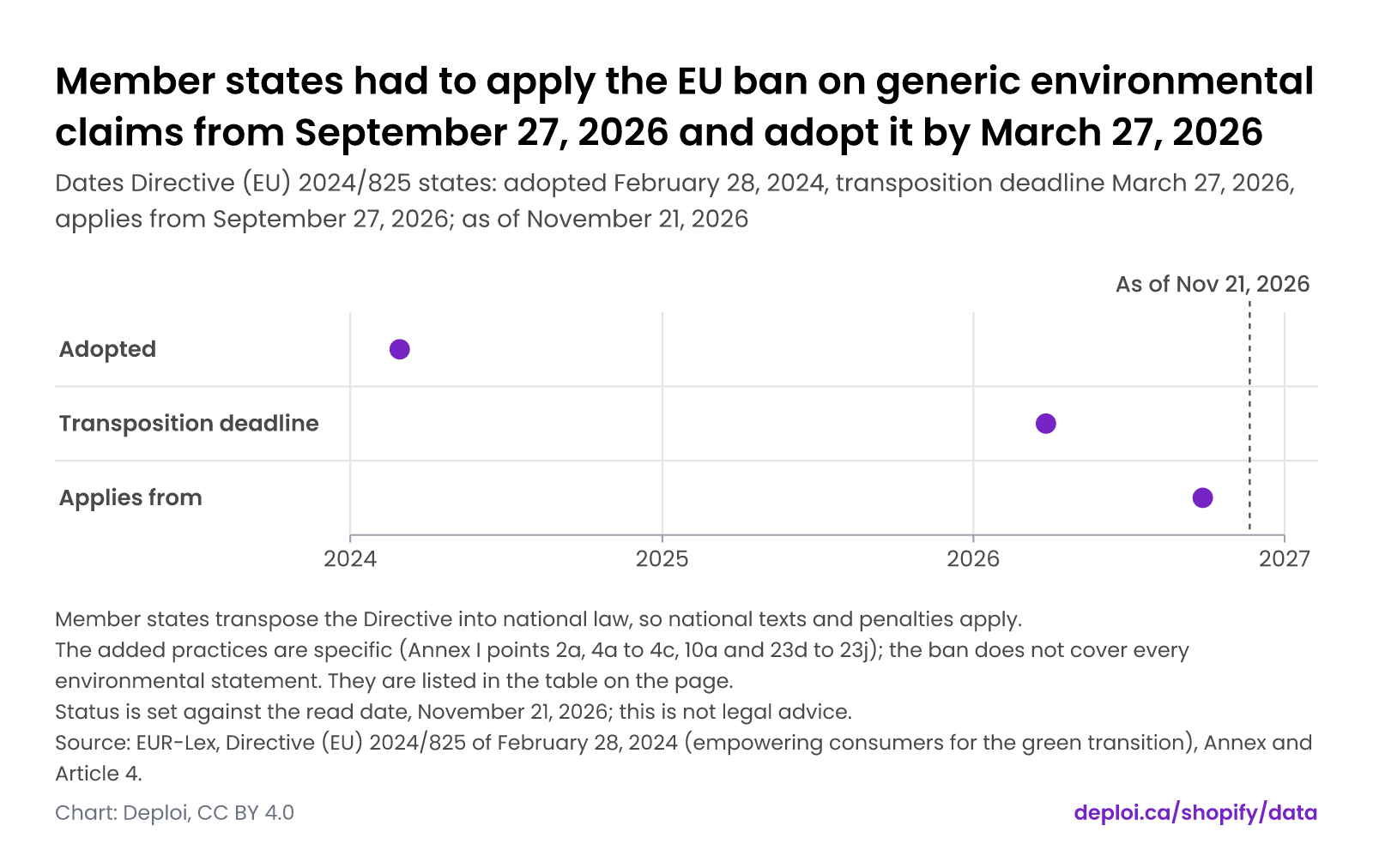
Member states had to apply the EU ban on generic environmental claims from September 27, 2026 and adopt it by March 27, 2026
Dates Directive (EU) 2024/825 states: adopted February 28, 2024, transposition deadline March 27, 2026, applies from September 27, 2026; as of November 21, 2026
- Member states transpose the Directive into national law, so national texts and penalties apply.
- The added practices are specific (Annex I points 2a, 4a to 4c, 10a and 23d to 23j); the ban does not cover every environmental statement. They are listed in the table on the page.
- Status is set against the read date, November 21, 2026; this is not legal advice.
Source: EUR-Lex, Directive (EU) 2024/825 of February 28, 2024 (empowering consumers for the green transition), Annex and Article 4. Read on .
From what date does the EU ban on generic environmental claims apply?
Member states must apply their national measures for the EU ban on generic environmental claims from September 27, 2026 under Article 4 of Directive (EU) 2024/825, which required them to adopt and publish those measures by March 27, 2026, per EUR-Lex, read November 21, 2026. The Directive was adopted on February 28, 2024, and all three dates had passed by the read date.
| Event | Date | Status on November 21, 2026 | Text |
|---|---|---|---|
| Adopted | February 28, 2024 | passed | "Done at Strasbourg, 28 February 2024." |
| Transposition deadline | March 27, 2026 | passed | "By 27 March 2026, Member States shall adopt and publish the measures necessary to comply with this Directive." |
| Applies from | September 27, 2026 | passed | "They shall apply those measures from 27 September 2026." |
Status is set by Deploi against the read date.
Which environmental claims does the Directive blacklist?
Directive (EU) 2024/825 blacklists environmental claims at Annex I points 4a to 4c: a generic environmental claim without recognised excellent environmental performance (4a), a whole-product or whole-business claim that concerns only one aspect (4b) and an offsetting-based emissions claim (4c), per EUR-Lex, read November 21, 2026. The Directive also blacklists displaying a sustainability label without a certification scheme or public authority basis (2a) and presenting legal requirements as a distinctive feature (10a).
| Annex point | Practice as the Directive states it |
|---|---|
| 2a | Displaying a sustainability label that is not based on a certification scheme or not established by public authorities. |
| 4a | Making a generic environmental claim for which the trader is not able to demonstrate recognised excellent environmental performance relevant to the claim. |
| 4b | Making an environmental claim about the entire product or the trader’s entire business when it concerns only a certain aspect of the product or a specific activity of the trader’s business. |
| 4c | Claiming, based on the offsetting of greenhouse gas emissions, that a product has a neutral, reduced or positive impact on the environment in terms of greenhouse gas emissions. |
| 10a | Presenting requirements imposed by law on all products within the relevant product category on the Union market as a distinctive feature of the trader’s offer. |
The text names a generic environmental claim and does not list example phrases in the quoted point. The Directive's own definition of a generic claim is not reproduced here.
Can a store still say a product is climate neutral through offsetting?
Point 4c of the Annex I blacklist, added by Directive (EU) 2024/825, bans claiming, based on the offsetting of greenhouse gas emissions, that a product has a neutral, reduced or positive impact on the environment in terms of greenhouse gas emissions. Member states must apply it through national measures from September 27, 2026, per EUR-Lex, read November 21, 2026.
The text is about offsetting as the basis of the claim. Point 4a separately covers a generic environmental claim without recognised excellent environmental performance.
Point 4b separately covers an environmental claim about the entire product or business when it concerns only a certain aspect.
Which durability and repair claims does the Directive blacklist?
Directive (EU) 2024/825 adds seven practices at Annex I points 23d to 23j: two on software updates (23d, 23e) and five on durability and repair (23f to 23j), covering a feature limiting durability, a false durability claim, a false repairability claim, inducing early consumable replacement and non-original parts. Member states must apply them through national measures from September 27, 2026, per EUR-Lex, read November 21, 2026.
| Annex point | Practice as the Directive states it |
|---|---|
| 23d | Withholding information from the consumer about the fact that a software update will negatively impact the functioning of goods with digital elements or the use of digital content or digital services. |
| 23e | Presenting a software update as necessary when it only enhances functionality features. |
| 23f | Any commercial communication in relation to a good containing a feature introduced to limit its durability despite information on the feature and its effects on the durability of the good being available to the trader. |
| 23g | Falsely claiming that under normal conditions of use a good has a certain durability in terms of usage time or intensity. |
| 23h | Presenting a good as allowing repair when it does not. |
| 23i | Inducing the consumer to replace or replenish the consumables of a good earlier than necessary for technical reasons. |
| 23j | Withholding information concerning the impairment of the functionality of a good when consumables, spare parts or accessories not supplied by the original producer are used, or falsely claiming that such impairment will happen. |
Points 23d and 23e concern software updates. Points 23f to 23j concern a durability-limiting feature (23f), a false durability claim (23g), a false repairability claim (23h), early consumable replacement (23i) and non-original parts (23j).
Who sets the penalties for breaking the ban?
Penalties are set in national law: each member state transposes Directive (EU) 2024/825 into its own law under Article 4, which has them adopt, publish and apply the measures needed to comply, per EUR-Lex, read November 21, 2026. National texts and penalties apply, and the dataset states no EU-wide penalty figure.
The Directive adds practices to the Annex I blacklist, and member states put them into national law. Penalties are set in national law, and the dataset records no figure for any of them.
This is not legal advice. Deploi is not affiliated with Shopify or the European Union.
The data
Each chart on this page is drawn from the numbers below. Units are in the column headers.
| Event | Date | Date text | Status |
|---|---|---|---|
| Adopted | Feb 28, 2024 | Done at Strasbourg, 28 February 2024. | passed |
| Transposition deadline | Mar 27, 2026 | 1. By 27 March 2026, Member States shall adopt and publish the measures necessary to comply with this Directive. | passed |
| Applies from | Sep 27, 2026 | They shall apply those measures from 27 September 2026. | passed |
Download Commercial practices added to the EU blacklist by Directive 2024/825 on environmental claims, labels and durability, and its key dates, read November 2026 as CSV · All 9 columns on the dataset page
Methodology
Reading the chart: Member states had to apply the EU ban on generic environmental claims from September 27, 2026 and adopt it by March 27, 2026
- Member states transpose the Directive into national law, so national texts and penalties apply.
- The added practices are specific (Annex I points 2a, 4a to 4c, 10a and 23d to 23j); the ban does not cover every environmental statement. They are listed in the table on the page.
- Status is set against the read date, November 21, 2026; this is not legal advice.
Caveats: Commercial practices added to the EU blacklist by Directive 2024/825 on environmental claims, labels and durability, and its key dates, read November 2026
- Member states transpose the Directive into national law; national texts and penalties apply, and the dataset states no EU-wide penalty figure.
- The recognised excellent environmental performance test applies only to the practice in point 4a, generic environmental claims; each other point bans its own practice as quoted.
- Annex I points are as the Directive numbers them: 2a, 4a, 4b, 4c, 10a and 23d to 23j. The theme of each practice is set by Deploi from the point's text.
- The status column compares each date with the read date, November 21, 2026, and is set by Deploi.
- Rule text is quoted verbatim from the official text; this is not legal or tax advice.
Deploi's charts and compilation are licensed CC BY 4.0. The underlying facts belong to their sources, which are named on every page. How Deploi Shopify Data works.
Sources
Tier A sources are primary documents: filings, official releases and official price pages. How sources are ranked.
- Tier ADirective (EU) 2024/825 of 28 February 2024 amending Directives 2005/29/EC and 2011/83/EU as regards empowering consumers for the green transition (English XHTML via the Publications Office)
European Parliament and Council of the EU (Publications Office of the European Union) · HTML · Read on
Cite and reuse
Deploi's charts and compilation are licensed CC BY 4.0. The underlying facts belong to their sources, which are named on every page.
APA
Deploi. (2026). Which environmental and durability claims can a store selling to EU consumers no longer make from September 27, 2026? [Web page]. https://deploi.ca/shopify/data/eu-generic-environmental-claims-ban Retrieved November 21, 2026.
BibTeX
@misc{deploi_eu_generic_environmental_claims_ban_2026,
  author = {{Deploi}},
  title = {Which environmental and durability claims can a store selling to EU consumers no longer make from September 27, 2026?},
  year = {2026},
  url = {https://deploi.ca/shopify/data/eu-generic-environmental-claims-ban},
  note = {Accessed 2026-11-21}
}
Embed this chart
Embed code
<iframe src="https://deploi.ca/embed/shopify/data/empco-key-dates" title="Member states had to apply the EU ban on generic environmental claims from September 27, 2026 and adopt it by March 27, 2026" loading="lazy" style="width:100%;height:420px;border:0"></iframe>
<p style="font:12px/1.4 Arial,sans-serif;margin:4px 0 0">Source: <a href="https://deploi.ca/shopify/data/charts/empco-key-dates">Deploi, Member states had to apply the EU ban on generic environmental claims from September 27, 2026 and adopt it by March 27, 2026</a></p>
Keep the credit line under the embed. It is the license condition.
Downloads
Questions
When does the EU ban on generic environmental claims start?
Member states must apply their national measures for the ban from September 27, 2026 under Article 4 of Directive (EU) 2024/825, and they had to adopt and publish those measures by March 27, 2026, per EUR-Lex, read November 21, 2026.
Is a generic environmental claim banned in the EU?
Yes, where the trader cannot demonstrate recognised excellent environmental performance relevant to the claim. Point 4a of the Annex I blacklist added by Directive (EU) 2024/825 bans it, per EUR-Lex, read November 21, 2026.
Is a climate neutral claim based on offsetting banned in the EU?
Yes. Point 4c bans claiming, based on the offsetting of greenhouse gas emissions, that a product has a neutral, reduced or positive impact on the environment in terms of greenhouse gas emissions, per Directive (EU) 2024/825 on EUR-Lex, read November 21, 2026.
What durability claims does the Directive ban?
Directive (EU) 2024/825 bans falsely claiming that a good has a certain durability under normal use (Annex I point 23g) and presenting a good as allowing repair when it does not (23h), per EUR-Lex, read November 21, 2026. Point 23f covers marketing a good with a feature introduced to limit its durability when the trader has information on it. Points 23i and 23j cover inducing early consumable replacement and withholding or falsely claiming impairment from non-original parts.
Does the ban cover every environmental statement?
No. It covers the practices at Annex I points 2a, 4a to 4c, 10a and 23d to 23j, including generic claims without recognised excellent environmental performance, not every environmental statement. National texts and penalties apply, per Directive (EU) 2024/825 on EUR-Lex, read November 21, 2026.
More on Merchant benchmarks
- At what annual sales must an online store register for VAT or GST in the UK and New Zealand, and what is the low-value import line in each?
As the tax authorities state it on November 21, 2026, the UK threshold is £90,000 of taxable turnover for businesses, and New Zealand's NZ$60,000 applies to overseas sellers supplying low value goods of NZ$1,000 or less each to New Zealand consumers in 12 months. Updated November 21, 2026.
- Does a small cosmetics brand have to register its facility and list or notify its products in the US, the EU and Canada?
A cosmetics business under the US small-business sales limit of $1,000,000, adjusted for inflation, is not subject to facility registration or product listing unless it manufactures or processes the products described in 21 U.S.C. 364h(b), but it still reports serious adverse events. The EU and Canadian texts read set no small-business exemption. Updated November 21, 2026.
- How long does a shopper have to cancel an online order in the EU, UK, US, Ontario, Quebec and British Columbia, and how fast must the store refund?
As the official pages read on November 21, 2026 state it, the EU and UK give 14 days to cancel for any reason, while Ontario, Quebec and British Columbia give a store 15 days to refund. Updated November 21, 2026.
- How long must a store stand behind a faulty product in the EU, the UK and the US?
EU sellers are liable for faults that appear within at least two years of delivery under Directive (EU) 2019/771, and the UK Consumer Rights Act 2015 gives a 30-day short-term right to reject faulty goods. US federal texts set no minimum period and state $15 and $10 price thresholds for written warranty rules. Updated November 21, 2026.
- How much of revenue do public online retailers spend on advertising, and how much gross margin is left after it?
Eight public online retailers spent between 6.5% and 29.7% of revenue on advertising or marketing in fiscal 2025, computed by Deploi from SEC 10-K facts. Updated November 21, 2026.
- How must a store prove a 'was' price when advertising a sale: the EU 30-day lowest price rule versus Canada's ordinary selling price tests?
The EU sets a look-back of at least 30 days for the prior price; Canada's Competition Bureau tests more than 50% of sales or a substantial period, usually within a year; the US guide says a reasonably substantial period, per texts read November 2026. Updated November 21, 2026.
Changes
- · Commercial practices added to the EU blacklist by Directive 2024/825 on environmental claims, labels and durability, and its key dates, read November 2026
First release. 15 rows, 8 fields read from 1 sources; each value agreed by extractor and verifier or ruled by the judge.