
Which allergens must a food seller declare in the US, the EU and Canada, and when must an EU seller show them to online shoppers?
The US lists 9 major food allergens, the EU's Annex II 14 entries and Canada 13 items, a count computed by Deploi, per official texts read November 21, 2026. Updated November 21, 2026.
By Martin DejnickiUpdated Data through November 21, 2026
Short answer
The US names 9 major food allergens, Annex II of the EU food information regulation has 14 entries and Canada's regulations require 13 items to be declared, including cereals containing gluten, a count computed by Deploi, per official texts read November 21, 2026. In the EU, mandatory food information for prepacked food sold online, except the particulars in point (f) of Article 9(1), must be available before the purchase is concluded.
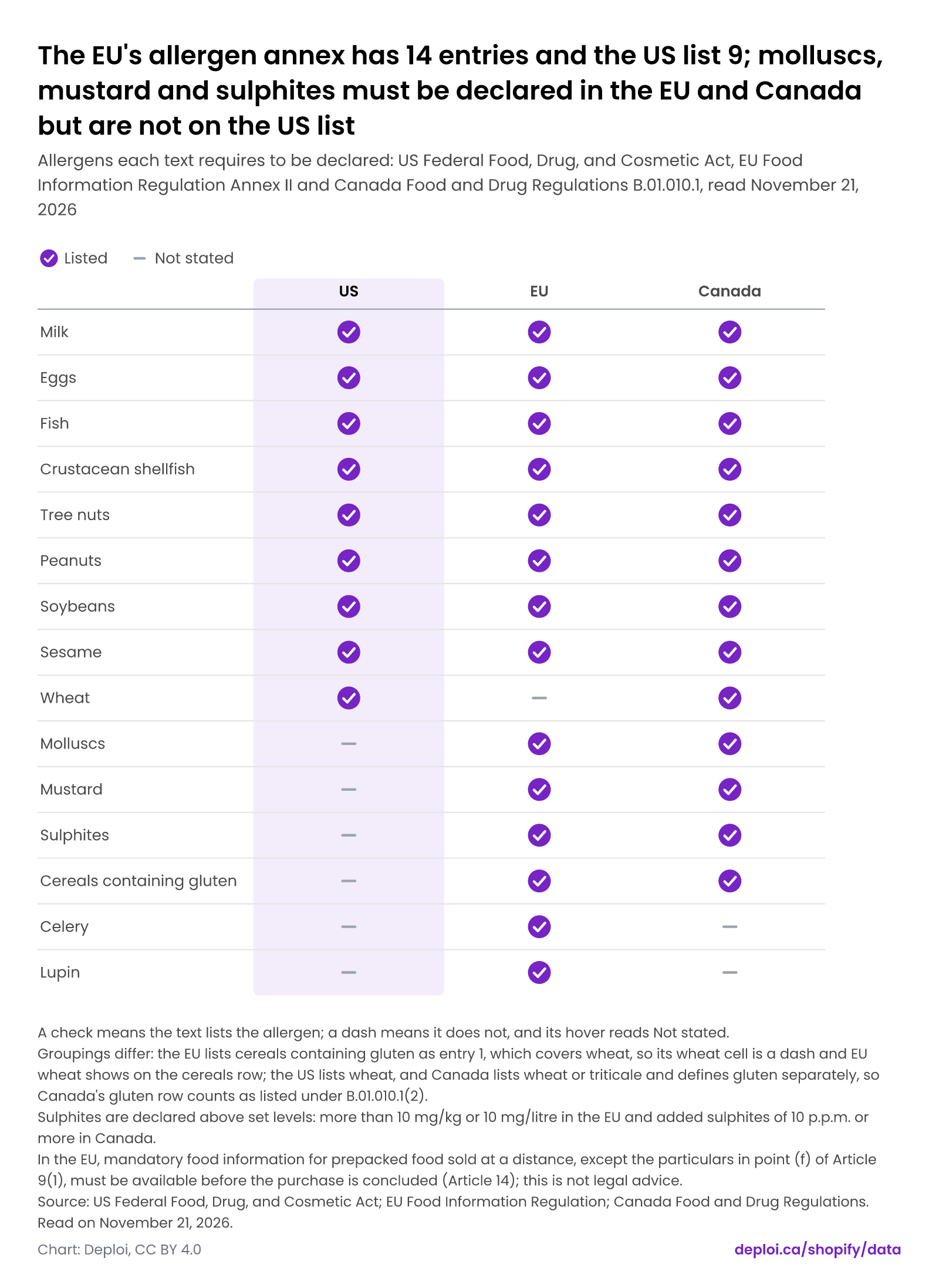
The EU's allergen annex has 14 entries and the US list 9; molluscs, mustard and sulphites must be declared in the EU and Canada but are not on the US list
Allergens each text requires to be declared: US Federal Food, Drug, and Cosmetic Act, EU Food Information Regulation Annex II and Canada Food and Drug Regulations B.01.010.1, read November 21, 2026
- A check means the text lists the allergen; a dash means it does not, and its hover reads Not stated.
- Groupings differ: the EU lists cereals containing gluten as entry 1, which covers wheat, so its wheat cell is a dash and EU wheat shows on the cereals row; the US lists wheat, and Canada lists wheat or triticale and defines gluten separately, so Canada's gluten row counts as listed under B.01.010.1(2).
- Sulphites are declared above set levels: more than 10 mg/kg or 10 mg/litre in the EU and added sulphites of 10 p.p.m. or more in Canada.
- In the EU, mandatory food information for prepacked food sold at a distance, except the particulars in point (f) of Article 9(1), must be available before the purchase is concluded (Article 14); this is not legal advice.
Source: US Federal Food, Drug, and Cosmetic Act; EU Food Information Regulation; Canada Food and Drug Regulations. Read on .
Which allergens must a food seller declare in the US, the EU and Canada?
Eight allergen groups appear on all three lists: milk, eggs, fish, crustaceans, tree nuts, peanuts, soybeans and sesame, while molluscs, mustard, sulphites and cereals containing gluten are listed in the EU and Canada but not the US, and celery and lupin only in the EU, per the three official texts read November 21, 2026. The matrix shows wheat once for the EU, on the cereals row.
| Allergen group | US | EU | Canada |
|---|---|---|---|
| Milk | listed | listed | listed |
| Eggs | listed | listed | listed |
| Fish | listed | listed | listed |
| Crustacean shellfish | listed | listed | listed |
| Molluscs | not listed | listed | listed |
| Tree nuts | listed | listed | listed |
| Peanuts | listed | listed | listed |
| Wheat | listed | not listed | listed |
| Cereals containing gluten | not listed | listed | listed |
| Soybeans | listed | listed | listed |
| Sesame | listed | listed | listed |
| Mustard | not listed | listed | listed |
| Celery | not listed | listed | not listed |
| Lupin | not listed | listed | not listed |
| Sulphites | not listed | listed | listed |
The US column follows the US Code's definition of major food allergen, 2024 edition. The EU column follows Annex II in the consolidated text of April 1, 2025, a documentation tool without legal effect; the original text and amending acts are authoritative. The Canada column follows the Food and Drug Regulations' section on food allergens, gluten and added sulphites. Its cereals row rests on the definition of gluten in B.01.010.1(1) and the label duty in B.01.010.1(2).
How many allergens does each market list?
The US Code lists 9 major food allergens, Annex II of the EU food information regulation has 14 numbered entries and Canada's rules name 13 items as this table counts them, a count computed by Deploi, per the three official texts read November 21, 2026. The counts are of groups, not of individual foods, and each text groups differently.
| Market | Allergen groups | How the count is made |
|---|---|---|
| United States | 9 | The nine allergens the US text names |
| European Union | 14 | The 14 numbered entries of Annex II |
| Canada | 13 | Items on this table's rows, computed by Deploi |
Canada's 13 includes two items that sit outside its food allergen definition but must also be declared. One is gluten, which B.01.010.1(1) defines and this table shows on the cereals containing gluten row. The other is added sulphites, which the text names in the definition of the food allergen source, gluten source and added sulphites statement. Tree nuts are one group in all three texts, although each names different nuts.
Why does the EU list show cereals containing gluten and not wheat?
EU Annex II entry 1 is cereals containing gluten, namely wheat (such as spelt and khorasan wheat), rye, barley, oats or their hybridised strains, and products thereof, so wheat is covered inside entry 1 and has no entry of its own, per the consolidated text of April 1, 2025, read November 21, 2026. The EU wheat cell in the matrix is a dash for that reason.
The matrix shows EU wheat once, on the cereals containing gluten row. A dash on the wheat row's EU cell does not mean the EU exempts wheat from declaration.
The US names wheat, and Canada names "wheat or triticale" in its food allergen definition. Canada's Food and Drug Regulations also define gluten separately, as any gluten protein from the grain of barley, oats, rye, triticale or wheat, or of a hybridized strain of them. B.01.010.1(2) requires the source of a food allergen or gluten present in a prepackaged product to be shown on its label. The source must appear in the list of ingredients or in a food allergen source, gluten source and added sulphites statement. The Canada cell on the cereals row therefore reads listed, on the gluten wording.
What are the sulphite levels that trigger a declaration?
The EU lists sulphur dioxide and sulphites at concentrations of more than 10 mg/kg or 10 mg/litre in terms of total SO2, and Canada names added sulphites in a total amount of 10 p.p.m. or more, per Annex II and the Canadian Food and Drug Regulations, read November 21, 2026. The US list of major food allergens does not include sulphites.
Both levels are quoted from the texts. The EU figure is calculated for products as proposed ready for consumption or as reconstituted according to the manufacturer's instructions. The Canadian figure covers added sulphites.
The two units differ, milligrams per kilogram or litre and parts per million, and the page does not convert them.
Must an EU seller show the allergens to online shoppers before they buy?
For prepacked food offered by distance communication, Article 14 of the EU food information regulation requires the mandatory food information, except the particulars in point (f) of Article 9(1), to be available before the purchase is concluded and to appear on the selling material or other clearly identified means, per the consolidated text read November 21, 2026.
Article 14 adds that "all mandatory particulars shall be available at the moment of delivery". For non-prepacked food sold at a distance, the particulars required under Article 44 follow the same rule. The before-purchase requirement does not apply to food sold through automatic vending machines or automated commercial premises.
This page quotes Article 14 and Annex II; it does not trace which other articles make each allergen particular mandatory.
What does this page leave out?
The comparison covers the US, the EU and Canada from three official texts read on November 21, 2026, and leaves out the UK, whose rules were not read, and every label wording rule beyond the allergen lists, such as the format of a precautionary statement. Groupings differ by text, so a count of groups is not a count of foods.
The table is a comparison of lists, not a labelling guide. Several Annex II entries, cereals containing gluten among them, end with exceptions that the table leaves out. A seller's duties depend on the product, the label and the market it ships to.
This is not legal or tax advice. Deploi is not affiliated with Shopify, the FDA, the European Commission or the Canadian Food Inspection Agency.
The data
Each chart on this page is drawn from the numbers below. Units are in the column headers.
| Allergen | US | EU | Canada | Wording by market |
|---|---|---|---|---|
| Milk | Listed | Listed | Listed | US: Milk. EU: 7. Milk and products thereof (including lactose). Canada: milk. |
| Eggs | Listed | Listed | Listed | US: egg. EU: 3. Eggs and products thereof. Canada: eggs. |
| Fish | Listed | Listed | Listed | US: fish (e.g., bass, flounder, or cod). EU: 4. Fish and products thereof. Canada: fish. |
| Crustacean shellfish | Listed | Listed | Listed | US: Crustacean shellfish (e.g., crab, lobster, or shrimp). EU: 2. Crustaceans and products thereof. Canada: crustaceans. |
| Tree nuts | Listed | Listed | Listed | US: tree nuts (e.g., almonds, pecans, or walnuts). EU: 8. Nuts, namely: almonds (Amygdalus communis L.), hazelnuts (Corylus avellana), walnuts (Juglans regia), cashews (Anacardium occidentale), pecan nuts (Carya illinoinensis (Wangenh.) K. Koch), Brazil nuts (Bertholletia excelsa), pistachio nuts (Pistacia vera), macadamia or Queensland nuts (Macadamia ternifolia), and products thereof. Canada: almonds, Brazil nuts, cashews, hazelnuts, macadamia nuts, pecans, pine nuts, pistachios or walnuts. |
| Peanuts | Listed | Listed | Listed | US: peanuts. EU: 5. Peanuts and products thereof. Canada: peanuts. |
| Soybeans | Listed | Listed | Listed | US: soybeans. EU: 6. Soybeans and products thereof. Canada: soybeans. |
| Sesame | Listed | Listed | Listed | US: sesame. EU: 11. Sesame seeds and products thereof. Canada: sesame seeds. |
| Wheat | Listed | Not stated | Listed | US: wheat. EU: not listed. Canada: wheat or triticale. |
| Molluscs | Not stated | Listed | Listed | US: not listed. EU: 14. Molluscs and products thereof. Canada: molluscs. |
| Mustard | Not stated | Listed | Listed | US: not listed. EU: 10. Mustard and products thereof. Canada: mustard seeds. |
| Sulphites | Not stated | Listed | Listed | US: not listed. EU: 12. Sulphur dioxide and sulphites at concentrations of more than 10 mg/kg or 10 mg/litre in terms of the total SO2 which are to be calculated for products as proposed ready for consumption or as reconstituted according to the instructions of the manufacturers. Canada: added sulphites in a total amount of 10 p.p.m. or more. |
| Cereals containing gluten | Not stated | Listed | Listed | US: not listed. EU: 1. Cereals containing gluten, namely: wheat (such as spelt and khorasan wheat), rye, barley, oats or their hybridised strains, and products thereof. Canada: any gluten protein from the grain of any of the following cereals or from the grain of a hybridized strain that is created from at least one of the following cereals: (i) barley, (ii) oats, (iii) rye, (iv) triticale, (v) wheat. |
| Celery | Not stated | Listed | Not stated | US: not listed. EU: 9. Celery and products thereof. Canada: not listed. |
| Lupin | Not stated | Listed | Not stated | US: not listed. EU: 13. Lupin and products thereof. Canada: not listed. |
Download Food allergens that must be declared in the US, the EU and Canada, and the EU distance-selling rule, read November 2026 as CSV · All 17 columns on the dataset page
Methodology
Reading the chart: The EU's allergen annex has 14 entries and the US list 9; molluscs, mustard and sulphites must be declared in the EU and Canada but are not on the US list
- A check means the text lists the allergen; a dash means it does not, and its hover reads Not stated.
- Groupings differ: the EU lists cereals containing gluten as entry 1, which covers wheat, so its wheat cell is a dash and EU wheat shows on the cereals row; the US lists wheat, and Canada lists wheat or triticale and defines gluten separately, so Canada's gluten row counts as listed under B.01.010.1(2).
- Sulphites are declared above set levels: more than 10 mg/kg or 10 mg/litre in the EU and added sulphites of 10 p.p.m. or more in Canada.
- In the EU, mandatory food information for prepacked food sold at a distance, except the particulars in point (f) of Article 9(1), must be available before the purchase is concluded (Article 14); this is not legal advice.
Caveats: Food allergens that must be declared in the US, the EU and Canada, and the EU distance-selling rule, read November 2026
- Groupings differ: the EU lists cereals containing gluten as entry 1, which covers wheat, the US lists wheat, and Canada lists wheat or triticale as a food allergen and defines gluten (barley, oats, rye, triticale, wheat) separately. Canada's B.01.010.1(2) requires the source of gluten to be shown on the label, so gluten counts as listed for Canada, like added sulphites. EU wheat is covered inside entry 1 and the matrix shows it once, on the cereals row.
- The allergen counts are groups as this table defines them: 9 for the US, 14 for the EU and 13 for Canada, the Canadian count computed by Deploi. They are not counts of individual foods.
- Sulphites are declared above set levels: more than 10 mg/kg or 10 mg/litre in the EU and added sulphites of 10 p.p.m. or more in Canada. They are not on the US list.
- The EU text is the consolidated version of April 1, 2025, a documentation tool without legal effect; the original text and amending acts are authoritative. The UK is not covered.
- Rules are quoted from the official text with the publisher named; this is not legal or tax advice.
Deploi's charts and compilation are licensed CC BY 4.0. The underlying facts belong to their sources, which are named on every page. How Deploi Shopify Data works.
Sources
Tier A sources are primary documents: filings, official releases and official price pages. How sources are ranked.
- Tier ARegulation (EU) No 1169/2011 on the provision of food information to consumers, consolidated text of 01.04.2025 (Annex II as amended by Delegated Regulation (EU) No 78/2014 and later acts), English XHTML from the Publications Office Cellar
Publications Office of the European Union (EUR-Lex) · HTML · Read on
- Tier A21 U.S.C. 321, definitions, including (qq) major food allergen, United States Code 2024 Edition
U.S. Government Publishing Office (govinfo) · HTML · Read on
- Tier AFood and Drug Regulations, C.R.C., c. 870, full text (includes B.01.010.1)
Department of Justice Canada · HTML · Read on
Cite and reuse
Deploi's charts and compilation are licensed CC BY 4.0. The underlying facts belong to their sources, which are named on every page.
APA
Deploi. (2026). Which allergens must a food seller declare in the US, the EU and Canada, and when must an EU seller show them to online shoppers? [Web page]. https://deploi.ca/shopify/data/food-allergens-to-declare-us-eu-canada Retrieved November 21, 2026.
BibTeX
@misc{deploi_food_allergens_to_declare_us_eu_canada_2026,
  author = {{Deploi}},
  title = {Which allergens must a food seller declare in the US, the EU and Canada, and when must an EU seller show them to online shoppers?},
  year = {2026},
  url = {https://deploi.ca/shopify/data/food-allergens-to-declare-us-eu-canada},
  note = {Accessed 2026-11-21}
}
Embed this chart
Embed code
<iframe src="https://deploi.ca/embed/shopify/data/allergen-lists-matrix" title="The EU's allergen annex has 14 entries and the US list 9; molluscs, mustard and sulphites must be declared in the EU and Canada but are not on the US list" loading="lazy" style="width:100%;height:850px;border:0"></iframe> <p style="font:12px/1.4 Arial,sans-serif;margin:4px 0 0">Source: <a href="https://deploi.ca/shopify/data/charts/allergen-lists-matrix">Deploi, The EU's allergen annex has 14 entries and the US list 9; molluscs, mustard and sulphites must be declared in the EU and Canada but are not on the US list</a></p>
Keep the credit line under the embed. It is the license condition.
Downloads
Questions
Which allergens does the EU require that the US does not?
Annex II lists molluscs, mustard, celery, lupin, sulphites above set levels and cereals containing gluten other than wheat, such as rye, barley and oats, none of which is on the US list of 9 major food allergens, per the EU consolidated text of April 1, 2025 and the US Code 2024 edition, read November 21, 2026.
How many food allergens does the US list?
Nine: milk, eggs, fish, crustacean shellfish, tree nuts, peanuts, wheat, soybeans and sesame, per the US Code definition of major food allergen, 2024 edition, read November 21, 2026.
How many allergens are in the EU list?
Annex II of the EU food information regulation has 14 numbered entries, from cereals containing gluten as entry 1 to molluscs as entry 14, per the consolidated text of April 1, 2025, read November 21, 2026.
Is wheat an EU allergen?
Yes, inside entry 1. Annex II lists cereals containing gluten, namely wheat (such as spelt and khorasan wheat), rye, barley, oats or their hybridised strains, per the consolidated text of April 1, 2025, read November 21, 2026. It has no wheat entry of its own.
Do EU product pages have to show allergens before purchase?
For prepacked food sold at a distance, Article 14 requires the mandatory food information, except the particulars in point (f) of Article 9(1), to be available before the purchase is concluded, and all mandatory particulars at delivery, per the EU food information regulation, consolidated text read November 21, 2026.
Does Canada require gluten to be declared on food labels?
Yes, for prepackaged products. Food and Drug Regulations B.01.010.1(2) requires the source of a food allergen or gluten to be shown on the label, and B.01.010.1(1) defines gluten as gluten protein from the grain of barley, oats, rye, triticale or wheat, per the Canadian Food and Drug Regulations, read November 21, 2026.
More on Merchant benchmarks
- At what annual sales must an online store register for VAT or GST in the UK and New Zealand, and what is the low-value import line in each?
As the tax authorities state it on November 21, 2026, the UK threshold is £90,000 of taxable turnover for businesses, and New Zealand's NZ$60,000 applies to overseas sellers supplying low value goods of NZ$1,000 or less each to New Zealand consumers in 12 months. Updated November 21, 2026.
- Does a small cosmetics brand have to register its facility and list or notify its products in the US, the EU and Canada?
A cosmetics business under the US small-business sales limit of $1,000,000, adjusted for inflation, is not subject to facility registration or product listing unless it manufactures or processes the products described in 21 U.S.C. 364h(b), but it still reports serious adverse events. The EU and Canadian texts read set no small-business exemption. Updated November 21, 2026.
- How long does a shopper have to cancel an online order in the EU, UK, US, Ontario, Quebec and British Columbia, and how fast must the store refund?
As the official pages read on November 21, 2026 state it, the EU and UK give 14 days to cancel for any reason, while Ontario, Quebec and British Columbia give a store 15 days to refund. Updated November 21, 2026.
- How long must a store stand behind a faulty product in the EU, the UK and the US?
EU sellers are liable for faults that appear within at least two years of delivery under Directive (EU) 2019/771, and the UK Consumer Rights Act 2015 gives a 30-day short-term right to reject faulty goods. US federal texts set no minimum period and state $15 and $10 price thresholds for written warranty rules. Updated November 21, 2026.
- How much of revenue do public online retailers spend on advertising, and how much gross margin is left after it?
Eight public online retailers spent between 6.5% and 29.7% of revenue on advertising or marketing in fiscal 2025, computed by Deploi from SEC 10-K facts. Updated November 21, 2026.
- How must a store prove a 'was' price when advertising a sale: the EU 30-day lowest price rule versus Canada's ordinary selling price tests?
The EU sets a look-back of at least 30 days for the prior price; Canada's Competition Bureau tests more than 50% of sales or a substantial period, usually within a year; the US guide says a reasonably substantial period, per texts read November 2026. Updated November 21, 2026.
Changes
- · Food allergens that must be declared in the US, the EU and Canada, and the EU distance-selling rule, read November 2026
First release. 19 rows, 6 fields read from 3 sources, among them Canada's gluten definition and its label duty under B.01.010.1(1) and (2), so gluten counts as a declared item for Canada; each value agreed by extractor and verifier or ruled by the judge.