
When does a Canadian food business need a Safe Food for Canadians licence?
The Safe Food for Canadians Regulations require a licence to import food and to prepare food for export or another province, with some foods excluded and four listed exceptions for preparation, and a licence expires two years after issuance or renewal, as read November 21, 2026. Updated November 21, 2026.
By Martin DejnickiUpdated
Short answer
The Safe Food for Canadians Regulations, as read on Justice Laws Website November 21, 2026, require a licence to import food (s 5(2)) and to prepare food for export or another province (s 7(2)(a)(i)), each excluding some foods referred to in s 11(2), the second with four listed exceptions. A licence expires two years after issuance or renewal (s 33(1)).
Importing food (with some foods excluded), or preparing it for export or another province (with 4 listed exceptions), needs a Safe Food for Canadians licence
Whether the Safe Food for Canadians Regulations (SOR/2018-108) require a licence for each activity, sections 5(2), 7(2) and 17(2), text current on November 21, 2026; Justice Laws Website
- Not legal advice: cells repeat what the quoted Regulation text states, and each row's full text is in the tooltip and the table.
- The export row is section 17(2): holding a licence to export is a condition for the Minister to issue an export certificate.
- Each exception applies only on the conditions its text states; exception (D) names a restaurant or other similar enterprise sending food to consumers and does not name retailers.
- Which activities need a licence is set by the Safe Food for Canadians Regulations; the matrix covers the quoted sections only.
Source: Department of Justice Canada, Safe Food for Canadians Regulations (SOR/2018-108), sections 5, 7, 17 and 33, Justice Laws Website, read November 21, 2026. Read on .
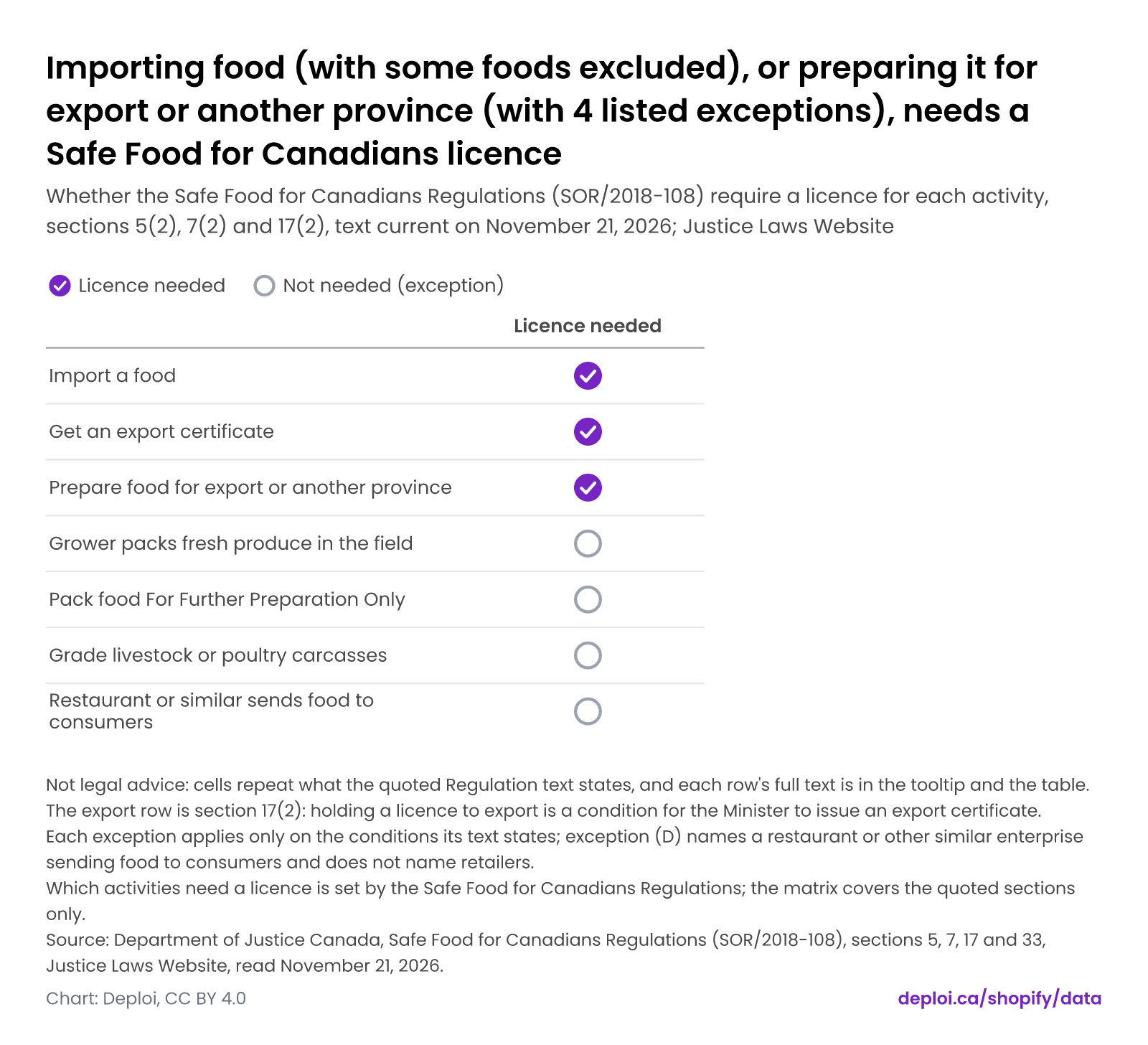
Which food activities need a Safe Food for Canadians licence?
Per the text read November 21, 2026, the Safe Food for Canadians Regulations require a licence to import food (s 5(2)) and to prepare food for export or another province (s 7(2)(a)(i)), with some s 11(2) foods excluded from each, and make a licence to export one condition of an export certificate for food intended for commercial use (s 17(2)).
| Activity | Licence needed | Section |
|---|---|---|
| Import a food | Yes | s 5(2) |
| Get an export certificate | Yes, a licence to export is one condition, for food intended for commercial use | s 17(2) |
| Prepare food for export or another province | Yes | s 7(2)(a)(i) |
| Grower packs fresh produce in the field | No, an exception | s 7(2)(a)(i)(A) |
| Pack food For Further Preparation Only | No, an exception | s 7(2)(a)(i)(B) |
| Grade livestock or poultry carcasses | No, an exception | s 7(2)(a)(i)(C) |
| Restaurant or similar sends food to consumers | No, an exception | s 7(2)(a)(i)(D) |
Each cell repeats what the quoted text states. The import rule excludes foods referred to in s 11(2)(a) to (c), and the preparation rule excludes foods referred to in s 11(2)(a) or (b). Source: Department of Justice Canada, Safe Food for Canadians Regulations (SOR/2018-108), Justice Laws Website, read November 21, 2026.
Does sending food to another province need a licence?
Section 7(2)(a)(i) of the Safe Food for Canadians Regulations requires a licence to manufacture, process, treat, preserve, grade, package or label a food, other than one referred to in s 11(2)(a) or (b), that is to be exported or sent from one province to another, apart from four listed exceptions, per the text read November 21, 2026.
The text reads that any food, other than a food referred to in paragraph 11(2)(a) or (b), "is a prescribed food commodity that is to be exported or sent or conveyed from one province to another". A person is prohibited to conduct the listed activities "unless the person is authorized to conduct that activity by a licence."
This page quotes the rule and does not say whether a given business is covered. Source: SOR/2018-108, s 7(2)(a)(i), Justice Laws Website.
Which activities are excepted from the licence?
Section 7(2)(a)(i) of the Safe Food for Canadians Regulations excepts four activities: a grower packing fresh produce in the field (A), packing food labeled For Further Preparation Only (B), grading livestock and poultry carcasses (C), and activity by a restaurant or other similar enterprise sending the food to consumers (D), per the text read November 21, 2026.
Each exception applies only on the conditions its text states. Exception (D) covers "any such activity conducted by a restaurant or other similar enterprise, where the food is to be sent or conveyed by the restaurant or other similar enterprise to consumers." It names a restaurant or other similar enterprise, and it does not name retail sellers.
Source: SOR/2018-108, s 7(2)(a)(i)(A) to (D), Justice Laws Website.
How long does a Safe Food for Canadians licence last?
A Safe Food for Canadians licence expires two years after the date of issuance or renewal that is specified in it, unless the licence is cancelled before that date, according to section 33(1) of the Regulations (SOR/2018-108), read on Justice Laws Website on November 21, 2026.
The dataset records the term as 2 years, from the text of s 33(1). The page repeats the text and states no renewal process or fee. Source: Department of Justice Canada, Safe Food for Canadians Regulations.
Does a small food business need a written preventive control plan?
Section 86(1) of the Safe Food for Canadians Regulations requires a licence holder to prepare, keep and maintain a written preventive control plan, and s 86(3) limits that to specific activities for a holder whose gross food sales were C$100,000 or less in the 12 months before their most recent licence application, per the text read November 21, 2026.
Under s 86(3), a plan is then required only for activities in respect of a food animal, meat product, fish, dairy product, egg, processed egg product or processed fruit or vegetable product identified in the licence. A plan is also required for a food for which an export certificate is sought.
Section 86(2) separately says a plan is not required for activities on exported food other than fish or a meat product, unless a certificate is sought. Source: SOR/2018-108, s 86, Justice Laws Website.
How long must traceability records be kept?
Traceability documents must be kept for two years after the day the food was provided to another person or sold at retail, and must be accessible in Canada, according to section 90(3) of the Safe Food for Canadians Regulations (SOR/2018-108), read on Justice Laws Website on November 21, 2026.
The dataset records the retention period as 2 years. The documents are those referred to in subsections 90(1) and (2). This page does not list which records those subsections require. Source: SOR/2018-108, s 90(3), Justice Laws Website.
What does this page leave out?
Provincial food law is not covered by this page, which repeats what sections 5(2), 7(2), 17(2), 33(1), 86 and 90(3) of the Safe Food for Canadians Regulations state in the text read on Justice Laws Website on November 21, 2026. The page is not legal advice.
A yes or no in the table only repeats what the quoted text states. The Safe Food for Canadians Act and the Canadian Food Inspection Agency's guidance are not in this dataset.
Deploi is not affiliated with the Government of Canada or the Canadian Food Inspection Agency.
The data
Each chart on this page is drawn from the numbers below. Units are in the column headers.
| Activity | Licence needed (yes, no or not stated) | Section | Rule as stated | Licence term (years) | Small-business sales line (C$ gross annual food sales) | Record keeping (years) |
|---|---|---|---|---|---|---|
| Import a food | Licence needed | s 5(2) | (2) For the purposes of subsection 10(2) of the Act, any food — other than a food referred to in any of paragraphs 11(2)(a) to (c) of these Regulations — is a prescribed food commodity that a person is prohibited to import unless the person is authorized to do so by a licence. | Not stated | Not stated | Not stated |
| Get an export certificate | Licence needed | s 17(2) | (2) The Minister may issue a certificate or other document referred to in section 48 of the Act in respect of a food commodity that is intended for commercial use if the applicant holds a licence to export the food commodity and | Not stated | Not stated | Not stated |
| Prepare food for export or another province | Licence needed | s 7(2)(a)(i) | (2) For the purposes of subsection 13(2) of the Act, any food — other than a food referred to in paragraph 11(2)(a) or (b) of these Regulations — and any food animal is a prescribed food commodity that is to be exported or sent or conveyed from one province to another, and any of the following activities is a prescribed activity that a person is prohibited to conduct in respect of that prescribed food commodity unless the person is authorized to conduct that activity by a licence:
(a) in the case of a food,
(i) manufacturing, processing, treating, preserving, grading, packaging and labelling, other than | Not stated | Not stated | Not stated |
| Grower packs fresh produce in the field | Not needed (exception) | s 7(2)(a)(i)(A) | (A) the packaging and labelling of fresh fruits or vegetables in the field by the person who grows or harvests them if they are to be sent or conveyed from one province to another to be subsequently manufactured, processed, treated, preserved or graded by a licence holder, | Not stated | Not stated | Not stated |
| Pack food For Further Preparation Only | Not needed (exception) | s 7(2)(a)(i)(B) | (B) the packaging and labelling of a food referred to in subparagraph 11(2)(c)(i) if, at the time that the food is exported or is sent or conveyed from one province to another, it is not a consumer prepackaged food and it has a label applied or attached to it, or accompanying it, that bears the expression “For Further Preparation Only” or “pour conditionnement ultérieur seulement”, | Not stated | Not stated | Not stated |
| Grade livestock or poultry carcasses | Not needed (exception) | s 7(2)(a)(i)(C) | (C) the grading of a livestock carcass and a poultry carcass, and | Not stated | Not stated | Not stated |
| Restaurant or similar sends food to consumers | Not needed (exception) | s 7(2)(a)(i)(D) | (D) any such activity conducted by a restaurant or other similar enterprise, where the food is to be sent or conveyed by the restaurant or other similar enterprise to consumers, and | Not stated | Not stated | Not stated |
| Licence expiry | Not stated | s 33(1) | 33 (1) A licence expires two years after the date of issuance or renewal that is specified in it, unless the licence is cancelled before that date. | 2 | Not stated | Not stated |
| Written preventive control plan | Not stated | s 86(1) and 86(3) | 86 (1) A licence holder must prepare, keep and maintain a written preventive control plan that meets the requirements of section 89 for any activity identified in their licence that they conduct in respect of a food or food animal.
(2) Despite subsection (1), a preventive control plan is not required to be prepared, kept or maintained for any activity that the licence holder conducts in respect of a food, other than fish or a meat product, that is exported, unless a certificate or other document referred to in section 48 of the Act is sought in respect of the food.
(3) Despite subsection (1), if a licence holder’s gross sales that are derived from food are $100,000 or less for the 12 months before the day on which they most recently made an application for the issuance, renewal or amendment of a licence, a preventive control plan must be prepared, kept and maintained only for any activity that they conduct in respect of
(a) a food animal, meat product, fish, dairy product, egg, processed egg product or processed fruit or vegetable product that is identified in their licence; and
(b) a food in respect of which a certificate or other document referred to in section 48 of the Act is sought. | Not stated | 100,000 | Not stated |
| Traceability: retention period of documents | Not stated | s 90(3) | (3) The documents referred to in subsections (1) and (2) must be kept for two years after the day on which the food was provided to another person or sold at retail, and must be accessible in Canada. | Not stated | Not stated | 2 |
Download Safe Food for Canadians Regulations: which food activities need a licence, the listed exceptions, the licence term, the written preventive control plan and its small-business sales line, and how long traceability records are kept as CSV · All 9 columns on the dataset page
Methodology
Reading the chart: Importing food (with some foods excluded), or preparing it for export or another province (with 4 listed exceptions), needs a Safe Food for Canadians licence
- Not legal advice: cells repeat what the quoted Regulation text states, and each row's full text is in the tooltip and the table.
- The export row is section 17(2): holding a licence to export is a condition for the Minister to issue an export certificate.
- Each exception applies only on the conditions its text states; exception (D) names a restaurant or other similar enterprise sending food to consumers and does not name retailers.
- Which activities need a licence is set by the Safe Food for Canadians Regulations; the matrix covers the quoted sections only.
Caveats: Safe Food for Canadians Regulations: which food activities need a licence, the listed exceptions, the licence term, the written preventive control plan and its small-business sales line, and how long traceability records are kept
- Not legal advice. Cells repeat what the quoted Regulation text states; a business selling only within one province may still be subject to provincial food law, which the dataset does not cover.
- Exceptions carry conditions in the text; the verbatim text is the row note. Exception (D) names a restaurant or other similar enterprise sending food to consumers and does not name retail sellers. The row key exception|restaurant-or-retail-to-consumers is a fixed internal key set at planning; the item label and ruleText follow the Regulation's wording.
- The export row is section 17(2): holding a licence to export is a condition for the Minister to issue an export certificate; paragraphs after the lead-in are not quoted.
- The preventive control plan row quotes section 86(1) to (3) in full, including the exception in 86(2) for exported food other than fish or meat unless an export certificate is sought.
Deploi's charts and compilation are licensed CC BY 4.0. The underlying facts belong to their sources, which are named on every page. How Deploi Shopify Data works.
Sources
Tier A sources are primary documents: filings, official releases and official price pages. How sources are ranked.
- Tier ASafe Food for Canadians Regulations (SOR/2018-108), full text
Department of Justice Canada (Justice Laws Website) · HTML · Read on
Cite and reuse
Deploi's charts and compilation are licensed CC BY 4.0. The underlying facts belong to their sources, which are named on every page.
APA
Deploi. (2026). When does a Canadian food business need a Safe Food for Canadians licence? [Web page]. https://deploi.ca/shopify/data/safe-food-for-canadians-licence-rules Retrieved November 21, 2026.
BibTeX
@misc{deploi_safe_food_for_canadians_licence_rules_2026,
  author = {{Deploi}},
  title = {When does a Canadian food business need a Safe Food for Canadians licence?},
  year = {2026},
  url = {https://deploi.ca/shopify/data/safe-food-for-canadians-licence-rules},
  note = {Accessed 2026-11-21}
}
Embed this chart
Embed code
<iframe src="https://deploi.ca/embed/shopify/data/sfcr-licence-by-activity" title="Importing food (with some foods excluded), or preparing it for export or another province (with 4 listed exceptions), needs a Safe Food for Canadians licence" loading="lazy" style="width:100%;height:570px;border:0"></iframe>
<p style="font:12px/1.4 Arial,sans-serif;margin:4px 0 0">Source: <a href="https://deploi.ca/shopify/data/charts/sfcr-licence-by-activity">Deploi, Importing food (with some foods excluded), or preparing it for export or another province (with 4 listed exceptions), needs a Safe Food for Canadians licence</a></p>
Keep the credit line under the embed. It is the license condition.
Downloads
- Chart: Importing food (with some foods excluded), or preparing it for export or another province (with 4 listed exceptions), needs a Safe Food for Canadians licence PNG
- Data: Safe Food for Canadians Regulations: which food activities need a licence, the listed exceptions, the licence term, the written preventive control plan and its small-business sales line, and how long traceability records are kept CSV
Questions
Do I need a Safe Food for Canadians licence to ship food to another province?
Section 7(2)(a)(i) of the Safe Food for Canadians Regulations requires a licence to manufacture, process, treat, preserve, grade, package or label food, other than a food referred to in s 11(2)(a) or (b), that is to be sent from one province to another, apart from four listed exceptions, per the text read on Justice Laws Website November 21, 2026.
Do I need a licence to import food into Canada?
Section 5(2) of the Safe Food for Canadians Regulations makes any food a prescribed food commodity that a person is prohibited to import unless authorized by a licence, other than foods referred to in s 11(2)(a) to (c), per the text read on Justice Laws Website November 21, 2026.
How long does a Safe Food for Canadians licence last?
Section 33(1) of the Safe Food for Canadians Regulations says a licence expires two years after the date of issuance or renewal specified in it, unless cancelled earlier, per the text read on Justice Laws Website on November 21, 2026.
Does a restaurant need a licence to send food to customers?
Exception (D) in s 7(2)(a)(i) of the Safe Food for Canadians Regulations removes the licence requirement for preparing food for export or another province when a restaurant or other similar enterprise conducts the activity and sends the food to consumers, per the text read November 21, 2026. The exception does not name retail sellers.
How long must food traceability records be kept?
Section 90(3) of the Safe Food for Canadians Regulations requires traceability documents to be kept for two years after the day the food was provided to another person or sold at retail, and to be accessible in Canada, per the text read November 21, 2026.
More on Compliance
- How long must a gift card sold in the US stay valid, and when may a store charge an inactivity fee?
US federal rules bar gift card funds from expiring within 5 years of issue or the last load and allow an inactivity fee only after 12 months without activity, once a month at most, as the eCFR states. Updated November 22, 2026.
- Must a US online apparel listing show fiber content and country of origin under the FTC's Textile Rules?
US textile labels must carry fiber content, a name or RN number and the country of origin, and mail order catalogs and promotional material must state made in USA, imported or both, per 16 CFR Part 303 in the eCFR for November 1, 2026. Updated November 22, 2026.
- What lead limits apply to consumer products, children's jewellery and surface coatings in Canada, and how do they compare with the US?
Canada limits lead to 90 mg/kg in accessible parts of consumer products containing lead, children's jewellery and surface coatings; US texts set 100 parts per million for children's products, unless found not technologically feasible, and 0.009 percent for paint, as read on November 21, 2026. Updated November 22, 2026.
- What must a Canadian clothing or textile seller disclose under the Textile Labelling Act?
A prescribed consumer textile article must carry a label with its fibre content and the dealer's name and postal address or a CA number; the advertising and mail order catalogue rules apply with conditions, per Justice Laws read November 21, 2026. Updated November 22, 2026.
- What size limits does 49 CFR 173.185 set for small lithium batteries shipped in the United States, and what conditions apply by air?
To qualify for the 49 CFR 173.185(c) exception for smaller cells or batteries, a lithium ion cell may not exceed 20 Wh and a battery 100 Wh, or 60 Wh and 300 Wh for highway or rail only, as the eCFR stated on November 22, 2026. By air, under (c)(5)(i), a package of cells or batteries not packed with, or contained in, equipment stays subject to all applicable requirements, with relief only from UN performance packaging within set quantities. Updated November 22, 2026.
- Which businesses must file an annual forced labour report in Canada, and by when?
Entities meeting at least two of three tests (at least C$20 million in assets, at least C$40 million in revenue, an average of at least 250 employees), listed entities and prescribed entities must report to the Minister by May 31 each year if they produce, sell, distribute or import goods or control an entity that does, per the Act read on Justice Laws on November 21, 2026. Updated November 22, 2026.
Changes
- · Safe Food for Canadians Regulations: which food activities need a licence, the listed exceptions, the licence term, the written preventive control plan and its small-business sales line, and how long traceability records are kept
First release. 10 rows, 8 columns from 1 source (Justice Laws Website, SOR/2018-108); each value agreed by extractor and verifier or ruled by the judge.