
What do the US federal text-marketing rules require of a store: calling hours, opt-outs, Do Not Call checks and damages?
US federal rules in the eCFR version of November 1, 2026 require opt-outs to be honored within 10 business days, and 47 U.S.C. 227 (2024 edition) sets statutory damages of $500 per violation under 227(b) and up to $500 under 227(c), which a court may raise up to 3 times for a willful or knowing violation. Updated November 21, 2026.
By Martin DejnickiUpdated Data through November 1, 2026
Short answer
US federal rules bar telephone solicitations to residential subscribers before 8 a.m. or after 9 p.m. at the called party's location, require opt-outs to be honored within 10 business days, and allow statutory damages of $500 per violation under 227(b) and up to $500 under 227(c), or up to $1,500 if willful or knowing (computed by Deploi), per 47 CFR 64.1200 (eCFR version of November 1, 2026) and 47 U.S.C. 227 (2024 edition).
What calling hours does the federal telephone solicitation rule set?
47 CFR 64.1200(c)(1) bars telephone solicitations to a residential telephone subscriber before 8 a.m. or after 9 p.m., local time at the called party's location, per the eCFR version of November 1, 2026. The quoted rule text does not say whether a marketing text message counts as a telephone solicitation.
The earliest time is 8 a.m. and the latest is 9 p.m. at the called party's location, not the sender's. Federal rules only: several states add their own text-marketing laws, and this page does not cover them.
How fast must an opt-out be honored?
Within a reasonable time not to exceed 10 business days from receipt of the request, per 47 CFR 64.1200(a)(10) in the eCFR version of November 1, 2026. The text applies to all requests to revoke prior express consent or prior express written consent made in any reasonable manner.
The 10 business day deadline is the text of the eCFR version of November 1, 2026. That version links to an amendment of 47 CFR 64.1200, covered below.
Is the opt-out rule changing?
The snapshot read on November 21, 2026 does not say. The eCFR version of 47 CFR 64.1200 dated November 1, 2026 links to an amendment to the section published at 91 FR 67219 on October 26, 2026, without stating what the amendment changes or when it takes effect, so this page gives only the November 1, 2026 text.
The 10 business day opt-out period above is the text shown in that version. The amendment's content and effective date are not in the snapshot, so this page does not state them.
How often must the Do Not Call registry be checked?
To avoid liability for calling a registered number in error, a caller's process must use a version of the national Do Not Call registry obtained no more than 31 days before the date any call is made, per 47 CFR 64.1200(c)(2)(i)(D) in the eCFR version of November 1, 2026. A do-not-call request made to a company must be honored for 5 years from the time it is made, under 64.1200(d)(6).
The 31 day limit appears in the conditions under which a caller is not liable for calling a number on the registry. The caller must also keep records documenting the process, as paragraph (c)(2)(i)(D) states.
What are the damages per message for violating the rules?
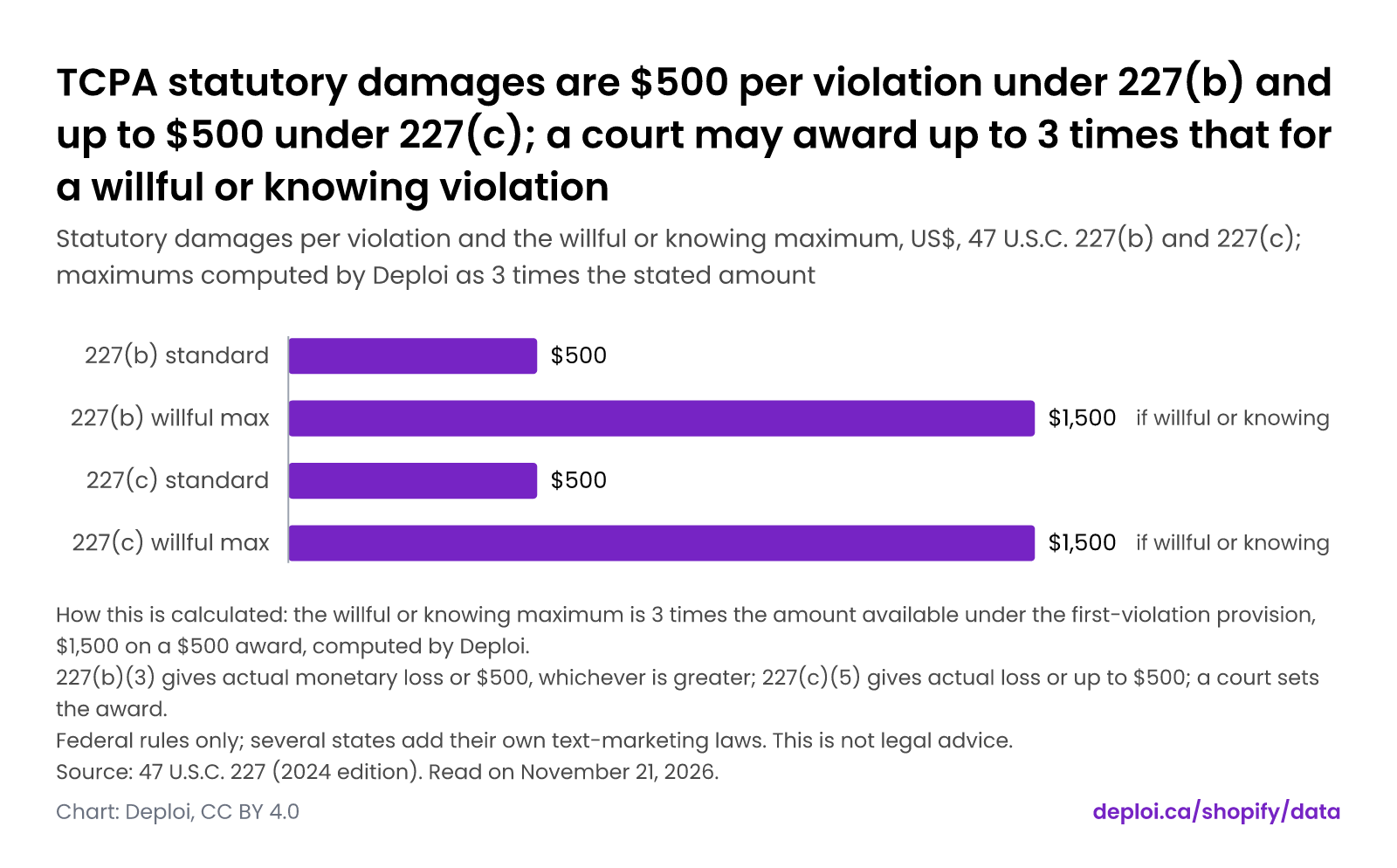
Under 47 U.S.C. 227(b)(3), a person may recover actual monetary loss or $500 in damages for each violation, whichever is greater, per the 2024 edition of the US Code; under 227(c)(5) the statutory amount is up to $500. A court that finds a willful or knowing violation may award up to 3 times the amount available, which is $1,500 on a $500 award, computed by Deploi.
| Provision | Per violation | Willful or knowing maximum |
|---|---|---|
| 47 U.S.C. 227(b) (autodialed or prerecorded) | $500 | $1,500 |
| 47 U.S.C. 227(c) (Do Not Call) | Up to $500 | $1,500 |
The willful or knowing maximum is 3 times the amount available under subparagraph (B), $1,500 on a $500 award, computed by Deploi. Either provision gives actual monetary loss instead when that is greater. A court sets the award.
TCPA statutory damages are $500 per violation under 227(b) and up to $500 under 227(c); a court may award up to 3 times that for a willful or knowing violation
Statutory damages per violation and the willful or knowing maximum, US$, 47 U.S.C. 227(b) and 227(c); maximums computed by Deploi as 3 times the stated amount
- How this is calculated: the willful or knowing maximum is 3 times the amount available under the first-violation provision, $1,500 on a $500 award, computed by Deploi.
- 227(b)(3) gives actual monetary loss or $500, whichever is greater; 227(c)(5) gives actual loss or up to $500; a court sets the award.
- Federal rules only; several states add their own text-marketing laws. This is not legal advice.
Source: 47 U.S.C. 227 (2024 edition). Read on .
Do these federal rules cover everything a store must do to text customers?
No. This page covers the federal calling hours, opt-out period, registry access limit, Do Not Call retention and damages, per 47 CFR 64.1200 (eCFR version of November 1, 2026) and 47 U.S.C. 227 (2024 edition). State laws and the consent rules for starting a texting program are not covered.
Several states add their own text-marketing laws. The rules are quoted from the official text with the publisher named. This is not legal advice.
The data
Each chart on this page is drawn from the numbers below. Units are in the column headers.
| Rule | Damages per violation (US$) | Willful multiplier (times) | Maximum per violation (US$) | Citation |
|---|---|---|---|---|
| Damages per violation, 227(b) (autodialed or prerecorded) | 500 | Not stated | 500 | 47 U.S.C. 227(b)(3)(B) |
| Willful or knowing maximum, 227(b) | Not stated | 3 | 1,500 | 47 U.S.C. 227(b)(3) |
| Damages per violation, 227(c) (Do Not Call) | 500 | Not stated | 500 | 47 U.S.C. 227(c)(5)(B) |
| Willful or knowing maximum, 227(c) | Not stated | 3 | 1,500 | 47 U.S.C. 227(c)(5) |
Download US federal text and call marketing rule values: calling hours, opt-out deadline, Do Not Call list checks and statutory damages (47 CFR 64.1200 and 47 U.S.C. 227) as CSV · All 12 columns on the dataset page
Methodology
Reading the chart: TCPA statutory damages are $500 per violation under 227(b) and up to $500 under 227(c); a court may award up to 3 times that for a willful or knowing violation
- How this is calculated: the willful or knowing maximum is 3 times the amount available under the first-violation provision, $1,500 on a $500 award, computed by Deploi.
- 227(b)(3) gives actual monetary loss or $500, whichever is greater; 227(c)(5) gives actual loss or up to $500; a court sets the award.
- Federal rules only; several states add their own text-marketing laws. This is not legal advice.
Caveats: US federal text and call marketing rule values: calling hours, opt-out deadline, Do Not Call list checks and statutory damages (47 CFR 64.1200 and 47 U.S.C. 227)
- Federal rules only; several states add their own text-marketing laws.
- The opt-out deadline is the text in the eCFR version of November 1, 2026. That version links to an amendment published at 91 FR 67219 on October 26, 2026; the snapshot does not state the amendment's content or effective date, so the effective text column is empty.
- Willful maximums are 3 times the stated per-violation amount, computed by Deploi.
- The calling hours rule, 64.1200(c)(1), is stated for telephone solicitations to residential subscribers.
- Rules are quoted from the official text with the publisher named; this is not legal or tax advice.
Deploi's charts and compilation are licensed CC BY 4.0. The underlying facts belong to their sources, which are named on every page. How Deploi Shopify Data works.
Sources
Tier A sources are primary documents: filings, official releases and official price pages. How sources are ranked.
- Tier A47 CFR 64.1200 Delivery restrictions (eCFR, 2026-11-01 version)
Office of the Federal Register (eCFR) · TEXT · Read on
- Tier A47 U.S.C. 227, restrictions on use of telephone equipment, United States Code 2024 Edition
U.S. Government Publishing Office (govinfo) · HTML · Read on
Cite and reuse
Deploi's charts and compilation are licensed CC BY 4.0. The underlying facts belong to their sources, which are named on every page.
APA
Deploi. (2026). What do the US federal text-marketing rules require of a store: calling hours, opt-outs, Do Not Call checks and damages? [Web page]. https://deploi.ca/shopify/data/us-sms-marketing-rules-tcpa Retrieved November 21, 2026.
BibTeX
@misc{deploi_us_sms_marketing_rules_tcpa_2026,
  author = {{Deploi}},
  title = {What do the US federal text-marketing rules require of a store: calling hours, opt-outs, Do Not Call checks and damages?},
  year = {2026},
  url = {https://deploi.ca/shopify/data/us-sms-marketing-rules-tcpa},
  note = {Accessed 2026-11-21}
}
Embed this chart
Embed code
<iframe src="https://deploi.ca/embed/shopify/data/tcpa-damages-per-message" title="TCPA statutory damages are $500 per violation under 227(b) and up to $500 under 227(c); a court may award up to 3 times that for a willful or knowing violation" loading="lazy" style="width:100%;height:390px;border:0"></iframe>
<p style="font:12px/1.4 Arial,sans-serif;margin:4px 0 0">Source: <a href="https://deploi.ca/shopify/data/charts/tcpa-damages-per-message">Deploi, TCPA statutory damages are $500 per violation under 227(b) and up to $500 under 227(c); a court may award up to 3 times that for a willful or knowing violation</a></p>
Keep the credit line under the embed. It is the license condition.
Downloads
- Chart: TCPA statutory damages are $500 per violation under 227(b) and up to $500 under 227(c); a court may award up to 3 times that for a willful or knowing violation PNG
- Data: US federal text and call marketing rule values: calling hours, opt-out deadline, Do Not Call list checks and statutory damages (47 CFR 64.1200 and 47 U.S.C. 227) CSV
Questions
What calling hours do US federal rules set for telephone solicitations?
Federal rule 47 CFR 64.1200(c)(1) bars telephone solicitations to residential subscribers before 8 a.m. or after 9 p.m., local time at the called party's location, per the eCFR version of November 1, 2026. The quoted text does not say whether a marketing text counts as a telephone solicitation. Several states add their own text-marketing laws, which this page does not cover.
How long does a business have to honor an opt-out under US federal rules?
Within a reasonable time not to exceed 10 business days from receipt of the request, per 47 CFR 64.1200(a)(10) in the eCFR version of November 1, 2026. That version links to an amendment to the section published at 91 FR 67219, and the snapshot does not state what it changes or when it takes effect.
How often must a company check the Do Not Call registry?
To avoid liability for calling a registered number in error, the registry version a caller uses must be obtained no more than 31 days before any call, per 47 CFR 64.1200(c)(2)(i)(D) in the eCFR version of November 1, 2026. A do-not-call request must be honored for 5 years.
What are the TCPA penalties per text?
In a private action, 47 U.S.C. 227(b)(3) gives $500 per violation or actual monetary loss, whichever is greater, and 227(c)(5) up to $500 or actual loss, per the 2024 edition of the US Code. A court may award up to 3 times that amount for a willful or knowing violation, which is $1,500 on a $500 award, computed by Deploi.
Do US states have their own text-marketing rules?
Yes. Several states add their own text-marketing laws, and this page covers federal rules only, from 47 CFR 64.1200 (eCFR version of November 1, 2026) and 47 U.S.C. 227 (2024 edition).
More on Merchant benchmarks
- At what annual sales must an online store register for VAT or GST in the UK and New Zealand, and what is the low-value import line in each?
As the tax authorities state it on November 21, 2026, the UK threshold is £90,000 of taxable turnover for businesses, and New Zealand's NZ$60,000 applies to overseas sellers supplying low value goods of NZ$1,000 or less each to New Zealand consumers in 12 months. Updated November 21, 2026.
- Does a small cosmetics brand have to register its facility and list or notify its products in the US, the EU and Canada?
A cosmetics business under the US small-business sales limit of $1,000,000, adjusted for inflation, is not subject to facility registration or product listing unless it manufactures or processes the products described in 21 U.S.C. 364h(b), but it still reports serious adverse events. The EU and Canadian texts read set no small-business exemption. Updated November 21, 2026.
- How long does a shopper have to cancel an online order in the EU, UK, US, Ontario, Quebec and British Columbia, and how fast must the store refund?
As the official pages read on November 21, 2026 state it, the EU and UK give 14 days to cancel for any reason, while Ontario, Quebec and British Columbia give a store 15 days to refund. Updated November 21, 2026.
- How long must a store stand behind a faulty product in the EU, the UK and the US?
EU sellers are liable for faults that appear within at least two years of delivery under Directive (EU) 2019/771, and the UK Consumer Rights Act 2015 gives a 30-day short-term right to reject faulty goods. US federal texts set no minimum period and state $15 and $10 price thresholds for written warranty rules. Updated November 21, 2026.
- How much of revenue do public online retailers spend on advertising, and how much gross margin is left after it?
Eight public online retailers spent between 6.5% and 29.7% of revenue on advertising or marketing in fiscal 2025, computed by Deploi from SEC 10-K facts. Updated November 21, 2026.
- How must a store prove a 'was' price when advertising a sale: the EU 30-day lowest price rule versus Canada's ordinary selling price tests?
The EU sets a look-back of at least 30 days for the prior price; Canada's Competition Bureau tests more than 50% of sales or a substantial period, usually within a year; the US guide says a reasonably substantial period, per texts read November 2026. Updated November 21, 2026.
Changes
- · US federal text and call marketing rule values: calling hours, opt-out deadline, Do Not Call list checks and statutory damages (47 CFR 64.1200 and 47 U.S.C. 227)
First release. 9 rows read from 2 sources; each value agreed by extractor and verifier or ruled by the judge.