
Which version and level of WCAG does each accessibility law point to: the EAA, ADA, Section 508, AODA and the Accessible Canada Act?
Section 508 and Ontario's AODA rule name WCAG 2.0, the ADA Title II rule and EN 301 549 name 2.1 Level AA, and the EAA, ADA Title III and Accessible Canada Act name no version in the texts captured, per official texts read November 2026. Updated November 21, 2026.
By Martin DejnickiUpdated Data through November 21, 2026
Short answer
Section 508 and Ontario's AODA regulation name WCAG 2.0 Level AA. The US ADA Title II rule and EN 301 549 V3.2.1 name WCAG 2.1 Level AA, and the EU Web Accessibility Directive reaches it through EN 301 549 V3.2.1 under Decision (EU) 2021/1339, per official texts read November 19 and 21, 2026. The EAA, ADA Title III and Accessible Canada Act name no version in the texts captured.
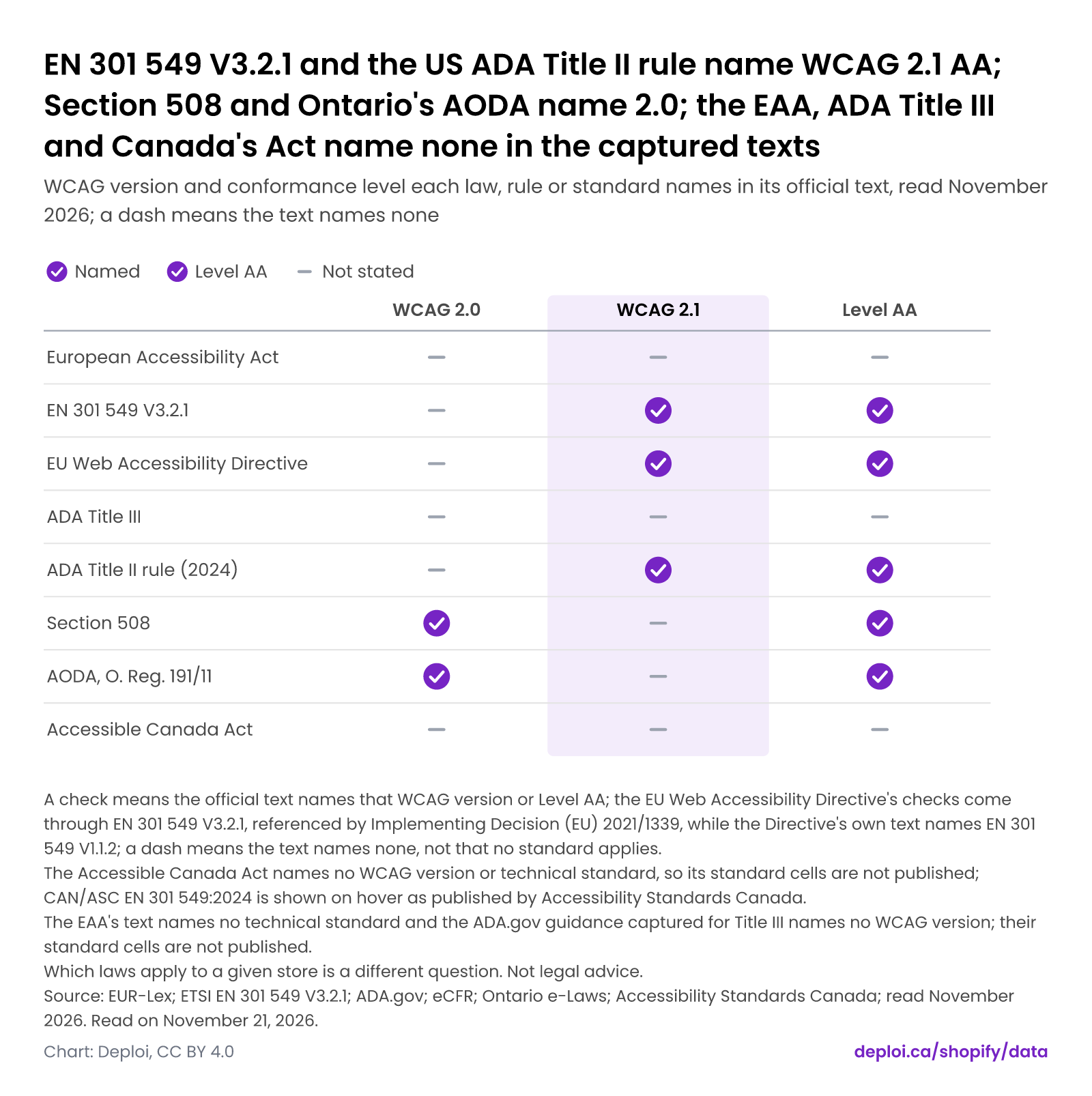
EN 301 549 V3.2.1 and the US ADA Title II rule name WCAG 2.1 AA; Section 508 and Ontario's AODA name 2.0; the EAA, ADA Title III and Canada's Act name none in the captured texts
WCAG version and conformance level each law, rule or standard names in its official text, read November 2026; a dash means the text names none
- A check means the official text names that WCAG version or Level AA; the EU Web Accessibility Directive's checks come through EN 301 549 V3.2.1, referenced by Implementing Decision (EU) 2021/1339, while the Directive's own text names EN 301 549 V1.1.2; a dash means the text names none, not that no standard applies.
- The Accessible Canada Act names no WCAG version or technical standard, so its standard cells are not published; CAN/ASC EN 301 549:2024 is shown on hover as published by Accessibility Standards Canada.
- The EAA's text names no technical standard and the ADA.gov guidance captured for Title III names no WCAG version; their standard cells are not published.
- Which laws apply to a given store is a different question. Not legal advice.
Source: EUR-Lex; ETSI EN 301 549 V3.2.1; ADA.gov; eCFR; Ontario e-Laws; Accessibility Standards Canada; read November 2026. Read on .
Which WCAG version does each accessibility law name?
Section 508 and Ontario's O. Reg. 191/11 name WCAG 2.0, while EN 301 549 V3.2.1 and the US ADA Title II rule name WCAG 2.1 at Level AA, and the EU Web Accessibility Directive reaches 2.1 through EN 301 549 V3.2.1 under Decision (EU) 2021/1339, per official texts read November 19 and 21, 2026. The EAA, ADA Title III and Accessible Canada Act name no version in the texts captured.
| Law or rule | Standard the text names | WCAG version | Level |
|---|---|---|---|
| Section 508 (36 CFR 1194) | Level A and Level AA success criteria in WCAG 2.0 | 2.0 | AA |
| Ontario, AODA O. Reg. 191/11 | WCAG 2.0 | 2.0 | AA |
| EN 301 549 V3.2.1 | WCAG 2.1 Level AA | 2.1 | AA |
| EU Web Accessibility Directive | EN 301 549 V3.2.1, designated by Decision (EU) 2021/1339 | 2.1 | AA |
| ADA Title II rule (28 CFR 35.200) | Level A and Level AA success criteria and conformance requirements specified in WCAG 2.1 | 2.1 | AA |
| European Accessibility Act | not published | not published | not published |
| ADA Title III | not published | not published | not published |
| Accessible Canada Act | not published | not published | not published |
A dash or not published means the text captured gives no value for that cell, not that no standard applies.
Does the European Accessibility Act name a WCAG version?
The European Accessibility Act, Directive (EU) 2019/882, names no technical standard or WCAG version in the text captured from the Official Journal, read on November 19, 2026. It applies from June 28, 2025 to services provided to consumers, including e-commerce services, among others.
The EU Web Accessibility Directive, Directive (EU) 2016/2102, covers the websites and mobile applications of public sector bodies. Its recital 42 names the earlier EN 301 549 V1.1.2, and Commission Implementing Decision (EU) 2021/1339 designates V3.2.1. V3.2.1 treats conformance with WCAG 2.1 Level AA as equivalent to conforming with all of its clauses 9.1 to 9.4 and the conformance requirements of clause 9.6.
Member States had to adopt the Act's measures by June 28, 2022 and apply them from June 28, 2025. Those dates apply to the Act as a whole, not to a WCAG version.
What do ADA Title II and Title III say about WCAG?
The ADA Title II rule at 28 CFR 35.200 names WCAG 2.1's Level A and Level AA success criteria and conformance requirements for state and local governments, with compliance dates of April 26, 2027 for entities of 50,000 people or more and April 26, 2028 for smaller ones and any special district government, per the eCFR as of November 1, 2026 and ADA.gov. The ADA.gov guidance captured for Title III names no WCAG version.
Title III covers businesses open to the public. The ADA.gov web accessibility guidance captured, dated March 18, 2022, names no WCAG version for them.
The April 2027 and April 2028 dates come from an interim final rule published in the Federal Register on April 20, 2026, which extended the earlier compliance dates.
Which WCAG version do Section 508 and Ontario's AODA name?
Section 508 standards, 36 CFR Part 1194, incorporate the Level A and Level AA success criteria of WCAG 2.0 and are mandatory for Federal agencies subject to Section 508, per the eCFR as of November 1, 2026. Ontario's O. Reg. 191/11 requires WCAG 2.0, initially Level A and increasing to Level AA, for the internet websites of designated public sector organizations and large organizations, per Ontario e-Laws read November 21, 2026.
Under O. Reg. 191/11, section 14, designated public sector organizations and large organizations had to bring new internet websites to WCAG 2.0 Level A by January 1, 2014. By January 1, 2021, all their internet websites and web content had to conform with WCAG 2.0 Level AA, other than success criteria 1.2.4 Captions (Live) and 1.2.5 Audio Descriptions (Pre-recorded).
The regulation was read on e-Laws on November 21, 2026.
Does the Accessible Canada Act require a WCAG version?
The Accessible Canada Act, S.C. 2019, c. 10, names no WCAG version or technical standard, per the Department of Justice text read on November 19, 2026. CAN/ASC-EN 301 549:2024 is a separate standard published by Accessibility Standards Canada, which calls it voluntary, and the Act does not name it.
Accessibility Standards Canada's summary says "This standard applies to all private and public sector organizations in federally regulated sectors". That is the standard's own scope statement, not text of the Act. Accessibility Standards Canada's May 31, 2024 news release calls the standard voluntary, and the Act names no standard. The Act's WCAG version and level cells are not published.
What does this table not say about which laws apply to a store?
The table states which WCAG version and level each law, rule or standard names in the texts captured, as read on November 19 and 21, 2026, and does not say which laws apply to a given store, which depends on size and market. It is not legal advice, and no law is coded into yes or no.
Text cells in the dataset are quoted from the sources: official texts for most rows and ADA.gov guidance for the ADA Title III row. The Accessible Canada Act row's standard note is computed by Deploi. The compliance dates in the data are the ones the sources state. The EAA row carries the Directive's Article 31 dates, which apply to the Directive as a whole. The ADA Title III row states no WCAG version, and the Accessible Canada Act row states no standard or WCAG version.
The data
Each chart on this page is drawn from the numbers below. Units are in the column headers.
| Law, rule or standard | WCAG 2.0 | WCAG 2.1 | Level AA | Standard note | Technical standard named | WCAG version (version number) | Who it covers | Compliance date |
|---|---|---|---|---|---|---|---|---|
| European Accessibility Act | Not stated | Not stated | Not stated | Not stated | 2. Without prejudice to Article 32, this Directive applies to the following services provided to consumers after 28 June 2025: (a) electronic communications services with the exception of transmission services used for the provision of machine-to-machine services; (b) services providing access to audiovisual media services; (c) the following elements of air, bus, rail and waterborne passenger transport services, except for urban, suburban and regional transport services for which only the elements under point (v) apply: (i) websites; (ii) mobile device-based services including mobile applications; (iii) electronic tickets and electronic ticketing services; (iv) delivery of transport service information, including real-time travel information; this shall, with regard to information screens, be limited to interactive screens located within the territory of the Union; and (v) interactive self-service terminals located within the territory of the Union, except those installed as integrated parts of vehicles, aircrafts, ships and rolling stock used in the provision of any part of such passenger transport services; (d) consumer banking services; (e) e-books and dedicated software; and (f) e-commerce services. | 1. Member States shall adopt and publish, by 28 June 2022, the laws, regulations and administrative provisions necessary to comply with this Directive. They shall immediately communicate the text of those measures to the Commission. 2. They shall apply those measures from 28 June 2025. | ||
| EN 301 549 V3.2.1 | Not stated | Named | Level AA | Conformance with W3C Web Content Accessibility Guidelines (WCAG 2.1) [5] Level AA is equivalent to conforming with all of clauses 9.1 to 9.4 and the conformance requirements of clause 9.6 of the present document. | Conformance with W3C Web Content Accessibility Guidelines (WCAG 2.1) [5] Level AA is equivalent to conforming with all of clauses 9.1 to 9.4 and the conformance requirements of clause 9.6 of the present document. | 2.1 | The present document specifies the functional accessibility requirements applicable to ICT products and services, together with a description of the test procedures and evaluation methodology for each accessibility requirement in a form that is suitable for use in public procurement within Europe | |
| EU Web Accessibility Directive | Not stated | Named | Level AA | EN 301 549 v3.2.1 (2021-03) | EN 301 549 v3.2.1 (2021-03) | 2.1 | This Directive lays down accessibility requirements for the websites and mobile applications of public sector bodies. | |
| ADA Title III | Not stated | Not stated | Not stated | Not stated | businesses open to the public | |||
| ADA Title II rule (2024) | Not stated | Named | Level AA | Level A and Level AA success criteria and conformance requirements specified in WCAG 2.1 | Level A and Level AA success criteria and conformance requirements specified in WCAG 2.1 | 2.1 | Title II of the ADA requires state and local governments to make sure that their services, programs, and activities are accessible to people with disabilities. | On April 20, 2026, the Federal Register published the Department’s Interim Final Rule (IFR) extending the compliance date for State and local government entities with a total population of 50,000 or more to April 26, 2027. The compliance date for public entities with a total population of less than 50,000, or any special district government, is extended to April 26, 2028. |
| Section 508 | Named | Not stated | Level AA | Level A and Level AA Success Criteria and Conformance Requirements in WCAG 2.0 | Level A and Level AA Success Criteria and Conformance Requirements in WCAG 2.0 | 2.0 | Compliance with these standards is mandatory for Federal agencies subject to Section 508 of the Rehabilitation Act of 1973, as amended (29 U.S.C. 794d). | |
| AODA, O. Reg. 191/11 | Named | Not stated | Level AA | World Wide Web Consortium Web Content Accessibility Guidelines (WCAG) 2.0 | World Wide Web Consortium Web Content Accessibility Guidelines (WCAG) 2.0 | 2.0 | 14. (1) The Government of Ontario and the Legislative Assembly shall make their internet and intranet websites and web content conform with the World Wide Web Consortium Web Content Accessibility Guidelines (WCAG) 2.0, at Level AA, and shall do so in accordance with the schedule set out in this section. O. Reg. 191/11, s. 14 (1). (2) Designated public sector organizations and large organizations shall make their internet websites and web content conform with the World Wide Web Consortium Web Content Accessibility Guidelines (WCAG) 2.0, initially at Level A and increasing to Level AA, and shall do so in accordance with the schedule set out in this section. O. Reg. 191/11, s. 14 (2). | (3) The Government of Ontario and the Legislative Assembly, for both their internet and intranet sites, shall meet the requirements in this section in accordance with the following schedule: 1. By January 1, 2012, new internet and intranet websites and web content on those sites must conform with WCAG 2.0 Level AA, other than, i. success criteria 1.2.4 Captions (Live), and ii. success criteria 1.2.5 Audio Descriptions (Pre-recorded). 2. By January 1, 2016, all internet websites and web content must conform with WCAG 2.0 Level AA, other than, i. success criteria 1.2.4 Captions (Live), and ii. success criteria 1.2.5 Audio Descriptions (Pre-recorded). 3. By January 1, 2020, all internet and intranet websites and web content must conform with WCAG 2.0 Level AA. O. Reg. 191/11, s. 14 (3). | (4) Designated public sector organizations and large organizations for their internet websites shall meet the requirements of this section in accordance with the following schedule: 1. By January 1, 2014, new internet websites and web content on those sites must conform with WCAG 2.0 Level A. 2. By January 1, 2021, all internet websites and web content must conform with WCAG 2.0 Level AA, other than, i. success criteria 1.2.4 Captions (Live), and ii. success criteria 1.2.5 Audio Descriptions (Pre-recorded). O. Reg. 191/11, s. 14 (4). |
| Accessible Canada Act | Not stated | Not stated | Not stated | The Act names no technical standard. CAN/ASC-EN 301 549:2024 is a separate standard, which Accessibility Standards Canada calls voluntary. | Not stated |
Download Which WCAG version and level each accessibility law or rule names: EAA, EU Web Accessibility Directive, ADA Titles II and III, Section 508, AODA and the Accessible Canada Act, 2026 as CSV · All 12 columns on the dataset page
Methodology
Reading the chart: EN 301 549 V3.2.1 and the US ADA Title II rule name WCAG 2.1 AA; Section 508 and Ontario's AODA name 2.0; the EAA, ADA Title III and Canada's Act name none in the captured texts
- A check means the official text names that WCAG version or Level AA; the EU Web Accessibility Directive's checks come through EN 301 549 V3.2.1, referenced by Implementing Decision (EU) 2021/1339, while the Directive's own text names EN 301 549 V1.1.2; a dash means the text names none, not that no standard applies.
- The Accessible Canada Act names no WCAG version or technical standard, so its standard cells are not published; CAN/ASC EN 301 549:2024 is shown on hover as published by Accessibility Standards Canada.
- The EAA's text names no technical standard and the ADA.gov guidance captured for Title III names no WCAG version; their standard cells are not published.
- Which laws apply to a given store is a different question. Not legal advice.
Caveats: Which WCAG version and level each accessibility law or rule names: EAA, EU Web Accessibility Directive, ADA Titles II and III, Section 508, AODA and the Accessible Canada Act, 2026
- Not legal advice. Rules as the official texts state them on the capture date.
- Text cells are verbatim; no law is coded into yes or no.
- Which laws apply to a given store (size, market) is a different question, not answered here.
- Accessibility Standards Canada's summary describes a separate standard, CAN/ASC-EN 301 549:2024; the Act itself names no technical standard. Accessibility Standards Canada's May 2024 news release calls it a voluntary standard.
- The European Accessibility Act names no technical standard in the text captured. The ADA.gov guidance captured for Title III says existing technical standards 'provide helpful guidance' and names 'the Web Content Accessibility Guidelines (WCAG) and the Section 508 Standards', with no WCAG version and no requirement: businesses 'have flexibility in how they comply'. Their standard and version cells are not published.
Deploi's charts and compilation are licensed CC BY 4.0. The underlying facts belong to their sources, which are named on every page. How Deploi Shopify Data works.
Sources
Tier A sources are primary documents: filings, official releases and official price pages. How sources are ranked.
Show all 12 sources
- Tier AAccessible Canada Act (S.C. 2019, c. 10), full text
Government of Canada, Department of Justice · HTML · Read on
- Tier AFact Sheet: New Rule on the Accessibility of Web Content and Mobile Apps Provided by State and Local Governments
U.S. Department of Justice, Civil Rights Division (ADA.gov) · HTML · Read on
- Tier AGuidance on Web Accessibility and the ADA
U.S. Department of Justice, Civil Rights Division (ADA.gov) · HTML · Read on
- Tier AAccessibility Standards Canada adopts the globally recognized accessibility standard for ICT products and services (news release, May 31, 2024)
Accessibility Standards Canada · HTML · Read on
- Tier ASummary of CAN/ASC - EN 301 549:2024 Accessibility requirements for ICT products and services (EN 301 549:2021, IDT)
Accessibility Standards Canada · HTML · Read on
- Tier ADirective (EU) 2019/882 on the accessibility requirements for products and services (Official Journal L 151, 7.6.2019), English XHTML from the Publications Office Cellar
European Union, Publications Office (Official Journal) · HTML · Read on
- Tier A28 CFR 35.200 Requirements for web and mobile accessibility (ADA Title II)
U.S. Government (Electronic Code of Federal Regulations) · HTML · Read on
- Tier A36 CFR Part 1194 Information and Communication Technology Standards and Guidelines (Section 508)
U.S. Government (Electronic Code of Federal Regulations) · HTML · Read on
- Tier AEN 301 549 V3.2.1 (2021-03) Accessibility requirements for ICT products and services (harmonised European standard)
ETSI (with CEN and CENELEC) · PDF · Read on
- Tier ACommission Implementing Decision (EU) 2021/1339 amending Decision (EU) 2018/2048 as regards the harmonised standard for websites and mobile applications
European Commission (EUR-Lex, Official Journal) · HTML · Read on
- Tier ADirective (EU) 2016/2102 on the accessibility of the websites and mobile applications of public sector bodies
European Union (EUR-Lex, Official Journal) · HTML · Read on
- Tier AO. Reg. 191/11 Integrated Accessibility Standards (AODA), rendered page
Government of Ontario (e-Laws) · HTML · Read on
Cite and reuse
Deploi's charts and compilation are licensed CC BY 4.0. The underlying facts belong to their sources, which are named on every page.
APA
Deploi. (2026). Which version and level of WCAG does each accessibility law point to: the EAA, ADA, Section 508, AODA and the Accessible Canada Act? [Web page]. https://deploi.ca/shopify/data/wcag-version-by-accessibility-law Retrieved November 21, 2026.
BibTeX
@misc{deploi_wcag_version_by_accessibility_law_2026,
  author = {{Deploi}},
  title = {Which version and level of WCAG does each accessibility law point to: the EAA, ADA, Section 508, AODA and the Accessible Canada Act?},
  year = {2026},
  url = {https://deploi.ca/shopify/data/wcag-version-by-accessibility-law},
  note = {Accessed 2026-11-21}
}
Embed this chart
Embed code
<iframe src="https://deploi.ca/embed/shopify/data/wcag-version-by-law-matrix" title="EN 301 549 V3.2.1 and the US ADA Title II rule name WCAG 2.1 AA; Section 508 and Ontario's AODA name 2.0; the EAA, ADA Title III and Canada's Act name none in the captured texts" loading="lazy" style="width:100%;height:620px;border:0"></iframe> <p style="font:12px/1.4 Arial,sans-serif;margin:4px 0 0">Source: <a href="https://deploi.ca/shopify/data/charts/wcag-version-by-law-matrix">Deploi, EN 301 549 V3.2.1 and the US ADA Title II rule name WCAG 2.1 AA; Section 508 and Ontario's AODA name 2.0; the EAA, ADA Title III and Canada's Act name none in the captured texts</a></p>
Keep the credit line under the embed. It is the license condition.
Downloads
- Chart: EN 301 549 V3.2.1 and the US ADA Title II rule name WCAG 2.1 AA; Section 508 and Ontario's AODA name 2.0; the EAA, ADA Title III and Canada's Act name none in the captured texts PNG
- Data: Which WCAG version and level each accessibility law or rule names: EAA, EU Web Accessibility Directive, ADA Titles II and III, Section 508, AODA and the Accessible Canada Act, 2026 CSV
Questions
Which WCAG version does the ADA require?
The ADA Title II rule, 28 CFR 35.200, names the Level A and Level AA success criteria and conformance requirements of WCAG 2.1 for state and local governments, per the eCFR as of November 1, 2026. The ADA.gov guidance captured for Title III names no WCAG version for businesses open to the public.
Which WCAG version does the European Accessibility Act name?
None. The text of Directive (EU) 2019/882 captured from the Official Journal, read on November 19, 2026, names no technical standard or WCAG version. It applies from June 28, 2025 to services including e-commerce services.
Does Section 508 use WCAG 2.0 or 2.1?
Section 508, 36 CFR Part 1194, incorporates the Level A and Level AA success criteria of WCAG 2.0, per the eCFR as of November 1, 2026. It is mandatory for Federal agencies subject to Section 508.
Which WCAG version does Ontario's AODA require?
O. Reg. 191/11 names WCAG 2.0, initially Level A and increasing to Level AA, for the internet websites of designated public sector organizations and large organizations, with Level AA due by January 1, 2021, per Ontario e-Laws read on November 21, 2026.
Is CAN/ASC-EN 301 549:2024 required by the Accessible Canada Act?
No. The Act, in the Department of Justice text read on November 19, 2026, names no standard. CAN/ASC-EN 301 549:2024, published by Accessibility Standards Canada, is a separate standard that Accessibility Standards Canada's May 31, 2024 news release calls voluntary.
More on Merchant benchmarks
- At what annual sales must an online store register for VAT or GST in the UK and New Zealand, and what is the low-value import line in each?
As the tax authorities state it on November 21, 2026, the UK threshold is £90,000 of taxable turnover for businesses, and New Zealand's NZ$60,000 applies to overseas sellers supplying low value goods of NZ$1,000 or less each to New Zealand consumers in 12 months. Updated November 21, 2026.
- How long does a shopper have to cancel an online order in the EU, UK, US, Ontario, Quebec and British Columbia, and how fast must the store refund?
As the official pages read on November 21, 2026 state it, the EU and UK give 14 days to cancel for any reason, while Ontario, Quebec and British Columbia give a store 15 days to refund. Updated November 21, 2026.
- How must a store prove a 'was' price when advertising a sale: the EU 30-day lowest price rule versus Canada's ordinary selling price tests?
The EU sets a look-back of at least 30 days for the prior price; Canada's Competition Bureau tests more than 50% of sales or a substantial period, usually within a year; the US guide says a reasonably substantial period, per texts read November 2026. Updated November 21, 2026.
- What are the maximum penalties for fake reviews in the US, UK and Canada, and for misleading price claims in the UK and Canada?
As written on the pages read on November 20 and 21, 2026, the maximum is the higher of £300,000 or 10% of turnover in the UK, the greater of C$10 million or three times the benefit for a corporation's first violation in Canada, and $53,088 in the US under FTC Act section 5(m)(1)(A). Updated November 21, 2026.
- What do Gmail, Yahoo and Microsoft Outlook require of stores that send marketing email at volume?
Gmail and Outlook set bulk-sender rules above 5,000 messages a day, and Gmail and Yahoo both name a 0.3% spam rate and 2 days to honor unsubscribes, per provider pages read November 21, 2026. Updated November 21, 2026.
- What does it cost to ship a 1, 5 and 10 lb parcel to Zone 5 with UPS Ground and USPS Ground Advantage at 2026 list rates?
At 2026 list rates, a 1 lb parcel to Zone 5 costs $11.70 by USPS Ground Advantage retail and $14.10 by UPS Ground; at 10 lb UPS is cheaper, $20.46 against $24.25. FedEx is not covered. Updated November 21, 2026.
Changes
- · Which WCAG version and level each accessibility law or rule names: EAA, EU Web Accessibility Directive, ADA Titles II and III, Section 508, AODA and the Accessible Canada Act, 2026
First release. 8 rows, 7 fields read from 10 sources; each value agreed by extractor and verifier or ruled by the judge.